

Not always. You can represent yourself or authorize:
- An Enrolled Agent (EA)
- A CPA
- An attorney
For complex or high-dollar cases, many people feel more comfortable with a professional representative. A firm like Tax Hardship Center can handle most audit appeals administratively and bring in tax attorneys where needed.
Getting through an IRS audit is stressful enough.
Getting the results and realizing the IRS says you owe more? That’s the moment most people ask:
“Should I appeal this IRS audit, just accept it, or get someone to fight for me?”
The IRS expects some taxpayers to appeal legitimate disagreements. That’s why there is an Independent Office of Appeals, a division separate from the auditors who examined your return.
This guide walks you through:
- When it makes sense to fight an IRS audit result.
- When you’re usually better off settling or moving on to payment/relief options.
- How the IRS audit appeal process works (including Form 12203 and Form 9423).
- Where a tax relief firm like Tax Hardship Center fits in if you don’t want to face Appeals alone.
What “Appealing an IRS Audit” Actually Means
When an audit ends, the IRS examiner issues a report proposing changes to your return and a letter explaining your rights. Often, that’s a “30-day letter,” giving you 30 days to request an appeal.
Appealing means:
- You disagree with some or all of the proposed changes, and
- You ask the IRS Independent Office of Appeals to review the case.
According to IRS Publication 556 and appeals guidance, Appeals is:
- Separate from the exam function that audited you
- Designed to resolve disputes fairly and impartially
- Allowed to consider both the IRS’s and your “hazards of litigation” (how each side might fare in court) when settling
In other words, an IRS audit appeal is your chance to get a second opinion inside the IRS without going straight to Tax Court.
Fight or Settle? A Practical Way to Decide
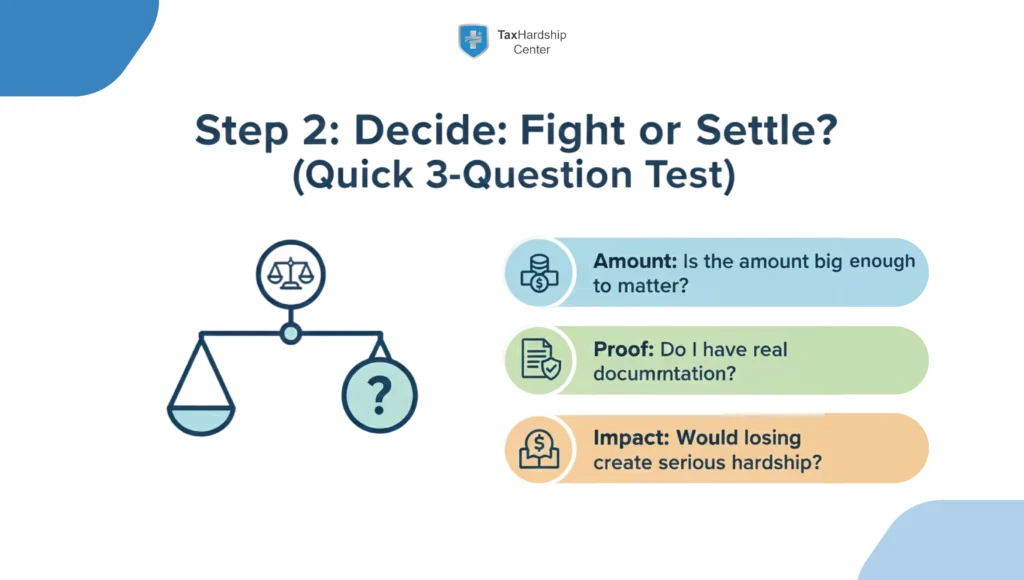
Before you file anything, ask three questions:
- How big is the difference?
- Is the proposed change a few hundred dollars or tens of thousands?
- Appeals involve time, paperwork, and stress. For small amounts, it may not be worth the fight.
- Do I have actual support?
- Can you produce receipts, contracts, logs, bank statements, or legal documents to back up your position?
- If your disagreement is mostly “I feel this is unfair,” Appeals has less room to help.
- What happens if you lose?
- If losing the appeal would create a severe hardship, it may be smarter to pivot quickly to tax relief options (payment plans, Offer in Compromise, hardship status) rather than spending months appealing first.
A good tax resolution firm like Tax Hardship Center will walk you through these questions before recommending whether to appeal, negotiate, or move directly to resolution.
How the IRS Office of Appeals Works
The IRS Independent Office of Appeals is the only formal appeal layer within the IRS.
Key features:
- Independence: Appeals is structurally separate from the auditors and collection staff who worked your case.
- Mission: Resolve disputes without litigation when possible, using the tax law and a realistic view of how the case might do in court.
- Format: Conferences can be held by phone, video, correspondence, or in person. You or your representative presents your side and discusses a settlement.
Publication 556 and Publication 5 outline your appeal rights, how to prepare a protest, and what Appeals expects to see in your case file.
When You Should Appeal an IRS Audit
Appealing is usually worth serious consideration when:
1. The dollar amount is significant
If the audit proposes thousands or tens of thousands in extra tax, penalties, and interest, even modest concessions from Appeals can translate into real money over time.
2. You have solid documentation that wasn’t fully considered
Common situations:
- The auditor ignored or misunderstood the records you provided
- You found additional documentation after the exam ended.
- You believe the IRS used the wrong legal standard (for example, treating a bona fide business as a hobby)
Appeals are specifically intended to revisit situations in which facts or law may have been misapplied.
3. There’s room for judgment or interpretation
Many audit issues involve grey areas, such as:
- Reasonable business expenses
- Allocation of personal vs. business use
- Valuation disputes (e.g., real estate, crypto, closely held business interests)
Appeals Officers are allowed to consider the risk that the IRS could lose on some issues in court, and sometimes settle accordingly.
4. The examiner was unreasonable or rushed
If you genuinely feel that:
- You weren’t given a fair chance to present your case, or
- The examiner seemed biased, dismissive, or unwilling to listen.
…Appeals can offer a fresh perspective.
When It’s Better to Accept and Focus on Relief
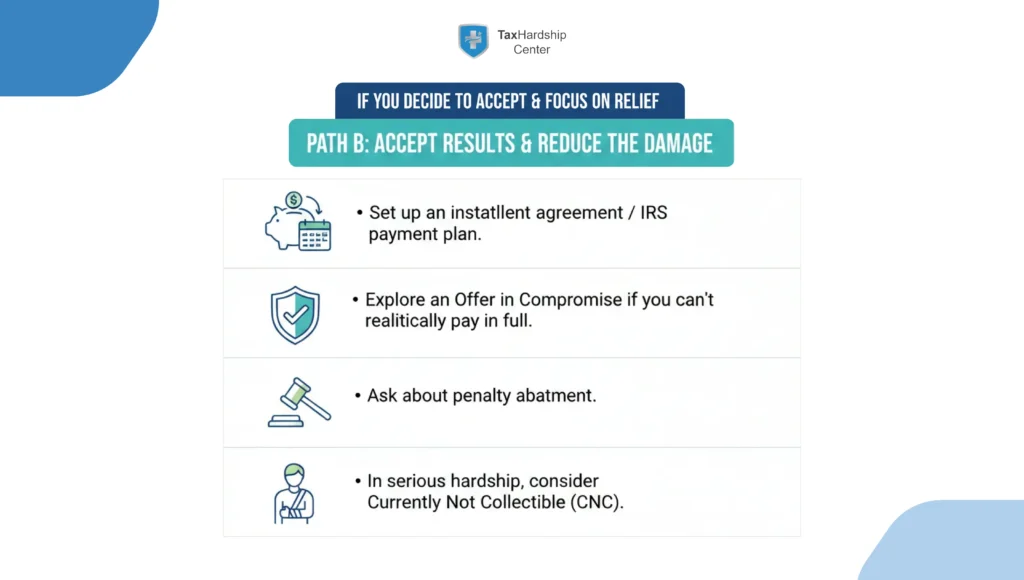
Appeals aren’t always the most brilliant move.
You may be better off accepting the audit results and going straight to tax relief planning if:
- The proposed changes are small relative to the time and stress of an appeal
- You don’t have documentation to back up your disagreement.
- You’d rather put your energy into minimizing what you actually have to pay through:
- Installment agreements / IRS payment plans
- Offer in Compromise (if you qualify)
- Penalty abatement
- Currently Not Collectible hardship status
Many taxpayers are shocked by the audit bill, but in the end, the real battle is over how to pay as little as possible in a way the IRS will accept, not the last dollar of the audit itself.
This is where the Tax Hardship Center can advise whether it’s time to fight the numbers or fight the bill through resolution strategies.
Step-by-Step: How to Appeal an IRS Audit Result
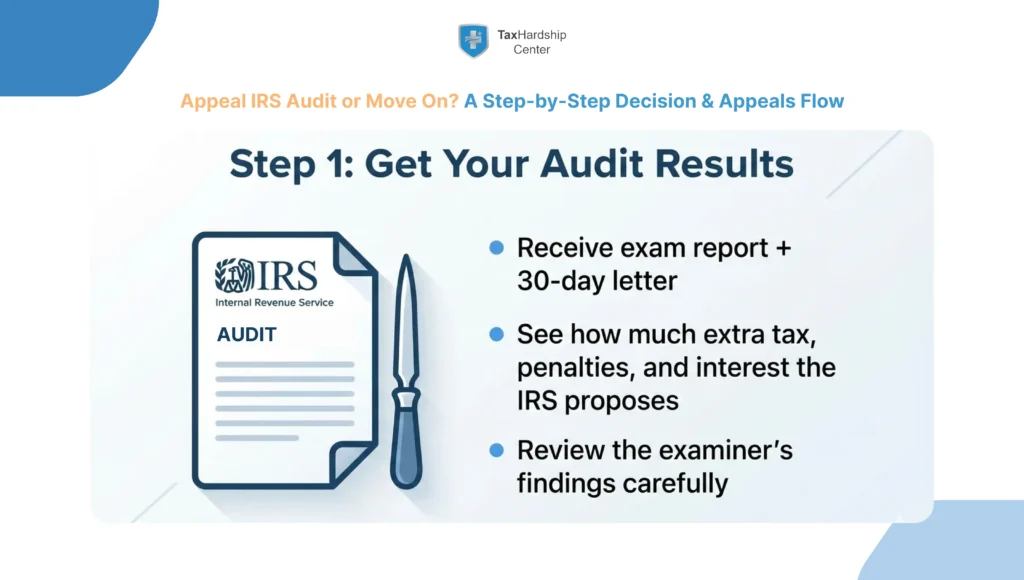
Here’s a high-level walkthrough of how an IRS audit appeal usually works, mainly based on IRS Publication 556, Publication 5, and the IRS’s own appeal guidance.
Step 1: Read your exam report and “30-day letter” carefully
You’ll typically receive:
- An exam report listing each proposed change and the tax impact
- A letter explaining your right to appeal (often a 30-day letter, such as Letter 525)
The letter tells you:
- How long do you have to request Appeals (usually 30 days from the date of the letter)
- Whether you may use a small case request or need a formal written protest
Miss this deadline, and you may lose the chance to appeal before the IRS assesses the tax.
Step 2: Decide if your case qualifies as a “small case request”
If the total amount of additional tax and penalties for any tax period is $25,000 or less, you may qualify to use a simplified “small case request” instead of a formal protest.
In many examination cases, this is done with Form 12203, Request for Appeals Review, which:
- Let’s you list the items you disagree with
- Includes space for a brief explanation of why you disagree
- Is sent to the address shown in your 30-day letter or exam report
This is often the fastest and least formal way to get to Appeals.
Step 3: Prepare a formal written protest (if required)
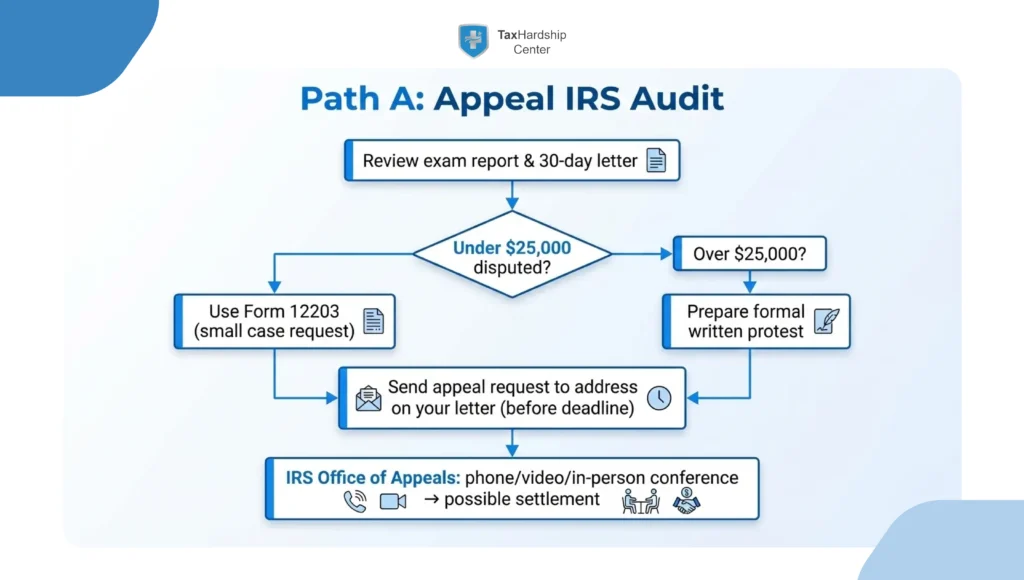
If your disputed amount is more than $25,000 for any period, or if the IRS specifically requires it, you must submit a formal written protest instead of a small case request.
Publication 5 and Publication 556 explain that a formal protest generally must include:
- Your name, address, and contact information
- A statement that you want to appeal the IRS findings
- A copy of the letter showing the changes you disagree with
- Tax periods and issues you’re disputing
- A list of each item you disagree with and the reason (facts and law) for your position
- Your signature and a statement that the facts are actual under penalties of perjury
This is where most people feel out of their depth and look for help from a tax professional or firm like Tax Hardship Center.
Step 4: Send your appeal request to the address in your letter
Your 30-day letter will tell you where to send your protest or Form 12203. In general, you send it back to the IRS office that handled your audit, not directly to Appeals.
Send it:
- Before the deadline (ideally by certified mail with return receipt), and
- With all the requested attachments and supporting explanations
The exam function will review your protest and, if accepted, forward your case to Appeals.
Step 5: Work with the IRS Office of Appeals
Once in Appeals:
- An Appeals Officer is assigned to your case.
- You may be asked for additional explanation or documentation.
- You’ll have a conference by phone, video, correspondence, or in person, where you or your representative walks through the issues.
Appeals will then:
- Analyze the facts, law, and litigation risks
- Try to reach a mutually acceptable settlement.
- Document any agreed changes and send you the closing papers.
If you still disagree after Appeals, your last administrative option is usually to file a petition with the Tax Court within the required timeframe after a Notice of Deficiency.
Appealing IRS Collection Actions: Where Form 9423 Fits
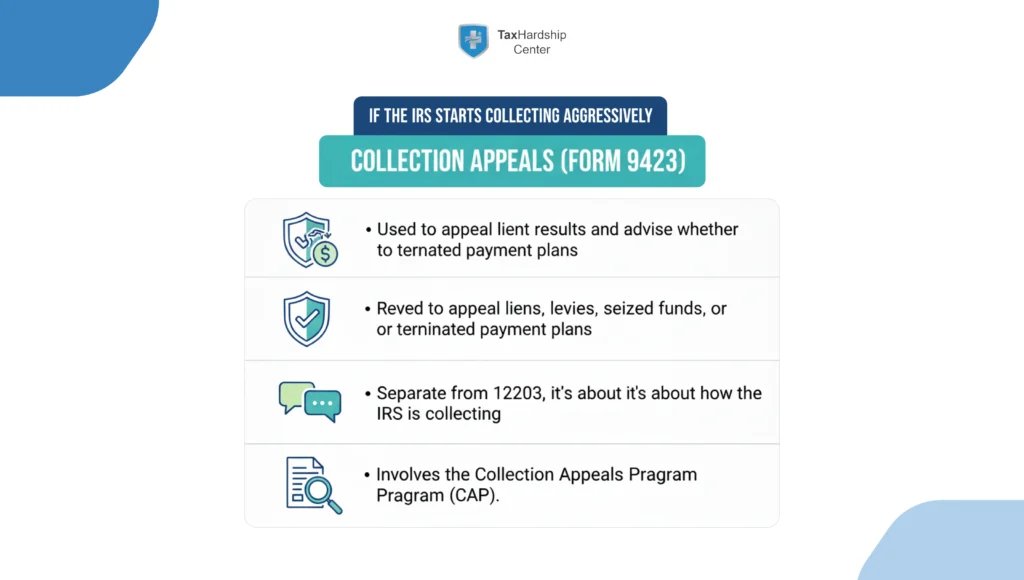
So where does Form 9423 come in?
Form 9423, Collection Appeal Request, is not used to appeal an audit result. Instead, it’s used to appeal specific collection actions, such as liens, levies, seizures, or termination of an installment agreement under the Collection Appeals Program (CAP).
You might use Form 9423 when:
- The IRS has filed, or plans to file, a Notice of Federal Tax Lien.
- Your wages or bank account are being levied.
- Your installment agreement has been rejected, modified, or terminated.
The process generally looks like this:
- You try to resolve the issue with the IRS employee or their manager.
- If unresolved, you submit Form 9423 within the required timeframe (often a few days after the conference), asking for review by the Collection manager and, if needed, the Independent Office of Appeals.
- Appeals reviews whether the collection action is appropriate and may suggest alternatives (e.g., a different payment plan, temporary relief, etc.).
Form 9423 is about how the IRS is trying to collect, not whether the audit result itself was correct. But in real life, many taxpayers face both:
- An audit result and
- Aggressive collection actions on that new balance
That’s why a firm like Tax Hardship Center often handles both examination and collection appeals within a single integrated strategy.
How Tax Hardship Center Helps You Decide (and Defend)
Tax Hardship Center (THC) is a nationwide tax resolution and IRS audit defense firm that helps individuals and businesses:
- Respond to IRS audits
- Appeal unfair audit results
- Fight or resolve IRS collection actions (liens, levies, garnishments)
- Negotiate payment plans, Offers in Compromise, and hardship relief.
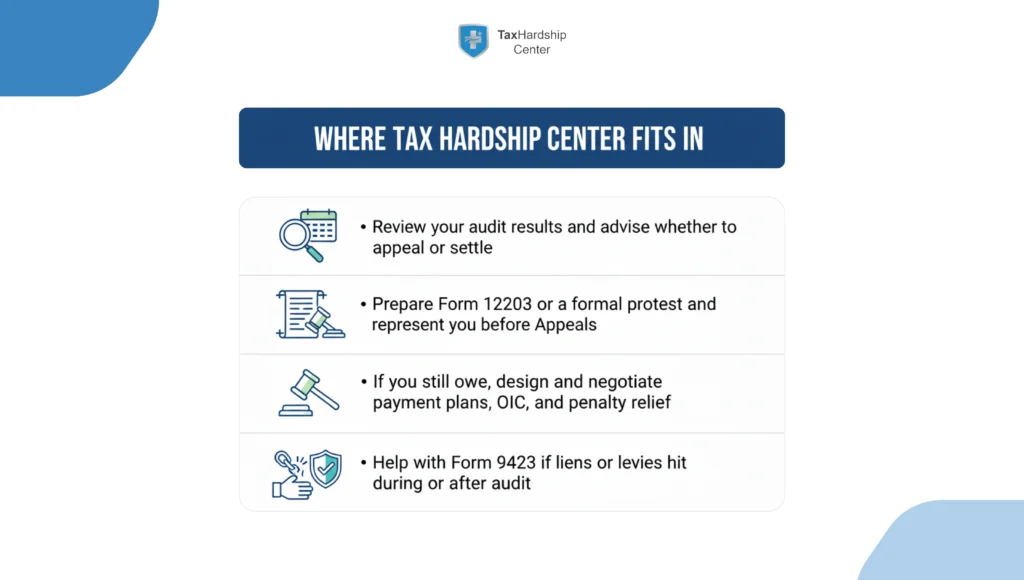
According to their audit and resolution service descriptions and third-party summaries, Tax Hardship Center:
- Reviews your audit report and letters to decide whether an appeal is worth it
- Prepares Form 12203 (small case appeals) or formal protests when appropriate
- Represents you in communications with the IRS Office of Appeals
- Uses your documentation, transcripts, and legal arguments to push back on unfair adjustments
- If a balance remains after Appeals, designs, and negotiations:
- Installment agreements / IRS payment plans
- Offer in Compromise (where you genuinely can’t pay in full)
- Penalty abatements
- Currently Not Collectible status for severe hardship
- File Form 9423 or other collection appeals when the IRS is moving too aggressively on liens, levies, or seized funds.
In short, they don’t just help you fight the numbers; they help you survive the fallout.
FAQs: IRS Audit Appeals, Office of Appeals, and Form 9423
1. How do I know if it’s worth appealing my IRS audit?
Ask:
Is the dollar amount significant?
Do you have real documentation to support your position?
Would you be better off putting your energy into paying less overall through tax relief?
If the answer to the first two is “yes,” an appeal is often worth considering. If not, it may be smarter to accept payment plans or settlements instead.
2. How long do I have to appeal an IRS audit?
Most audit reports come with a 30-day letter giving you 30 days from the date of the letter to request Appeals.
If you miss that deadline, the IRS may issue a Notice of Deficiency (“90-day letter”), at which point your primary recourse is Tax Court, not the Office of Appeals.
3. What is Form 12203, and when do I use it?
Form 12203, Request for Appeals Review, is a one-page form used in many small case requests after an audit when:
The total additional tax and penalties for a period are $25,000 or less, and
Your 30-day letter states that you can use a small-case request instead of a formal protest.
You list the issues you disagree with and briefly explain why. You then send it to the address in your audit letter.
4. What is Form 9423, and how is it different?
Form 9423, Collection Appeal Request ,is used to appeal specific collection actions (liens, levies, seizures, and some installment agreement decisions), not the audit itself.
You use Form 9423 when you disagree with how the IRS is collecting, not with what the audit concluded.
5. Do I need a lawyer to appeal an IRS audit?
Not always. You can represent yourself or authorize:
An Enrolled Agent (EA)
A CPA
An attorney
For complex or high-dollar cases, many people feel more comfortable with a professional representative. A firm like Tax Hardship Center can handle most audit appeals administratively and bring in tax attorneys where needed.
6. Can appealing an audit make things worse?
Appeals are designed to be impartial, and they don’t usually “punish” taxpayers for appealing. But:
Appeals can sustain the full adjustment, and
If new issues are discovered during the review, they can sometimes be raised.
That’s why it’s essential to have a clear strategy and realistic expectations before appealing, something a tax resolution firm can help you build.
7. When should I call Tax Hardship Center about my IRS audit?
You should consider contacting the Tax Hardship Center if:
You’ve received an audit report or 30-day letter and disagree with the changes
The potential bill is substantial, or you can’t afford it
You’re already seeing or fearing liens, levies, or garnishments.
You don’t want to manage deadlines, forms, and IRS negotiations on your own
They can review your situation, tell you honestly whether it’s worth appealing, settling, or focusing on relief, and if you choose, handle the entire IRS audit appeal and follow-up resolution process for you.