

If you have an IRS levy causing hardship, the IRS is legally required to release a wage levy once it confirms you can’t cover basic living expenses. You request the IRS levy release by calling the number on your levy notice, proving your income and expenses, and asking for a hardship determination. The debt stays. The levy stops.
That’s the short answer. Here’s the longer one.
Your debit card gets declined at the grocery store. You think it’s fraud. Then it gets declined at the gas station too. And then you remember the envelopes you didn’t open.
That’s how most people find out the IRS has reached their bank account. Not with a phone call. With a declined card and a cart full of groceries.
If that’s you right now, breathe. An IRS levy causing hardship is fixable. Not magically. But the law has a release valve built for exactly this moment.

TL;DR
- An IRS levy causing hardship means the levy leaves you unable to pay rent, food, utilities, or other basic living costs.
- Under the tax code, the IRS must release a wage levy that creates economic hardship. For bank levies, release is allowed but not automatic.
- To get the release, call the number on the levy, explain your situation, and back it up with income and expense proof.
- A release stops the taking. It does not erase the balance. Penalties and interest keep running.
- Economic hardship relief applies to individuals only. A business entity can’t use it.
What Does an IRS Levy Causing Hardship Actually Mean?
A levy is the IRS actually taking your money or property. Not threatening to. Taking.
It usually comes after a long paper trail: balance-due notices, then a final notice such as Letter 1058 or an LT11. Ignore those, and the IRS can levy your wages, your bank account, and even certain federal payments.
An IRS levy causing hardship is a specific legal situation. The IRS defines economic hardship as a levy that prevents you from meeting basic, reasonable living expenses.
Think rent, groceries, utilities, getting to work, and necessary medical care.
Not Netflix. Not the vacation fund.
The economic hardship IRS test isn’t about whether the levy hurts. Every levy hurts. It’s about whether, after the levy, your household can still survive month to month.
So how does the IRS decide that? And, more importantly, does it have to say “yes”?
When Is the IRS Required to Grant an IRS Levy Release?
This is the part most people don’t know.
Under Internal Revenue Code section 6343, the IRS is required to release a levy in several situations. According to the IRS guidance on getting a levy released, those include:
- You paid the amount you owe.
- The collection period expired before the levy was issued.
- Releasing the levy will help you pay your taxes.
- You entered an installment agreement whose terms don’t allow the levy to continue.
- The levy creates an economic hardship.
- The property is worth more than you owe, and releasing it won’t hurt collection.
Number five is your lifeline.
If the IRS confirms an IRS levy causing hardship, an IRS levy release is not a favor. It’s a legal requirement for wage levies.
Here’s the twist most people miss.
The IRS’s own manual tells agents not to make hardship relief wait on your unfiled returns. So “I haven’t filed in two years” doesn’t automatically mean the levy will be lifted. You’ll still need to file eventually. The two are handled separately.
Wage Levy vs. Bank Levy: Does the Hardship Rule Work the Same Way?
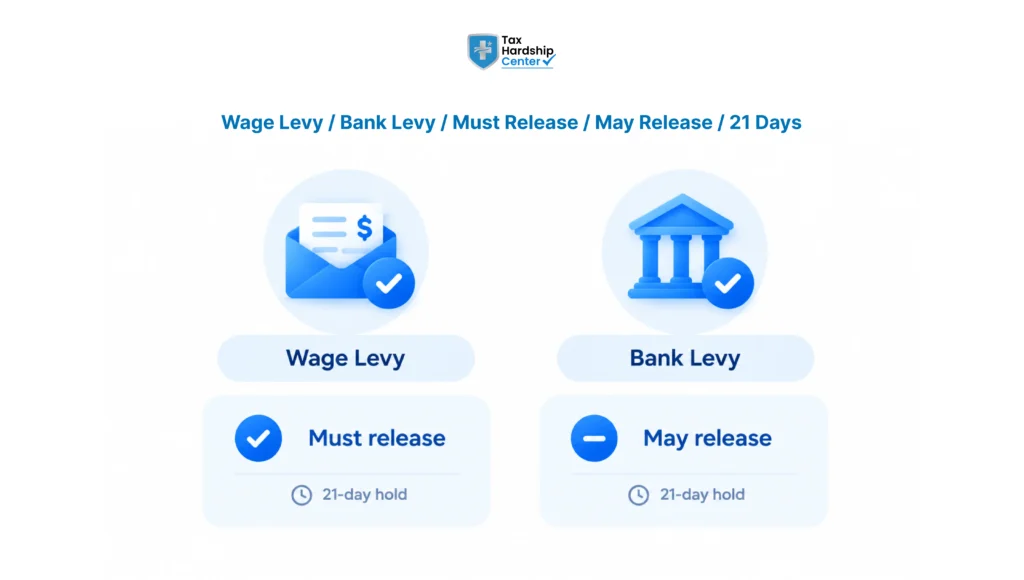
Not exactly. And the difference matters.
| Wage Levy (Form 668-W) | Bank Levy (Form 668-A) | |
| How it works | Continuous. Takes part of every paycheck until released | One-time snapshot of the account balance on the day it hits |
| Hardship release | Must be released if hardship is confirmed | May be released if hardship is confirmed |
| Your time window | Ongoing. Every payday counts | Bank holds funds for 21 days before sending them to the IRS |
| Best move | Call fast, before the next payroll cycle | Call inside the 21-day window |
That 21-day bank hold is your biggest opportunity. Miss it, and the money is gone to the IRS.
With wages, every payday you wait is another bite out of your paycheck. If you’re not sure how much they can actually take, our wage garnishment calculation guide breaks down the math.
How Do You Prove Economic Hardship to the IRS?
Saying “I can’t afford this” isn’t enough.
The IRS wants numbers. Real ones.
To meet the economic hardship IRS standard, you’ll typically provide a financial statement, usually Form 433-F or Form 433-A. This lays out:
- Monthly income: wages, side income, benefits
- Monthly expenses: housing, utilities, food, transportation, insurance, medical
- Assets: bank balances, vehicles, property, retirement accounts
- Household size: who depends on that income
The IRS then compares your expenses to its Collection Financial Standards, national and local allowances for food, housing, and transportation.
This is where people get stuck. Your real rent might be higher than the IRS allowance for your county. That doesn’t mean you lose. It means you need documents showing why the real number is necessary.
Before you call, pull together pay stubs, three months of bank statements, your lease or mortgage statement, utility bills, and car loan details.
The cleaner your paperwork, the faster the economic hardship IRS review moves.
How Do You Request a Levy Release, Step by Step?
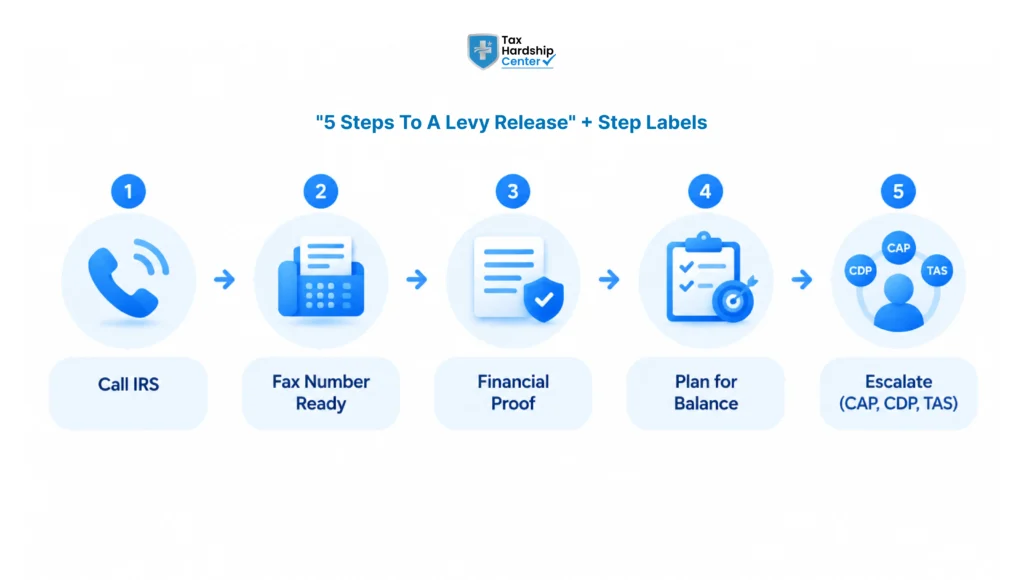
Here’s how to get relief from an IRS levy causing hardship, in the order it actually happens.
Step 1: Call the number on the levy notice.
The IRS hardship guidance says to contact them immediately at the number on the levy or correspondence and explain your situation.
Step 2: Have the fax number ready.
Get the fax number for your employer’s payroll department or your bank’s levy processing team. If the IRS approves the release, it can send Form 668-D (Release of Levy) directly to them.
Step 3: Provide your financial information.
Walk through your income, expenses, and assets on the call, or submit a 433 form after.
Step 4: Ask what happens to the balance.
A release usually comes paired with a next step. That might be an installment agreement or Currently Not Collectible (CNC) status, where the IRS pauses collection because you can’t pay right now.
Step 5: Escalate if the answer is no.
You have options:
- Collection Appeals Program (CAP): File Form 9423 to appeal a levy before or after it happens. It’s fast, but the decision is final.
- Collection Due Process (CDP) hearing: If you’re still within 30 days of a final notice, file Form 12153. Our guide to the LT11 notice and CDP hearing explains this route.
- Taxpayer Advocate Service: If you’re facing immediate harm and normal channels are stuck, the Taxpayer Advocate Service can step in using Form 911.
Simple on paper. Less simple on a two-hour IRS hold with rent due Friday.
What Mistakes Make an IRS Levy Causing Hardship Worse?
Most people don’t lose these cases because they don’t qualify. They lose them to avoidable mistakes.
Waiting for the next paycheck to “see what happens.”
With a wage levy, the next paycheck is what happens. Every week of delay with an IRS levy causing hardship is money you won’t see again.
Missing the 21-day bank window.
Once the bank releases funds to the IRS, a hardship argument gets much harder to win.
Treating a release like forgiveness.
An IRS levy release stops the taking. It doesn’t touch the balance. Interest and penalties keep growing, and a federal tax lien may still sit on your record.
Overstating expenses.
The IRS checks your bank statements. Honest numbers win more cases than dramatic ones.
Assuming a business can claim hardship.
Economic hardship release applies to individuals. If the levy is on a corporation or LLC account, you’ll need a different strategy entirely.
How Tax Hardship Center Gets Levies Released When Hardship Hits
When an IRS levy causing hardship is draining your paycheck or freezing your account, speed and accuracy decide the outcome. That’s the work Tax Hardship Center does. We start with your actual levy notice: wage or bank, and how much time is left before the next payroll cycle or the 21-day bank deadline.
Then we build the hardship case. Our team prepares your Form 433-F financial statement, matches your expenses against IRS Collection Financial Standards, and contacts the IRS on your behalf to request the IRS levy release. Once the levy is lifted, we don’t stop there. Depending on your numbers, we move your case into Currently Not Collectible status, a realistic IRS installment agreement, or, if you genuinely qualify, an Offer in Compromise.
And we’ll tell you what we can’t promise. The IRS makes the final call on every hardship request. What we control is how complete, accurate, and fast your case gets in front of them, and that’s often what moves it.
FAQs
Can the IRS refuse to release a levy causing hardship?
For wage levies, no. Once the IRS determines that economic hardship exists, it must release the levy. For bank levies, release is allowed but not required.
How long does an IRS levy release take?
It mostly depends on how fast you provide financial information. Once approved, the IRS can fax Form 668-D straight to your employer or bank.
Does a levy release mean I no longer owe the money?
No. A levy release only stops the IRS from taking money. The balance, penalties, and interest stay until you resolve them through a payment plan, CNC status, or another option.
What counts as economic hardship for the IRS?
Economic hardship IRS rules apply when a levy leaves you unable to pay basic, reasonable living expenses like rent, food, utilities, and transportation. The IRS compares your costs against its Collection Financial Standards.
Can I get a levy released if I haven’t filed all my tax returns?
Often, yes. The IRS manual says that hardship relief should not be contingent on the return of delinquent returns. You’ll still need to file them to fully resolve your case.
Can a business claim an IRS levy causing hardship?
No. Economic hardship release applies to individual taxpayers only. Businesses need other strategies, like an installment agreement or a collection appeal.
What if the IRS already took money from my bank account?
Once the 21-day hold ends, recovery gets harder. You can still request a return of levied funds or appeal through CAP, but early action gives you better odds.
Conclusion
An IRS levy causing hardship feels like the floor dropping out.
But it isn’t the end of the story. The law gives you a way to stop the bleeding, especially for wage levies. Prove the economic hardship IRS standard with real numbers, act inside your deadlines, and pair the release with a plan for the balance.
The levy is loud. Your next step just needs to be clear.
Key Takeaways
- An IRS levy causing hardship is one that leaves you unable to cover basic living expenses.
- The IRS must release a wage levy once it confirms economic hardship.
- Bank levy releases for hardship are possible but not guaranteed.
- Banks hold levied funds for 21 days, so that window is your best shot.
- Proving the economic hardship IRS standard requires real income and expense documents.
- Unfiled returns don’t automatically block hardship relief on a levy.
- An IRS levy release stops collection but does not reduce the balance owed.
- CAP, CDP hearings, and the Taxpayer Advocate Service are your escalation routes.
- The economic hardship release applies to individuals, not to business entities.
- Pair every levy release with a long-term plan so the IRS doesn’t come back.
Stop the levy before the next payday. Every payday you wait costs you money. Let a tax specialist read your levy notice and tell you honestly whether you qualify for a hardship release.
Click here to get a quote and a free case review
Call us at (877) 829-7099 / (877) 829-0590 to speak to a tax specialist today.