

Can the IRS levy a business account for personal taxes? It depends on how your business is set up. If you’re a sole proprietor, yes, because the business account legally belongs to you. If you operate through an LLC or corporation that’s kept truly separate, generally no. But if you mix personal and business money, the IRS can treat the business as you, and the protection disappears.
That’s the answer. Here’s why it matters more than most owners realize.
It’s Thursday. Payroll goes out Friday. You log into the business account to check the balance. It’s frozen.
Not because the business owes the IRS. Because you do. That 2022 return from the year your side income got messy. The one you meant to deal with.
And now 12 employees are waiting on checks you can’t send.
So, can IRS levy business account for personal taxes? Let’s get specific.
TL;DR
- Can IRS levy business account for personal taxes? For sole proprietors, yes. The business account is legally yours.
- A properly run LLC or corporation is a separate legal entity, so an IRS business bank account levy for the owner’s personal debt is generally off the table.
- Commingling funds lets the IRS argue the company is your “nominee” or “alter ego” and levy it anyway.
- Even when the IRS can’t touch the business account, it can levy your owner distributions, wages, and ownership interest.
- Unpaid payroll taxes can flip the risk the other way and make business debt personal.
Can IRS Levy Business Account for Personal Taxes?

The IRS works from one rule: a levy can reach your property and your rights to property. So the real question isn’t “is this a business account?” It’s “whose money is this, legally?”
If the answer is “mine,” the IRS can take it. If the answer is “my company’s, and my company is a separate legal entity,” it generally can’t.
That’s why two owners can ask the exact same question, can IRS levy business account for personal taxes, and get completely different answers.
The difference is structure. And behavior.
Does Your Business Structure Actually Protect You?
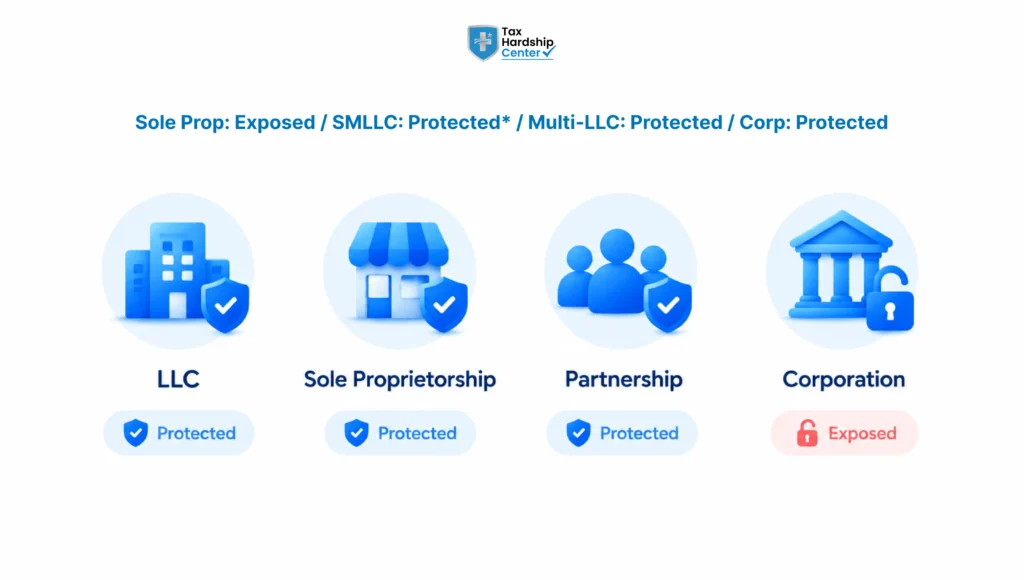
Here’s how the answer to “can IRS levy business account for personal taxes” changes by structure:
| Business structure | Can the IRS levy the business account for the owner’s personal taxes? |
| Sole proprietorship / DBA | Yes. The account is legally yours |
| Single-member LLC | Generally no, if kept separate |
| Multi-member LLC | Generally no. The IRS goes after your share instead |
| S corp or C corp | Generally no, if kept separate |
Sole Proprietors: There’s No Wall
A sole proprietorship isn’t a separate entity. Your “business account” is just your account with a business name.
So can the IRS levy a business account for personal taxes when you’re a sole proprietor? Yes. An IRS business bank account levy for your personal tax debt is fully on the table. The IRS can also levy money your customers owe you, because those receivables are your property too.
Single-Member LLCs: The Confusing One
This is where most owners get tripped up.
According to IRS guidance on single-member LLCs, a single-member LLC is “disregarded” for income tax purposes. Its profit lands on your personal return.
So people assume an IRS levy LLC situation works the same way. If the income is mine, the account must be mine too, right?
Not quite.
Being disregarded for income tax doesn’t erase the LLC under state law. The LLC still owns its own bank account. That means an IRS levy LLC account action for your personal taxes generally needs more than “you’re the only member.”
But it’s not a guarantee. Which brings us to the part that actually decides most cases.
When Can the IRS Ignore Your LLC Completely?
When you stop treating it like a separate business.
The IRS can argue that your company is your nominee (holding your money in its name) or your alter ego (not truly separate from you). If that sticks, the IRS can file a nominee lien and pursue an IRS levy LLC funds action as if the account were yours.
Red flags that invite this:
→ Paying your mortgage, car loan, or groceries from the business account
→ Moving personal money into the LLC to “hide” it from the IRS
→ No operating agreement, no separate books, no real business activity
→ Transferring personal assets to the LLC after the tax debt started
That last one is the big one. Shifting money into the business after you owe is exactly what the IRS looks for.
So can the IRS levy a business account for personal taxes when your LLC is basically a personal piggy bank? Yes. And clean, caught-up bookkeeping is often the difference between a protected company and an exposed one.
What Can the IRS Take From Your Business Instead?
Here’s the twist most owners don’t see coming.
Even if the IRS can’t touch the company account, it doesn’t just walk away. It goes after what the business pays you:
- Your wages or salary from the company, through a wage levy
- Owner draws and distributions, served as a levy on the company
- Your ownership interest in the LLC or corporation
- Loans the company owes you, if you lent it money
So the question shifts from “can IRS levy business account for personal taxes” to “how much of what flows to me can it grab?”
Answer: a lot. A levy on your distributions can leave you with nothing to take home while the business keeps running.
Can Business Tax Debt Become Personal Too?
Yes. This is the flip side of “can IRS levy business account for personal taxes,” and it surprises owners even more.
If your business withholds payroll taxes from employees’ pay and doesn’t remit them to the IRS, the Trust Fund Recovery Penalty can make you personally liable. That applies even if you run an LLC or corporation.
Once that penalty is assessed against you, the IRS can levy your personal accounts for what the business owed.
So the wall works in both directions. And it can crack in both directions too. If you’re dealing with unpaid payroll taxes, personal exposure is already part of the picture.
What Should You Do If the IRS Levies Your Business Bank Account?
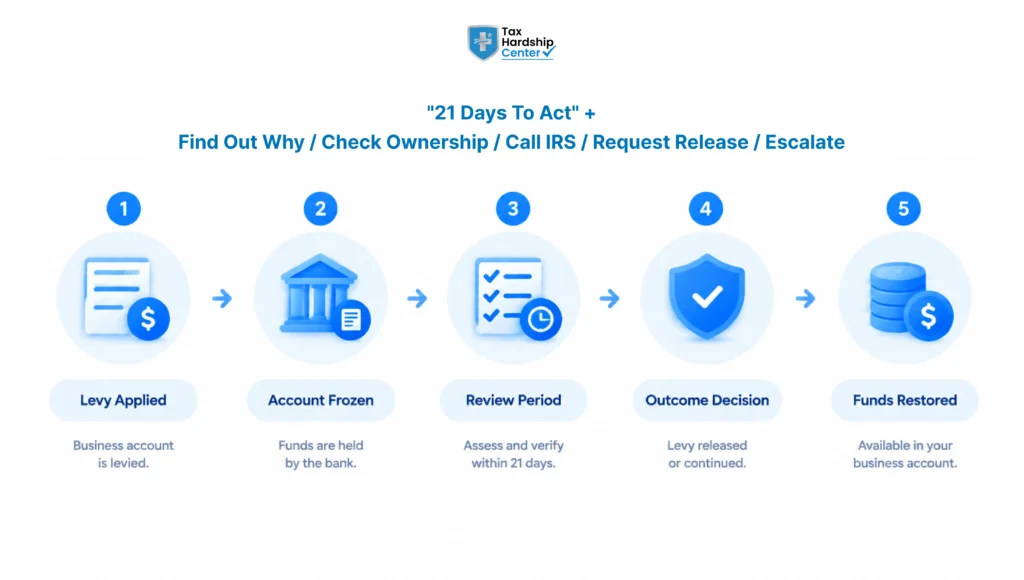
First: don’t panic. You have a window.
When an IRS business bank account levy is executed, the bank holds the funds for 21 days before remitting them to the IRS. That window is everything.
Here’s what to do:
- Find out why. Is it for your personal taxes, the business’s taxes, or a payroll penalty? The answer decides your strategy.
- Check whose account it is. If the debt is personal and the account belongs to a separate LLC or corporation, the IRS business bank account levy may be wrongful.
- Call the IRS immediately. Use the number on the levy notice and ask for the specific basis.
- Request a release. If you can show that the levy hits the wrong entity, or that you have set up a payment arrangement, the IRS can issue a levy release.
- Escalate if needed. A Collection Appeals Program request can challenge the levy fast, sometimes within the 21-day window.
And protect payroll. Tell your bank immediately, and don’t move money around in a panic. Moving funds after a levy can create bigger problems than the levy itself.
How Tax Hardship Center Stops Business Account Levies Before Payroll Breaks
When you’re asking “can IRS levy business account for personal taxes in my case,” you need someone who understands both sides: the tax debt and the business running on top of it. Tax Hardship Center starts by pulling IRS transcripts for you and your company, so we know exactly whose debt triggered the levy, whether it’s personal income tax, business tax, or a trust fund penalty, and how many days are left in the 21-day bank hold.
Then we act on the levy and the debt behind it. If an IRS levy LLC account action hits the wrong entity, we push for a fast bank levy release. If the debt is yours, we set up an installment agreement or Offer in Compromise that stops future levies on your distributions. If a lien is hurting your vendor credit or bonding, we can help with tax lien removal. Our business tax services coordinate with your existing CPA rather than replace them.
We’ll also be honest about what we can’t promise. If you’ve been running personal bills through the company, the IRS may have a real case. What we can do is fix the books, properly separate the funds, and keep your payroll running while we resolve what you owe.
FAQs
Can the IRS levy a business account for personal taxes if I’m a sole proprietor?
Yes. A sole proprietorship isn’t a separate legal entity, so the business account is legally yours. The IRS can levy it, along with money your customers owe you.
Can the IRS levy an LLC bank account for the owner’s personal taxes?
Generally no, if the LLC is kept separate. An IRS levy LLC action becomes possible if the IRS proves the LLC is your nominee or alter ego, usually because of commingled funds.
Does a single-member LLC protect my business account from the IRS?
Partly. It’s disregarded for income tax, but it’s still a separate legal entity under state law. That protection holds only if you keep business and personal money apart.
How long do I have after an IRS business bank account levy?
The bank holds levied funds for 21 days before sending them to the IRS. Use that time to contact the IRS, prove the account’s ownership, or arrange payment.
Can the IRS take my owner distributions?
Yes. Even if the business account is protected, the IRS can levy distributions, draws, wages, and other payments the company owes you.
Can business payroll taxes become my personal debt?
Yes. The Trust Fund Recovery Penalty can make owners and responsible people personally liable for unpaid payroll taxes, even inside an LLC or corporation.
Can I move money into my LLC to protect it from the IRS?
No. Moving personal funds into a business after you owe taxes is a classic nominee red flag. The IRS can still reach that money and may treat the transfer as fraudulent.
Conclusion
So, can the IRS levy a business account for personal taxes?
If you’re a sole proprietor, yes. If you’re an LLC or corporation that’s truly separate, generally no.
But “truly separate” is the whole game. Commingle funds, and that wall turns into paper. And even when the account is safe, your distributions and paycheck usually aren’t.
Your business can survive an IRS problem. It just can’t survive ignoring one.
Key Takeaways
- Can IRS levy business account for personal taxes? It depends on your structure and behavior.
- Sole proprietors have no wall. The business account is legally theirs.
- A properly run LLC or corporation generally protects its account from the owner’s debt.
- Single-member LLCs are disregarded for income tax but still separate legal entities.
- Commingling funds lets the IRS use nominee or alter ego theories to levy anyway.
- An IRS business bank account levy gives you 21 days before funds go to the IRS.
- The IRS can still levy your distributions, wages, and ownership interest.
- Unpaid payroll taxes can make business debt personal through the Trust Fund Recovery Penalty.
- Moving personal money into a business after owing taxes rarely protects it.
- Clean books and fast action are your best defense against any IRS levy LLC risk.
Facing an IRS business bank account levy, or worried it’s next? Let a tax specialist check whose debt triggered it and how fast we can protect your payroll.
Click here to get a quote and a free case review
Call us at 844-427-5100 to speak to a tax specialist today.