


Cannot pay your full federal tax by the deadline? The IRS charges interest from the due date, adds penalties, and sends notices when your balance remains unpaid. You can still file the return on time to avoid the late filing penalty, then request an installment agreement or hardship status. If you ignore the debt, the IRS can file a federal tax lien that impacts credit, and later levy wages or bank accounts. You can often stop enforcement by entering a payment plan, showing hardship, or applying for an Offer in Compromise. The sooner you respond, the lower your total cost and stress. For program basics, review the IRS page on getting help with tax debt, which lists payment plans, hardship holds, and Offers in Compromise.
Immediate Consequences: Interest, Penalties, and Notices
Interest, Penalties, and Notices
This section explains what hits your account first, what each charge means, and how IRS notices escalate if you do not respond.
Interest starts day one
Interest begins on the unpaid balance from the original due date and compounds daily. The rate changes each quarter based on federal rates, so it can rise in high rate periods. Interest applies even if you set up a payment plan, so faster payoff still saves money. You reduce interest most by cutting the principal quickly, not by waiting for a lower rate. Treat interest as the meter that never pauses until you fully pay. Learn how payment relief works in this primer, Understanding IRS Payment Plans.
Penalties stack if you do not act
The failure to pay penalty adds a monthly charge on the unpaid tax, up to a set cap. The failure to file penalty grows much faster than the failure to pay penalty, which is why you should always file on time. Penalties can shrink if you qualify for first‑time abatement or if you show reasonable cause. The IRS reviews your history and facts before it removes any penalty. You control penalty growth by filing now and setting up a plan rather than waiting. If penalties already hit, see our Penalty Abatement service page for relief paths.
Notices build from soft to serious
The IRS starts with a balance‑due notice, then sends follow‑ups if you ignore the first letter. Later notices warn about lien filing or levy action. Each notice includes a due date to respond, so read the letter and act before that date. If you disagree with the tax, you can request an appeal or meet with the IRS to resolve the numbers. Silence invites the next, tougher notice.
File Even If You Can’t Pay: Why Filing Matters

This section shows why filing the return now protects you from bigger penalties and keeps options open even when cash is tight.
Filing shuts down the worst penalty
When you file by the deadline, you avoid the large failure to file penalty that grows every month. Filing also starts the clock for many legal time limits that later protect you. You can file a complete return or a valid extension if you need a few more months to gather documents. An extension gives extra time to file the forms, but it does not give extra time to pay, so plan payments anyway. File first, then sort out how to pay over time. If you have unfiled years, our Unfiled Tax Returns service can help you clear the backlog quickly.
You keep refund rights and credits clean
If you qualify for refundable credits, filing triggers those benefits. You avoid offsets on future refunds caused by unfiled years. Clean filings help when you ask for penalty relief or a payment plan because the IRS checks if you filed all returns. Accurate filings also prevent new bills from audits that add to your balance. Good records help you correct any IRS mismatch fast. Our team can prepare missing returns so your payment plan request moves without delay.
Filing speeds up relief options
The IRS will not approve many relief programs until all returns are filed. Installment agreements, Offers in Compromise, and hardship status all require filing compliance. When you file, the IRS can verify what you owe and move your case forward. You reduce back‑and‑forth by sending complete, signed returns with support. Filing is the gate you must pass to get almost any help. Review our overview of IRS payment plans, Understanding IRS Payment Plans, to choose the next step.
Help From Tax Hardship Center: Fast First Steps and Setup
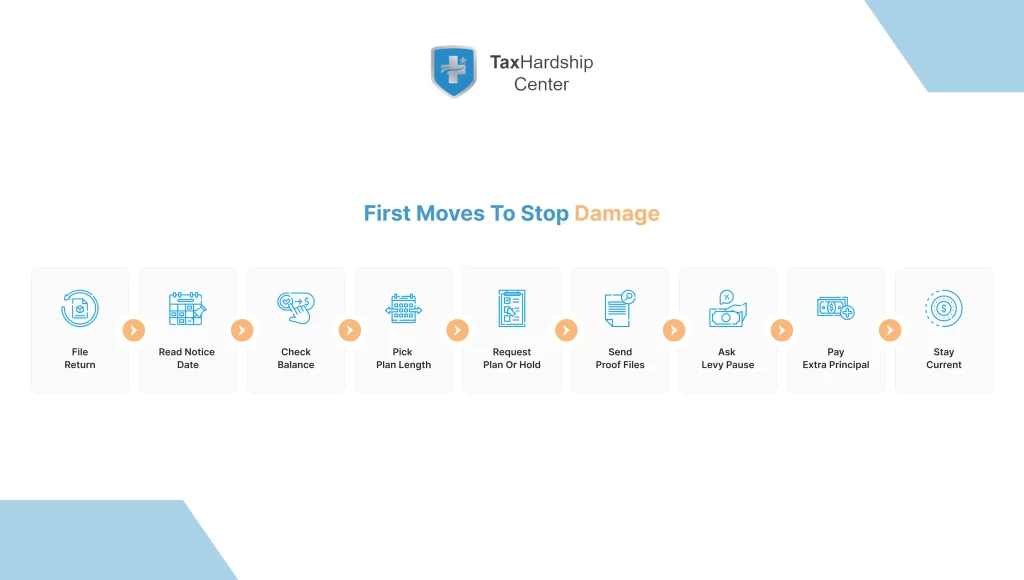
At Tax Hardship Center, we help you file missing returns, choose the right relief, and set up protection before liens or levies escalate. Our services at Tax Hardship Center include setting up an Installment Agreement service that matches your budget, preparing an Offer in Compromise service when hardship applies, and booking a free consultation to plan the shortest route to resolution. Start with a quick review of our Installment Agreement service, see if you may qualify for an Offer in Compromise, and schedule a confidential call to map your options.
Your Payment Options with the IRS: What to Request First
This section outlines the most common ways to handle a balance, how each option works, and how to pick the right path for your budget.
Short‑term extensions and simple plans
If you can pay within a few months, request a short‑term payment plan. The IRS may allow up to 180 days without a formal installment agreement setup. You still pay interest and penalties during that time, but you avoid setup fees and keep things simple. If you need a bit longer, a streamlined installment agreement can spread payments over up to six years in many cases. Pick the shortest plan you can afford to limit interest. For step‑by‑step details, see our blog on the Streamlined Installment Agreement.
Standard installment agreements
A standard plan drafts a fixed monthly payment from your bank until the debt is paid. The IRS may ask for financial data if you owe above certain thresholds. Lower payments protect your budget but extend interest costs, so find a number you can keep without default. You can add extra principal any month to reduce the balance faster. If your income drops, you can request a revised amount with proof. When you are ready to proceed, visit our Installment Agreement service to get your plan filed correctly.
Offer in Compromise
An Offer in Compromise lets you settle for less than you owe if you cannot pay the full amount within the collection window. The IRS reviews your income, assets, and allowable expenses to test ability to pay. A strong offer matches what the IRS could collect from you over time, based on real numbers. You need accurate forms and documents to avoid a quick rejection. If the IRS accepts, you must stay current for five years to keep the deal. Read the IRS overview of the Offer in Compromise program and then review our Offer in Compromise service to see how we prepare winning files.
Currently Not Collectible status
If you cannot pay anything after basic living costs, you can request Currently Not Collectible status. The IRS reviews your finances and pauses active collection once you qualify. Interest keeps adding, but the IRS stops levies while you remain in hardship. You must file returns on time while in this status. If your income rises, the IRS can review and restart payments. For a deeper look, read our guide on how to qualify for IRS hardship.
What the IRS Can Do: Liens, Levies, and Garnishments

This section explains the tools the IRS uses to secure and collect the debt when you do not resolve the balance.
Federal tax lien
A federal tax lien attaches to your property and rights to property after the IRS assesses the tax and sends a demand for payment you do not meet. The lien makes it harder to sell or finance assets because the IRS has a legal claim. You can avoid a filed Notice of Federal Tax Lien by entering certain payment plans early. If a notice is filed, you may ask for withdrawal or subordination in limited cases. Paying the balance releases the lien, but smart planning can avoid or limit it. See our article on unfiled taxes to understand why timely filing reduces lien risk.
Levy on wages or bank accounts
A levy lets the IRS take a portion of your wages or funds from your bank to cover the tax. Before a levy, the IRS sends a final notice and gives you a right to a hearing. You can stop a levy by setting up a plan, showing hardship, or filing an appeal on time. If a levy hits, you can often get a release once you agree to terms and show documents. Fast contact helps you protect your next paycheck.
Seizure of assets in rare cases
The IRS can seize vehicles or other assets in severe and rare cases. Seizure follows repeated notices and failure to respond or resolve the account. Most taxpayers can avoid this outcome by filing, communicating, and keeping agreements. If you face a seizure threat, you need a quick plan and proof of hardship or payment ability. Early action is your best shield.
Time Limits and Statutes: How Long the IRS Can Collect
This section covers how long the IRS can pursue a balance, and how your actions can change that clock.
The 10‑year collection clock
The IRS usually has 10 years from assessment to collect a balance. Certain actions can pause or extend that period, such as bankruptcy or an Offer in Compromise review. Knowing the assessment date helps you map the remaining time. Do not rely only on the clock, since interest can keep the debt large even late in the period. Use the time to reach a deal that fits your budget.
How pauses and extensions work
When you request some relief options, the clock stops while the IRS reviews your case. After the pause, the IRS adds that time back to the end of the period. Appeals, litigation, and time outside the country can also affect the end date. You can ask for account transcripts to see key dates. A precise timeline helps you choose between a plan, an offer, or hardship status.
Why timing shapes your choice
If you have many years left, a longer plan may be fine. If you are late in the period, an Offer in Compromise or hardship could make more sense. The right move depends on income, assets, and debts right now. A budget that you can keep matters more than a perfect but fragile plan. Fit the option to your timeline and cash flow.
How Financial Hardship Works: Reasonable Expenses and Proof
This section shows how the IRS measures ability to pay and what evidence you need to qualify for relief.
Allowable expenses and standards
The IRS uses national and local standards for food, housing, transportation, and other costs. You can claim actual costs up to those standards, and in some cases above with strong proof. Health care and court ordered payments often receive more room. You should gather leases, bills, insurance statements, and loan papers to support each cost. A clear budget helps the IRS see that you cannot pay more.
Income, assets, and equity
The IRS reviews pay stubs, bank statements, and business records to measure true monthly income. Assets and equity also count, including cash value life insurance and some investments. You may need to show why you cannot borrow against equity without severe harm. If an asset is not marketable or is needed for work, explain that with documents. Full disclosure builds trust and speeds approvals.
Documentation that wins cases
Successful cases include clean forms and matching support. Keep bank statements for the full period the IRS requests, usually three to six months. Label each file and match it to a line on the form to avoid confusion. If a number changes month to month, add a short note to explain the swing. Strong documentation turns a weak ask into a solid approval.
How Tax Hardship Center Supports You: Strategy, Setups, and Relief

This section outlines how our team helps you choose the right path, prepare documents, and keep relief in place.
Rapid case review and plan
We start with a focused intake that maps your debt, income, assets, and deadlines. We flag quick wins like first‑time penalty abatement or a short‑term plan when cash is on the way. If you qualify for hardship or an Offer in Compromise, we build that case with the right numbers. You get a clear timeline and tasks so we can move fast. Speed and accuracy reduce interest and stress. Explore our Penalty Abatement service if fines are driving your balance.
Hands‑on setup and negotiation
Our team files missing returns, sets up payment plans, and talks with the IRS on your behalf. We prepare financials that match IRS standards so your request lands well the first time. When needed, we pursue appeals to protect your rights and buy time. We work to prevent liens or levies while we finalize your agreement. You stay informed at each step with plain‑English updates. Book a free consultation to start your case review.
Long‑term compliance and protection
Relief sticks when you stay current. We set reminders for estimates and filings so you avoid future penalties. If your income dips, we can adjust the plan with the IRS before a default. If you receive a new notice, we respond quickly with facts and options. Our goal is lasting relief and a clean slate. For small businesses, our bookkeeping service can help keep cash flow and records steady.
Why Tax Hardship Center?
1. Hassle-Free Assistance:
Say goodbye to sleepless nights and endless tax-related stress. At the Tax Hardship Center, we believe in simplifying the complex. Our team of experts is dedicated to guiding you through every step of the process, ensuring that your tax concerns are met with precision and care.
2. 14-Day Money Back Guarantee:
We’re so confident in our ability to ease your tax worries that we offer a 14-day money-back guarantee. If you’re not satisfied with our service for any reason, we’ll gladly refund your investment. Your peace of mind is our top priority!
3. Free Consultation:
Are you curious about how we can transform your tax experience? Book a free consultation now! Our team will assess your situation, answer your questions, and provide free insights tailored to your needs.
4. Nationwide Coverage:
No matter which corner of the United States you call home, the Tax Hardship Center covers you. We proudly serve all 50 states, bringing our expertise to your doorstep. Wherever you are, our commitment to excellence follows.
In summary…
This section recaps what happens, what to do first, and how to pick the best relief for your budget.
- What happens first
- Interest starts from the due date and compounds.
- Penalties add monthly charges that grow fast when you do not file.
- IRS notices escalate if you ignore them.
- Interest starts from the due date and compounds.
- What to do now
- File all returns to stop the worst penalty and open relief paths.
- Pick the shortest payment option you can afford to reduce interest.
- Call if hardship applies so we can request a pause or an offer.
- File all returns to stop the worst penalty and open relief paths.
- How to avoid enforcement
- Act before lien or levy notices reach the final stage.
- Keep agreements current and send documents on time.
- Update the IRS if income changes so you can adjust the plan.
- Act before lien or levy notices reach the final stage.
A fast, informed move cuts costs and stress. With the right filings, documents, and plan, you can stop enforcement and get back on track.
FAQs
Can I go to jail for not paying my taxes?
Jail for unpaid taxes is rare and tied to fraud or willful evasion. If you filed accurate returns and simply cannot pay, the IRS uses civil tools, not criminal charges. Focus on filing and requesting a plan or hardship. Keep records to show good faith. Communication keeps your case in the civil track.
How much are the interest and penalties?
Interest changes each quarter and compounds daily. The failure to pay penalty adds a small monthly amount, while the failure to file penalty grows faster. Filing reduces the worst penalty and keeps costs lower. You still pay interest during any plan. Paying principal early saves the most.
Will a payment plan stop a levy?
A payment plan can stop or prevent a levy once the IRS approves it. You may still see interest and penalties while you pay. If a levy already hit, you can often get a release after you set a plan and show hardship. Quick response helps protect your next check. Keep the plan current to avoid new action.
Can the IRS take my house or car?
Seizures are rare and follow many notices. The IRS often tries liens and levies first. You can avoid seizure by filing, setting a plan, or proving hardship. If you receive a seizure warning, contact help fast. Early action gives you more options.
Should I put the tax on a credit card?
A card may cost less than IRS interest if you can pay the card off quickly. Card fees and higher rates can erase any savings if you carry a balance. A short‑term IRS plan often beats high card interest. Compare numbers before you move the debt. Avoid swaps that raise your total cost.
