


I haven’t filed taxes in 3 years, so what now? File returns fast to stop the harsh failure to file penalty, replace any IRS substitute return, and guard refund rights before the three-year statute expires. You can request penalty relief when Eligibility Criteria fit, set a plan if you face Tax Payment Inability, and protect Social Security benefits by fixing missing earnings. If you worry about Tax Complexity, you still win by following clear steps, keeping proof, and answering every IRS notice on time. This comprehensive guide covers unfiled returns, refund request rules, payment options, audit letters, and the practical criteria relief paths that help you move forward.
What happens if you don’t file taxes for three years in the U.S.
Skip three filing seasons and you face a bigger bill and tighter enforcement. The IRS can create a substitute return, assess penalties and interest, and start collections that reach paychecks and bank accounts. You also risk losing refunds after three years and weakening your Social Security record. This section shows what hits first and how fast action limits damage.
IRS substitute for return: how SFRs inflate your tax liability
When you don’t file, the IRS may post a substitute for return using W-2s and 1099s. That SFR ignores legitimate tax deductions and credits, so your tax liability and total liability jump. Replace it with your own accurate tax return to correct the numbers and reset the account. Disclose all income, including unemployment income shown on Form 1099-G, and attach schedules that support your claims. Full disclosure with proof prevents a future tax audit and keeps you in control.
Penalties and interest that pile up when you don’t file or pay
For a deeper breakdown of failure to file and failure to pay charges, see our guide on the IRS penalty for not filing taxes.
Lost tax refunds after three years and what “late” means
You usually lose a tax refund if you don’t file within three years of the original tax filing deadline. The refund statute expires and your refund request dies with it. Check the tax refund website under payment status to confirm whether the IRS shows a return or a pending refund for still-open years. If the window closed, still file to fix records and protect Social Security benefits. File open years first so you don’t forfeit money that belongs to you.
Social Security benefits and credits you could forfeit
Your filed taxes record wages and self-employment tax that entitle you to future Social Security benefits. Gaps in reported earnings can cut retirement or disability calculations. Self-employed filers should review Schedule SE and, when you run a sole proprietorship, upgrade Schedule C tax form entries so they match bank and bookkeeping records. Accurate filings protect credits for you and, when applicable, for dependents.
Passport restrictions and other consequences for unpaid taxes
Large unpaid balances can trigger passport restrictions after IRS certification to the State Department. You can avoid this by entering an installment agreement, proving Currently Not Collectible hardship, or settling the tax debt. Collections can also include federal tax liens and levies on wages and bank accounts. Act early so you choose terms instead of reacting to enforcement.
Why you should file your past-due tax returns now
Filing now stops the steepest penalty, replaces an SFR, and restores control over deductions and credits. It also lowers criminal exposure because voluntary filing shows cooperation. In short, filing starts relief.
Stop IRS notices, wage garnishments, and bank levies
Unfiled returns trigger CP notices that escalate. File, disclose your plan, and ask for a short hold on enforcement while the IRS posts your returns. Doing so can prevent wage garnishments and bank levies from ever starting. If a levy already hit, quick filing plus a payment option often gets it released.
Reclaim deductions, credits, and a possible tax refund
Your return puts real numbers on the page. You add credits for family and education, business expenses on Schedule C, and legitimate write-offs that an SFR misses. For open years, timely returns keep your refund request alive. For expired years, accurate filings still cut balances and fix your account.
Lower audit and criminal risk with voluntary filing
You lower audit risk when your return matches third-party reports and you disclose everything with documentation. Voluntary filing reduces criminal risk unless facts show willful evasion. Keep a clean paper trail so an audit letter, if it arrives, reads as a routine check, not a fraud case.
Our services at Tax Hardship Center for fast, honest help
At Tax Hardship Center, we help you fix unfiled returns and control collections without drama. Our services at Tax Hardship Center line up the right solution for your facts, including an Installment Agreement, an Offer in Compromise, relief from Wage Garnishment, and Payroll Tax cleanups for business entities. We prepare accurate returns, speak with the IRS for you, and track statute dates so you keep refunds and avoid avoidable penalties. We review eligibility criteria in plain language and build a plan that respects your budget and time. If you feel stuck due to tax payment inability, we turn that into a clear set of steps you can follow today.
How to know if you missed filing a federal tax return
Don’t guess. Confirm your status in minutes so you file the right years in the right order and avoid duplicate work.
Check your IRS online account and wage and income transcripts
If you need a walkthrough on filing older returns after pulling transcripts, read our post on filing back taxes with IRS help.
Look for CP59 or CP515 IRS notices for unfiled returns
These notices mean the IRS has no record of your return. Reply by filing or by showing why you did not need to file under filing requirements, state rules, or tax exempt thresholds. Keep certified mail receipts and copies of everything to prove timely action.
Compare W-2s, 1099s, and state filings to your filed returns
Match every information form to your filed returns. If your state return posted but your federal didn’t, you likely mailed only one set. Pull state transcripts if needed. Align federal and state numbers to avoid a CP2000 underreporter notice later.
Is there a time limit on tax collection and refunds
Two clocks govern your next moves. One controls refunds. The other controls collections. Know both.
Three-year deadline to claim a tax refund from a filed return
You generally have three years from the original due date to claim a refund. Track tax extension deadlines by year so you file on time. If you qualify for credits, claim them before the refund statute lapses. Once it lapses, the law no longer entitles you to a check.
Ten-year IRS collection statute for unpaid taxes
See the IRS explanation of the time it can collect tax for details on the Collection Statute Expiration Date and examples.
When the clock pauses for bankruptcy, appeals, and offers
Appeals, offers in compromise, bankruptcy, and pending installment agreements can toll the statute. Track availability and dates carefully, because pauses add time to the back end. Balance breathing room now against a longer overall timeline.
Potential criminal charges for not filing taxes
Most cases stay civil. Criminal cases target willful acts like evasion or false documents. You cut risk with fast, accurate filings and careful disclosure.
Failure to file vs tax evasion: what the IRS pursues
Failure to file means you ignored filing requirements when a return was due. Tax evasion involves acts that conceal income or assets. The government focuses on egregious cases and repeat patterns. You avoid that path by filing, paying what you can, and staying current.
Red flags that raise a case from civil to criminal
Badges of fraud include hidden accounts, sham entities, false invoices, and repeated lies to IRS personnel. Moving assets after levy warnings looks worse. Avoid shortcuts. Clean filings and open books undercut any claim that you intended to evade.
Voluntary disclosure and prompt filing to reduce exposure
If facts create exposure, consider the voluntary disclosure program with counsel. Most taxpayers can simply file past due returns, pay, and request relief. Either way, speed and accuracy help more than silence.
How to file tax returns for previous years
Use a tight checklist so you finish fast and avoid surprises.
Gather W-2s, 1099s, bank records, and business income
Build year folders. Add W-2s, 1099s, bank statements, and receipts. If records are thin, rely on IRS transcripts and reasonable reconstruction. This supports deductions and credits and prevents a CP2000 later.
Use the correct prior-year tax forms and instructions
The IRS page on filing past-due tax returns lists prior-year forms, instructions, and mailing addresses if you must paper file.
File federal and state returns together when required
Prepare state and federal at the same time so figures match. Some states move faster than the IRS on collections, so resolve both. If you operate multiple entities, ensure each entity files the correct return and pays on time.
E-file prior years where allowed or mail certified with tracking
E-file speeds processing when software supports it. If you must mail, use certified mail and keep receipts. Follow up with an account transcript to confirm posting and to verify that the IRS replaced any SFR with your filing.
Proof to keep: copies, transcripts, and mailing receipts
Save digital and paper copies of returns, transcripts, and receipts. Keep a call log with dates, names, and ID numbers. Good files speed penalty relief and solve disputes.
When to hire a tax professional for multiple years
Hire a tax return preparer when you have business income, real estate, trust issues, or multiple years. You gain expertise that cuts errors, shortens prep time, and improves outcomes on penalty relief. Choose someone who explains criteria, statutes, and payment paths in plain language.
What if you can’t pay your tax bill when you file
File first. Then pick the option that fits your budget and facts.
Set up an installment agreement to pay over time
An installment agreement spreads payments and protects you from levy. Choose an amount you can sustain. If income changes, adjust rather than default.
Short-term payment plans vs long-term plans: which fits
Short-term plans fit when money arrives soon. Long-term plans fit tighter budgets. Partial-payment plans reduce monthly cost when numbers support it. Pick the path that keeps you current on new taxes so you don’t add debt.
Request Currently Not Collectible if you can’t afford payments
If paying would cause hardship, request Currently Not Collectible. You share financials that prove inability to pay. The IRS pauses enforcement while interest continues. Revisit the case yearly and move to a plan when cash flow improves.
Explore an Offer in Compromise for true tax debt relief
An Offer in Compromise settles for less when facts show the IRS cannot collect in full within the statute. Eligibility criteria look at income, assets, and allowable expenses. You must file all returns, make estimated payments for the current year, and stay compliant for five years after acceptance.
Avoid IRS wage garnishments and bank levies while you arrange payment
Call as soon as you file and ask for a hold on enforcement while you submit the plan. Use your appeal rights if you receive a Final Notice of Intent to Levy. Fast, documented action prevents garnishments and protects your pay period cash flow.
Pursue a penalty abatement request to cut costs
Penalty relief can save real money when you meet the rules and provide evidence.
First-time penalty abatement for a clean filing history
If your tax compliance history shows three clean years, you may qualify for first-time abatement on failure to file and failure to pay. Ask by phone after the return posts or file Form 843. Keep paying and keep filing to preserve future eligibility.
Reasonable cause penalty relief for documented hardships
Reasonable cause applies when events outside your control caused the late file or pay. COVID pandemic disruptions, serious illness, fires, or natural disasters can qualify when you document dates and impacts. Show how the event caused inability to file or pay and how you fixed the problem.
How to request penalty relief and what evidence helps
File first, then request relief. Provide a timeline, medical or insurance records, and other proof. If you relied on wrong advice from a professional, explain the oversight and your corrective steps. Ask about penalty waiver codes on your account and confirm which charges qualify.
Which penalties qualify: failure-to-file vs failure-to-pay
First-time abatement usually covers failure to file and failure to pay. Accuracy penalties need stronger proof. Interest stays because the statute requires it.
IRS notices and communication you might receive
For a step-by-step on common letters and timelines, bookmark our overview of the IRS collection process.
CP14 balance due and how failure-to-pay penalties grow
A CP14 states a balance due and shows penalty and interest detail. Pay, set a plan, or dispute with documents. Even a small payment reduces interest over time.
CP59 and CP515: the IRS says you haven’t filed taxes
These notices point to missing returns. File immediately or show why you fell outside filing requirements or tax exempt thresholds for that year. Keep certified mail proof.
CP2000 underreporter notice after mismatched income
When third-party forms don’t match your return, the IRS sends a CP2000. Agree and pay or respond with documentation that corrects the mismatch. Respond on time to avoid assessments.
Final Notice of Intent to Levy and your appeal rights
A final notice precedes levy action. Request a hearing before the deadline and propose a plan, CNC, or an offer. Use your rights. Deadlines matter.
Six tips for filing back tax returns the smart way
Win with simple steps that you control.
File the oldest year first and then move forward
Start with the oldest year unless a refund window on a newer year closes soon. Filing in order also aligns carryovers and credits cleanly.
Fix address issues so critical IRS notices reach you
Update your address with the IRS and USPS. Bad addresses cause missed letters and quick enforcement.
Don’t forget state income tax and sales tax obligations
File state income tax alongside federal. If you run a business, review payroll and sales tax. States act fast. Resolve both sides to avoid duplicate pressure.
Make estimated tax payments if you’re self-employed
Send quarterly estimates so you don’t repeat the problem. Use last year’s tax as a safe harbor or project current income. Paying current taxes strengthens any payment request.
Use transcripts to verify income and withholding
Transcripts show income, withholding, and payer entities. Match everything to avoid a later audit letter. Keep printouts with your files.
Communicate early with the IRS to avoid enforcement
File, then call. Ask for time to submit your plan. Log every call and keep copies of every letter and disclosure.
Tax filing deadlines for different scenarios
Deadlines shape penalties and determine refund rights. Track dates and act early.
Late filing after extensions vs no return at all
Filing by a valid extension date avoids the failure to file penalty. No return at all starts penalties the day after the original due date. Mark dates and file now to stop the clock.
Amended returns to claim missed deductions or credits
File an amended return when you forgot deductions or credits. Stay within the refund statute. Amending also fixes filing status errors and math mistakes.
Injured spouse vs innocent spouse relief if you’re impacted
Injured spouse relief protects your share of a joint refund. Innocent spouse relief removes your liability when your spouse caused the tax and kept you in the dark. Meet the eligibility criteria and file the right forms on time.
Back payroll and sales tax if you own a business
Trust fund taxes carry heavy consequences. File missing payroll and sales tax returns, pay current deposits, and set a plan for the past. Responsible individuals can face assessments, so act fast.
Claiming a tax refund: three years to file and claim
Refunds expire. Protect them with on-time filings and proof.
How the refund statute works and when it expires
The law gives you three years to claim most refunds. File early and keep proof of mailing or e-file acceptance. Once expired, the statute no longer entitles you to the money.
Special rules for withholding, credits, and estimated payments
Refunds flow from withholding, refundable credits, and estimated payments. Keep documents for each. Some credits have unique criteria and disclosure rules.
What to do if the refund window has closed
File anyway to correct records, preserve Social Security credits, and reduce balances. Then keep current so future refunds land on time.
What happens if you don’t pay your taxes after filing
Filing ends the biggest penalty. Unpaid balances still grow with interest and can trigger liens and levies. Choose a plan that fits now so you avoid enforcement.
Interest charges, federal tax liens, and levies
Interest accrues until you pay in full. The IRS can file a lien and levy wages and bank accounts if you ignore notices. Respond early and pick a path.
Payment options if you can’t pay in full right now
To compare choices side by side, review our guide on IRS payment plans.
When to consider tax relief programs for unpayable debt
When numbers show no chance to pay within the collection statute, consider an offer in compromise. Strong cases include accurate returns, tight budgets, and proof of assets and debts. Weak cases should favor a steady installment plan.
How Tax Hardship Center helps with unfiled returns
You don’t need to face the IRS alone. At Tax Hardship Center, we help you file multiple years, cut penalties when possible, and secure payment options that fit your life. We often pair accurate filings with a tailored Installment Agreement or a well-supported Offer in Compromise. When collections threaten your paycheck, we move quickly on Wage Garnishment releases and long-term fixes. For business entities with payroll tax issues, our Payroll Tax relief team addresses trust fund exposure and keeps deposits current.
Free consultation to review transcripts and missing returns
We pull transcripts, list missing years, and confirm which refunds remain open. We map tax extension deadlines, penalty statute timelines, and the right sequence to file. You leave with a checklist and a timeline.
Filing multiple years accurately to reduce tax liability
We prepare complete returns with correct-year forms and schedules. We reconcile transcripts, W-2s, 1099s, and state numbers. We correct prior oversight, fix mismatches, and protect refund requests that still fall within statute.
In summary…
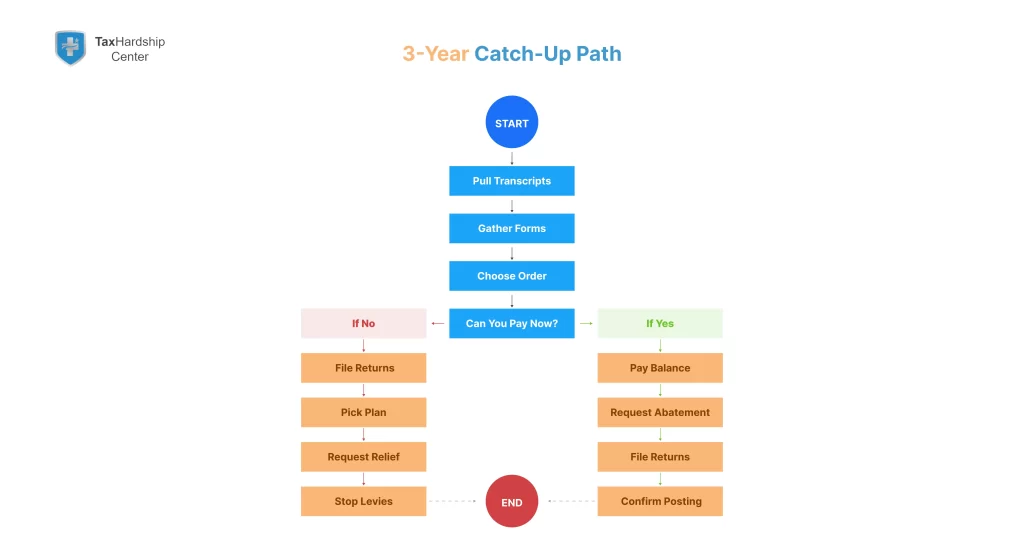
You can fix three years of unfiled taxes with a simple plan. File accurate returns, request relief where you qualify, and pick a payment path that fits your budget. Use the steps below to move today.
- File first to stop penalties: Replace any SFR, protect refunds within the statute, and record earnings for Social Security.
- Gather transcripts and missing tax forms by year.
- Use correct-year schedules and keep proof of mailing or e-file acceptance.
- Gather transcripts and missing tax forms by year.
- Choose the right payment path: Installments, CNC, or an offer each serve specific criteria and cash flows.
- Pay something now if you can to reduce interest.
- Stay current on this year’s estimated taxes and withholding.
- Pay something now if you can to reduce interest.
- Request relief where eligible: First-time abatement and reasonable cause can cut costs.
- COVID pandemic disruptions and documented illness may support relief.
- Track deadlines and use penalty appeal eligibility rules.
- COVID pandemic disruptions and documented illness may support relief.
- Respond to every notice: CP letters and levy warnings carry deadlines that protect rights.
- Use appeal rights when you receive a final levy notice.
- Keep a call log, copies, and receipts for every disclosure.
- Use appeal rights when you receive a final levy notice.
Take the next step. Start your year folders, file the oldest return this week, and line up a plan. If you want help, Tax Hardship Center can review your Tax Compliance History and build a clean, defensible package from start to finish.
FAQs
What happens if I haven’t filed taxes in three years?
You can face an SFR, penalties, interest, liens, and levies. File now, request relief when eligible, and pick a payment option. Acting fast lowers costs and risk.
How many years back can I file and still claim a refund?
You generally have three years from the original due date. Track extension dates and file before the refund statute expires so the law still entitles you to a check.
Can the IRS put me in jail for not filing taxes?
Criminal cases target willful evasion, not honest mistakes fixed with prompt filing. File, disclose, and pay what you can to keep the case civil.
How long does the IRS have to collect unpaid taxes?
About ten years from assessment, with pauses for appeals, offers, bankruptcy, or pending plans. Don’t wait it out. Use the time to set a plan that protects income and assets.
What if I can’t pay the full amount when I file?
File anyway and request an installment agreement, CNC, or an offer if criteria fit. If inability persists, ask for a hold while you submit documents.
Will filing back taxes trigger an IRS audit?
Clean, documented filings reduce audit risk. If you receive an audit letter, respond on time with proof. Many cases end with simple corrections.
How do I know if the IRS filed a substitute return for me?
Pull your account transcript. It will show an SFR code if the IRS posted one. Replace it by filing your own accurate return with full disclosure.
Can I file old returns myself, or should I use a tax professional?
You can file on your own, but a tax return preparer with expertise helps when you face multiple years, business income, or penalty relief requests.
Do unfiled taxes affect my Social Security benefits?
Yes. Missing returns can leave gaps in your earnings record. File to record wages and self-employment tax so your future benefits stay accurate.
What IRS notices should I expect when I don’t file?
Expect CP59 or CP515 for missing returns, CP14 for balances, CP2000 for mismatches, and a final levy notice if you ignore balances. Open and respond to each on time.
