


IRS code 807 means the IRS reduced or removed the federal income tax withholding it had credited to your account. In plain terms, it is a reversed withholding credit, and it can turn an expected refund into a balance due.
You opened your transcript hoping for good news. Instead, IRS code 807 was sitting there like an uninvited guest at your own party.
Honestly, that line looks scarier than it is. It is a signal, not a verdict. Here is what IRS code 807 means, how code 806 vs 807 works, and what to do before a notice lands in your mailbox.
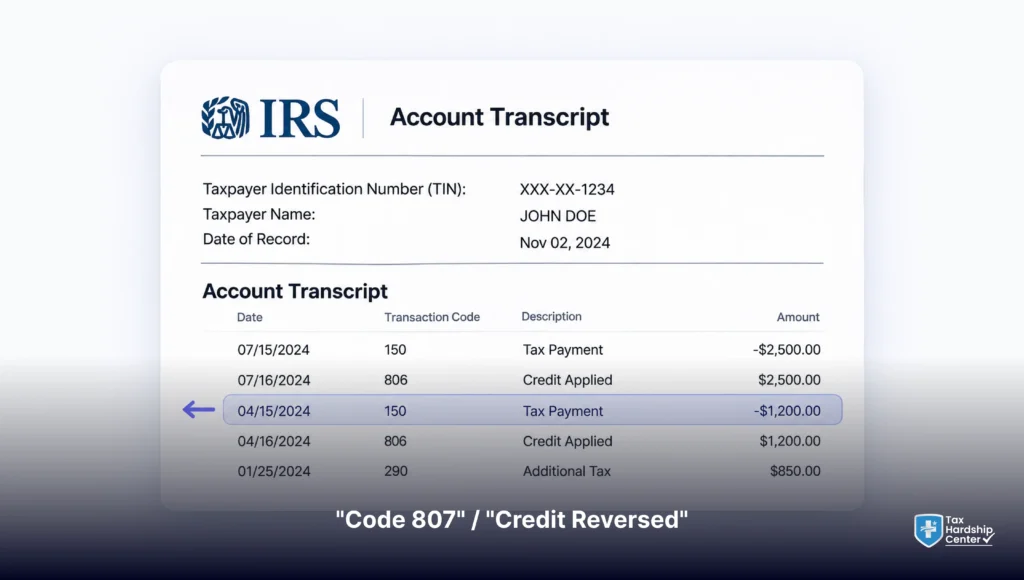
What Does IRS Code 807 Mean on a Tax Transcript?
Your account transcript lists transaction codes, which the Taxpayer Advocate Service describes as processing instructions for IRS systems. Each code gets a plain label for the public.
IRS code 807 carries the label “Reduced or removed W-2 or 1099 withholding.” Think of withholding as money you prepaid all year. When the IRS posts it, you get credit. When IRS code 807 posts, some or all of that credit walks back out the door.
A reversed withholding credit usually appears with the same date and amount as the original credit, just with the opposite sign. Same number, opposite direction. That pattern is your first clue.
Code 806 vs 807: What Is the Difference?
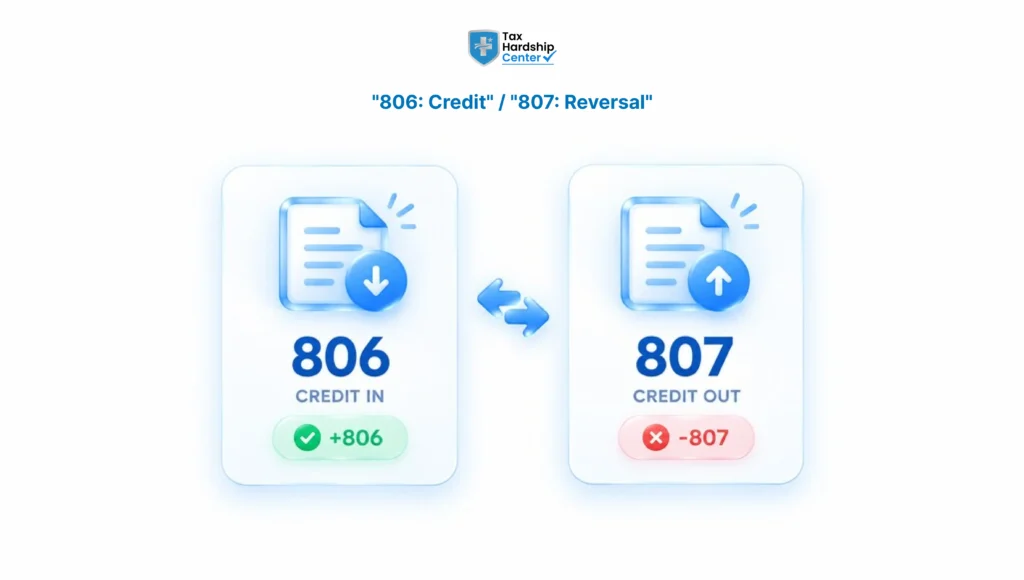
The simplest way to read code 806 vs 807 is as a pair.
| Code | Transcript Label | What It Does | Effect on You |
| 806 | W-2 or 1099 withholding | Credits tax withheld from your pay | Lowers your balance or raises your refund |
| 807 | Reduced or removed W-2 or 1099 withholding | Reverses all or part of that credit | Raises your balance or shrinks your refund |
Think of it as a two-scene story. In scene one, the IRS credits your withholding. In scene two, it takes some or all of it back.
Here is the plot twist. Code 807 does not prove the IRS is right. It only shows the IRS could not match your claimed withholding to what it has on file. Sometimes a fresh 806 posts soon after with a corrected amount, which means the IRS simply fixed the number.
Why Did the IRS Reverse My Withholding Credit?
A reversal like this usually traces back to one of four causes.
Your W-2 or 1099 Does Not Match IRS Records
Employers report withholding to the IRS separately from your return. If the employer reported less than the Box 2 figure you claimed, filed late, or made a typo, the IRS may refuse the full credit. This mismatch is a common reason the entry appears.
Duplicate Claims, Math Errors, or Amended Returns
Withholding claimed twice, a keying error, or a corrected return can all lead the IRS to adjust the credit.
Identity or Income Verification Reviews
Returns held for review may have credits pulled while the IRS verifies the numbers.
Notice or Exam Adjustments
A CP2000 notice or an IRS audit, which follows a predictable audit timeline, can change what the IRS accepts.
How Does a Reversed Withholding Credit Change What You Owe?
Try an illustrative example. Your transcript shows an 806 credit of $4,200. Then code 807 posts for $1,800. Your credit drops to $2,400, so your balance rises by $1,800, plus interest and any penalties. Interest can run from the original filing deadline, so the reversal gets expensive fast.
Never read this code alone. Check its neighbors. Codes like 290 or 300 often point to additional tax assessed, while code 570 means an account action is pending.
When a new balance is billed, it often arrives as a CP501 notice, so open that envelope. Then use the tax relief calculator to estimate where you stand.
What Should You Do First When You See IRS Code 807?
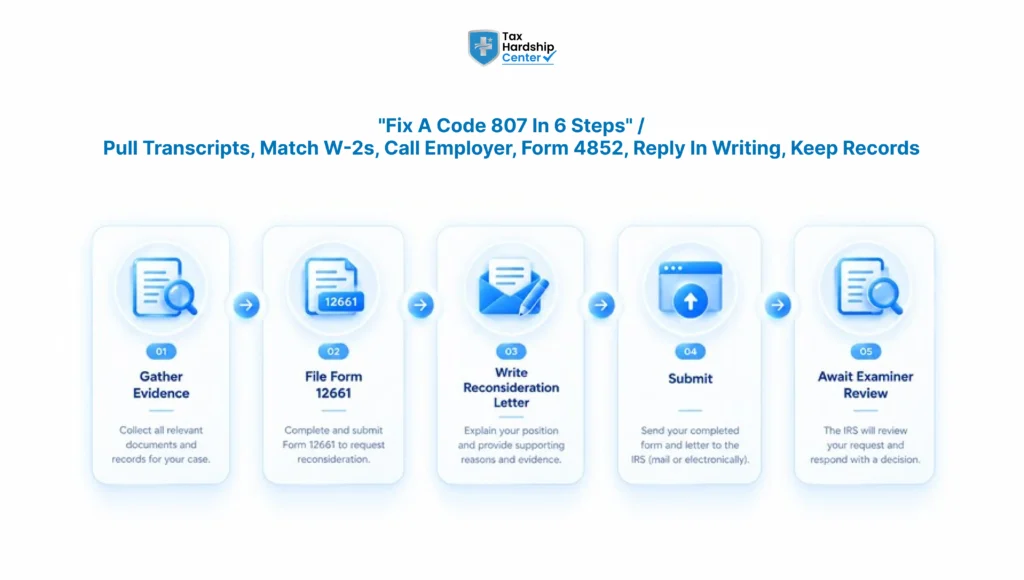
Follow this order:
- Pull both transcripts. Download your account transcript and your wage and income transcript through IRS Get Transcript.
- Match the numbers. Compare Box 2 on each W-2 with the 806 and 807 amounts.
- Call your employer. Ask for a corrected W-2 if the reported withholding is wrong.
- Use Form 4852 if needed. If the employer will not help, the IRS accepts Form 4852 as a substitute W-2, supported by pay stubs.
- Answer in writing. Reply to any notice by the date printed on it.
- Keep records. Save pay stubs, W-2s, and bank statements.
The entry can post weeks before a notice arrives, so waiting for the mail can burn time you may need.
Which Mistakes Make a Withholding Reversal Worse?
- Ignoring the notice. Silence is how a fixable mismatch becomes an enforced balance.
- Paying before verifying. Sometimes the IRS is right, but paying a bill built on a bad reversal means funding a mismatch.
- Guessing at the cause. The amounts on the 806 and 807 lines tell the story, so check them first.
- Filing a second original return. An amended return or a written response is usually the better route.
How Tax Hardship Center Resolves a Balance Created by IRS Code 807
When IRS code 807 leaves a balance you did not plan for, Tax Hardship Center works the problem in order: transcript review, mismatch correction, then payment strategy. We read your account and wage and income transcripts side by side, flag where the reversed withholding credit does not match your W-2s, and handle the written IRS response so you are not decoding notice language at 11 pm.
If the reversal stands, we match you to the right fix. A moderate balance may fit an IRS installment agreement. A larger one may need an Offer in Compromise review. If collection has already started, our IRS tax relief services cover notice response and enforcement.
Picture a warehouse employee whose employer reported less withholding than his W-2 shows. We request his transcripts, push for a corrected W-2, and document the gap, or we set up a payment plan he can actually afford. We never promise outcomes, because the IRS decides, but we tell you what is realistic before you pay anything.
Conclusion
IRS code 807 is a reversed withholding credit, not a final bill. Compare the numbers, gather your documents, and answer the IRS in writing. Do that, and many mismatches get fixed. And if it still feels like too much, that is exactly what specialists are for.
P.S. Which code is sitting on your transcript right now?
FAQs
Is code 807 good or bad?
It is usually bad news for your refund, but it is not a final judgment. Code 807 means withholding credit was reduced or removed, so check the amounts against your W-2s first.
What is the difference between code 806 vs 807?
Code 806 credits your withholding. Code 807 reverses some or all of it. Code 806 vs 807 is simply credit versus reversal.
Can code 807 make me owe money?
Yes. Less credit means a higher balance due or a smaller refund, plus possible interest and penalties.
How long does it take to fix a code 807 entry?
Timelines vary. Corrected W-2s can take weeks, and IRS processing can take longer, so respond by the date on your notice.
Does code 807 mean I am being audited?
Not by itself. It can follow an exam or notice adjustment, but many reversals trace back to a simple reporting mismatch.
Can I dispute a reversed withholding credit?
Yes. Send a written response with W-2s, pay stubs, and any corrected forms before the notice deadline.
Key Takeaways
- Code 807 means the IRS reduced or removed a withholding credit it posted earlier.
- Code 806 credits your withholding and code 807 reverses it, so the two usually appear as a pair.
- A common trigger is a mismatch between your W-2 and what your employer reported.
- A reversal can turn a refund into a balance due.
- Never read code 807 alone, because nearby codes like 570 and 290 add context.
- Pull your account and wage and income transcripts before doing anything else.
- Form 4852 is the backup when an employer will not issue a corrected W-2.
- Always respond to IRS notices in writing and before the printed deadline.
- Verify before you pay, because the reversal may be fixable with documents.
- Payment plans and relief options exist if the new balance is real.
Ready to untangle your transcript? Click here to get a free case review or call us at 844-427-5100.