
You checked your IRS transcript, hoping to see progress, and instead you found code 971 with the words “Notice Issued.”
That single line can trigger a lot of stress, especially if your refund is already delayed. The good news is that 971 is not the problem on its own. It is the IRS telling you a letter or notice was generated, and the next step depends on what that notice says.
What Does 971 Mean On Tax Transcript
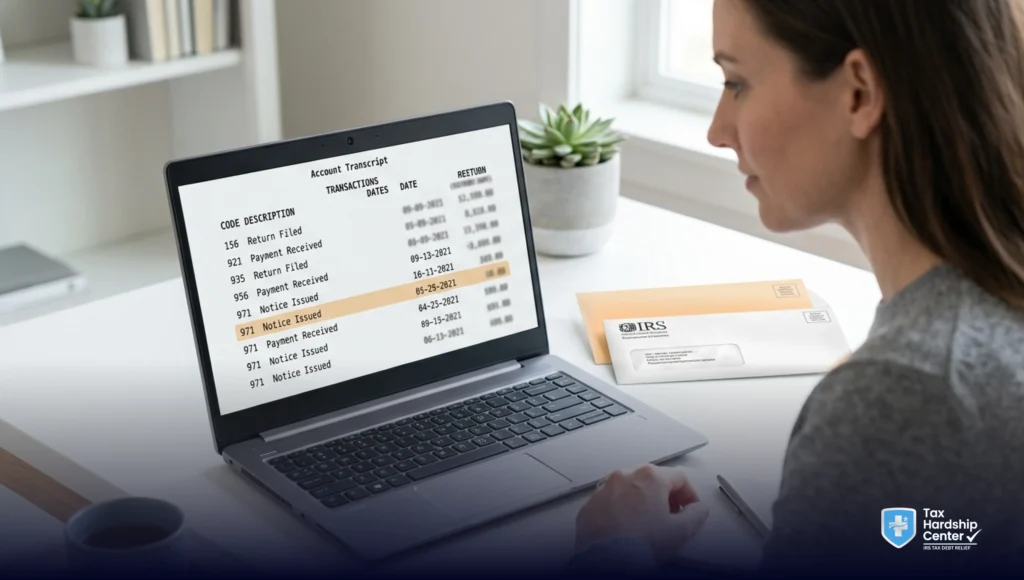
IRS transcript code 971 is officially labeled as a “Miscellaneous Transaction.” That matters because it can represent different actions depending on the Action Code used behind the scenes.
On most taxpayer-facing account transcripts, 971 commonly displays as “Notice Issued.” In plain English, it usually means the IRS generated a notice or letter connected to your return, refund, or tax account, and that notice explains what happens next.
One important clarification: IRS transcript code 971 is not the same thing as IRS Publication 971. Publication 971 is about innocent spouse relief, which is unrelated to the transcript transaction code.
Why Notice Issued 971 Appears
A 971 entry can be triggered by many different situations, because the IRS uses it to log certain notices and internal actions.
Here are the most common real-world causes taxpayers see.
The IRS Needs More Time To Verify Income, Withholding, Or Credits
If the IRS sends a CP05 notice, it means the IRS needs more time to verify items like income, withholding, or credits. CP05 specifically says you usually do not need to take action, and to allow up to 60 days before reaching out.
In other cases, the IRS may send CP05A, which is a request for supporting documentation. The IRS says to allow 60 days from the date you provided the supporting documentation to complete the review.
Identity Verification
If the IRS needs you to verify your identity and the return, you might receive notices like CP5071 series or letters like 4883C.
After identity verification, the IRS says processing may take up to 9 weeks, and you should wait 2 to 3 weeks before even checking your refund status again.
Return Adjustments Or Missing Information
Some 971 notices are tied to corrections, missing forms, or requests for clarification. The IRS notice page explains that letters can be sent when your refund changes, the IRS corrected your return, the IRS has a question, or the IRS is delayed in processing.
Exam “Soft Notices” And Other IRS Pipelines
In IRS procedures, TC 971 can also log certain “soft notices” issued by Examination, depending on the action code.
For most taxpayers, you do not need to decode the action code. You need to locate the notice number and follow that notice.
Transcript 971 After 570: What The Combination Usually Means
If you are seeing transcript 971 after 570, that pattern is common.
Here is the typical meaning of each code:
- Code 570 indicates an additional liability pending and/or a credit hold, and it freezes the module from refunding or offsetting credit out.
- Code 971 indicates a miscellaneous transaction that, on many transcripts, corresponds to the generation of a notice.
In simple terms, 570 is the pause, and 971 is the IRS telling you a letter was generated to explain the pause, request information, or notify you of a change.
What You Might See Next
Many taxpayers will later see:
- Code 571 or 572 when the 570 freeze is released or corrected.
- Code 846 when the refund is issued.
If you do not see 571/572 and 846, it usually means the hold is still active, or the IRS is waiting on a response or verification.
Code 971 Timeline: When To Expect Movement
There is no single “how long after 971 will I get my refund” answer, because 971 is only a marker. The timeline is determined by the notice type.
Use this as a practical timeline guide.
Typical Timeline Guide By Notice Type
| Notice Type Example | What It Usually Means | What You Should Do | Typical Time Frame |
| CP05 | IRS needs more time to verify return items | Follow the instructions to verify | Up to 60 days per notice guidance |
| CP05A | IRS requests supporting documents | Send the requested docs, then wait | 60 days after you provide documents |
| CP5071 Series / Identity Verification | IRS must verify identity and return | Follow notice instructions to verify | Up to 9 weeks after verification |
| Letter 4883C | IRS needs identity verification by phone or in person | Verify identity as instructed | Processing can take time after verification |
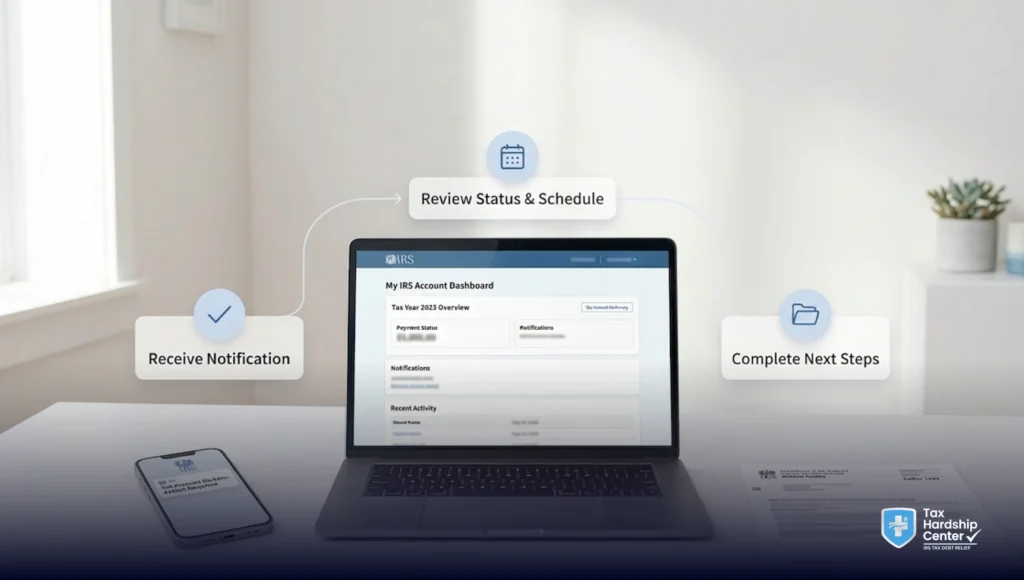
If your transcript shows 971 but you have no notice yet, remember the IRS may post the transcript update before the letter reaches you, and many notices are also available digitally in your IRS online account.
How To Resolve 971 Step By Step
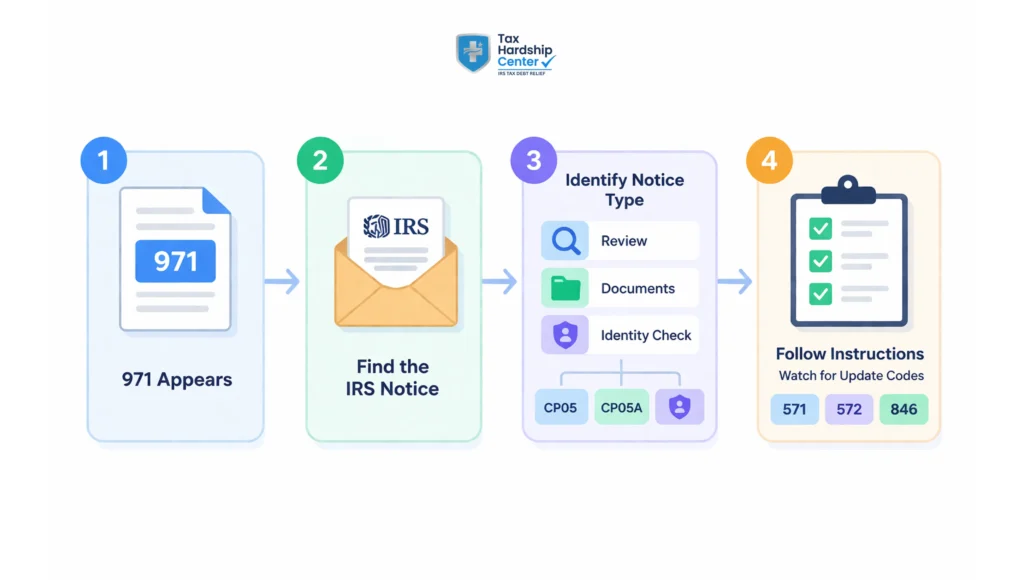
Step 1: Pull The Right Transcript And Note The 971 Date
Get your tax records through the IRS “Get Transcript” tool or your IRS online account.
Write down:
- The date shown on the 971 line
- Any related codes near it, especially 570, 571/572, or 846
Step 2: Find The Notice Number And Read What It Actually Says
The IRS says you can find the CP or LTR number on the notice itself, usually in the corner. Then you can search for that notice number to understand what it means and what to do.
If you have an IRS online account, you can often view digital notices under the “Notices and Letters” section.
Step 3: Follow The Notice Instructions Exactly
The IRS guidance is consistent:
- Review the notice and keep it for your records
- If the IRS asks you to respond, respond by the due date
- If you agree, you often do not need to reply unless asked
- If you disagree, follow the dispute instructions and include copies of documents
Step 4: If It Is Identity Verification, Use The IRS Verification Path
If your notice tells you to verify your identity, use the IRS verification service and follow the steps listed on your letter or notice.
After you verify, the IRS says it may take up to 9 weeks to process the return, and you should wait 2 to 3 weeks before checking refund status again.
For identity verification letters, you may also find Tax Hardship Center’s guides helpful, especially if you received Letter 4883C:
Step 5: If The Notice Is A Review Notice Like CP05, Do Not Overreact
A CP05 notice specifically says you usually do not need to take action, and to wait up to 60 days before contacting the IRS.
A common mistake is sending random documents that were never requested. If the IRS needs documentation, it will say so, as CP05A does.
Step 6: Watch For The “Release” Codes
If your 971 is on a refund hold, your transcript usually advances only when the hold is released.
Watch for:
- 571 or 572, which releases or corrects the 570 freeze
- 846, which indicates the refund of an overpayment
What If You Never Got The IRS Notice
If your transcript shows notice issued 971 and you still cannot find the notice, do this in order.
Check Your IRS Online Account First
The IRS online account can provide digital copies of select notices, and the FAQ explains that you can find notice details under “Notices and Letters.”
Confirm Your Address Is Correct
If you moved, you can update your address with the IRS using Form 8822 or other approved methods listed by the IRS.
Use The IRS Notice Search Page
The IRS maintains a “Understanding Your IRS Notice Or Letter” page where you can search by notice number or topic and follow the official guidance for next steps.
Also, if something feels suspicious, the IRS says to call using official numbers, because scam letters do happen.
When Code 971 Signals A Bigger Problem
Most 971 entries are routine notice logging. Sometimes, it points to something that can escalate if ignored, such as:
- Identity verification must be completed to continue processing
- Audit-related correspondence or review pipelines that have deadlines
- Balance due or collections notices, where missing a deadline can limit options
If you are receiving multiple notices, dealing with multiple tax years, or facing enforcement letters, it can help to review the full transcript history and build a response plan instead of guessing.
How the Tax Hardship Center Can Help
When 971 becomes more than a simple refund delay, the biggest advantage is clarity. The fastest path forward usually comes from transcript analysis plus the right response strategy.
Tax Hardship Center’s process emphasizes transcript analysis and program matching, which is useful when IRS activity is confusing or layered across multiple notices.
If your notice involves audits, documentation disputes, or deadlines, you may also want:
If the notice connects to a balance due problem and you need a structured plan:
Frequently Asked Questions
What Does 971 Mean On Tax Transcript With $0.00
A $0.00 next to 971 typically means the IRS issued a notice that does not directly change the dollar balance on that line item. The notice can still require action, so the notice content matters more than the amount shown.
Does Code 971 Mean I Am Being Audited
Not automatically. Code 971 is a miscellaneous transaction code that can reflect different actions depending on the action code, and many notices are routine processing notices.
Transcript 971 After 570: Is My Refund Frozen
Often, yes. Code 570 is a credit hold that can freeze refunding or offsetting credits, and 971 commonly means the IRS has generated a notice related to that hold.
How Long After Code 971 Will I Get My Refund
There is no universal timeline because 971 only tells you a notice was generated. The notice type controls the timeline. For example, CP05 allows up to 60 days, and identity verification can take up to 9 weeks after you verify.
Where Do I Find The Notice If I Never Got It In The Mail
Start with your IRS online account, which can show digital copies of select notices under “Notices and Letters.” Then confirm with the IRS that your address is updated if you have moved.
Is IRS Publication 971 Related To Transcript Code 971
No. Publication 971 covers innocent spouse relief. Transcript code 971 is a transaction code that often reflects a notice being generated.
Conclusion
IRS transcript code 971 is best read as a signal, not a diagnosis. It usually means the IRS generated a notice, and that notice explains whether you need to verify identity, provide documents, wait through a review window, or respond to a change.
The fastest way to “fix” a 971 situation is to locate the notice, follow it exactly, and then watch your transcript for the codes that show the hold is released and the refund is issued.
Key Takeaways:
- Code 971 is a miscellaneous transaction code that often appears as “Notice Issued,” and the real details are in the notice number and instructions.
- If 971 appears after 570, the IRS is commonly holding the refund and sending a notice explaining why.
- The timeline depends on the notice type; CP05 can mean waiting up to 60 days, and identity verification can take up to 9 weeks.
- If you did not receive the notice, check your IRS online account for digital notices and update your address with the IRS if needed.