
You do not decide what counts as a necessary expense when you owe the IRS. The IRS does. It decides using a rulebook called the IRS Collection Financial Standards.
If you are applying for a payment plan, an Offer in Compromise, or Currently Not Collectible status, this rulebook sits between “the IRS agrees you cannot pay” and “the IRS thinks you owe more.” Know it, and you walk into your case prepared. Ignore it, and the IRS fills in the blanks. Rarely in your favor.
Here is the short version first.
Quick answer:
- IRS allowable living expenses 2026 figures are fixed monthly expense caps used to test whether you can afford to pay tax debt.
- They cover four categories: food and personal care, housing and utilities, transportation, and out of pocket health care.
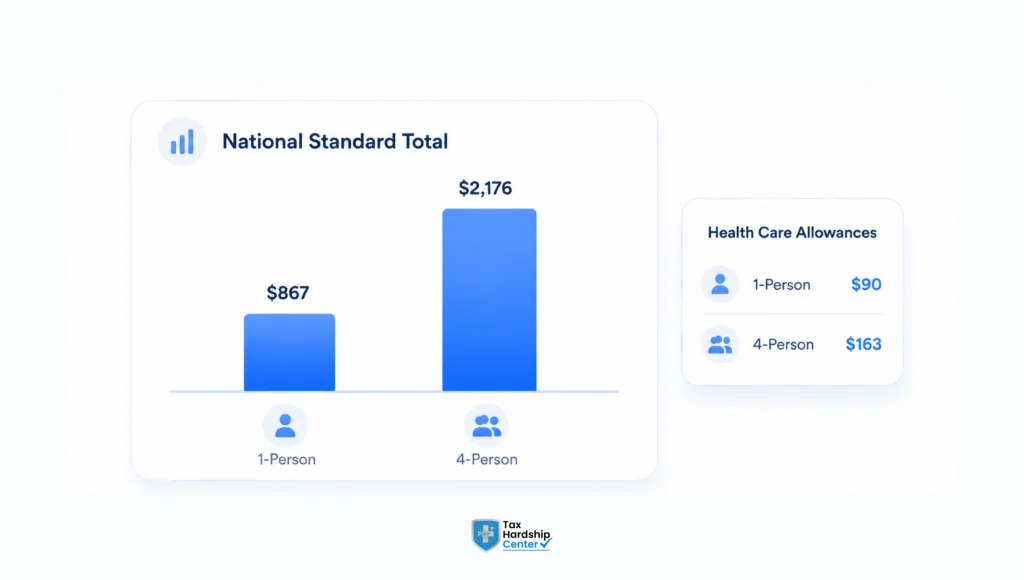
- For 2026, the national food, clothing, personal care and miscellaneous allowance is $867 a month for one person, rising to $2,176 for four.
- The 2026 health care allowance is $90 a month per person under 65, and $163 for anyone 65 or older.
- Housing and transportation are local, not national. They shift by county and region.
What Are IRS Collection Financial Standards?

The IRS Collection Financial Standards are the government’s version of your household budget. Not the one you actually run. The one it decides is reasonable.
When you file Form 433-A or 433-F for an installment agreement, Offer in Compromise, or CNC status, the IRS does not just ask what you spend. It compares that number against the collection standards for your household size and county, using its own published collection financial standards as the reference point.
That rule decides a lot. Rent at $2,600 against a county housing standard of $1,900 means the IRS works with $1,900, unless you can prove the higher figure is necessary. The gap becomes money the IRS believes should go toward your balance. This is why understanding IRS collection financial standards before you file anything matters more than most taxpayers realize.
The Four Categories the IRS Measures
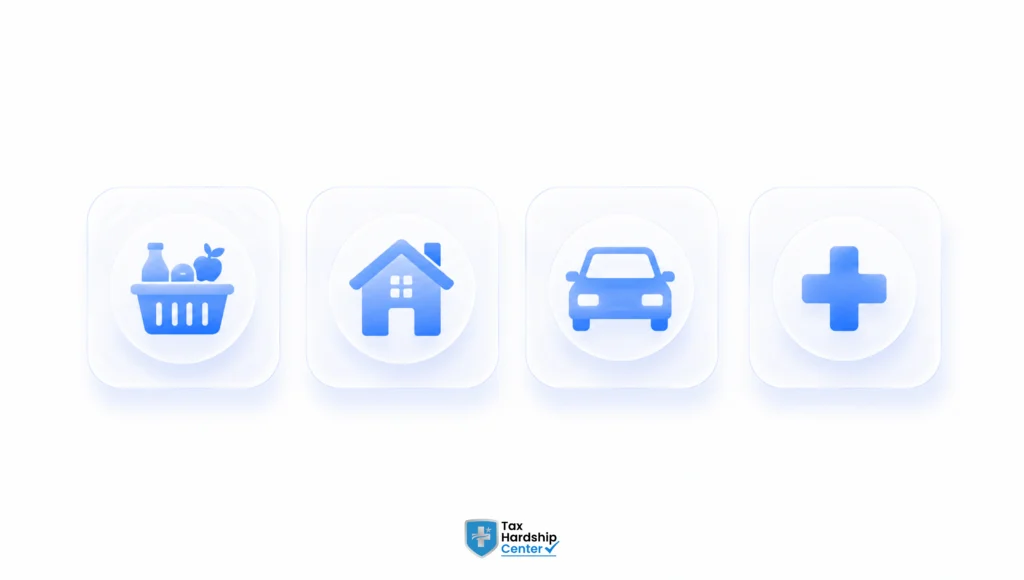
Every dollar you spend falls into one of four buckets under the IRS Collection Financial Standards. Miss one, and you leave money on the table. Overstate one, and you invite scrutiny.
National Standards: Food, Clothing, Personal Care
Flat amounts based on household size alone. They do not change between rural Ohio and downtown San Francisco. For 2026, a single filer’s national allowance breaks down to $496 food, $44 housekeeping, $98 apparel, $54 personal care, and $175 miscellaneous. Total: $867 a month.
Local Standards: Housing and Utilities
Housing is regional. A one person household in Los Angeles County gets over $3,100 a month. The same household in Wayne County, Michigan sits closer to $1,500. The IRS collection financial standards for housing pull straight from your county, so identical incomes can produce very different results depending on zip code.
Local Standards: Transportation
Transportation splits into ownership and operating costs. Nationally, owning one vehicle allows $617 a month, a second vehicle adds the same. Operating costs, covering gas, insurance, and repairs, run roughly $290 to $345 depending on region. No car means a flat $244 public transportation allowance instead.
Out of Pocket Health Care
Copays, prescriptions, uninsured medical costs. Insurance premiums are separate and allowed at actual cost. The IRS allowable living expenses for health care sit at $90 a month per person under 65, and $163 for 65 and older, per the IRS out of pocket health care standards for 2026.
Where the IRS Allowable Living Expenses 2026 Numbers Landed
| Category | 2026 Standard (1 person) | Notes |
| Food, clothing, personal care | $867/month | National, fixed by household size |
| Housing and utilities | $1,500 to $3,400+/month | Local, varies by county |
| Vehicle ownership | $617/month per vehicle | National flat rate |
| Vehicle operating costs | $290 to $345/month | Regional |
| Out of pocket health care | $90/month (under 65) | National, per person |
Every household size has its own version of this table. The four person national standard climbs to $2,176 a month, with $397 added per additional person.
When Your Real Expenses Are Higher Than the Standard
This is where people get caught off guard. IRS collection financial standards are caps, not guarantees. Spend less than the standard, and the IRS typically still lets you claim the full standard amount.
Spend more, and you are capped unless you document a necessary expense exception. A documented medical condition. A court-ordered support payment. A commute that genuinely requires a second vehicle for work. These move the needle, but only with paperwork behind them, not an explanation on a phone call.
This is exactly where taxpayers lose ground on their own. They assume the IRS will simply believe what they write on Form 433. It checks every figure against the collection standards for your county and household size first, and unsupported claims above those numbers usually get stripped before your case is even reviewed.
How These Standards Decide Your Case
Collection financial standards are not a side detail. They are the math behind three common IRS resolutions.
For an installment agreement, allowable expenses under the IRS collection financial standards get subtracted from net income. What is left becomes your proposed payment.
For an Offer in Compromise, the same allowable expenses feed the Reasonable Collection Potential formula, which decides how low an offer the IRS will accept.
For Currently Not Collectible status, the IRS checks whether income minus allowable expenses leaves anything at all. If not, collection activity pauses.
In every path, the IRS allowable living expenses 2026 figures do the heavy lifting behind the scenes. Get the categories right, document what runs above standard, and your case is built on facts instead of guesswork.
How Tax Hardship Center Applies These Standards to Real Cases
Tax Hardship Center pulls the exact IRS collection financial standards for your county and household size before your Form 433 is drafted, so nothing gets stripped out for missing documentation. That means verifying current local housing and transportation figures, not last year’s numbers, and separating what counts as a national allowance from what needs county-specific proof.
For cases running above standard, THC builds the necessary expense file directly into the installment agreement or Offer in Compromise submission, gathering medical records, court orders, or employment-related transportation documentation before the IRS asks twice. For households evaluating Currently Not Collectible status, THC runs the same allowable living expenses calculation IRS Collection uses, so a case gets built on numbers instead of narrative.
That groundwork is what separates a case accepted on the first pass from one that bounces back months later for missing paperwork.
FAQs
What are IRS Collection Financial Standards used for?
The IRS uses collection financial standards to decide how much income is available to pay tax debt. They apply to installment agreements, Offers in Compromise, and Currently Not Collectible determinations.
Are IRS allowable living expenses the same nationwide?
Only partly. Food, clothing, and personal care follow national standards. Housing and transportation are set locally, by county and census region, so allowances shift by where you live.
Can I claim more than the IRS collection standards allow?
Sometimes, with documentation proving the higher amount is a necessary expense, such as a medical condition, a court order, or a work-related transportation need.
What is the health care allowance under IRS allowable living expenses 2026?
For 2026, it is $90 a month per person under 65 and $163 a month per person 65 and older, separate from insurance premiums.
Does the IRS check my actual bills against the standards?
Yes. It compares reported expenses against the IRS collection financial standards for your household size and county, using whichever figure is lower.
Do collection standards apply to Currently Not Collectible status too?
Yes. CNC eligibility depends on whether income minus allowable expenses under the collection standards leaves anything available to collect.
Conclusion
IRS allowable living expenses 2026 figures decide more of your case than your income does. They set the ceiling on what counts as a reasonable monthly expense, and every resolution path runs through this same math. Know your category numbers, document anything above standard, and you walk into your case with facts the IRS cannot easily dismiss.
Key Takeaways
- IRS Collection Financial Standards set fixed expense caps used across installment agreements, OIC, and CNC cases.
- Four categories apply: food and personal care, housing and utilities, transportation, and out of pocket health care.
- The 2026 national standard for one person covering food, clothing, and personal care totals $867 a month.
- Housing and transportation allowances are set locally, not nationally, and vary by county and region.
- IRS allowable living expenses 2026 health care allowances sit at $90 monthly under 65 and $163 monthly for 65 and older.
- The IRS generally uses whichever is lower, your actual expense or the standard amount.
- Expenses above standard need documentation to count as a necessary expense exception.
- IRS allowable living expenses directly calculate your proposed payment or offer amount.
- Getting these numbers wrong on Form 433 can delay or derail an otherwise qualifying case.
- Reviewing current-year collection standards before filing prevents avoidable rejections.
Ready to see what the IRS collection financial standards mean for your case? Get a free case review from Tax Hardship Center today.