

Your bank just said your money is frozen. Cue the cold sweat.
IRS Form 668-A is the Notice of Levy the IRS sends to your bank to seize money from your account for unpaid taxes. The bank holds your funds for 21 days before sending them over. That window is your shot at fixing this, so let’s use it.
TL;DR: What You Need to Know First
- An IRS Form 668-A notice is a legal order to your bank, not a bill.
- An IRS levy on bank account takes what sits there on the day the bank receives the order.
- Your bank holds the money for 21 days before it reaches the IRS.
- Your IRS bank levy response should start within days, not weeks.
- Release is possible through payment, a plan, hardship proof, or proof the levy was a mistake.
What Is IRS Form 668-A and Why Did My Bank Get It?
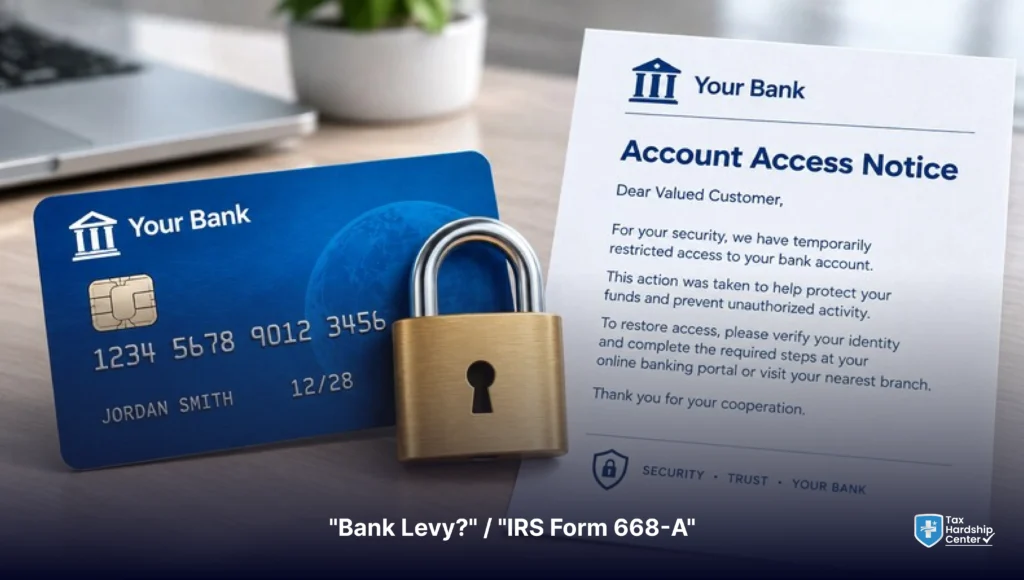
Think of IRS Form 668-A as an order with zero room for negotiation at the bank counter. The IRS sends it to your bank, and the bank has to comply. A few versions exist, but they all work the same way.
An IRS levy on bank account is not a lien. A lien is a claim on your property. A levy is the IRS actually taking money. The IRS explains the basics on its levy overview page.
Your bank usually can’t help you fight it. It is the messenger. The IRS agent named on the notice is the person who can release it.
How Does an IRS Levy on Bank Account Work Step by Step?
Here is the usual road:
- Balance notices arrive. Many get ignored. A CP504 notice is one of the last warnings.
- A final notice of intent to levy follows, like IRS Letter 1058. It gives you 30 days to request a hearing.
- The deadline passes. Now the IRS can send IRS Form 668-A to your bank.
- The bank freezes the balance as of the day it receives the order.
- After 21 days, the bank sends the money to the IRS.
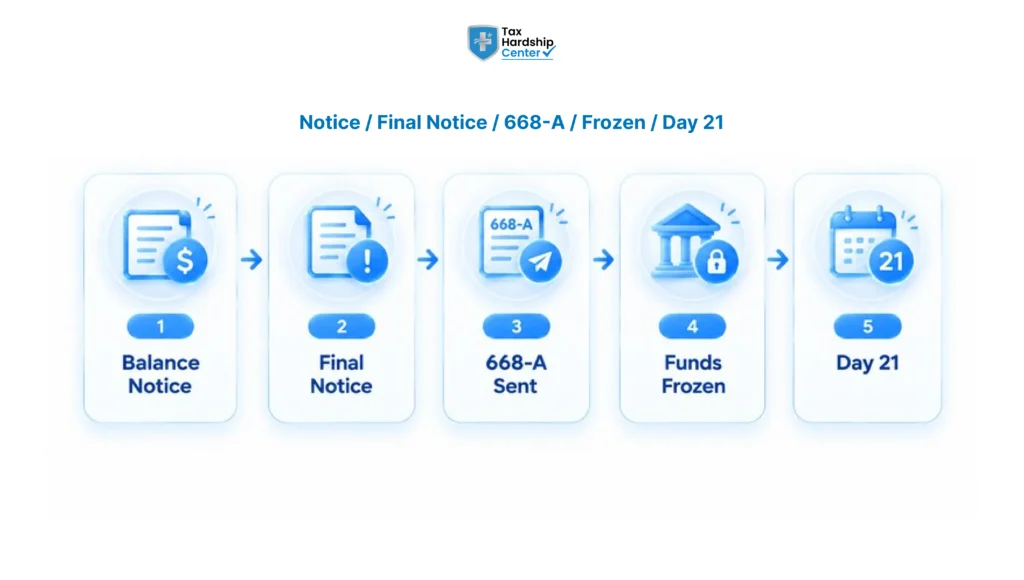
Here is the twist. The levy catches what is in the account on that day. Money deposited later is not taken by that levy. But the IRS can send another one, so don’t relax.
What Does an IRS Form 668-A Notice Look Like When It Hits?
It usually starts with your bank, not the IRS. Watch for:
- A frozen or reduced balance
- Bounced payments
- A bank letter mentioning a levy
- A copy of the notice in your mailbox
The IRS Form 668-A notice lists the tax periods, the amount owed, and the IRS contact. Keep that page close. It is your map.
Can I Stop an IRS Levy on Bank Account Within 21 Days?
Often yes, but approval is never guaranteed. A strong IRS bank levy response matches your situation to the right exit.
| Option | Best For | Honest Catch |
| Pay in full | You have the cash | Hurts if rent is due |
| Installment agreement | Steady income | Interest and penalties continue |
| Hardship release | The levy blocks rent, food, utilities | Needs proof of income and bills |
| Currently Not Collectible | You cannot pay anything now | Debt remains and may be revisited |
| Error or already paid | The notice is wrong | Needs documents, fast |
The official release is called Form 668-D, the Release of Levy. Ask for it in writing.
Not sure which path fits? Our guide to payment plans vs OIC vs CNC breaks down the trade-offs.
What Should My IRS Bank Levy Response Look Like in the First 72 Hours?
Fast, documented, and calm. Do this:
- Read the notice. Find the amount owed and the agent’s phone number.
- Call that number, not the general IRS line.
- Gather proof: pay stubs, rent, utilities, medical bills.
- Ask your bank the date it received the levy and how much it is holding.
- Request release in writing and keep a copy.
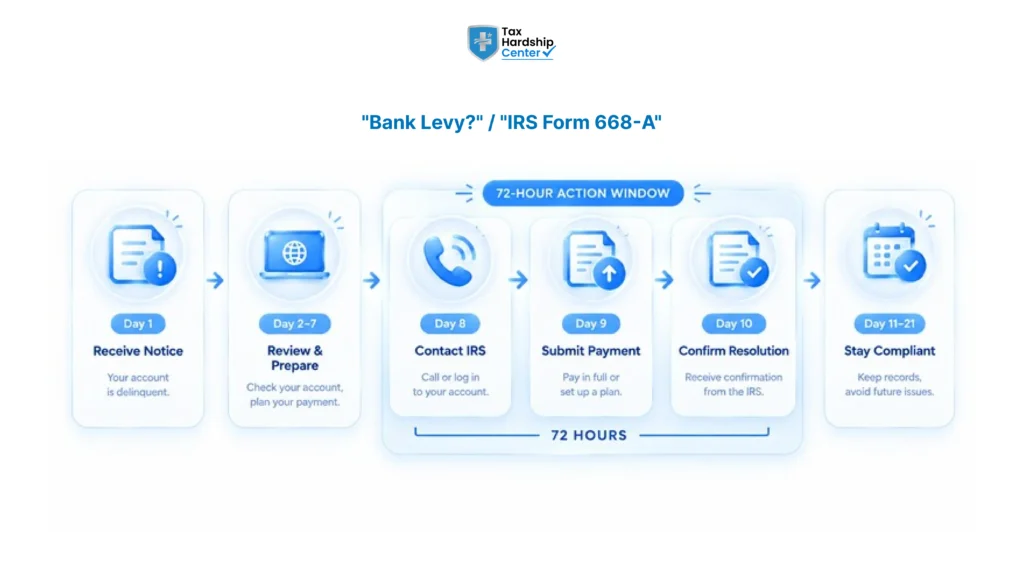
If the levy causes serious hardship, the Taxpayer Advocate Service may be able to help. A good IRS bank levy response is less about arguing and more about showing the IRS paperwork it can act on.
What Mistakes Make an IRS Form 668-A Notice Worse?
Most damage comes from what people do next. Avoid these:

- Ignoring it until day 20
- Moving money around in a panic, which can invite more collection trouble
- Assuming the bank can cancel it
- Paying a firm that promises to wipe out your debt. Nobody controls the IRS outcome
Here is the good news. Even after IRS Form 668-A lands, you can often negotiate before the funds move. Day one beats day twenty, but day twenty beats never.
When Is IRS Form 668-A a Sign of a Bigger Back Tax Problem?
Usually, a levy is the final scene, not the first. Behind it, there are often unfiled returns, years of unopened mail, or a balance that kept growing with penalties.
If the root issue stays unfixed, another IRS levy on bank account can follow. Our guide to help with back taxes shows how to catch up. For a deeper look at your rights during collection, read IRS Publication 594.
How Tax Hardship Center Runs an IRS Bank Levy Response Before the 21 Days End
When IRS Form 668-A shows up, we start by reading your notice and account to see what was assessed and how many days are left. Then we contact the IRS collection agent, request a release, and organise the paperwork the agent needs to say yes.
Depending on your case, our IRS tax relief services can mean negotiating an installment agreement, requesting hardship release, or checking whether you qualify for an offer in compromise. If returns are missing, we file them first so the IRS stops guessing your income. You can see how fees work on our tax relief service costs page before you commit.
Picture a rent payment bouncing on Friday. We want the agent on the phone that same week, with proof in hand. Not every case ends in a release, and we tell you that before you pay anything. Click here to get a quote or Call us at [THC phone number].
Conclusion
A bank levy feels like a punch, but it comes with a countdown, not a verdict. Check the notice, call the agent, and build your IRS bank levy response today. If an IRS levy on bank account is already in motion, 21 days is enough time only if you use it.
FAQs
What does IRS Form 668-A mean?
It is the Notice of Levy the IRS sends to your bank. It orders the bank to freeze and hold funds in your account for unpaid tax.
How long does my bank hold the money?
The bank holds the funds for 21 days before sending them to the IRS. That gap gives you time to request a release or arrange payment.
Can I get my money back after an IRS Form 668-A notice?
If the funds have not been sent, a release can free them. Money already sent is harder to recover, but a wrongful levy can be challenged.
Does an IRS levy on bank account take everything?
No. It takes what is in the account when the bank receives the order, up to the amount owed. Later deposits are not caught by that levy.
What is the best IRS bank levy response if I just got the notice?
Call the agent named on the notice, gather proof of income and bills, and ask for release in writing. Speed matters more than perfection.
Can the IRS levy my account again?
Yes. If the debt is unpaid and no agreement is in place, the IRS can send a new levy. A payment plan or release stops the pattern.
Key Takeaways
- IRS Form 668-A is a Notice of Levy that tells your bank to freeze your funds.
- A levy takes real money, while a lien is only a claim on your property.
- Your bank holds the funds for 21 days before sending them to the IRS.
- The levy catches the balance on the day the bank receives it.
- Bank levies usually follow final notices like CP504 and Letter 1058.
- Release options include payment, installment agreements, hardship, and proof of error.
- Ask for Form 668-D, the Release of Levy, in writing.
- Call the agent on the notice within 72 hours with proof in hand.
- Panic moves and “wipe out your debt” promises usually make things worse.
- Unfiled returns and old balances are often the root cause behind a levy.
Get a free case review or call us at [THC phone number] before your 21 days run out.
P.S. Ever opened your banking app and felt your stomach drop for a good reason? Tell me I’m not alone.