
Your boss pulls you aside. There is a stack of IRS paperwork on the desk. Your name is on it.
Welcome to IRS Form 668 W, the document that turns a tax problem into a payroll problem.
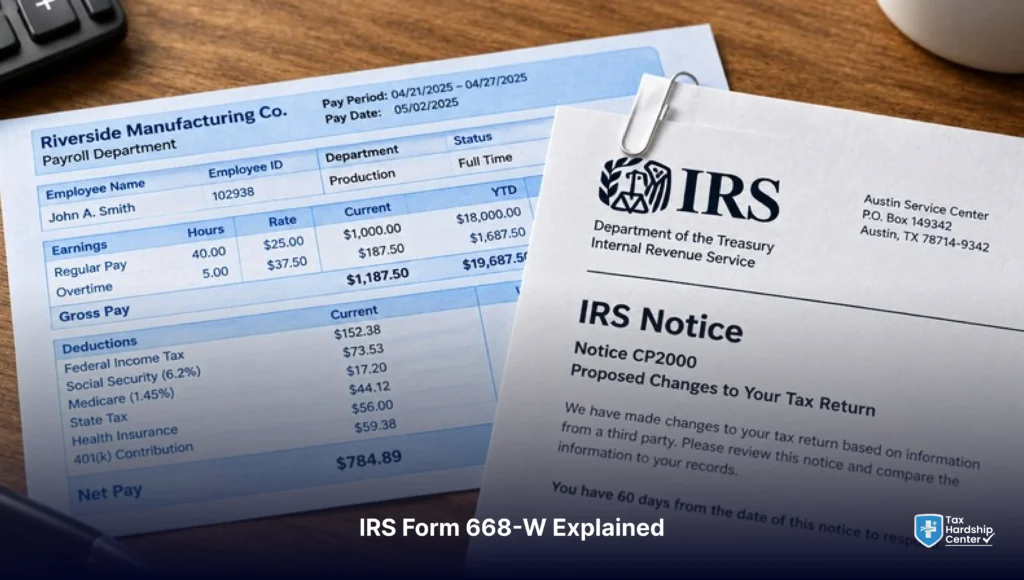
Here is the quick answer. IRS Form 668-W is the notice of levy the IRS sends to your employer to take part of your paycheck for unpaid taxes. It is a legal collection action, but it is not the end of the road. In many cases you can stop it, and getting an IRS wage levy release is possible if you act fast.
Written by Arpita Shekhawat, Tax Hardship Center content team.
Quick Answer: Key Facts at a Glance
- IRS Form 668 W is a levy sent to your employer, not to you.
- It is a levy on wages salary and other income, and it continues until the IRS releases it.
- Your employer must follow it, so ignoring it will not make it disappear.
- IRS Form 668-W instructions require the employer to leave you a set exempt amount each pay period.
- An IRS wage levy release is possible if you set up a payment plan, prove hardship, or resolve the debt.
What Is IRS Form 668 W and Why Did My Employer Get It?
Picture a fire alarm going off at work. Except the fire is your tax balance, and everyone just heard it.
IRS Form 668-W is formally called the Notice of Levy on Wages, Salary, and Other Income. The IRS sends it to your employer after your tax debt goes unpaid and earlier warnings are ignored. It tells the employer to hold back part of your pay and send it to the IRS.
The notice is a levy on wages salary and other income. That means it can also reach commissions, bonuses, and in some cases other payments, depending on what the notice covers.
Here is the part that stings. Your employer does not get a vote. Once they receive IRS Form 668 W, they must comply.
What Do the IRS Form 668-W Instructions Tell Your Employer to Do?
The IRS Form 668-W instructions are written mostly for your employer, but you should know what they say. In plain terms, the employer is told to:
- Start withholding from your pay right away.
- Leave you an exempt amount based on your filing status and dependents.
- Send the withheld money to the IRS on schedule.
- Keep withholding until the IRS releases the levy in writing.
The levy has a section that you complete to claim your exemption, which is why the IRS Form 668-W instructions matter to you too. If your employer never gets that information back, they may use a lower exempt amount, and more of your paycheck gets taken. You can read the IRS overview on levies for the official language.
How Much of Your Paycheck Can the IRS Take?
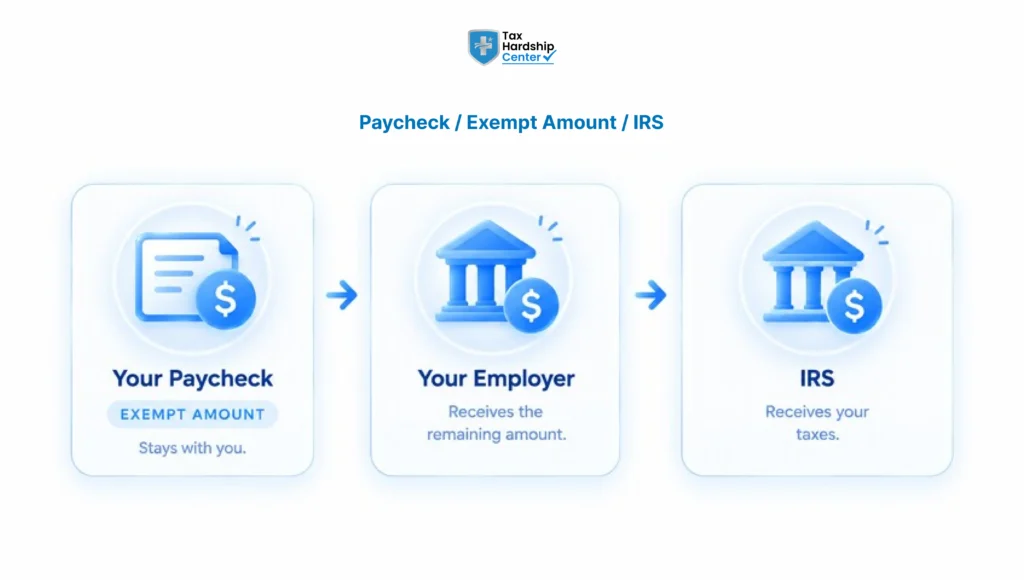
Not all of it. The IRS has to leave an exempt amount, and it changes with your filing status, dependents, and pay period.
Here is how that works in a real week:
| Pay Period | Exempt Amount Depends On | What Happens |
| Weekly | Filing status and dependents | Employer pays you the exempt amount, sends the rest to IRS |
| Biweekly | Filing status and dependents | Same, but scaled to a two-week period |
| Monthly | Filing status and dependents | Same, scaled to a month |
Because the levy on wages salary and other income is continuous, it hits every paycheck until released. One paycheck is not a one-time hit. It keeps going.
Not sure how your own numbers shake out? Our wage garnishment calculator guide walks through the math step by step.
What Happened Before the Levy Landed?
Nobody wakes up to IRS Form 668 W out of the blue. The IRS usually sends a trail of notices first.
You may have seen a CP504 final warning before levy, or a Letter 1058 final notice of intent to levy. Those letters often include your right to a Collection Due Process hearing, which can pause collection if you request it on time. Our guide to the LT11 notice and CDP hearing explains how that window works.
If those letters went unopened, you are not alone. Plenty of people do the same thing. The key is what you do next.
How Do You Get an IRS Wage Levy Release?
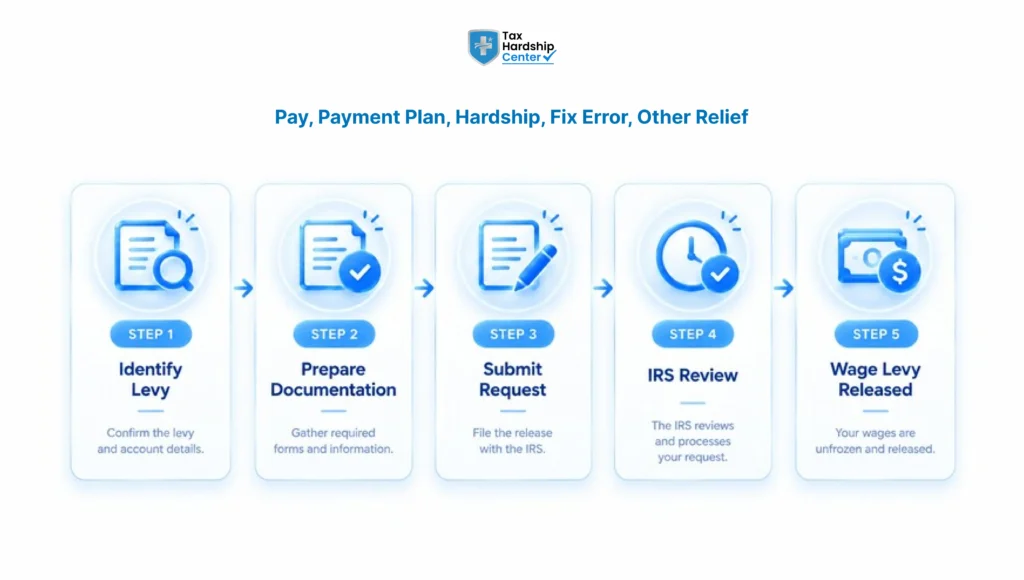
This is the big question. An IRS wage levy release is the IRS officially telling your employer to stop taking money from your pay.

The IRS can release a levy when you:
- Pay the debt in full. Simple, but not always realistic.
- Set up a payment plan. An approved installment agreement can lead to a release. See our guide on IRS payment plan options.
- Show financial hardship. If the levy keeps you from meeting basic living expenses, you can ask for an IRS wage levy release on that basis.
- Fix an IRS error. If the debt is wrong or already paid, the IRS should release it.
- Resolve the debt another way. Some taxpayers qualify for an offer in compromise or other relief.
The IRS explains the process on its page about releasing a levy. Not everyone qualifies for every route, and the IRS makes the final call.
An IRS wage levy release usually comes in writing to the employer, not just to you. Keep a copy for your records.
What Mistakes Make a Wage Levy Worse?
Here are the ones we see most:
- Ignoring the notice. It does not fade. It keeps taking.
- Not returning the exemption information. This can leave you with less pay than you should keep.
- Quitting your job. The IRS can still pursue the debt and other income.
- Waiting to talk to the IRS. Early contact gives you more options.
- Hiding it from payroll. HR has seen this before, and it helps to be upfront.
Also, remember that a levy on wages salary and other income is not your only risk. If your balance stays open, the IRS can move to bank accounts and other assets too.
Why Taxpayers Get Help With IRS Form 668 W Before the Next Paycheck
When IRS Form 668 W hits your employer, the clock is already running. Tax Hardship Center works on levy cases where the goal is simple: stop the next paycheck from shrinking and find a lasting fix. Our wage garnishment and levy help starts with reviewing your notices and your balance, then telling you honestly what is realistic.
In real cases, that means we contact the IRS on your behalf, request an IRS wage levy release where you qualify, and pair it with a payment plan, a hardship request, or another resolution. If you owe for several years, we also look at back tax relief options so the same problem does not return next year.
We do not promise outcomes the IRS controls. We do tell you where you stand before you pay for anything.
Click here to get a quote or call us at [phone number] if a levy notice has already reached your employer.
Conclusion
IRS Form 668 W is serious, but it is not final. It is a levy on wages salary and other income that continues until released. Read the IRS Form 668-W instructions, return your exemption details, and move quickly toward an IRS wage levy release.
P.S. What is the one piece of mail you always leave unopened?
FAQs
What is IRS Form 668-W?
IRS Form 668-W is a notice of levy sent to your employer. It tells them to withhold part of your pay and send it to the IRS for unpaid taxes.
Can my employer refuse to follow IRS Form 668 W?
No. Employers are legally required to comply. If they ignore it, they can face penalties.
How do I stop a wage levy?
You usually need to resolve the debt or reach an agreement with the IRS, then request an IRS wage levy release. Payment plans and hardship requests are common routes.
How long does a wage levy last?
It continues until the IRS releases it, the debt is paid, or the collection period expires. It does not stop after one paycheck.
Does the IRS take my whole paycheck?
No. The IRS must leave you an exempt amount based on your filing status and dependents. Everything above that amount can be taken.
Will my employer know I owe taxes?
Yes. The levy goes to your employer, so payroll will see it. Most employers handle it confidentially.
Key Takeaways
- IRS Form 668-W is a levy notice sent to your employer.
- It reaches wages, salary, and other income covered in the notice.
- Employers must follow it and cannot ignore it.
- The IRS Form 668-W instructions require an exempt amount to stay in your pay.
- The levy continues every pay period until released.
- Returning your exemption details helps protect more of your paycheck.
- An IRS wage levy release can come through payment, a plan, or hardship.
- Earlier notices often include a CDP hearing right with a deadline.
- Ignoring the levy makes the situation worse, not better.
Need to Stop the Next Paycheck Cut?
Get a free case review and see what options fit your situation.