
You pull your IRS transcript to check on your refund, and there it is: code 570. No clear explanation, no plain English answer, just a line that feels like a stop sign.
If you are here because you searched “what does 570 mean on a tax transcript,” you are not alone. The good news is that code 570 is usually a temporary hold, and there are clear next steps you can take to figure out what happens next and how to avoid making the delay worse.
What Does 570 Mean On A Tax Transcript?
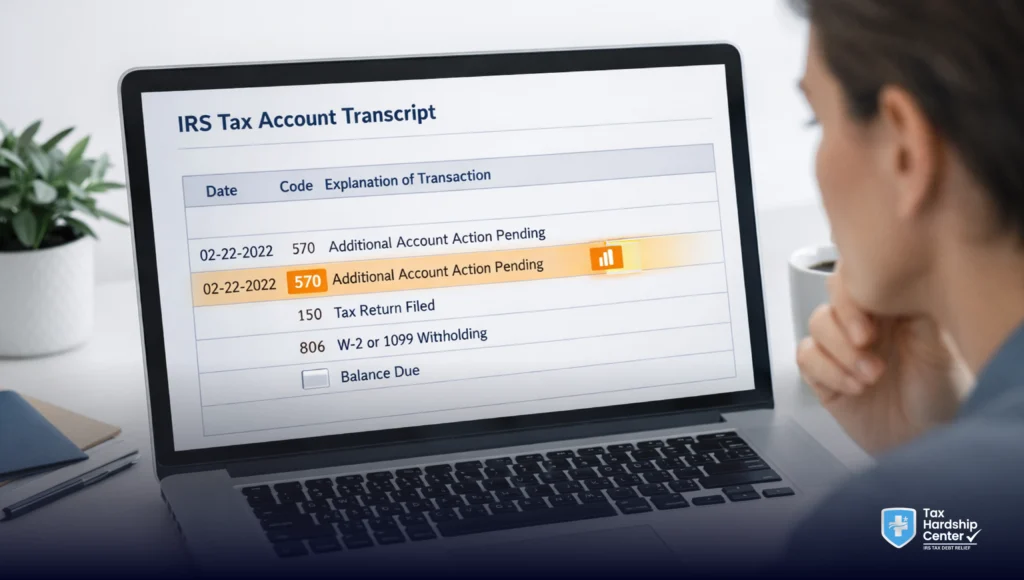
IRS transcript code 570 is a transaction code that indicates the IRS has placed a hold on your account while “additional account action” is pending. In IRS documentation, code 570 is tied to an additional liability pending and/or a credit hold, and it can freeze the account from refunding or offsetting credits out until the IRS clears the issue.
In normal terms, IRS code 570 freeze usually means this: the IRS is not ready to finish processing your return or release your refund yet, because something needs review, verification, or follow-up.
It is important to know what it does not mean.
- It does not automatically mean you are being audited.
- It does not, by itself, tell you the exact reason for the delay.
- It does not guarantee you will owe money, but it can appear when the IRS believes additional liability might be involved.
Where Code 570 Shows Up On Your IRS Account Transcript
Most people see account transcript 570 in the “Transactions” section of their Tax Account Transcript because it shows payments, refunds, penalties, interest, and account actions.
If you are not sure which transcript you pulled, the IRS explains the different transcript types and how to request them, including Tax Account Transcripts and Tax Return Transcripts.
Do Not Treat The Date Next To 570 As A Refund Date
A common trap is assuming the date next to code 570 is the day your refund will arrive.
That date is generally tied to the transaction’s effective date, and IRS processing can occur later. A transaction date is the effective date of a transaction, while the cycle date reflects when the IRS processed the transaction. Sometimes they match, sometimes they do not.
So if your transcript shows a future date next to 570, treat it as a sign that the IRS plans to revisit or progress the account around that time, not as a promised deposit date.
What Codes Often Appear With 570
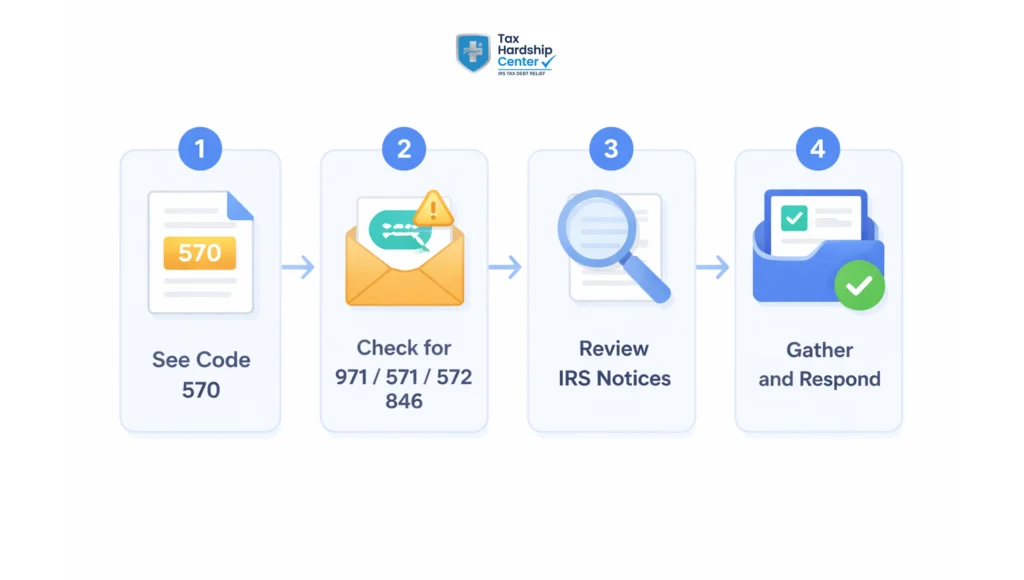
Code 570 rarely appears alone. You may also see:
- Code 971: A notice was issued, meaning the IRS sent a letter or notice connected to your return.
- Code 571 or 572: The hold was released or corrected, which is often the sign things are moving again.
- Code 846: Refund issued, which is the strongest confirmation that your refund has been scheduled.

What Usually Triggers IRS Transcript Code 570
The IRS can set a 570 hold for multiple reasons. Here are the most common ones taxpayers run into.
Identity Verification Or Fraud Filters
The IRS runs screening criteria to reduce identity theft and fraudulent refunds. If your return is flagged, you may receive an identity verification letter, and code 570 can appear while the IRS waits for verification or reviews your account.
Wage, Withholding, Or Income Reporting Mismatches
If what you reported does not match what the IRS received from employers or payers, your return can pause while the IRS verifies information. This includes corrected W-2s or late 1099 reporting.
Credit Reviews
Certain refundable credits tend to draw extra scrutiny, especially when the IRS needs to verify eligibility or documentation. IRS procedures discuss refund holds tied to review projects, including questionable credit review processes.
The IRS Needs More Time Or More Information
Sometimes the IRS simply needs additional time to verify details, or it will send a letter requesting documents. The IRS also notes that it may send notices when it is delayed in processing a return, needs to verify identity, or has questions about the return.
How Long Does IRS Code 570 Last?
There is no single timeline, because the “why” matters.
That said, many routine 570 holds resolve in a few weeks, especially when the IRS is completing internal verification, and no letter response is needed.
If the IRS needs something from you, it typically communicates by notice or letter. IRS procedures for refund holds also indicate that the IRS should contact the taxpayer within 30 days of the cycle date of the refund hold transaction code.
If you do see code 971, check your mail and your IRS online account for digital notices, because many notices can appear there.
Transcript 570 Next Steps: What To Do Right Now
Here is a practical checklist that works for most situations.
Step 1: Confirm You Are Looking At The Right Transcript And Tax Year
Use the IRS Individual Online Account to access transcripts quickly, or request transcripts by mail if needed.
If you cannot access your account online, the IRS also allows transcript requests by mail or via the automated phone transcript service listed on IRS guidance pages.
Step 2: Look For Companion Codes That Explain The “Story”
Scan the transaction list and note what appears after 570. Focus on:
- Code 971 (Notice Issued): The IRS is communicating a specific message.
- Code 571 or 572: The hold is released or corrected, which often occurs before the refund is issued.
- Code 846: Your refund is scheduled.
Step 3: Check Your IRS Online Account For Notices And Letters
Your IRS online account can show digital copies of many IRS notices under the “Notices and Letters” section.
If you received a letter, the IRS recommends reading it carefully, responding by the due date when asked, and keeping a copy for your records.
Step 4: Gather The Documents The IRS Typically Verifies
You do not have to send anything unless the IRS asks, but you can save time by preparing:
- W-2s and 1099s
- Proof supporting major credits you claimed
- Any IRS letters you received
- A copy of the filed return and supporting schedules
If the issue is a mismatch, having these ready makes it easier to respond quickly if a notice requests clarification.
Step 5: Avoid Moves That Commonly Make Delays Worse
If you are waiting on a 570 hold, these missteps often create more problems:
- Filing a duplicate return because you think the IRS “didn’t get it”
- Amending too early without a clear reason or IRS instruction
- Guessing at the reason and sending random documents that were not requested
In many cases, the best move is to wait for the IRS notice, then respond precisely and on time.
Step 6: Know When It Makes Sense To Contact The IRS
Calling the IRS rarely speeds up a 570 hold, because phone agents often can only confirm what the transcript already shows.
Consider reaching out if:
- It has been more than 30 days since the 570 was posted, and you have not received any notice.
- Your transcript shows code 971, but you cannot locate the notice in your mail or online account.
- You have an urgent hardship situation, such as an inability to pay rent, medical needs, or utilities, and the delay is causing serious harm.
When Code 570 Signals A Bigger Issue
Sometimes 570 is not just a routine pause. It can also appear when there may be additional liability pending or when the IRS is preventing credits from being refunded or offset out until the account is resolved.
If you are seeing repeated holds, multiple tax years affected, or other signs of enforcement and unresolved tax balances, it may be time for a deeper transcript review, not just refund tracking.
How Tax Hardship Center Helps When Transcripts Get Complicated
If your transcript shows IRS transcript code 570 and the situation is not resolving, professional transcript analysis can help you avoid delays caused by missing documents, misapplied credits, or unresolved IRS actions.
Tax Hardship Center’s approach includes transcript analysis and program matching, which is especially helpful when IRS activity is not clear from a single code.
Depending on what the transcript reveals, solutions may include:
- Audit and documentation support during IRS review of the return, including audit defense representation.
- Options for taxpayers who cannot afford payments right now, such as the Currently Not Collectible status.
- Longer-term resolution strategies for larger tax debt, including Offer in Compromise when appropriate.
Frequently Asked Questions
Does Code 570 Mean I Am Being Audited?
Not automatically. Code 570 indicates a hold while additional action is pending, and it can appear for verification, mismatches, or credit reviews. Audits involve specific IRS notices and processes, and 570 alone does not confirm an audit.
What Does 570 Mean On Tax Transcript With A Future Date?
A future date is commonly the IRS’s projected next action date for the account, not a guaranteed refund date. It often means the IRS expects to revisit the hold around that time.
What Should I Look For After Account Transcript 570?
Watch for code 971 (notice issued), then code 571 or 572 (release or correction of the 570 hold), and then code 846 (refund issued).
How Do I Find IRS Notices If I Never Received A Letter?
Check your IRS online account. The IRS states that digital copies of many notices can be found in your online account under “Notices and Letters,” although not every notice is available online.
How Do I Get My IRS Transcript To Check Code 570?
The IRS recommends using your Individual Online Account to view, print, or download transcripts. If you cannot use the online option, you can request transcripts by mail or use the automated phone transcript service referenced on IRS transcript pages.
Conclusion
Seeing IRS code 570 freeze on a transcript is stressful, especially when you are counting on a refund. In most cases, it is a temporary pause while the IRS verifies details, issues a notice, or completes an internal review. Your job is to read the transcript in context, watch for companion codes like 971, 571/572, and 846, and respond quickly if the IRS asks for documentation.
Key Takeaway
- IRS transcript code 570 is a hold due to additional action pending, and it can freeze refunds or credit offsets until it is cleared.
- Do not treat the date next to 570 as a refund date; it is not a promise, and processing can occur later.
- Look for code 971 (notice issued), then 571/572 (hold released), then 846 (refund issued).
- Use your IRS online account to check transcripts and find digital notices when available.
- If the hold drags on, spans multiple years, or ties into a larger IRS problem, a full transcript review can clarify the fastest path forward.