

Cashing a refund check late, filing a return a week past April 15, or missing a quarterly estimate can trigger costly IRS penalties and interest. The agency charges up to 25 percent of the unpaid tax for failure to file and another 25 percent for failure to pay, plus a half percent per month in continuing charges. Many taxpayers can erase or cut those fees by showing reasonable cause or by qualifying for the once‑in‑a‑lifetime First Time Penalty Abatement. You must act quickly because interest keeps compounding until the IRS grants relief. This guide walks you through each step so you can keep more cash in your pocket and get back on solid ground.
Understanding IRS Penalties
IRS penalties strike more than 40 million taxpayers each year. They come in many flavors, each tied to a different code section and enforcement track. Knowing which charge you face sets the rules for relief, interest, and the appeal path. The IRS explains each penalty type and possible relief on its penalty relief page.
Common Types of Penalties
The most frequent charges include failure to file, failure to pay, and estimated tax penalties. Failure to file rises to 5 percent of the unpaid tax per month and caps at 25 percent. Failure to pay runs at one half of 1 percent per month and also tops out at 25 percent. Estimated tax penalties vary by quarter and interest rates. Other common assessments involve accuracy‑related penalties, payroll deposit lapses, and information‑return failures.
How Penalties Accrue and Compound
The IRS starts the clock the day after a filing or payment deadline. Interest compounds daily on both the tax and the penalty. That means a $5,000 failure‑to‑pay balance can grow by hundreds of dollars a month. The longer you wait, the harder it becomes to reduce the total bill.
Why Quick Action Matters
Penalty relief works only on the unassessed portion. If your debt moves to the IRS Collection division and the agency files a federal tax lien, your options shrink. Early contact keeps your account in the hands of Service Center staff who grant abatements more often than Collection agents.
Eligibility for Penalty Relief
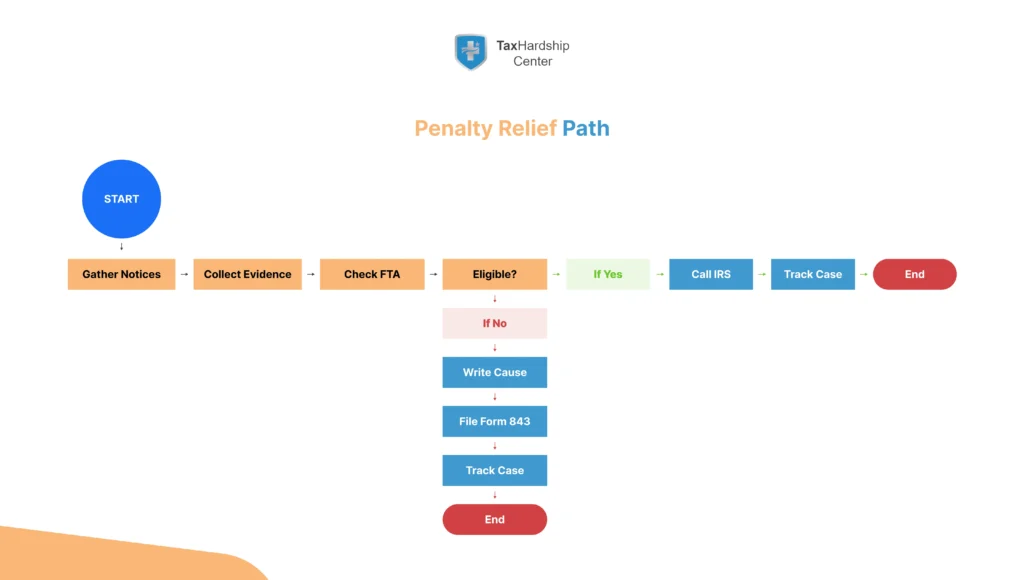
Relief programs fall into three buckets: First Time Penalty Abatement, Reasonable Cause, and Statutory Exceptions. Each requires different proof and procedural steps. For a deeper dive, see our blog on IRS penalty abatement strategies.

First Time Penalty Abatement
You qualify if you filed at least three years of returns on time, had no penalties in the prior three years, and paid or arranged to pay any tax due. This one‑shot cure erases failure to file, failure to pay, and failure to deposit penalties for a single tax period. You can request it by phone, letter, or Form 843.
Reasonable Cause Criteria
Reasonable cause hinges on facts showing you used ordinary business care and prudence yet could not comply. Acceptable grounds include serious illness, natural disaster, unavoidable absence, or reliance on professional advice. You must show the events were beyond your control, that you corrected the issue as soon as possible, and that you now comply with future tax duties.
Statutory Exceptions
Congress wrote relief into specific code sections such as 26 U.S.C. § 6651, which waives penalties when the taxpayer lived in a federal disaster area. Other examples include combat‑zone service and incorrect IRS oral advice.
Our Services at Tax Hardship Center
Our services at Tax Hardship Center focus on fast, effective penalty relief so you can reclaim peace of mind. Our Penalty Abatement team crafts evidence‑rich requests that the IRS accepts at a high rate. When penalties stem from larger debts, our specialists can pair abatement with an Offer in Compromise to settle the tax itself. Clients facing ongoing cash‑flow issues often benefit from our IRS Payment Relief Options service, which helps set affordable monthly plans. Each case begins with a complimentary analysis so you know your odds before committing a dime.
Gathering Your Documentation

A strong case begins with organized records. The IRS acts faster when you attach clear proof rather than vague claims. Our recent post on the best tax relief services for 2025 highlights why documentation drives approval odds.
IRS Notices Decoded
Most taxpayers receive Notice CP14 or CP161 that lists the penalty type, tax year, and amount. Keep these letters because you must reference the notice number when filing Form 843 or calling the agency.
Evidence That Strengthens Your Case
Collect hospital discharge papers, insurance claims, police reports, or letters from your tax preparer. Bank statements can show when funds became available, while email chains prove you sought timely advice. Use dated documents and label each one so an IRS employee can scan them quickly.
Organizing for a Smooth Submission
Arrange documents in chronological order. Create a brief cover sheet listing each exhibit. Number the pages so the IRS employee can follow the storyline without back‑tracking.
Crafting Your Reasonable Cause Argument
Your request letter or Form 843 statement must read like a courtroom brief: concise, factual, and supported by evidence.
Writing Your Letter
Open with your name, Social Security number or EIN, tax year, form filed, and notice number. State the penalty amount and the relief type you seek. Next, give a timeline of events in plain language. Explain how each event blocked compliance and how you corrected the issue. Close with a request for removal of the penalty and related interest.
Avoiding Common Mistakes
Do not blame the IRS unless you have documented proof of misinformation. Never claim ignorance of the law. Avoid emotional appeals without data. And never mail original documents; send copies and keep the originals safe.
Tone and Clarity Tips
Use short sentences, active verbs, and everyday vocabulary. The IRS employee may handle 30 cases a day, so clarity raises your chance of a quick yes.
Completing Form 843 and Other Submission Methods

Form 843, Claim for Refund and Request for Abatement, works for many but not all penalties. You can also request relief by phone or during an audit.
Form 843 Walk‑Through
Line 1 asks for the tax period. Use the year‑end date for income taxes or the quarter‑end for payroll taxes. Line 3 requires the penalty type code; you can find this on your notice. In Part II, write your reasonable cause statement. Staple your evidence behind the form and mail it to the address shown on your notice.
Phone Requests
First Time Penalty Abatement often succeeds over the phone. Call the number on your notice, verify your identity, and ask directly for first‑time abatement. Have your return filing dates and payment history handy because the agent will check compliance criteria in real time.
Appeals During Examination
If an auditor proposes a penalty, you can raise reasonable cause before the report becomes final. Provide evidence before the auditor closes the case. This path avoids a separate abatement request later.
Tracking Your Appeal Timeline
The IRS moves slowly, but you can keep your claim from stalling.
IRS Response Benchmarks
You should receive a confirmation letter within six weeks of mailing Form 843. The IRS aims to decide within 90 days for simple cases and 180 days for complex ones. If you hear nothing after three months, call the contact number on your acknowledgment letter.
Following Up Proactively
Keep a log of every call with date, time, employee ID, and summary. If the agent says the case is still under review, ask for the next action date. This record helps if you need to elevate the matter to the Taxpayer Advocate Service.
What to Do If Your Request Is Denied
A denial is not the end of the road. The IRS allows several layers of review.
Reconsideration Options
You can file a written protest to the IRS Independent Office of Appeals within 30 days of denial. Your protest must restate the facts, cite supporting law, and explain why the IRS decision was incorrect. Include any new evidence.
Taking Your Case to Tax Court
If Appeals rejects your protest and the IRS issues a Notice of Deficiency, you have 90 days to petition the United States Tax Court. Court petitions require strict formatting and filing fees, so many taxpayers hire counsel at this stage.
At Tax Hardship Center, We Help You Move Forward
At Tax Hardship Center, we help you dispute penalties and resolve underlying debts so you can move on with life. Our Fresh Start Program guidance shows how to pair penalty relief with manageable installment plans. We assign a dedicated case manager who updates you every week until the IRS closes your file. Transparent flat‑fee pricing means no surprises. Most clients see thousands of dollars erased and months of stress lifted.
In summary, Disputing an IRS Penalty
Taking on the IRS may sound daunting, but a structured plan and clear proof put the odds in your favor.
- Gather every notice and document within two weeks of receiving your penalty letter.
- Check eligibility for First Time Penalty Abatement first because it is the simplest route.
- If ineligible, build a reasonable cause file with dated evidence and a tight timeline.
- Complete Form 843 or call the IRS with your facts ready.
- Track the case every 30 days and escalate if responses stall.
- Seek professional help if the penalty exceeds what you can pay in one month or if the IRS denies your initial claim.
The sooner you act, the sooner interest stops compounding and the sooner you gain financial breathing room.
FAQs
How long does the IRS take to process a penalty abatement request?
Most decisions arrive within three to six months, depending on case complexity and staffing.
Can I dispute penalties from multiple years at once?
Yes. File a separate Form 843 or letter for each tax year and attach copies of relevant notices.
Will the IRS remove interest when it removes the penalty?
Yes. Interest tied directly to the penalty disappears once the IRS abates the penalty.
Do I need a lawyer to go to Tax Court for penalties under $50,000?
No. You can use the simplified small tax case track, but many taxpayers hire help to boost their odds.
Does a penalty abatement hurt my credit score?
No. IRS penalties and abatements do not appear on consumer credit reports unless the debt moves to a private collection agency and remains unpaid.