
You open an IRS letter, see a balance you cannot pay in full, and suddenly everyone is talking about the “Fresh Start program.”
Some ads make it sound like a magic reset button. In reality, the Fresh Start initiative is a set of IRS rules and thresholds that make certain relief options easier to access if you qualify. For some people, it is exactly the right path. For others, it is the wrong tool, or only part of the solution.
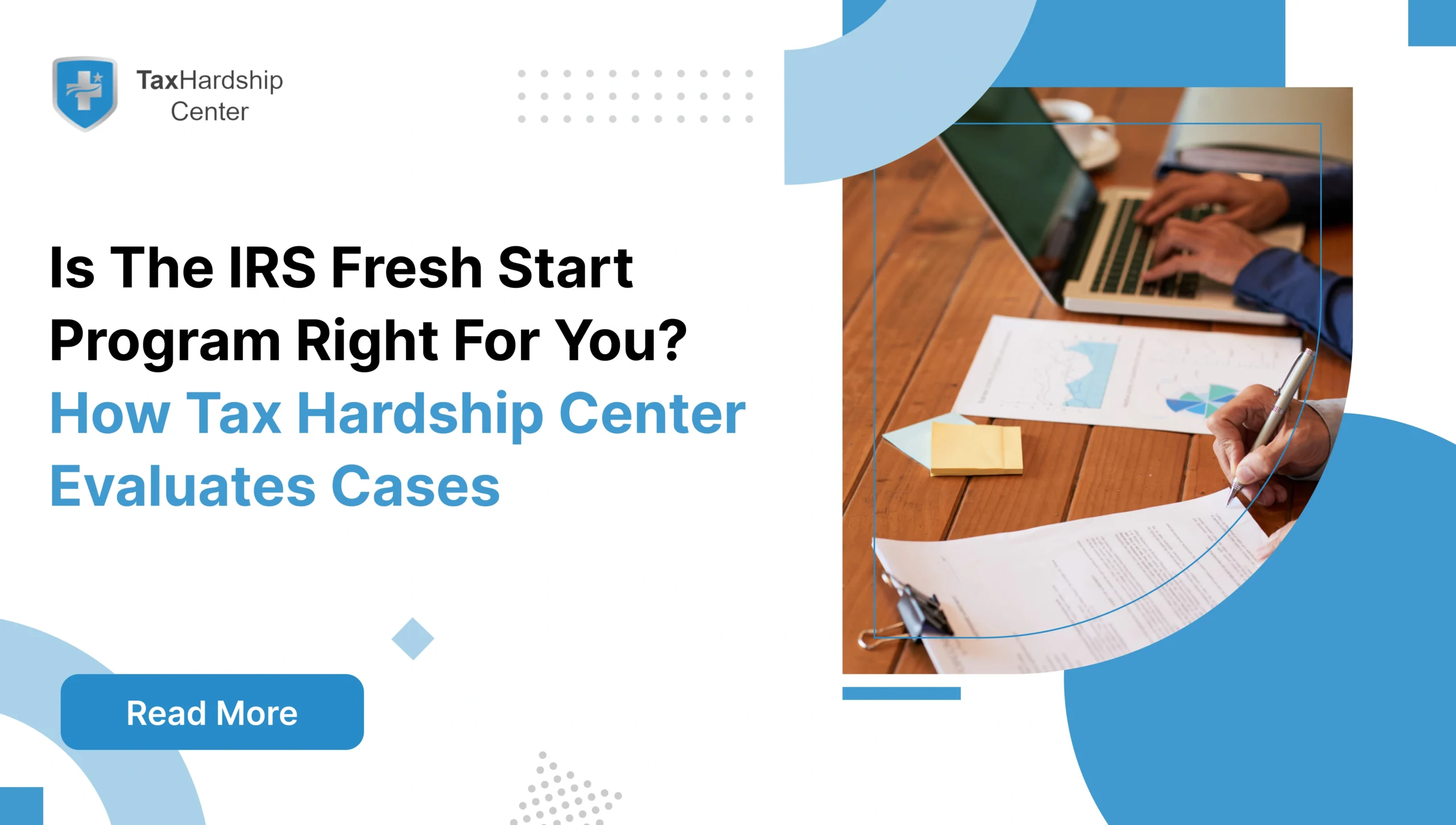
This is where a careful tax debt evaluation matters. Before Tax Hardship Center talks about payment plans, settlements, or hardship status, they run your situation through an evaluation process that mirrors how the IRS itself looks at tax relief requests.
This guide explains what the Fresh Start program actually is, when it is a good fit, and how Tax Hardship Center uses financial analysis and hardship criteria to decide if it is right for you.
What The Fresh Start Program Really Is
The “Fresh Start program” is not a single new law or form. It is a group of changes the IRS made to its existing relief tools to help taxpayers with back taxes get into realistic resolutions.
Under the Fresh Start initiative, the IRS:
- Expanded access to streamlined installment agreements so more people can set up payment plans without full financial disclosure.
- Adjusted how settlement offers (Offers in Compromise) are evaluated, making them more accessible in genuine hardship cases.
- Updated rules around federal tax liens and when they can be withdrawn or not filed if certain payment arrangements are in place.
On its “Get Help With Tax Debt” page, the IRS now lists payment plans, Offer in Compromise, temporary collection delays, and penalty relief as the main options, noting that Offer in Compromise was previously talked about as part of the Fresh Start program.
So when you ask if the Fresh Start program is right for you, what you are really asking is:
- Does a streamlined IRS payment plan, settlement, or hardship relief under these rules realistically fit my finances and my tax debt?
When The Fresh Start Program Makes Sense
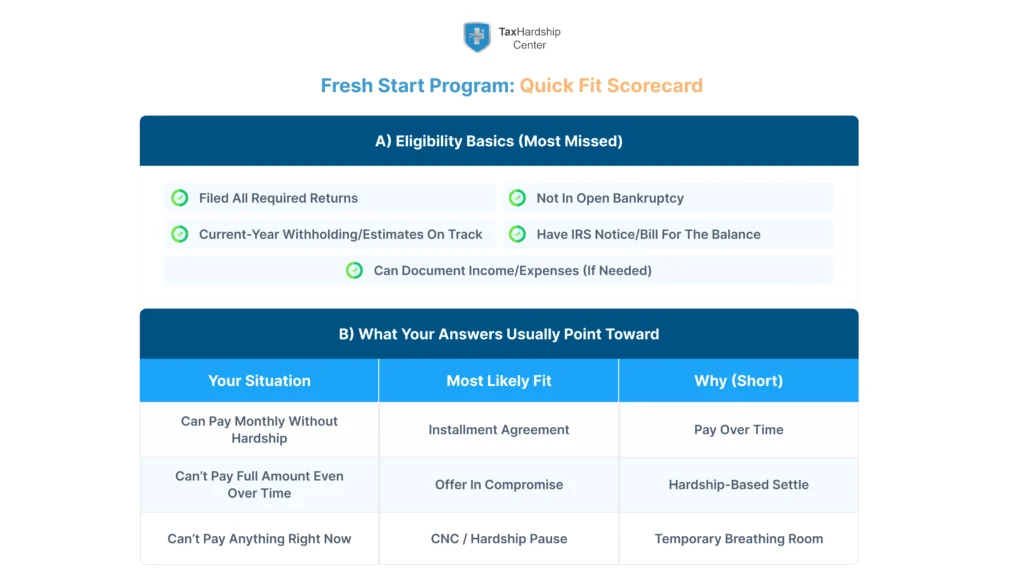
Fresh Start-based options are primarily designed for people who:
- Owe back taxes they cannot pay in full immediately.
- Want to avoid aggressive enforcement like levies and liens by entering into an approved arrangement.
- Are willing to file any outstanding returns and remain compliant going forward.
You are more likely to be a good candidate for a Fresh Start style strategy if:
- Your total IRS balance is within the typical streamlined thresholds (commonly up to around 50,000 dollars for many individual installment agreements).
- You can afford a monthly payment once your basic living expenses are covered, or you clearly cannot and may qualify for settlement or hardship status.
- You are prepared to be transparent about your income, expenses, and assets if you pursue more advanced options, such as an Offer in Compromise or a hardship delay.
If your situation is more complex, simply “asking for a Fresh Start” is not enough. That is why the Tax Hardship Center focuses so heavily on front-end evaluation.
How The IRS Evaluates You For Relief
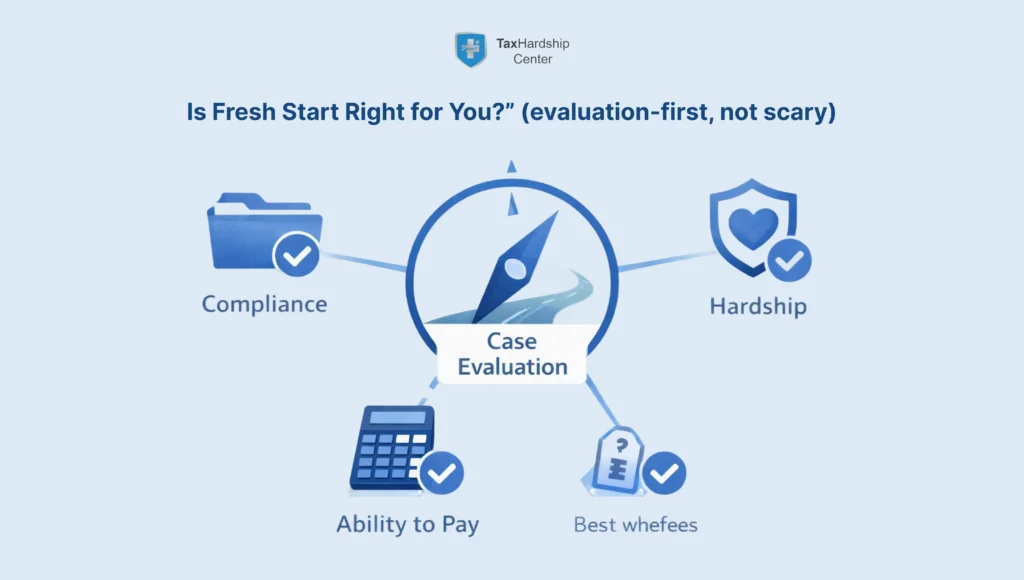
The IRS looks at your situation through a few consistent lenses, especially when you ask for structured relief like a payment plan, Offer in Compromise, or hardship status:
- Compliance
- Have you filed all required tax returns?
- Are you up to date on current-year withholding or estimated payments?
- Ability To Pay
- What is your income, and how stable is it?
- What are your necessary living expenses under IRS standards?
- Do you have assets or equity that could be used to pay?
- Hardship
- Would full payment cause genuine financial hardship, meaning you cannot meet basic needs like housing, food, and medical care?
The IRS explains these considerations across several public pages:
- Get Help With Tax Debt (overview of options)
- Payment Plans / Installment Agreements
- Offer in Compromise
- Temporarily Delay The Collection Process (Currently Not Collectible)
Tax Hardship Center builds its case evaluation model on these same factors, but in a more user-friendly, step-based way.
Tax Hardship Center’s Case Evaluation Framework
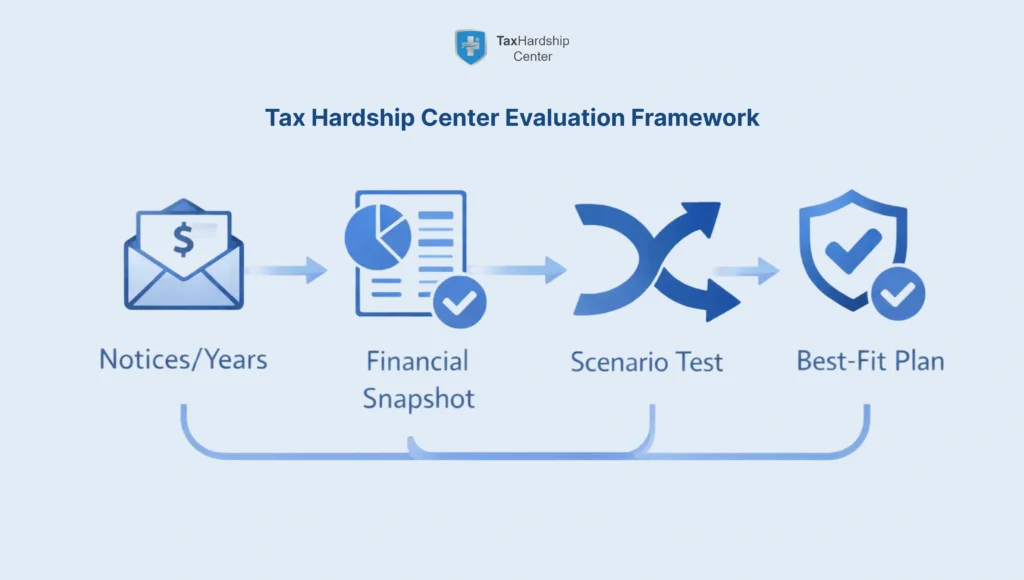
Tax Hardship Center’s approach is deliberately structured. They know IRS personnel follow internal checklists when evaluating tax relief requests, so they mirror that logic with a step-by-step case analysis model.
In broad terms, their evaluation framework includes:
- Compliance and notice review.
- Financial snapshot and hardship analysis.
- Scenario testing across payment plans, settlement, and hardship options.
- Risk and timeline assessment.
- Clear recommendation on whether a Fresh Start style path is appropriate or whether a different strategy makes more sense.
The goal is to answer, with numbers and evidence, a simple question:
- “Given how the IRS thinks, what is the most realistic way to resolve this tax debt?”
Step 1: Compliance And Notice Review
Before talking about specific Fresh Start options, the Tax Hardship Center first clarifies three things:
- What You Owe And To Whom
- They review your IRS notices and, with your permission, pull your IRS transcripts to see:
- Which tax years are involved?
- How much of your balance is tax versus penalties and interest?
- Whether there are separate state tax issues that need coordination.
- They review your IRS notices and, with your permission, pull your IRS transcripts to see:
- Where You Are In The IRS Collection Timeline
- Are you at the first CP14 bill, in the reminder phase, or already getting levy warnings?
- Are liens already filed, or are they just being threatened?
- Filing Status And Current-Year Compliance
- Are there unfiled returns that must be completed before the IRS will take Fresh Start requests seriously?
- Are you on track with current-year withholding or estimates, or will that need adjustment?
If this first step reveals major gaps in filings or current compliance, those become the immediate priority. Fresh Start tools almost always require that you are up to date on returns and current-year obligations.
Step 2: Financial Analysis For IRS Relief
Once the compliance picture is clear, the Tax Hardship Center turns to financial analysis, because that is exactly where the IRS will look next.
Key components include:
- Income Review
- Wages, self-employment income, rental income, pensions, and other sources.
- How variable or stable your income is over time.
- Necessary Living Expenses
- Housing and utilities, food, transportation, healthcare, and other essentials.
- Comparison to IRS national and local standards, because the IRS uses those as benchmarks in many cases.
- Assets And Equity
- Home equity, vehicles, savings, investment accounts, and business assets.
- Whether these assets are realistically available or whether using them would create hardship.
- Hardship Indicators
- Recent job loss, medical events, caregiving responsibilities, or other factors that affect your ability to pay.
This financial snapshot helps them estimate what the IRS would consider your “ability to pay,” which is central to determining whether a payment plan, settlement, or hardship status is realistic.
Step 3: Scenario Testing – Payment Plan, Settlement, Or Hardship
With your tax balance, filing status, and finances mapped out, the Tax Hardship Center then runs your situation through three broad categories of IRS relief, all of which fall under the Fresh Start umbrella in different ways:
- Payment Plans (Installment Agreements)
- They test whether you qualify for a streamlined long-term payment plan (often up to 72 months) based on balance and compliance.
- They model monthly payment amounts that fit your budget while still satisfying IRS requirements that the balance be paid within the collection period.
- Settlement Options (Offer In Compromise)
- They estimate whether the IRS is likely to view you as a candidate for settling for less, based on the Offer in Compromise rules.
- This often involves approximating the IRS’s “reasonable collection potential” calculation: how much they think they could collect from you over time, including income and assets.
- Hardship-Based Relief (Currently Not Collectible Or Temporary Delays)
- They assess whether your income and expenses indicate you cannot pay anything right now without failing to cover basic needs, a situation the IRS may treat as hardship.
Tax Hardship Center’s own materials describe this as scenario-based case modeling, designed to mirror how IRS agents compare options like payment plans, Offer in Compromise, and hardship status.
Step 4: Risk, Timeline, And Practical Fit
Even when multiple Fresh Start paths are technically available, not all of them are a good practical fit. Tax Hardship Center weighs:
- Risk Of Rejection Or Default
- How likely is the IRS to accept the requested plan or settlement based on your actual numbers?
- How realistic is it that you can maintain the agreement for its full term?
- Timeline To Resolution
- How long will each option likely take from application to final resolution?
- How much interest and penalty cost will accumulate under each scenario?
- Stress And Administrative Burden
- Does one option require more documentation, follow-up, or monitoring than another?
- Is that level of complexity realistic for you right now?
- Impact On Your Broader Financial Life
- How will each option affect your cash flow, ability to keep up with other obligations, and long-term stability?
The answer to “Is the Fresh Start program right for you?” is usually not a simple yes or no. It is “Which specific Fresh Start tool, or combination of tools, fits both the IRS’s rules and your real life?”
Signs The Fresh Start Program May Not Be Right For You
There are situations where a classic Fresh Start mix of payment plans and standard Offer in Compromise may not be the best primary solution, at least right away. For example:
- You Have Significant Unfiled Returns
- If several years are missing, the immediate priority is filing, not trying to plug into Fresh Start labels. Until filings are caught up, most IRS relief options will stall.
- You Have Clear Ability To Pay In Full Quickly
- If your income and assets show that you can clear the balance quickly, the IRS will generally expect you to pay or use a standard payment plan rather than entertain settlement offers.
- Your Main Problem Is Non-IRS Debt Or Cash Flow
- Sometimes the tax debt is only a small piece of a larger debt picture. In those cases, broader financial or legal strategies beyond IRS relief may need to be considered alongside, or even before, Fresh Start options.
- You Are Looking For A “Magic Eraser”
- If you expect Fresh Start to automatically erase most of your balance regardless of your finances, the reality will be disappointing. Legitimate relief is grounded in the IRS’s hardship and ability-to-pay analysis, not in marketing promises.
A good tax debt evaluation is honest about these limitations from the start, which is why Tax Hardship Center emphasizes transparent case reviews and realistic outcome ranges.
Frequently Asked Questions About Fresh Start And Case Evaluation
How Do I Know If The Fresh Start Program Is Even An Option For Me?
If you owe back taxes and cannot pay in full right away, Fresh Start-style tools may be on the table. The first test is whether you have filed all required returns and are current on this year’s withholding or estimated tax payments. From there, it comes down to your balance, income, expenses, and assets.
What Does Tax Hardship Center Look At First In A New Case?
They usually start with your IRS notices and transcripts to see what you owe, for which years, and where you are in the collection process. At the same time, they check for unfiled returns and current-year compliance, because those issues control which IRS relief options will even be considered.
Why Is Financial Analysis So Important For IRS Relief?
Because the IRS bases major relief decisions on your ability to pay and hardship, not on how stressed you feel. Income, necessary expenses, and asset equity drive whether you qualify for a simple payment plan, a settlement, or a hardship delay. A structured financial analysis helps you avoid asking for programs the IRS is almost certain to deny.
Can I Just Ask For a Fresh Start Without Providing Detailed Financial Information?
For smaller balances and straightforward payment plans, you can often set up a streamlined agreement with limited financial disclosure, especially online. But for Offers in Compromise and hardship-based relief, the IRS expects detailed documentation of income, expenses, and assets.
How Does Tax Hardship Center Decide Between A Payment Plan And An Offer In Compromise?
They compare scenarios: what happens if you use a streamlined payment plan versus what happens if you pursue an Offer in Compromise based on your financials. If you can clearly pay in full over time without severe hardship, a payment plan is usually the recommended route. If you cannot, and your financials support it, settlement or hardship options may become the primary strategy.
What If I Am Already Getting Levy Threats Or Have A Levy In Place?
Even at that stage, Fresh Start tools and other relief options can be used to stop or reverse certain collection actions, but timelines are tighter, and the evaluation has to move quickly. The IRS’s collection process guidance indicates that payment plans, Offers in Compromise, and hardship delays are still available in many cases, even after serious notices have been issued.
Is Professional Help Always Necessary for a Fresh Start?
Not always. Many straightforward payment plans can be set up by taxpayers themselves using IRS online tools. Professional help becomes more valuable when the balances are larger, the finances are complex, you are considering an Offer in Compromise or hardship status, or you simply do not want to deal with the IRS directly.
Conclusion And Key Takeaway
The IRS Fresh Start program is not a single program you “get into”; it is a more flexible way to use existing relief tools: payment plans, settlements, and hardship options. Whether it is right for you depends on three things the IRS cares about deeply: your compliance history, your ability to pay, and your hardship story.
Tax Hardship Center’s role is to translate that IRS logic into a clear, human process. They start by understanding exactly what you owe and where you stand, then build a financial and hardship profile that mirrors how the IRS will see you. From there, they run concrete scenarios so you can see, in plain numbers, whether a Fresh Start style payment plan, settlement, or hardship pause is realistic, or whether a different path makes more sense.
If your tax debt already feels bigger than you can manage on your own, the right evaluation can turn “I hope Fresh Start will save me” into “I know which IRS relief path actually fits my situation.”
Key Takeaways:
- The Fresh Start program is a set of IRS rules that make payment plans, settlements, and hardship options more accessible, not a single one-size-fits-all program.
- Whether Fresh Start is right for you depends on compliance (filed returns, current-year payments), your true ability to pay, and documented hardship.
- Tax Hardship Center evaluates cases the same way the IRS does, by analyzing your notices, transcripts, income, expenses, assets, and hardship factors.
- Scenario testing across payment plans, Offer in Compromise, and hardship status helps determine which specific relief path is realistic, instead of guessing.
- For many people, the real value of the Fresh Start program is unlocked only after a structured tax debt evaluation, often with professional guidance, that aligns with IRS rules and their real financial life.