

You open your banking app, and your joint account is frozen. Bills are due, your roommate is texting, and your spouse is panicking.
If you are asking, “Can the IRS levy a joint bank account?” the answer is usually yes, and the timing matters because a bank levy includes a 21-day holding period that can be your best window to fix this before money leaves the account.
This guide breaks down what happens in spouse and roommate scenarios, how to protect a non-liable co-owner, and how to get the levy released as quickly as possible.
What A Joint Account IRS Levy Really Means
An IRS levy is a legal seizure of property to satisfy a tax debt. It is different from a lien, which is a legal claim that secures the debt.
For joint accounts, the key concept is “rights to property.” IRS guidance and internal legal references explain that the federal tax lien attaches to a taxpayer’s interest in a bank account even when the account is jointly titled, because many joint accounts give each owner an unqualified right to withdraw funds.
That said, the IRS also recognizes an important practical reality: a joint depositor’s right to withdraw can be “provisional,” meaning the other co-owner may later claim the money actually belongs to them.

How A Bank Levy Works (And The 21-Day Clock)

A bank levy is typically issued to the bank using Form 668-A.
Here is what usually happens:
- The bank freezes the funds that are in the account on the date and time it receives the levy.
- There is a 21-day waiting period before the bank sends the funds to the IRS.
- In most cases, the levy does not attach to money deposited after the levy is received (so the freeze is typically tied to the balance at that moment).
Why the 21 days matter: the IRS explains this waiting period is intended to give you time to contact the IRS, arrange payment, or notify the IRS of errors in the levy.
For a plain-language overview of how bank levies work and what to do immediately, Tax Hardship Center’s bank levy resources can help you map out a response plan.
Spouse Scenarios: When The IRS Can Take Joint Funds
Scenario 1: The Tax Debt Is From A Joint Return
If you and your spouse filed a joint return, IRS rules generally treat you as jointly and severally liable for that tax. That means either spouse can be held responsible for the full liability.
In that situation, a levy on a joint bank account is not “taking your spouse’s money for your debt.” The IRS views the debt as shared.
If you believe you should not be responsible for a spouse’s tax issue (for example, you did not know about the problem), the IRS provides “innocent spouse relief” options requested through Form 8857.
The Tax Hardship Center also has a practical guide to innocent spouse relief if that is the direction your facts point.
Scenario 2: Only One Spouse Owes (Separate Tax Debt)
Even when only one spouse owes, the IRS may still levy a joint account if the liable spouse has access to withdraw funds. The non-liable spouse’s protection usually comes from proving ownership of the funds and requesting a release or return.
Special note for “helping” arrangements: the IRS bank levy guidance specifically addresses cases where someone is merely a signer on an elderly parent’s account to help pay bills. The IRS instructs the true owner (or their POA) to call the IRS number shown on the levy and be prepared to substantiate ownership of the funds.
Roommate And Non-Spouse Scenarios: What Protects Your Share
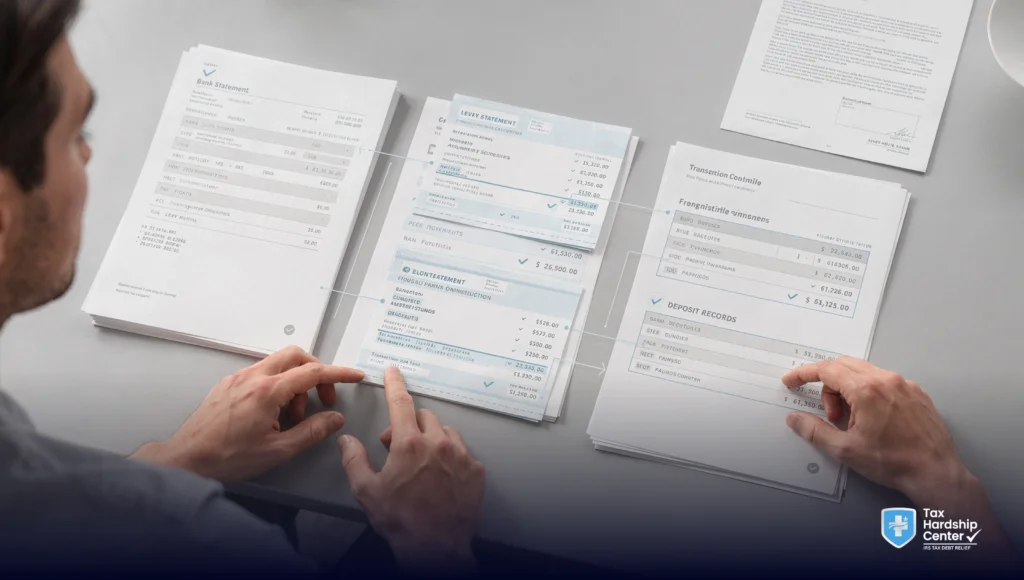
Roommates and unmarried co-owners face a harsh reality: banks often freeze first and ask questions later because they must comply with the levy.
Your best protection is documentation that clearly separates whose money is whose, such as:
- Pay stubs showing deposits from the non-liable owner
- A ledger of contributions for rent and bills
- Proof that the liable owner’s access was convenience-only (if true)
- Statements showing the pattern of deposits and withdrawals
If the IRS levy was based on one co-owner’s debt, the other co-owner’s usual path is to contact the IRS quickly during the 21-day period and provide evidence that the frozen funds are theirs.
Nominee Levy Risks: When “Not Your Account” Still Gets Hit
Sometimes a joint account problem is not just “shared ownership.” It is a nominee issue.
A nominee situation is when property is titled in someone else’s name, but the IRS believes the taxpayer is the true beneficial owner. When the IRS treats property as nominee or alter-ego property, it can pursue collection actions tied to that theory, and IRS appeals materials specifically reference nominee and alter-ego lien situations as actions that may be appealed under CAP using Form 9423.
Common risk flags that can trigger nominee attention include:
- The taxpayer is the primary user of the funds, but the account is titled mostly to someone else
- The taxpayer’s income is routed through another person’s account
- The “non-liable” person cannot explain deposits, withdrawals, or why the structure exists
If you suspect the IRS is treating the account as nominee property, it is worth getting help quickly, because the argument shifts from “these are my funds” to “this account is not the taxpayer’s property in substance.”
How To Get A Joint Account Levy Released Fast
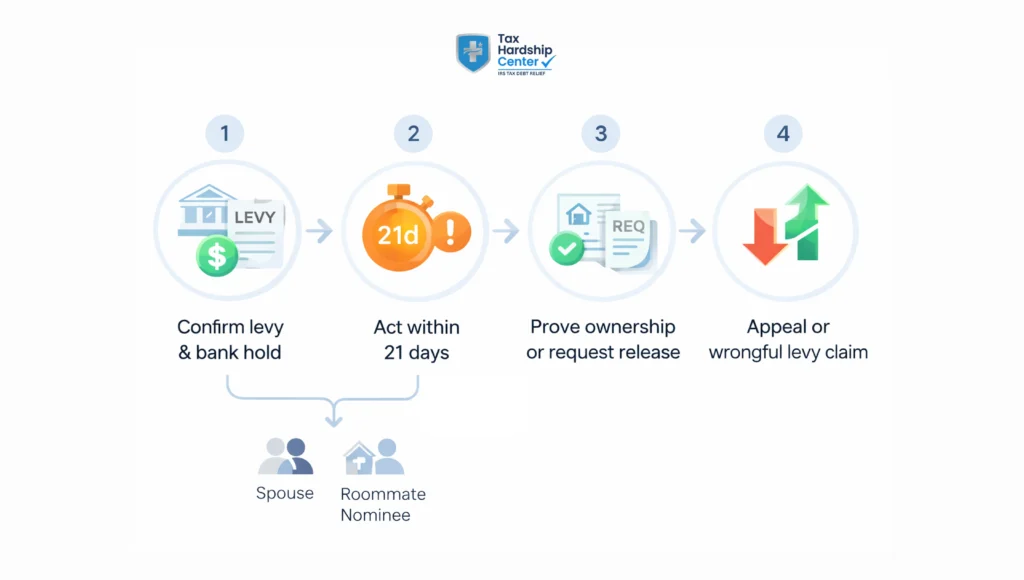
The IRS says to contact them immediately to resolve the liability and request a levy release. They can release a levy for several reasons, including full payment, expiration of the collection statute, a release that helps collection, entering an installment agreement (when the agreement does not allow the levy to continue), or economic hardship that prevents meeting basic living expenses.
Here is a practical “fast path”:
Step 1: Confirm It Is An IRS Levy And Identify The Levy Contact
Your bank can confirm the levy details, and IRS guidance notes that bank levies are generally issued using Form 668-A.
Step 2: Act During The 21-Day Hold
Use this window to request a release, fix errors, or prove the levy is wrongfully hitting a non-liable owner’s funds.
Step 3: Choose The Most Realistic Resolution
Common pathways include:
- Pay in full (fastest when possible)
- Enter an installment agreement
- Request hardship relief if the levy prevents basic living expenses
Tax Hardship Center’s installment agreement, Offer in Compromise, and Currently Not Collectible resources are helpful if you are choosing between “pay monthly,” “settle,” or “pause collection due to hardship.”
Step 4: If The IRS Denies A Release, Use Appeal Rights
The IRS states you may appeal a levy release denial, before or after a levy occurs, and points taxpayers to Collection Appeal Rights.
If CAP is the right tool, Form 9423 is used to request a CAP appeal for certain collection actions, including levies.
Step 5: If Funds Have Already Left The Account, Ask About Return Options
The IRS notes that after levy proceeds have been sent to the IRS, you may file a claim to have them returned.
What To Do If You Are The Non-Liable Joint Owner
If your spouse, roommate, or parent is the non-liable co-owner, the playbook changes slightly because they are protecting their property rather than negotiating the tax debt.
Option 1: Call The IRS And Prove Ownership During The Hold
The IRS bank levy guidance explicitly states that the true owner (or POA) should call the IRS number listed on the levy and be prepared to explain and substantiate why the funds belong to them.
Option 2: File A Wrongful Levy Claim If Needed
If the IRS wrongfully levied property belonging to a third party, Publication 4528 explains that a person other than the taxpayer may make an administrative wrongful levy claim.
Option 3: Consider The Taxpayer Advocate Service If Hardship Is Severe
If the levy is causing serious hardship and normal channels are stalled, TAS can be an option for escalating urgent cases. Tax Hardship Center’s educational content also references using Form 911 in urgent situations where a levy looms.
When To Get Professional Help
A joint account levy gets messy fast, especially when you have:
- A spouse who is not liable, but whose paycheck was frozen
- Roommate funds are mixed together with no clear recordkeeping
- Nominee or alter-ego concerns
- A final levy notice timeline, and you need to protect wages and bank funds
Tax Hardship Center helps taxpayers build a clear response strategy around levies, appeals, and resolution programs, including bank levy response resources and collection process guidance.
FAQs
Can The IRS Levy A Joint Bank Account If Only One Person Owes?
Yes, it can happen when the liable person has the right to withdraw funds from the joint account. The other joint owner may need to prove ownership of their share to seek a release or return.
Will The Bank Freeze The Entire Joint Account?
Banks typically freeze funds in the account as of the date and time the levy is received, then hold them during the waiting period. What is ultimately sent may depend on the levy amount and the case resolution during the hold.
Does A Bank Levy Take Future Deposits Too?
Generally, IRS bank levy guidance explains that the freeze is based on the funds in the account when the levy is received, and it normally does not affect funds added after that moment.
How Long Does The IRS Bank Levy Hold Last?
The IRS explains that bank levies have a 21-day waiting period before the bank sends the funds to the IRS.
How Do I Get A Levy Released Quickly?
The IRS says to contact them immediately and request a levy release. A levy can be released for reasons including payment, an installment agreement that does not allow the levy to continue, or economic hardship.
What If The IRS Took My Roommate’s Money By Mistake?
A non-liable person may pursue an administrative wrongful levy claim, and TAS guidance notes time limits can apply (often two years from the levy notice date for funds turned over).
Conclusion
Yes, the IRS can levy a joint bank account, and in real life, that often means the whole balance gets frozen first. The fastest way to protect a spouse or roommate is to act during the 21-day hold, document ownership, and push for a release or return through the correct channel for your situation.
Key Takeaways:
- A bank levy freezes the account balance at receipt and usually follows a 21-day waiting period.
- Joint accounts are vulnerable when the liable person has withdrawal rights, but the other owner can later prove funds belong to them.
- The IRS can release a levy for several reasons, including hardship or an installment agreement that stops the levy.
- Non-liable co-owners may have options for wrongful levy claims, but deadlines may apply.
- If nominee issues or tight deadlines are involved, getting professional help early can prevent permanent loss of funds and reduce levy risk.