

If the IRS has asked you to fill out Form 433-A, one thing is already true. Your case has moved past the automated stage. Someone at the IRS wants a full picture of what you own, what you earn, and what you spend before deciding what to do with your tax debt.
This form makes people nervous, and for good reason. It asks for details most people would rather not hand over to anyone, let alone the IRS. But it is also the document that decides whether you get a manageable payment plan, a real shot at an Offer in Compromise, or a rejection that sends your case back to square one.
Here is exactly what IRS Form 433-A is, what it asks for, and how to fill it out so it works in your favor instead of against you.
What Is IRS Form 433-A (And Who Actually Has to File It)

IRS Form 433-A is officially called the Collection Information Statement for Wage Earners and Self-Employed Individuals. It is a detailed financial disclosure the IRS uses to figure out how much you can realistically afford to pay toward a tax debt.
You do not need to file this form every time you owe the IRS money. Most people who owe under $50,000 and can pay it off within a set number of years qualify for a simple online payment plan without ever touching Form 433-A. The full form usually comes into play when a Revenue Officer is assigned to your case, when you are asking for a partial payment installment agreement, or when you are trying to prove you cannot pay at all and need Currently Not Collectible status.
There is also a lookalike form worth knowing about. Form 433-F is a shorter version the IRS sometimes accepts instead, and it is worth checking our Form 433-F guide if you are unsure which one your notice actually requires. If you are filing as part of an Offer in Compromise, the version changes again, to Form 433-A (OIC), which is built specifically to calculate a settlement amount rather than a payment plan.
You can view the official IRS Form 433-A directly on IRS.gov to see the full six-page layout before you start gathering documents. For a section-by-section walkthrough of what each line is actually asking for, the IRS’s own Publication 1854, How to Prepare a Collection Information Statement, is worth reading alongside the form itself.
What Information Goes Into the Collection Information Statement
Form 433-A is long because the IRS wants a complete financial snapshot, not a summary. Wage earners complete sections covering personal information, employment, household income, and expenses. Self-employed filers add two more sections covering business assets, accounts receivable, and monthly profit and loss.
Across the form, you are reporting bank accounts, retirement accounts, real estate, vehicles, life insurance cash value, and digital assets including cryptocurrency. You are also listing every monthly expense category, from housing and utilities to health care and transportation. None of this is optional detail. The IRS cross-checks what you report against your tax returns, bank records, and account history, so gaps and inconsistencies get noticed.
Expenses are not simply whatever you say you spend. The IRS compares your numbers against its own Collection Financial Standards, a set of national and local benchmarks for housing, transportation, food, and health care. If your actual spending is higher than the standard allows, you generally need documentation to justify it. If it is lower, the IRS uses your real number.
How the IRS Uses Form 433-A to Decide Your Case
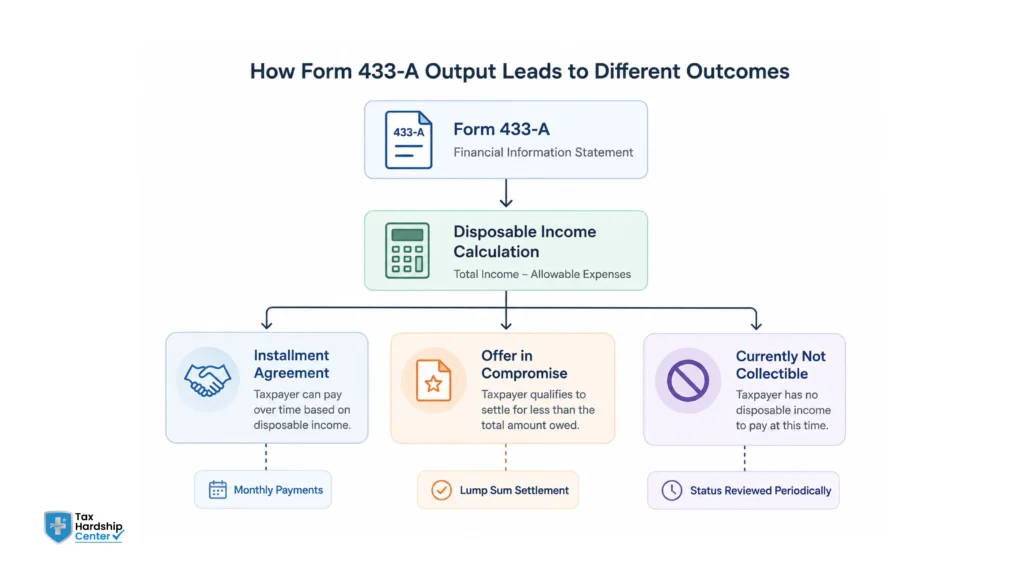
Once submitted, Form 433-A becomes the backbone of what the IRS calls your ability to pay. The agency subtracts your allowable expenses from your income to calculate disposable income, the amount left over each month that could go toward your tax debt.
That single number decides a lot. It can support a request for an installment agreement built around what you can actually afford, rather than a generic payment amount. It also plays a direct role in Offer in Compromise cases, where the IRS uses a version of this same financial analysis to calculate the minimum amount it will accept to settle your debt for less than you owe. You can review the qualification criteria for an Offer in Compromise to see how this connects to what you report on the 433-A.
If your disposable income shows you have nothing left after necessary expenses, the form can also support a request for Currently Not Collectible status, which pauses IRS collection activity. Not every relief option fits every situation, which is why it helps to see how a payment plan, an Offer in Compromise, and CNC status actually compare before deciding which one to pursue.
Common Mistakes That Slow Down or Sink a 433-A Submission
The most common problem is not dishonesty. It is incompleteness. Leaving a section blank instead of writing “N/A,” forgetting a bank account you rarely use, or undervaluing a vehicle or property can all trigger a request for additional verification, which restarts your timeline.
Another frequent issue is expense claims that exceed the IRS standards without any supporting documentation attached. The IRS does not automatically reject an above-standard expense, but it will ask you to prove it is necessary, and without that proof, the number gets adjusted down.
The last mistake is timing. Form 433-A only reflects a moment in time. If your income or expenses shift significantly before your case is resolved, an outdated 433-A can work against you instead of for you.
How Tax Hardship Center Helps Taxpayers Navigate IRS Form 433-A
Tax Hardship Center reviews Form 433-A submissions the way a Revenue Officer will, checking every section for gaps, unsupported expense claims, and numbers that will not reconcile against your bank records before the IRS ever sees them. That review happens before submission, not after a rejection letter shows up.
The team also handles the parts of the process that go beyond the form itself. That includes valuing real estate and vehicles correctly, documenting above-standard expenses with the right paperwork, and matching your completed 433-A to the right resolution path, whether that is an installment agreement, an Offer in Compromise, or Currently Not Collectible status. For a full breakdown of what filing involves for both individuals and businesses, the Form 433-A and 433-B guidance page walks through each section in more depth. If cost is part of what is holding you back from calling, the page on what tax relief services actually cost breaks down pricing before you commit to anything.
A financial statement that reconciles cleanly on the first submission moves faster through IRS review than one that gets flagged and sent back. That is the difference a proper review makes before the form ever leaves your hands.
FAQs
Do I have to file Form 433-A myself, or can someone help me?
You can complete it yourself, but the IRS holds you to the same accuracy standard either way. Many taxpayers work with a tax professional specifically because errors and omissions slow down the review process significantly.
What is the difference between Form 433-A and Form 433-F?
Form 433-A is longer and more detailed, typically required when a Revenue Officer is assigned. Form 433-F is a shorter version the IRS often accepts for simpler cases handled through its automated collection system.
How long does the IRS take to review a completed Form 433-A?
There is no fixed timeline, and it depends on your specific case type and whether a Revenue Officer is involved. Incomplete forms or unsupported expense claims typically add weeks to the process through follow-up requests.
Can I leave a section blank if it does not apply to me?
No. The IRS wants every line addressed, even if that means writing “N/A.” A blank section often gets treated as incomplete rather than not applicable.
Does Form 433-A affect whether I qualify for an Offer in Compromise?
Yes, directly. The financial information on your 433-A, or its OIC-specific version, is what the IRS uses to calculate your reasonable collection potential, which determines your minimum settlement offer.
What documents should I gather before starting Form 433-A?
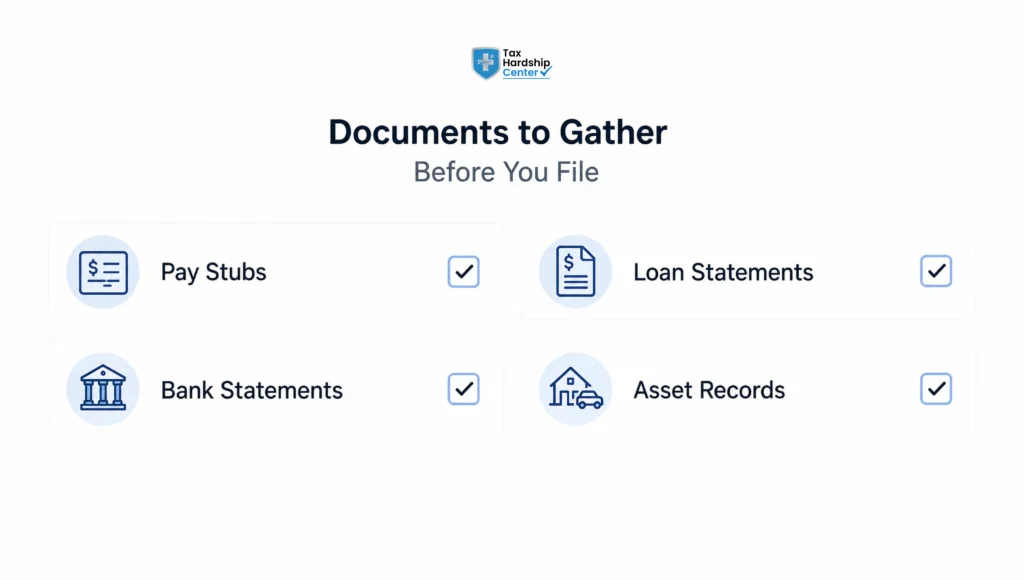
Recent pay stubs, at least three months of bank statements for every account, loan statements, retirement and investment statements, and documentation for any real estate or vehicles you own.
Conclusion
Form 433-A is not a formality. It is the document that decides how the IRS treats your case from this point forward. A complete, accurate, well-documented submission gives you a real shot at a payment plan or settlement that fits your actual finances. An incomplete or inconsistent one usually means more delay and less leverage.
Key Takeaways
- Form 433-A is the IRS Collection Information Statement for wage earners and self-employed individuals
- Not everyone needs to file it, many taxpayers qualify for a simpler online payment plan instead
- The form covers income, expenses, assets, and liabilities in significant detail
- The IRS compares your expenses against its own Collection Financial Standards
- Your disposable income calculation from this form drives installment agreement and Offer in Compromise decisions
- Incomplete sections and unsupported expense claims are the most common reasons for delay
- A version of this form also supports requests for Currently Not Collectible status
- Form 433-A (OIC) is a separate version used specifically for Offer in Compromise cases
- Outdated financial information can work against you if your case takes time to resolve
- Reviewing the form before submission catches errors before the IRS does
Get a Free Case Review
Before you submit Form 433-A, get it reviewed by a specialist who knows what the IRS is checking for. Get a free case review and find out which resolution option your numbers actually support.