
Your business owes the IRS money it genuinely cannot pay right now. Payroll comes first. Rent comes first. Keeping the lights on comes first. The tax bill sits there, growing, while you try to figure out how a company can be profitable on paper and broke in the bank account at the same time.
The IRS has one document that decides whether it believes that story. It’s called Form 433-B, and how you fill it out can be the difference between a payment plan you can actually afford and one that puts you right back where you started.
Here’s what it is, what it asks for, and how to use it to get real relief instead of a rejected request.
What Is IRS Form 433-B

Form 433-B, officially the Collection Information Statement for Businesses, is how a business proves to the IRS what it can and cannot afford to pay toward a tax debt. It covers assets, income, expenses, and liabilities for the business itself, separate from the personal finances of the owners.
The IRS uses this form to make three kinds of decisions. Whether to approve an installment agreement and at what monthly amount. Whether to place the account in Currently Not Collectible status, which pauses active collection. Or whether to accept an Offer in Compromise for less than the full balance owed.
This is not a form you fill out to explain your situation in general terms. It’s a form that produces a number, and that number decides what the IRS offers you next.
Who Actually Needs to File This Form
Form 433-B applies to partnerships, corporations, S corporations, LLCs classified as corporations, and other multi-member LLCs. If you’re a sole proprietor, you’re not off the hook, you’ll typically use Form 433-A instead, since a sole proprietorship isn’t a separate legal entity from you personally.
If your business is behind on payroll tax specifically, this form often comes up alongside a broader review of your options, including whether a small business IRS payment plan fits your cash flow better than a lump sum resolution.
What the IRS Is Looking For, Section by Section
The form breaks down into a few core areas, and each one is doing a specific job.
Business information. Basic identifying details, EIN, entity type, and whether the business engages in e-commerce. Simple, but skipping fields here is one of the fastest ways to get the form kicked back.
Business assets. Bank accounts, accounts receivable, investments, equipment, vehicles, and real property. Digital assets like cryptocurrency now have their own line, so if the business holds any, it needs to be disclosed.
Business income. Gross monthly income from sales, services, contracts, and any other revenue source, typically averaged over the last six to twelve months.
Business expenses. Necessary operating costs. Rent, utilities, supplies, payroll, current tax deposits. The IRS is specific about what counts as a legitimate expense here, and non-cash items like depreciation don’t count.
Monthly income and expense statement. This is where it all comes together into a single number, what’s often called your ability to pay. That number drives whatever resolution gets offered.
The Documents You Need Before You Start
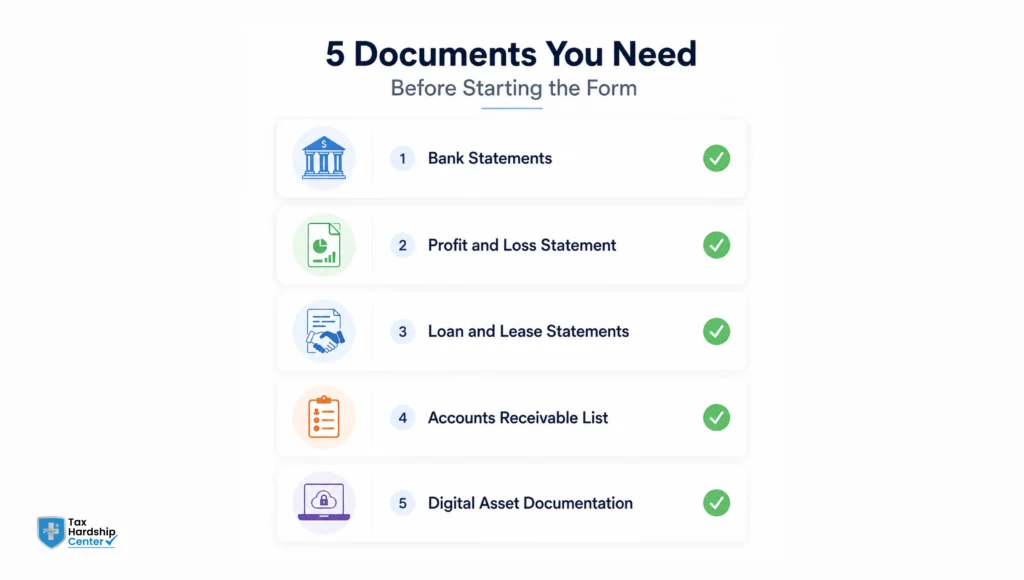
Trying to fill this out from memory is how businesses end up with numbers that don’t match what the IRS later asks to verify. Have these ready before you sit down with the form.
- The most recent six to twelve months of business bank statements
- A current profit and loss statement, or documentation to build one
- Loan and lease statements for any business debt
- A list of accounts receivable or outstanding contracts
- Documentation for any digital assets the business holds
If the business has fallen behind on multiple tax periods, gathering all of this at once can feel like a full-time project on top of running the company. This is where a Form 9465 installment agreement guide can help you understand how the payment side connects to what you’re reporting here.
The Mistake That Gets Business Hardship Requests Denied
The single biggest error businesses make on Form 433-B is understating expenses to make the hardship case look stronger, or overstating them to lower the ability-to-pay number. Both backfire.
The IRS cross-checks what you report against bank statements and tax filings. When the numbers don’t match, the request doesn’t just get denied, it can trigger a closer look at the whole account. Round numbers, missing months, and expenses that don’t show up anywhere in the bank statements are the fastest way to lose credibility with the revenue officer reviewing your file.
The businesses that get real relief are the ones that report accurately, including the uncomfortable parts, and let the actual numbers make the case. If your business has unfiled returns tangled up in this, resolving that first matters, since help with back taxes and IRS relief options usually needs to happen before a hardship request can move forward cleanly.
What Happens After You Submit Form 433-B
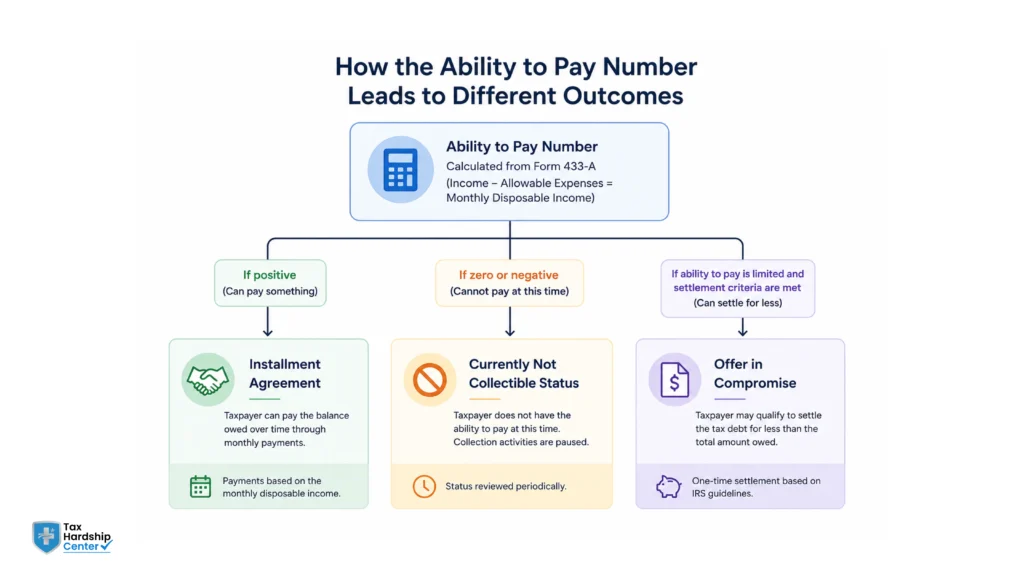
Once submitted, the IRS reviews the form against your documentation and calculates what the business can reasonably pay each month. From there, a few paths open up.
If the number shows genuine inability to pay anything, the account may be placed in Currently Not Collectible status, which pauses active collection but does not erase the debt or stop interest from accruing. If there’s some ability to pay but not the full balance, an installment agreement gets structured around that number. And if the business’s total asset and income picture supports it, this same financial statement often becomes the foundation for an Offer in Compromise to settle the debt for less than what’s owed.
Whichever direction it goes, comparing your installment plan options side by side before agreeing to anything is worth the extra hour it takes.
Form 433-B vs Form 433-A: Don’t Mix These Up
This trips up more business owners than almost anything else on the form. Form 433-B covers the business entity. Form 433-A covers you personally. If you own a vehicle that’s used for business, it goes on one form, not both, and listing it twice is a common error that slows down processing.
If your business structure is complicated enough that you’re not sure which form applies, or whether you need both, that’s usually a sign it’s worth getting a second set of eyes before you submit anything. Comparing what a tax attorney, CPA, or tax relief company actually does in a case like this can save you from filing something that has to be redone.
Why Businesses Trust Tax Hardship Center for IRS Form 433-B Relief
Tax Hardship Center works directly with business owners preparing Form 433-B, reviewing bank statements, profit and loss documentation, and asset records before anything gets submitted to the IRS, so the numbers hold up under review instead of triggering follow-up requests. The team builds the financial statement around what the business can actually document, not a guess at what sounds reasonable.
For businesses juggling multiple tax periods or payroll tax exposure alongside a hardship request, Tax Hardship Center coordinates the full resolution, from structuring installment agreements to preparing Offer in Compromise submissions when the numbers support it. The goal is getting the form right the first time, since a rejected 433-B often means starting the entire process over with a revenue officer who now has more questions.
FAQs
What is Form 433-B used for?
Form 433-B is the Collection Information Statement businesses use to report assets, income, and expenses so the IRS can determine ability to pay a tax debt.
Who needs to file Form 433-B instead of Form 433-A?
Partnerships, corporations, S corporations, and multi-member LLCs file Form 433-B. Sole proprietors typically use Form 433-A instead.
How long does the IRS take to review Form 433-B?
Review times vary by case complexity, but incomplete forms or unverifiable numbers can add weeks or months while the IRS requests additional documentation.
Can Form 433-B lead to Currently Not Collectible status?
Yes. If the financial statement shows the business genuinely cannot pay anything toward the debt, the IRS may place the account in CNC status, pausing active collection.
Does filing Form 433-B stop interest and penalties?
No. Even with an approved payment plan or CNC status, interest and applicable penalties continue to accrue on the unpaid balance.
What documents should I have ready before completing Form 433-B?
Recent bank statements, a profit and loss statement, loan documentation, accounts receivable records, and details on any digital assets the business holds.
Conclusion
Form 433-B is not a formality. It’s the document that tells the IRS whether your business genuinely cannot pay, and every number on it gets checked against your actual bank records. Getting it right the first time, with accurate figures and the right supporting documentation, is what turns a hardship claim into an approved resolution instead of a denial letter.
Key Takeaways
- Form 433-B is the Collection Information Statement businesses use to prove financial hardship to the IRS
- It applies to partnerships, corporations, S corporations, and multi-member LLCs, not sole proprietors
- The form covers business assets, income, expenses, and produces an ability-to-pay number
- That number determines whether you get an installment agreement, CNC status, or Offer in Compromise eligibility
- Gather bank statements, profit and loss records, and loan documentation before starting the form
- Inaccurate numbers get cross-checked against bank records and can trigger closer IRS scrutiny
- Vehicles and assets should be listed on either Form 433-A or 433-B, never both
- CNC status pauses collection but does not eliminate the debt or stop interest
- A rejected or incomplete 433-B often means starting the process over with more IRS scrutiny
- Accurate, well-documented numbers are what actually get hardship requests approved
Need help preparing Form 433-B for your business? Get a free case review with Tax Hardship Center before you submit your financial statement to the IRS.