
Falling behind on payroll and employment taxes feels different than owing personal income tax. The stakes are higher:
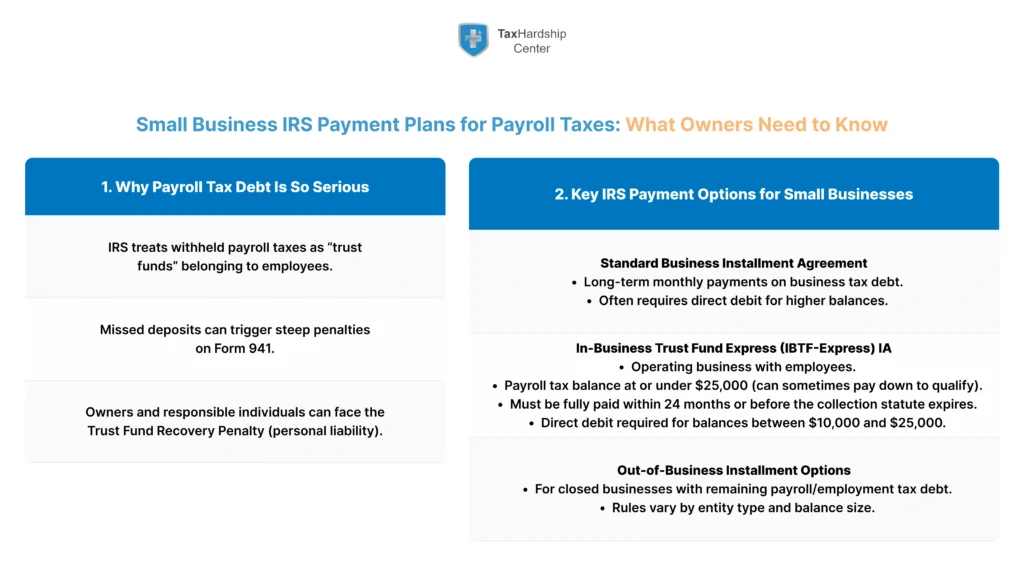
- The IRS sees payroll taxes as trust funds you withheld from employees.
- Missed deposits can trigger steep penalties and the Trust Fund Recovery Penalty (TFRP) against owners and responsible individuals.
The good news: there are structured tax payment plan options for small businesses, including business IRS payment plans and specialized payroll tax installment agreements. The challenge is choosing the right path before penalties snowball or the IRS escalates enforcement.
This guide explains:
- The main IRS payment plan options for business and payroll tax debt
- How the In-Business Trust Fund Express Installment Agreement works
- What the IRS looks for when approving employment tax debt payment plans
- Where a specialized firm like Tax Hardship Center fits in if you want professional help instead of negotiating alone
Why IRS Tax Payment Plans Matter So Much for Small Businesses
When a small business falls behind on payroll or employment taxes, the IRS responds more aggressively than with many other debts:
- Penalties stack quickly on Form 941 and related employment tax returns.
- The IRS may seize funds, file liens, or levy business accounts.
- Responsible individuals can be personally assessed via the Trust Fund Recovery Penalty.
An appropriate tax payment plan:
- Puts your business on a formal schedule to repay what’s owed
- Can prevent or pause certain levies and enforced collection, once approved and kept current
- Shows the IRS you are serious about fixing the problem and staying compliant going forward
For many owners, the choice is not between paying and not paying. It’s between closing the doors or using a realistic business IRS payment plan to buy time and preserve cash flow.
Understanding Employment and Payroll Tax Debt
Payroll/employment taxes include amounts your business must:
- Withhold from employee wages (income tax, Social Security, Medicare), and
- Match and remit as the employer portion of FICA and certain other employment taxes.
Unpaid payroll taxes create two layers of exposure:
- Business liability: The company owes the IRS.
- Trust fund liability: The “trust fund” portion (withheld from employees) can be personally assessed against owners and other responsible individuals under the Trust Fund Recovery Penalty (TFRP).
That’s why employment tax debt is considered one of the most serious types of back tax, even more sensitive than many income tax debts.
IRS Tax Payment Plan Options for Small Businesses
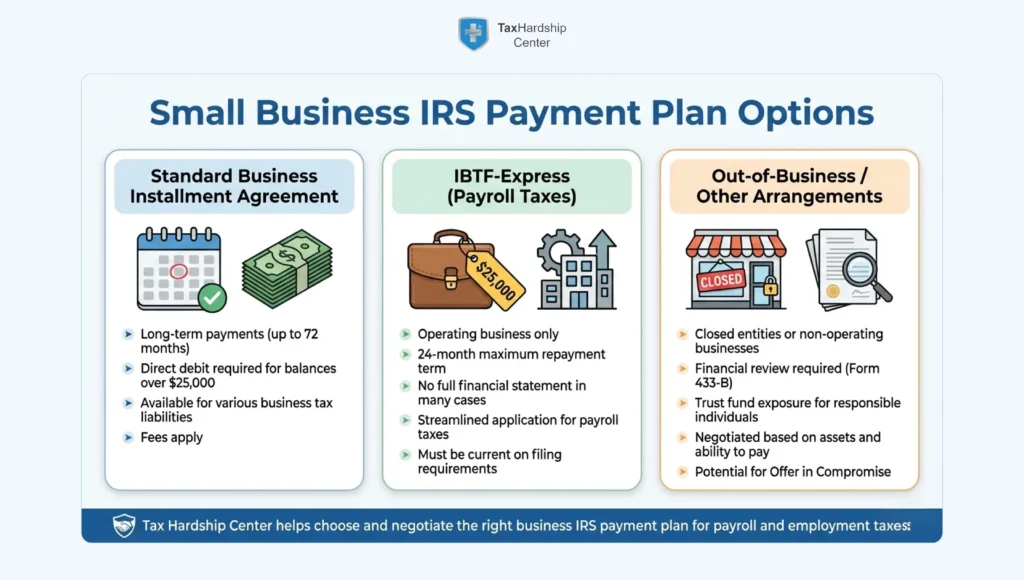
The IRS offers several business IRS payment plan options for back taxes, including payroll and employment tax. Key programs include:
1. Standard Long-Term Business Installment Agreement
Businesses with tax debt can request a long-term payment plan or an installment agreement to pay over time. According to IRS guidance:
- You request a monthly payment amount that will fully pay the balance within the allowed period.
- For businesses applying online, balances over $10,000 must be paid by Direct Debit.
- Setup fees apply (for example, a direct debit agreement established online currently has a lower setup fee than one established by phone or mail).
This type of plan can be used for income tax, employment tax, or other business liabilities, but payroll-specific rules may also apply (see below).
2. In-Business Trust Fund Express Installment Agreement (IBTF-Express IA)
For many small businesses with payroll tax debt, the most important program is the In-Business Trust Fund Express Installment Agreement.
This is designed for businesses that:
- We are currently operating and have employees
- Owe $25,000 or less in payroll taxes (you can sometimes pay down the balance to qualify)
- Can repay in full within 24 months or before the collection statute expires
- Are you current on all required filings and deposits
Advantages:
- Usually, no financial statement or complete financial verification is required
- Faster to set up than a fully documented installment agreement
- For balances between $10,000 and $25,000, direct debit is required, which the IRS prefers for reliability.
3. Streamlined / Other Business Installment Arrangements
In addition to IBTF-Express, businesses may qualify for:
- Standard long-term agreements up to certain thresholds (often around $25,000)
- Streamlined installment agreements for specific types of business income tax or penalty balances
- More complex non-streamlined agreements for larger balances, which generally require a Form 433-B financial statement and a deeper IRS review
The larger the employment tax debt, the more likely the IRS is to require full financial disclosure and active oversight.
Installment Options for Payroll and Employment Taxes
Let’s look specifically at payroll tax installment agreements for small businesses.
A. In-Business Trust Fund Express IA (IBTF-Express)
This is often the first choice for operating businesses with manageable payroll tax debt:
- Maximum total payroll tax balance (including penalties and interest): $25,000 at the time of agreement
- Full repayment is required within 24 months or before the collection statute expiration date
- Direct Debit required if the balance is between $10,000 and $25,000
If your balance is over $25,000, you may be able to pay it down to qualify.
B. Standard Business IRS Payment Plan
If you don’t fit into the IBTF-Express box, you may still set up a standard business IRS payment plan:
- Subject to broader balance thresholds and timelines
- Often requires more review, especially for larger employment tax debt
- May require Direct Debit, particularly for higher balances and online agreements
This is frequently used when:
- Payroll debt exceeds IBTF-Express limits
- There are multiple types of business debt (employment tax, income tax, etc.)
- The business needs a longer-term arrangement than 24 months.
C. Out-of-Business (Closed Business) Installment Agreements
If your business has closed but still has outstanding payroll or employment tax debt, you may qualify for a different set of streamlined rules depending on:
- Whether you are an entity (corporation, LLC) or a sole proprietor
- Total balance owed (standard thresholds are $25,000 or $50,000 for specific simplified plans)
These agreements are still serious and may affect your personal finances, especially regarding the trust fund portion.
How to Qualify for a Business IRS Payment Plan
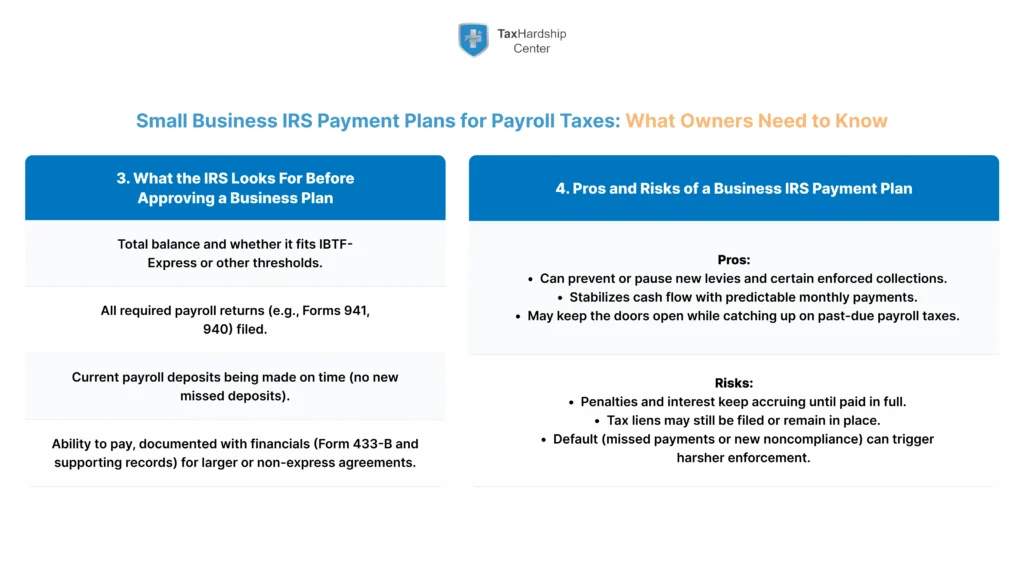
The IRS focuses on three main areas when assessing business IRS payment plan requests, especially for employment tax debt.
1. Balance and program thresholds
Eligibility depends heavily on how much you owe:
- Up to $25,000 in payroll tax debt → IBTF-Express may be available if other conditions are met
- Up to $25,000, $50,000 in certain business taxes → streamlined or standard installment agreements may still be possible, but with more scrutiny.
Above those levels, the IRS typically requires detailed financials and may discuss other collection alternatives.
2. Filing and deposit compliance
For payroll tax installment agreements, the IRS expects:
- All required returns filed (e.g., Forms 941, 940)
- Current deposits are being made on time (no new missed payroll tax deposits)
If you are still missing returns or not making current deposits, you’ll usually need to correct that before the IRS will finalize an agreement.
3. Ability to pay and documentation
For simplified programs such as IBTF-Express, the IRS may waive the requirement for complete financial statements. For other cases, they may require:
- Form 433-B, Collection Information Statement for Businesses
- Supporting documents (bank statements, AR aging, profit and loss statements, etc.)
Getting this right matters. Understating income or overstating expenses can cause delays, rejections, or even raise credibility concerns.
How to Request a Small Business IRS Payment Plan
There are three primary ways to request an IRS business payment plan for payroll and employment taxes.
1. Online Payment Agreement (OPA) for Businesses
The IRS Online Payment Agreement application now supports specific business payment plans. Generally:
- You can apply online for a long-term installment agreement if your business owes $25,000 or less in combined tax, penalties, and interest.
- Balances over $10,000 must typically be paid via Direct Debit.
This is often the fastest route for straightforward small business IRS payment plans within the thresholds.
2. By phone
You or your authorized representative can call:
- The number on your IRS notice, or
- The Business and Specialty Tax line (often used for IBTF-Express IA requests)
Phone negotiations are common when:
- Your balance is near or above thresholds
- The IRS has already assigned a Revenue Officer.
- You need to discuss payroll tax installment agreement specifics.
3. By mail using Form 9465
Some businesses still use Form 9465, Installment Agreement Request, to propose a tax payment plan:
- You indicate the balance owed, preferred monthly payment, and payment date.
- For more complex cases, this may accompany a Form 433-B financial statement.
However, for many small businesses, the online and phone routes are now preferred for speed and clarity.
Pros and Cons of Business Tax Payment Plans
Benefits
- Avoid or stop more aggressive enforcement
Once approved and kept current, an IRS installment agreement generally prevents new levies and similar collection actions. - Stabilize cash flow
A realistic tax payment plan gives you a predictable monthly obligation instead of unpredictable seizures. - Preserve the business
For many owners, a properly structured business IRS payment plan is the difference between survival and shutdown.
Drawbacks
- Penalties and interest continue
Entering an installment agreement does not stop penalties and interest; they continue until the balance is fully paid. - Liens may still be filed
Depending on your balance and history, the IRS may still file or maintain a Notice of Federal Tax Lien to protect the government’s interest. - Default risk
If you miss payments or fall behind on current deposits, your agreement can default, and enforcement can resume, often more aggressively.
Because of these factors, it’s critical to choose the right plan and payment amount from the start.
When a Payroll Tax Installment Agreement Is Not Enough
A payroll tax installment agreement is a powerful tool, but it doesn’t automatically solve every problem.
Consider:
- The Trust Fund Recovery Penalty can still be assessed personally on owners and responsible individuals. A business payment plan doesn’t erase that risk.
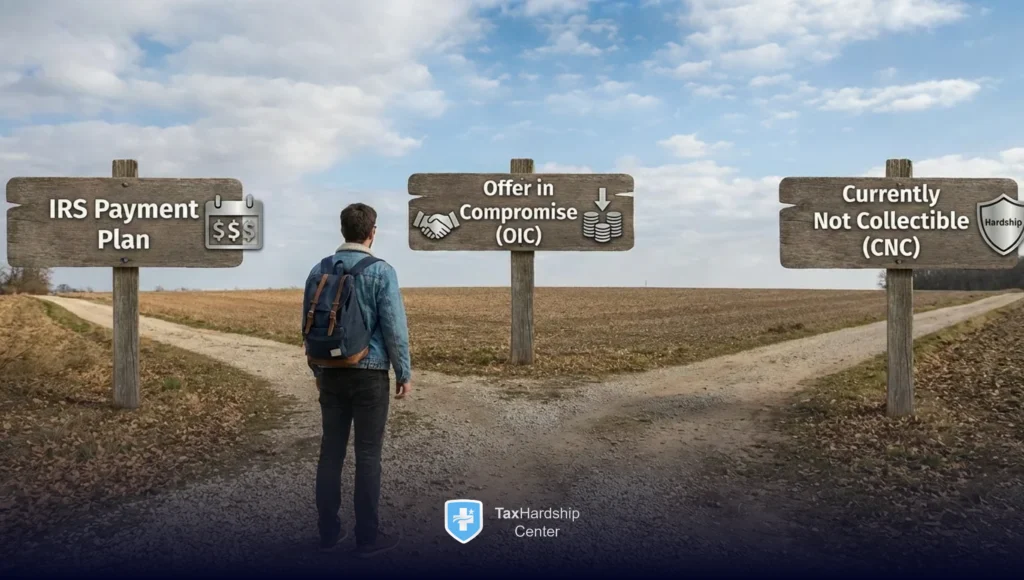
- In some cases, a business may also need to explore Offers in Compromise or other relief for the non-trust-fund portion of the liability.
- If your business cannot sustain any reasonable payment, you may need to discuss closure, asset sales, or hardship-based options with a professional.
This is where having experienced representation, just a form, becomes critical.
How Tax Hardship Center Helps With Employment Tax Debt
Tax Hardship Center is a nationwide tax problem resolution firm that works with both individuals and businesses, including those behind on payroll and employment taxes.
Focused support for business and payroll tax problems
According to its own materials and independent reviews, Tax Hardship Center:
- Provides dedicated Payroll Tax Debt Relief services to business owners behind on 941 and other employment tax obligations.
- Helps design and negotiate business IRS payment plans, including payroll tax installment agreements and IBTF-Express arrangements where appropriate.
- Assists with Trust Fund Recovery Penalty exposure analysis and strategy.
- Represents clients in all 50 states, handling communication with the IRS so owners can focus on running (or winding down) the business.
For smaller or mid-size balances, THC will often look first at installment options. For more complex or larger employment tax debt, they can coordinate broader strategies, including settlement efforts and penalty relief.
How their process works for small business IRS payment plans
While every case is different, their approach typically includes:
- Free consultation
- Review of your IRS notices, balances, and business situation
- Discussion of whether a business’s IRS payment plan, payroll tax installment agreement, or other relief (such as OIC) is realistic
- Investigation and protection phase
- Obtaining IRS transcripts and account histories
- Confirming exact balances and periods for employment tax debt
- Communicating with the IRS to stabilize the case and reduce immediate pressure
- Resolution design and negotiation
- Determining whether you qualify for IBTF-Express, a standard business payment plan, or another program
- Preparing any necessary forms (e.g., Form 9465, Form 433-B) and supporting documentation
- Negotiating directly with the IRS for workable payment terms based on your actual cash flow
- Ongoing compliance support
- Helping you stay current with deposits and filings
- Adjusting strategy if your business conditions change
FAQs: Small Business IRS Payment Plans and Payroll Tax Debt
1. Can my small business get an IRS payment plan for payroll tax debt?
Yes. The IRS does offer tax payment plan options for employment tax debt, including:
Standard business IRS payment plans, and
The In-Business Trust Fund Express Installment Agreement for qualifying payroll tax balances.
Eligibility depends on your balance, compliance, and ability to pay.
2. What is the In-Business Trust Fund Express Installment Agreement?
It’s a simplified payroll tax installment agreement for operating businesses that:
Owe $25,000 or less in payroll taxes (including penalties and interest)
Can pay in full within 24 months
Are you current on all required tax filings and deposits
No full financial statement is usually required, which can make it faster and less intrusive.
3. Does a business’s IRS payment plan stop all IRS enforcement?
An approved IRS installment agreement typically stops new levies and garnishments as long as you:
Make payments as agreed
Stay current with new filings and deposits
However:
Existing liens may remain, and
The IRS can still assess the Trust Fund Recovery Penalty personally if warranted.
4. Can I negotiate a payroll tax installment agreement myself?
You can, and many owners start by calling the IRS or using the Online Payment Agreement tool. But for employment tax debt, the stakes are high:
Penalties escalate quickly
Personal liability through TFRP is possible
A poorly structured plan can fail and put you in a worse position
That’s why many businesses choose to work with a dedicated tax relief firm like Tax Hardship Center to negotiate a realistic, sustainable agreement.
5. When should I call Tax Hardship Center about my business tax payment plan?
Consider contacting Tax Hardship Center if:
You owe $7,500 or more in back taxes (business or personal)
You’re behind on payroll tax deposits or 941 payments
The IRS has sent notices about levies, liens, or the Trust Fund Recovery Penalty
You’re unsure which business IRS payment plan or strategy fits your situation
They can review your case, explain your realistic options, and, if you move forward, handle the IRS side of the process so you can concentrate on running your business.
If your small business is struggling with employment tax debt, the worst thing you can do is ignore it. The second-worst thing is rushing into a payment plan your business can’t sustain.
Taking the time to understand your IRS payment options and, if needed, partnering with a firm like Tax Hardship Center can turn a potentially devastating payroll tax problem into a structured, manageable path back to compliance.