

Can IRS take inheritance money if you owe back taxes? Yes. Once someone passes away and you have a legal right to inherit, a federal tax lien can attach to your share, and the IRS can levy it from the estate or from your bank account after it’s paid. If the tax debt belonged to the person who died, it’s paid from the estate first, and heirs usually aren’t personally liable.
That’s the answer. Now here’s how it actually plays out. Your grandmother leaves you $60,000.
For a second, you breathe. Finally, something good. Then you look at the stack of IRS letters you’ve been avoiding for three years.
And the question hits you before the grief even settles: can IRS take inheritance money that was meant to help you? Let’s walk through it honestly.
TL;DR
- Can IRS take inheritance money from someone who owes back taxes? Yes, once you have a legal right to it.
- A federal tax lien attaches to your interest in the estate, even before the money reaches you.
- An IRS inheritance levy can be served on the executor or on your bank after the deposit.
- Refusing (disclaiming) the inheritance does not defeat a federal tax lien.
- If the deceased owed the IRS, the estate pays first. Heirs are generally not personally liable unless they received assets before the debt was paid.
Table of Contents
- Can IRS Take Inheritance Money If You Owe Back Taxes?
- When Does the IRS Actually Reach Your Inheritance?
- Can You Refuse the Inheritance to Keep It From the IRS?
- What If the Person Who Died Owed the IRS?
- How Does an Inheritance Affect a Payment Plan, CNC, or Offer in Compromise?
- What Mistakes Make an IRS Inheritance Levy More Likely?
- How Tax Hardship Center Protects Your Inheritance From IRS Collection
- Conclusion
- FAQs
- Key Takeaways
Can IRS Take Inheritance Money If You Owe Back Taxes?
Short answer: yes.
When you owe back taxes and ignore the notices, the IRS can file a federal tax lien. That lien attaches to everything you own and everything you have a right to own.
An inheritance counts.
The moment the person passes and you’re named in the will (or entitled under state law), you have a property interest in that estate. The IRS doesn’t need to wait for the check.
So can IRS take inheritance money before you even see it? In many cases, yes. That’s what makes inheritance IRS debt so stressful. You’re not just worried about a future paycheck. You’re worried about something you haven’t even received.
When Does the IRS Actually Reach Your Inheritance?
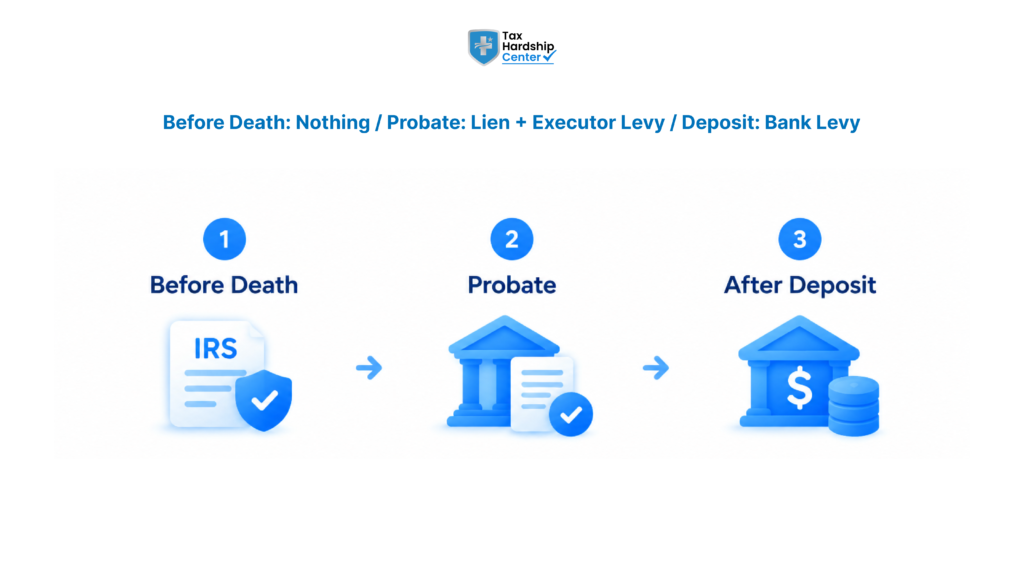
Timing changes everything, especially with IRS debt related to inheritance. Here’s how an IRS inheritance levy usually lines up with the life of an estate:
| Stage | What the IRS can do |
| Before the person dies | Nothing. You have no legal right to the money yet |
| During probate | Lien attaches to your share. The IRS can serve a levy on the executor |
| After distribution | The money is yours. The IRS can levy your bank account |
During Probate
If you’ve already received a final notice of intent to levy (Letter 1058 or LT11), the IRS can serve a levy directly on the executor. Your share then goes to the IRS instead of to you.
The executor doesn’t get to say no. Once served, they’re required to honor the levy.
After the Money Hits Your Account
Once the inheritance is deposited, it’s just money in your account. And a bank levy can freeze it. The bank holds the funds for 21 days before sending them to the IRS.
So can the IRS take inheritance money after it’s in your account? Yes. That 21-day window is your time to act.
Can You Refuse the Inheritance to Keep It From the IRS?
This is the move a lot of people think is clever.
“I’ll just disclaim it. Let it pass to my sister instead. The IRS can’t take what I never accepted.”
Unfortunately, the Supreme Court already shut that door.
In Drye v. United States, the Court held that disclaiming an inheritance does not defeat a federal tax lien. State law might protect a disclaimer from ordinary creditors. It doesn’t protect it from the IRS.
So can the IRS take inheritance money you tried to refuse? Yes. Disclaiming won’t erase the inheritance IRS debt problem. It can just create a messier one, with your relative caught in the middle.
What If the Person Who Died Owed the IRS?
Now flip the situation. You don’t owe anything. Your dad did.
Here’s the good news: the debt doesn’t automatically become yours. The estate pays the deceased’s taxes before anything gets distributed to heirs. If the estate doesn’t have enough, the IRS generally can’t come after you for the shortfall just because you’re family.
But there are exceptions:
→ The executor paid heirs first. If assets were distributed before the IRS was paid, heirs may be liable for the amount they received. The executor can be personally liable too.
→ You filed joint returns with the deceased. Joint return debt is yours as well. If you believe that debt shouldn’t be yours, innocent spouse relief may be worth exploring.
→ Unpaid federal estate tax. Rare, since the filing threshold is $15 million for 2026, but beneficiaries can be held liable up to the value received.
And if you’re wondering whether you’ll owe income tax on the inheritance itself, the IRS guidance on gifts and inheritances is clear: inherited property generally isn’t taxable income. Selling it at a gain, or withdrawing from an inherited IRA, can be.
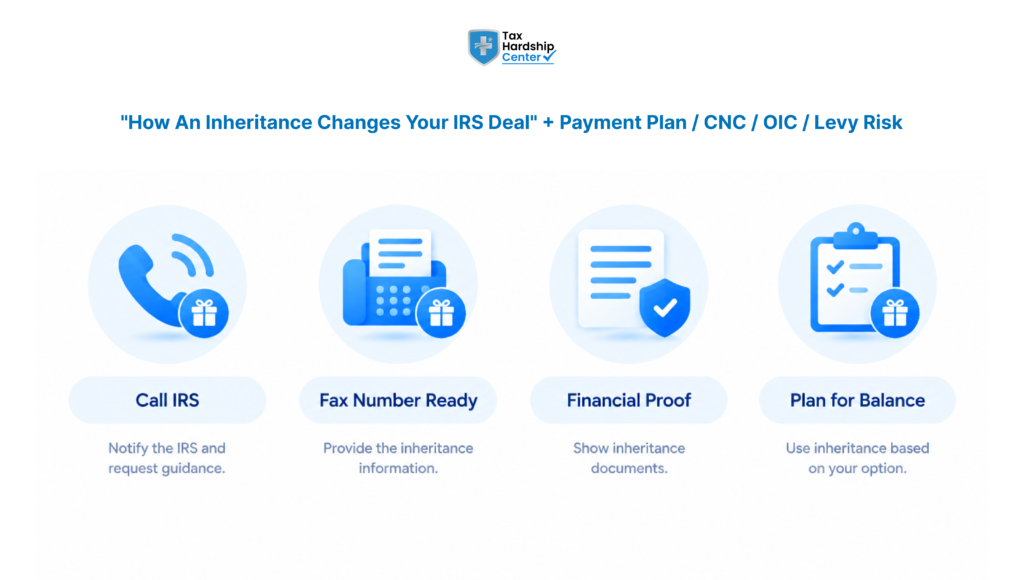
How Does an Inheritance Affect a Payment Plan, CNC, or Offer in Compromise?
This is the part nobody warns you about.
Can the IRS take inheritance money if you’re already on a payment plan or in a hardship status? It can affect everything.
Installment agreement: An IRS installment agreement is based on your ability to pay. A sudden inheritance changes that. The IRS may expect a lump-sum payment toward the balance.
Currently Not Collectible: CNC status exists because you can’t pay right now. An inheritance can end that status fast.
Offer in Compromise: An Offer in Compromise is calculated on your assets and future income. A pending inheritance raises what the IRS thinks you can afford. Ignoring it during an offer can get the offer rejected or reversed.
None of this means you should hide the inheritance. Hiding assets turns an inheritance IRS debt problem into a much bigger legal one.
It means you need a plan before the money moves.
What Mistakes Make an IRS Inheritance Levy More Likely?
Most people don’t lose their inheritance because the law forced it.
They lose it because of avoidable mistakes:
- Ignoring IRS notices until the estate closes. By then, a levy may already be waiting at the executor’s desk.
- Disclaiming to “protect” the money. As Drye showed, this doesn’t work against a federal tax lien.
- Depositing into your usual account. If your inheritance IRS debt is already at the levy stage, the IRS knows where you bank.
- Not telling the IRS during an active offer or CNC review. Hidden assets can kill an offer and trigger penalties.
- Spending it before resolving the debt. You lose the leverage that money could have bought you in negotiations.
An IRS inheritance levy isn’t inevitable. But it’s a lot more likely when you wait.
How Tax Hardship Center Protects Your Inheritance From IRS Collection
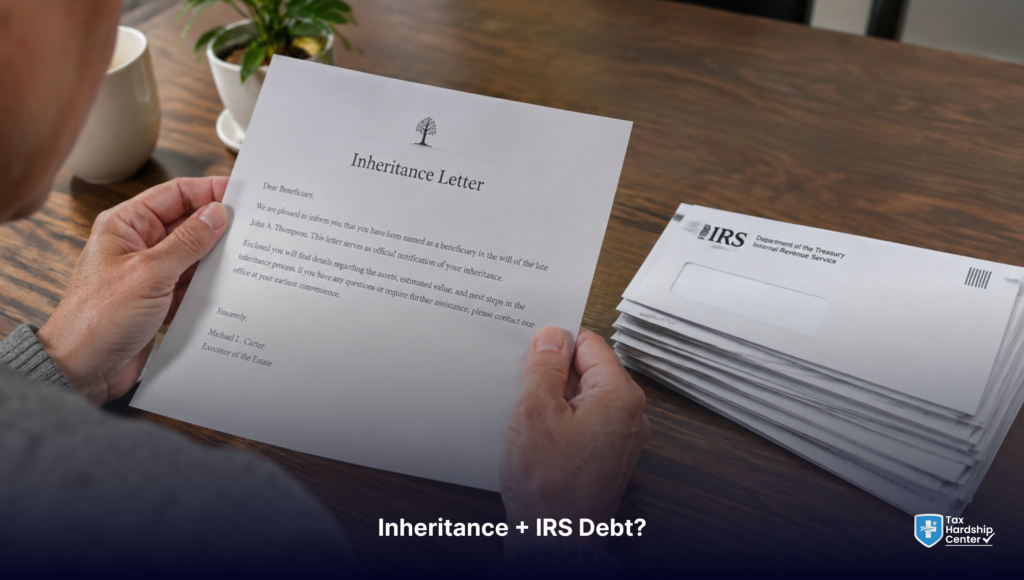
When you’re asking “can IRS take inheritance money in my situation,” you need a real answer, not a general one. Tax Hardship Center starts by pulling your IRS account transcripts to see what you actually owe, whether a lien has been filed, and how close you are to an IRS levy on your inheritance. If the estate is still in probate, we know how much time you have before the IRS can reach the executor.
Then we use that inheritance strategically rather than lose it. That might mean using part of it to negotiate a lower lump-sum resolution through an Offer in Compromise, setting up a structured installment agreement before the IRS demands everything, or requesting a levy release if a levy has already been placed on your account. If a lien is blocking the estate from closing, we work on lien withdrawal or discharge so the rest of the family isn’t stuck.
We’ll also tell you what we can’t do. If the law lets the IRS reach your share, we won’t promise otherwise. What we can do is make sure your inheritance IRS debt is resolved on terms you choose, not terms the IRS sets after the money is already gone.
FAQs
Can IRS take inheritance money before it’s distributed?
Yes. If you owe back taxes, a federal tax lien attaches to your interest in the estate. The IRS can serve a levy on the executor, so your share goes to the IRS instead of to you.
Can I disclaim an inheritance to avoid the IRS?
No. In Drye v. United States, the Supreme Court held that disclaiming doesn’t defeat a federal tax lien. The IRS can still reach the value of what you disclaimed.
Am I responsible for my parent’s IRS debt?
Generally no. Can IRS take inheritance money from you for a parent’s debt? Only in limited cases, because the estate pays the deceased’s taxes first. You could be liable only if you filed joint returns with them or received estate assets before the IRS was paid.
Is an inheritance taxable income?
Usually not. Inherited property isn’t taxable when you receive it. Gains from selling it, and withdrawals from an inherited IRA, can be taxable.
Can IRS take inheritance money from a joint account?
It can levy funds in a joint account if you have a right to withdraw them. The other account holder may have to prove their share to get it released.
What happens to my Offer in Compromise if I inherit money?
An inheritance increases your ability to pay. The IRS may reject a pending offer or ask for more. Hiding it can lead to the offer being revoked later.
How do I stop an IRS inheritance levy?
Act before the estate distributes. A payment plan, a levy release request, a Collection Due Process hearing, or a resolution using part of the inheritance can all stop or limit collection.
Conclusion
So, can IRS take inheritance money if you owe back taxes?
Yes. And it can start before the check ever reaches you.
But you’re not powerless. Know where the estate is in probate, know where you stand with the IRS, and make a plan before the money moves. An inheritance can either disappear into a levy or become the thing that finally closes your tax debt.
The difference is timing.
Key Takeaways
- Can IRS take inheritance money if you owe back taxes? Yes, once you have a legal right to it.
- A federal tax lien attaches to your share of an estate even before distribution.
- An IRS inheritance levy can be served on the executor during probate.
- After deposit, a bank levy can freeze inherited funds for 21 days.
- Disclaiming an inheritance does not defeat a federal tax lien.
- The deceased’s tax debt is paid from the estate before heirs receive anything.
- Heirs are generally not liable unless they filed jointly or received assets too early.
- An inheritance can end CNC status and change Offer in Compromise terms.
- Hiding an inheritance from the IRS makes inheritance IRS debt far worse.
- Using part of an inheritance to negotiate a resolution often protects the rest.
Inherited money and owe the IRS? Let a tax specialist check where you stand and how to protect what you’ve been left.
Click here to get a quote and a free case review
Call us at 844-427-5100 to speak to a tax specialist today.