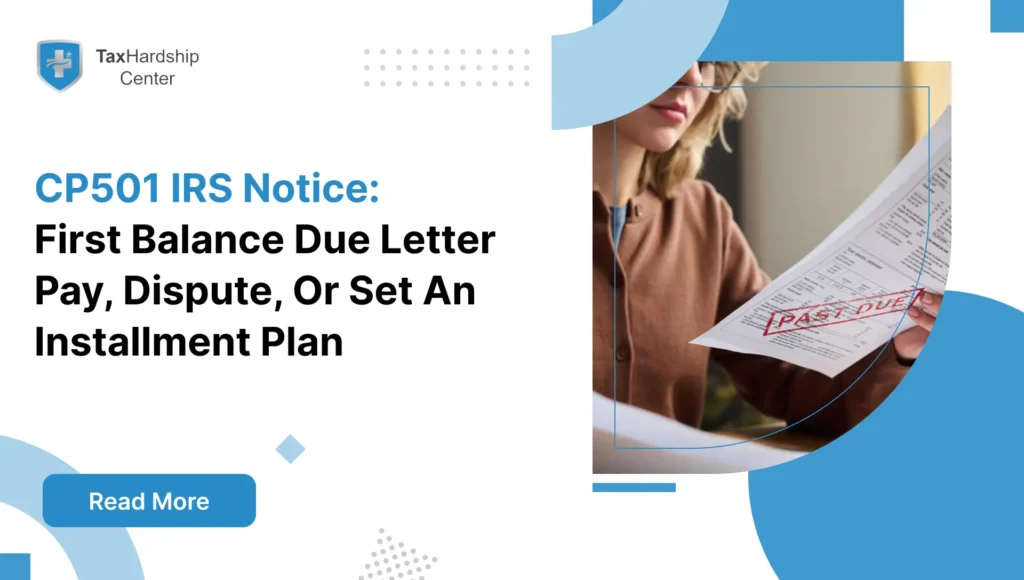

That first IRS balance-due letter can feel like a warning siren, even when you thought you were done with taxes for the year.
CP501 is often the IRS’s first reminder that a balance is still open. The good news is that this stage is usually very fixable, as long as you respond the right way and do not let it sit.
What A CP501 IRS Notice Means
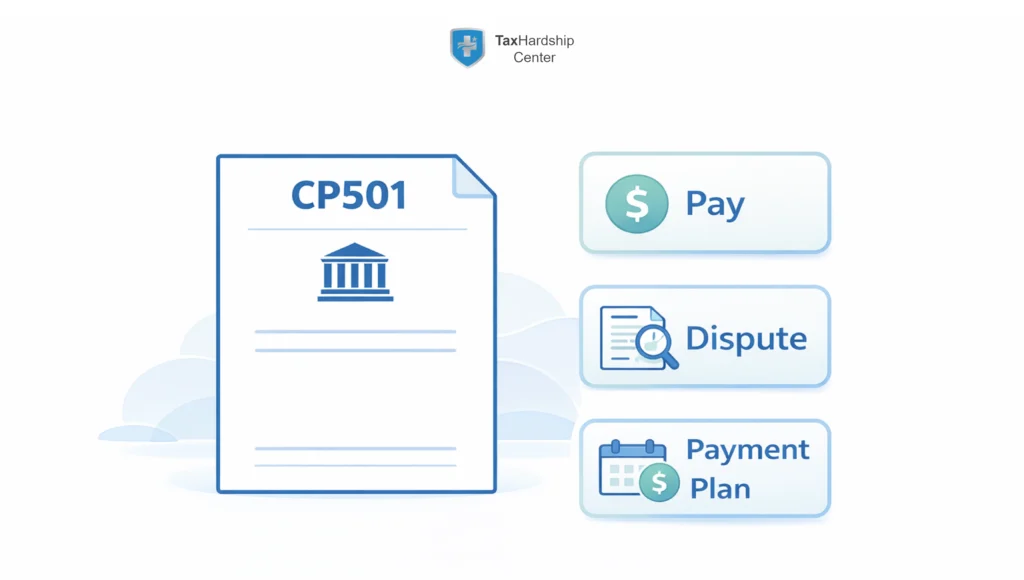
CP501 is a reminder that you have a balance due on one of your IRS tax accounts. The IRS sends it when it has not received your payment (or a response to the earlier payment request).
The Taxpayer Advocate Service describes CP501 as the “1st Notice” for a balance due, meaning it is an early collection notice that gives you time to address the balance before the IRS escalates to stronger actions.
Why You Received CP501
Most CP501 notices are triggered by one of these situations:
- You filed a return with a balance due and did not pay in full by the deadline.
- The IRS made an adjustment (for example, an assessed change) and the balance remained unpaid.
- The IRS sent a prior notice, but it did not receive payment or a response.
Do This First: A Quick CP501 Checklist
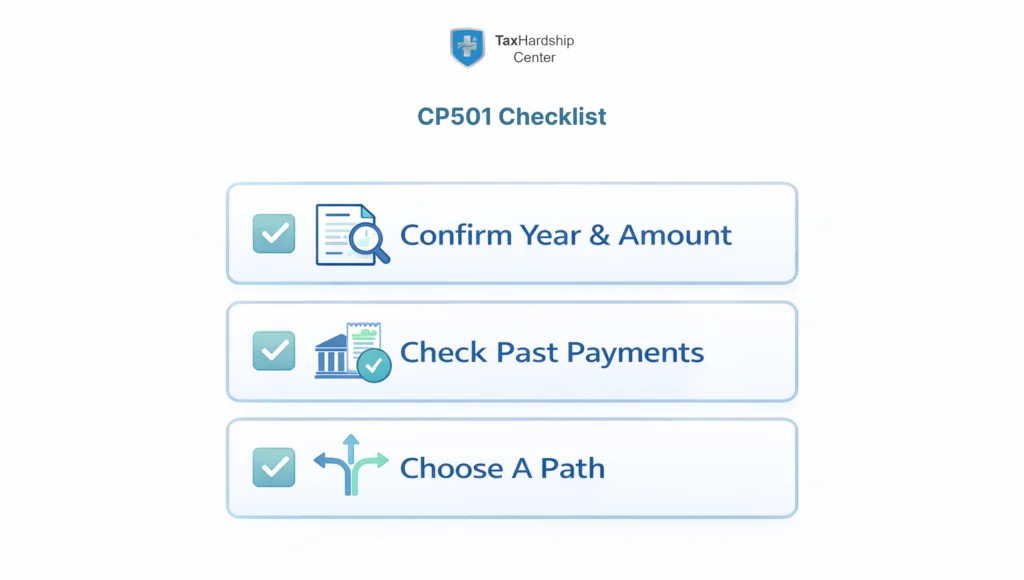
Before you pay, dispute, or set up a plan, do these quick steps first. They reduce the chance of paying the wrong amount or missing something important.
1) Confirm The Notice Is Really From The IRS
Use the IRS phone number shown on the notice and compare the notice details with your IRS Online Account if you have one.
2) Verify Three Details
- The tax year listed
- The balance due
- The payment due date shown on the notice
3) Check Whether The Balance Might Be Wrong
If you already paid, recently filed an amended return, or believe the IRS posted something incorrectly, do not assume the IRS updated the account. The IRS specifically instructs you to contact them if you disagree.
4) Decide Which Path You Are Taking
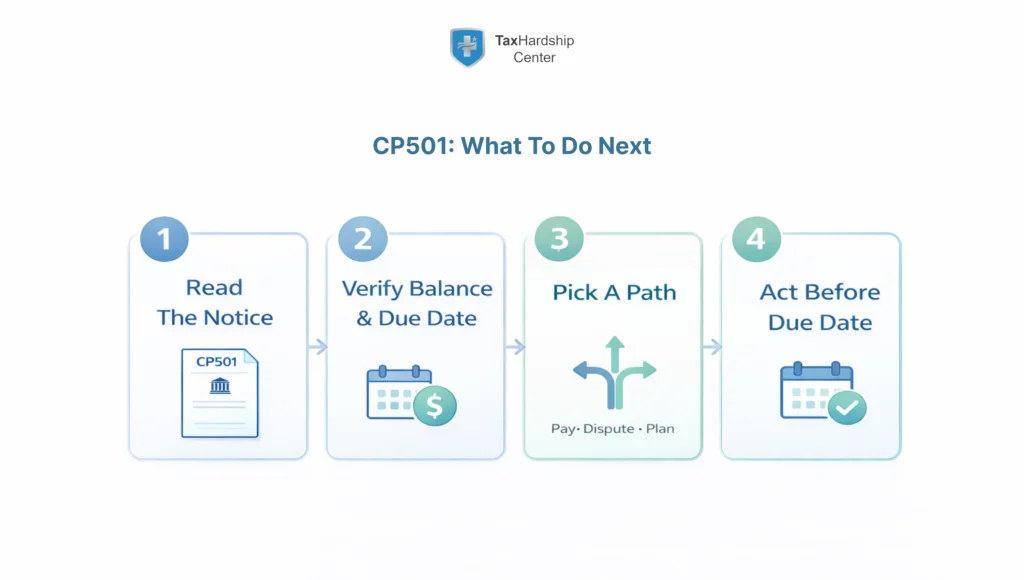
The IRS outlines the basic paths clearly: pay by the due date, set up a payment plan if you cannot pay in full, or call if you disagree.
Option 1: Pay The Balance (Fastest Fix)
If you can pay the full amount, this is usually the cleanest outcome. The IRS instructs you to pay by the due date shown on the notice and notes you can pay online or mail a payment using the envelope provided.
Practical tip that helps people avoid posting issues: the IRS tells you to include the bottom part of the notice with your payment so it is credited correctly.
Option 2: Dispute The Amount Or Correct An Error
If the CP501 amount is wrong, handle it quickly and cleanly.
When Disputing Makes Sense
- The balance does not match what you filed.
- You paid, but it is not showing correctly.
- The IRS made changes you disagree with.
What To Do If You Disagree
The IRS instructs you to call the toll-free number on your notice if you disagree, and to have paperwork ready such as canceled checks or an amended return.
If you need to correct your return, the IRS points to filing Form 1040-X (Amended U.S. Individual Income Tax Return).
Option 3: Set An Installment Plan (Payment Plan)
If you cannot pay in full, the IRS encourages you to set a payment plan.
How An Installment Plan Helps At The CP501 Stage
A payment plan helps you move from “unresolved balance” to an active arrangement. That typically reduces the chance your account escalates into more aggressive collection steps later.
Step-By-Step: IRS Online Payment Agreement
For many taxpayers, the fastest method is applying online.
- Go to the IRS Online Payment Agreement application
- Complete the application and choose your plan type
- Save the confirmation for your records
The IRS notes you typically receive immediate notification of approval after completing the online application.
Short-Term Vs Long-Term Plans (Simple Guide)
The IRS describes two common plan categories:
- Short-term payment plan: generally for taxpayers owing under the listed threshold who can pay within 180 days.
- Long-term payment plan (installment agreement): generally for taxpayers owing $50,000 or less in combined tax, penalties, and interest, and who have filed required returns.
If You Cannot Apply Online
The IRS allows taxpayers to request an installment agreement using Form 9465, and notes you will generally receive a response after submitting the form.
What Happens If You Ignore CP501
CP501 is early, but ignoring it can make things more expensive and more stressful.
The IRS states that if you do not pay, make arrangements, or contact them, they can file a Notice of Federal Tax Lien. It also notes interest accrues on unpaid balances and additional penalties may apply.
For clarity on what a federal tax lien is, the IRS explains it files a public document (Notice of Federal Tax Lien) to alert creditors that the government has a legal right to your property.
When To Call A Professional
Many CP501 cases are straightforward. Professional help becomes valuable when:
- You have multiple years involved, or multiple IRS notices are arriving close together.
- The balance is large enough that you are unsure which IRS option you qualify for.
- You believe the IRS is wrong and you need a clean documentation strategy.
- You want someone to negotiate or communicate with the IRS consistently so deadlines do not slip.
FAQs
Is CP501 A Serious Notice
CP501 is an early balance-due reminder, but it should not be ignored. The IRS notes that failure to pay or make arrangements can lead to a federal tax lien, and interest and penalties can continue to grow.
Is CP501 The First IRS Bill
CP501 is commonly treated as the first reminder notice for a balance due. The Taxpayer Advocate Service refers to it as the “1st Notice – Balance Due.”
Can I Set Up A Payment Plan From A CP501 Notice
Yes. The IRS specifically directs taxpayers to make a payment plan if they cannot pay the full amount owed, including applying through the online payment agreement application.
What If I Disagree With The CP501 Amount
The IRS instructs you to call the toll-free number shown on the notice and have documents ready (for example, canceled checks or an amended return).
Can I Appeal At The CP501 Stage
The IRS CP501 guidance notes you may be able to request an appeal under the Collection Appeals Program (CAP) before collection action takes place by following the instructions on your notice.
Conclusion
A CP501 notice is your early opportunity to resolve a balance due before the IRS filing becomes more difficult to manage. Start by verifying the year, amount, and due date, then choose one clear path: pay it, dispute it with documentation, or set an installment plan you can maintain.
If you address CP501 now, you are far more likely to avoid lien risk, prevent additional penalties and interest from stacking up, and keep the situation from escalating into more urgent collection letters.
Key Takeaway
- CP501 is an early IRS reminder that you have a balance due on a tax account.
- Your best options are to pay by the due date, set up a payment plan, or contact the IRS quickly if the notice is wrong.
- If you cannot pay in full, the IRS Online Payment Agreement is a common fast path, and you may receive immediate approval notification after applying online.
- Ignoring CP501 can lead to continuing interest and penalties, and potentially a Notice of Federal Tax Lien.
- If your balance is complex, disputed, or spread across multiple years, professional guidance can help you stabilize the account before it escalates