

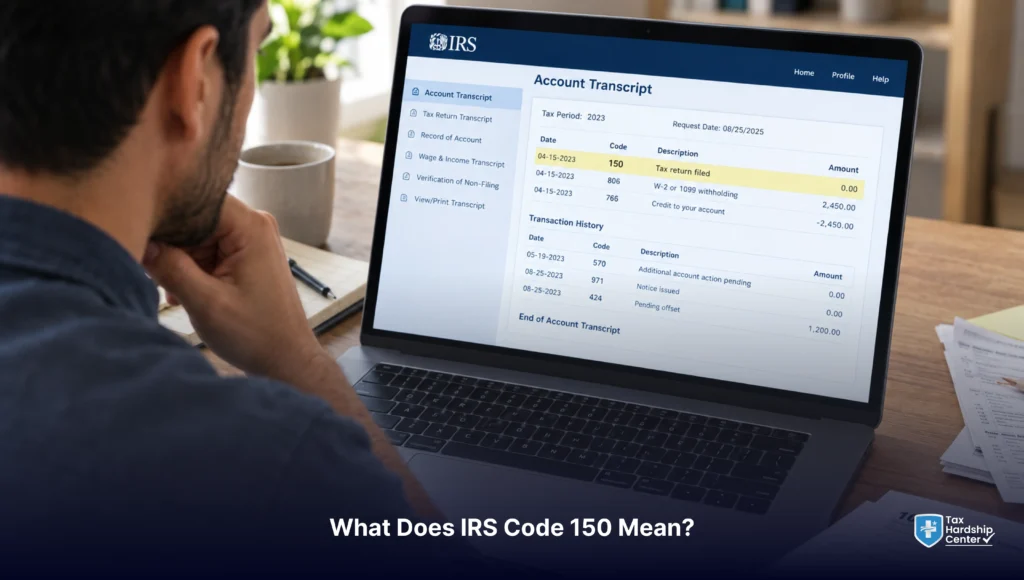
If you pulled your IRS transcript and spotted irs code 150 near the top, that’s not something to panic over. IRS code 150 simply means your tax return has been filed and processed, and it shows your total tax liability for the year based on what you reported. Whether you see code 150 with 0 balance, a positive number, or a future-dated code 150, each version tells you something slightly different about where your return actually stands.
Table of Contents
- IRS Code 150: What It Actually Represents
- Code 150 with 0 Balance: What This Specifically Means
- Code 150 Future Date: Why the Date Doesn’t Match Today
- Code 150 Amount: Reading the Number Correctly
- How Code 150 Fits Into the Rest of Your Transcript
- When IRS Code 150 Signals Something Worth Checking
- How Tax Hardship Center Helps When Transcript Codes Are Confusing
IRS Code 150: What It Actually Represents
IRS code 150 stands for “tax return filed” and represents the point at which the IRS has officially processed your return and established your total tax liability for the year. This is one of the very first codes to appear on your account transcript once your return moves from submitted to processed, and it essentially confirms the IRS has your return on record and has calculated what you owe based on it.
Seeing irs code 150 on your transcript is a good sign in the sense that it means your return isn’t sitting unprocessed. It’s been received, reviewed at a basic level, and logged into the system. From here, other codes will start appearing underneath it, reflecting credits, withholding, and eventually a refund or remaining balance.
Code 150 with 0 Balance: What This Specifically Means
Seeing code 150 with 0 balance next to it often confuses people who expect a dollar figure. This actually means your reported tax liability for the year came out to zero, meaning based on your income, deductions, and credits, you didn’t owe any federal tax before withholding and other credits are factored in.
This is common for people whose income was low enough that their standard deduction and credits brought their liability down to nothing, or for certain filing situations where deductions offset income entirely. Code 150 with 0 balance doesn’t mean your return wasn’t processed correctly. It simply reflects that your calculated tax liability, before withholding credits are applied, landed at zero for the year in question.
Code 150 Future Date: Why the Date Doesn’t Match Today
This is one of the more common points of confusion. If you see a code 150 future date, meaning the date listed next to the code is later than today’s date, this isn’t an error and it doesn’t mean anything is wrong with your return. The date associated with code 150 reflects the IRS’s processing cycle date, not the day your return was physically reviewed.
The IRS processes returns in weekly batches, and the code 150 future date represents the cycle in which your return is scheduled to formally post to the master file, even if the actual review happened earlier. Seeing a date a week or two ahead of today is completely normal and simply reflects how the IRS’s internal processing calendar works, not a delay or a problem with your specific return.
Code 150 Amount: Reading the Number Correctly
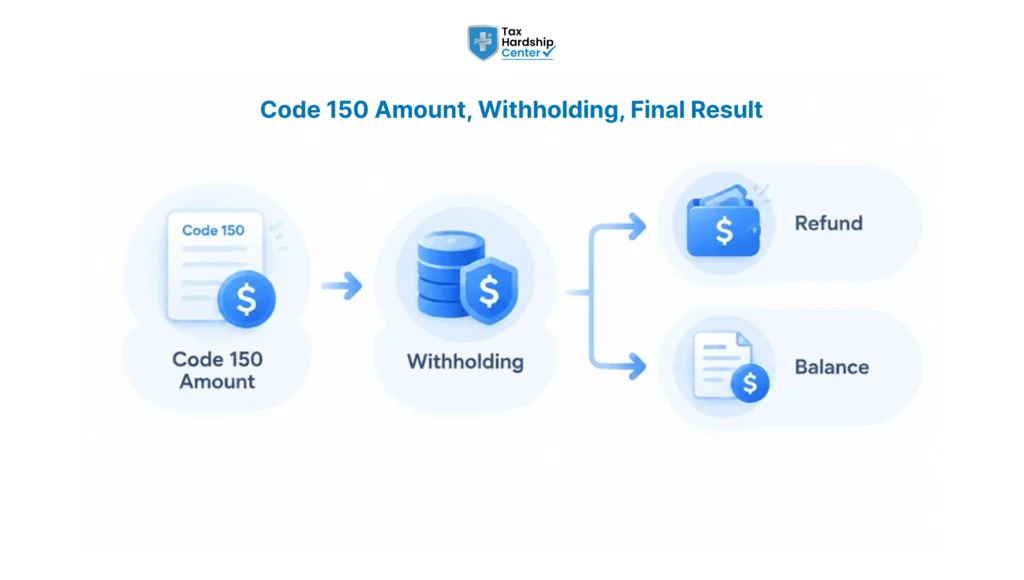
The code 150 amount listed on your transcript represents your total tax liability for the year, calculated from your reported income after deductions and credits are applied, but before withholding is subtracted. This is an important distinction, since the code 150 amount is not your refund and it’s not necessarily your final balance owed.
Think of the code 150 amount as the starting point in a larger calculation. From there, your withholding, shown under a separate code, gets applied as a credit. If your withholding exceeds the code 150 amount, you’re due a refund. If it’s less, you’ll owe the difference. Reading the code 150 amount in isolation without checking the corresponding withholding entry only gives you half the picture, which is why it’s worth reviewing your full transcript together rather than fixating on one line.
How Code 150 Fits Into the Rest of Your Transcript
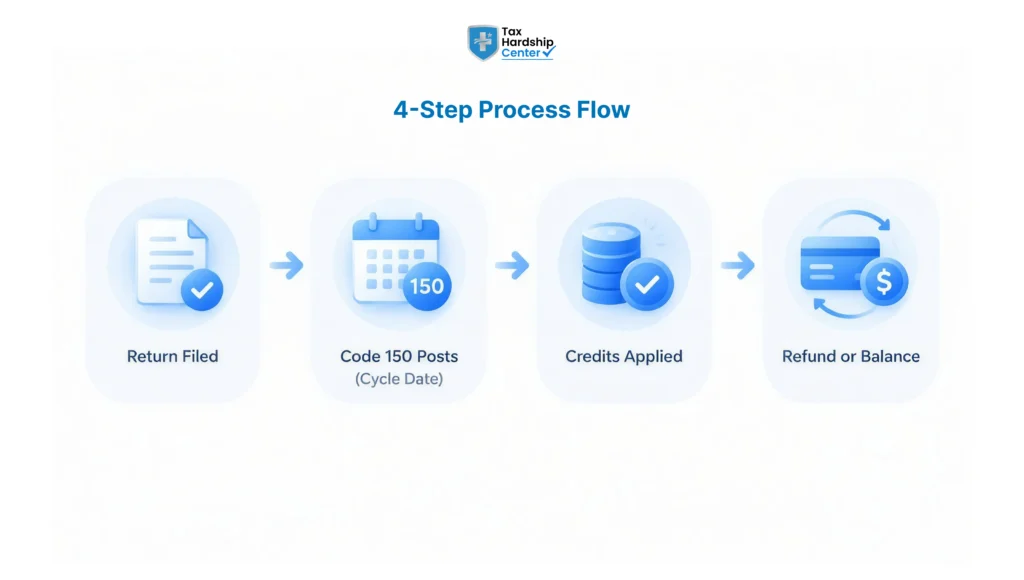
Understanding irs code 150 on its own only tells part of the story. Your transcript functions like a running ledger, and code 150 is typically the first substantive entry, establishing your baseline tax liability. From there, additional codes reflect what’s been credited against that liability, including your withholding and any refundable credits you claimed.
If your total credits exceed the code 150 amount and there are no holds in place, you’ll typically see a refund code appear further down your transcript. If a code 570 shows up alongside code 150, that means something in your return triggered a hold before further processing continues, which is different from code 150 itself indicating a problem. Our guide on what code 570 means on your tax transcript covers what typically causes that kind of hold and how long it usually takes to clear.
If your transcript shows a balance owed rather than a refund once all credits are applied against your code 150 amount, understanding your IRS payment options is the logical next step.
When IRS Code 150 Signals Something Worth Checking
In most cases, irs code 150 is simply informational and confirms your return was processed as filed. But there are a few situations where it’s worth a closer look:
- The code 150 amount doesn’t match what you calculated on your return. A discrepancy here can point to an IRS adjustment during processing that wasn’t communicated separately yet.
- Code 150 with 0 balance appears but you expected to owe something. This is worth double-checking against your actual return to confirm the numbers were entered and processed correctly.
- The code 150 future date is more than a few weeks out. While a short delay is normal, an unusually long gap can sometimes indicate your return was pulled for additional review.
If any of these apply and you’re also seeing a balance you didn’t expect, reviewing our guide on why you might owe more than expected can help you understand what happened and what to do next.
How Tax Hardship Center Helps When Transcript Codes Are Confusing
When a client comes to us with questions about irs code 150 or any other transcript entry, we start by pulling the full account transcript and reading it as a sequence rather than isolating a single code. This matters because the code 150 amount only tells part of the story until it’s compared against withholding, credits, and any holds that might be affecting your refund or balance.
If your transcript shows code 150 with 0 balance but you’re still seeing an unexpected notice, or if the code 150 future date has you wondering whether something was missed, we walk through the full picture so you know exactly where your return stands. And if reviewing your transcript reveals an actual balance owed once withholding is applied against your code 150 amount, we help set up a resolution path, whether that’s an installment agreement or evaluating Currently Not Collectible status, so the balance doesn’t sit and grow while you’re still trying to make sense of the codes.
Frequently Asked Questions
What does IRS code 150 mean on my transcript?
It means your tax return has been filed and processed, and it establishes your total tax liability for the year based on what you reported.
What does code 150 with 0 balance actually mean?
It means your calculated tax liability for the year, before withholding credits are applied, came out to zero based on your income and deductions.
Why does my code 150 future date show a date that hasn’t happened yet?
This reflects the IRS’s weekly processing cycle date, not a delay. It’s normal for the date to be a week or two ahead of today.
Is the code 150 amount the same as my refund?
No. The code 150 amount is your total tax liability before withholding is applied. Your refund depends on how that liability compares to your withholding credits.
Does code 150 mean my return was accepted without issues?
Generally yes, it confirms processing. But check for additional codes like 570, which can indicate a separate hold even after code 150 posts.
Should I be worried if the code 150 amount doesn’t match my own calculation?
It’s worth reviewing closely. A mismatch can point to an IRS adjustment made during processing, which is worth understanding before assuming it’s an error.
Conclusion
IRS code 150 is one of the most fundamental entries on your account transcript, marking the point where your return has been filed and your baseline tax liability established. Whether you’re looking at code 150 with 0 balance, trying to make sense of a code 150 future date, or reading the code 150 amount against your withholding, understanding what each version means takes the guesswork out of interpreting your transcript.
Key Takeaways
- IRS code 150 confirms your tax return has been filed and processed by the IRS.
- Code 150 with 0 balance means your calculated tax liability came out to zero for the year.
- A code 150 future date reflects the IRS’s processing cycle, not an error or delay.
- The code 150 amount represents total tax liability before withholding is applied.
- Your refund or balance owed depends on comparing the code 150 amount to your credits.
- A mismatch between your own numbers and the code 150 amount is worth investigating.
- Code 150 is typically the first substantive entry on an account transcript.
- Additional codes like 570 can indicate a hold separate from code 150 itself.
- Reading your transcript as a full sequence gives a clearer picture than one code alone.
- Unusual delays tied to a code 150 future date can sometimes signal additional review.
Confused about what your IRS transcript codes actually mean for your refund or balance? Get a free case review from Tax Hardship Center and get a clear read on your account.