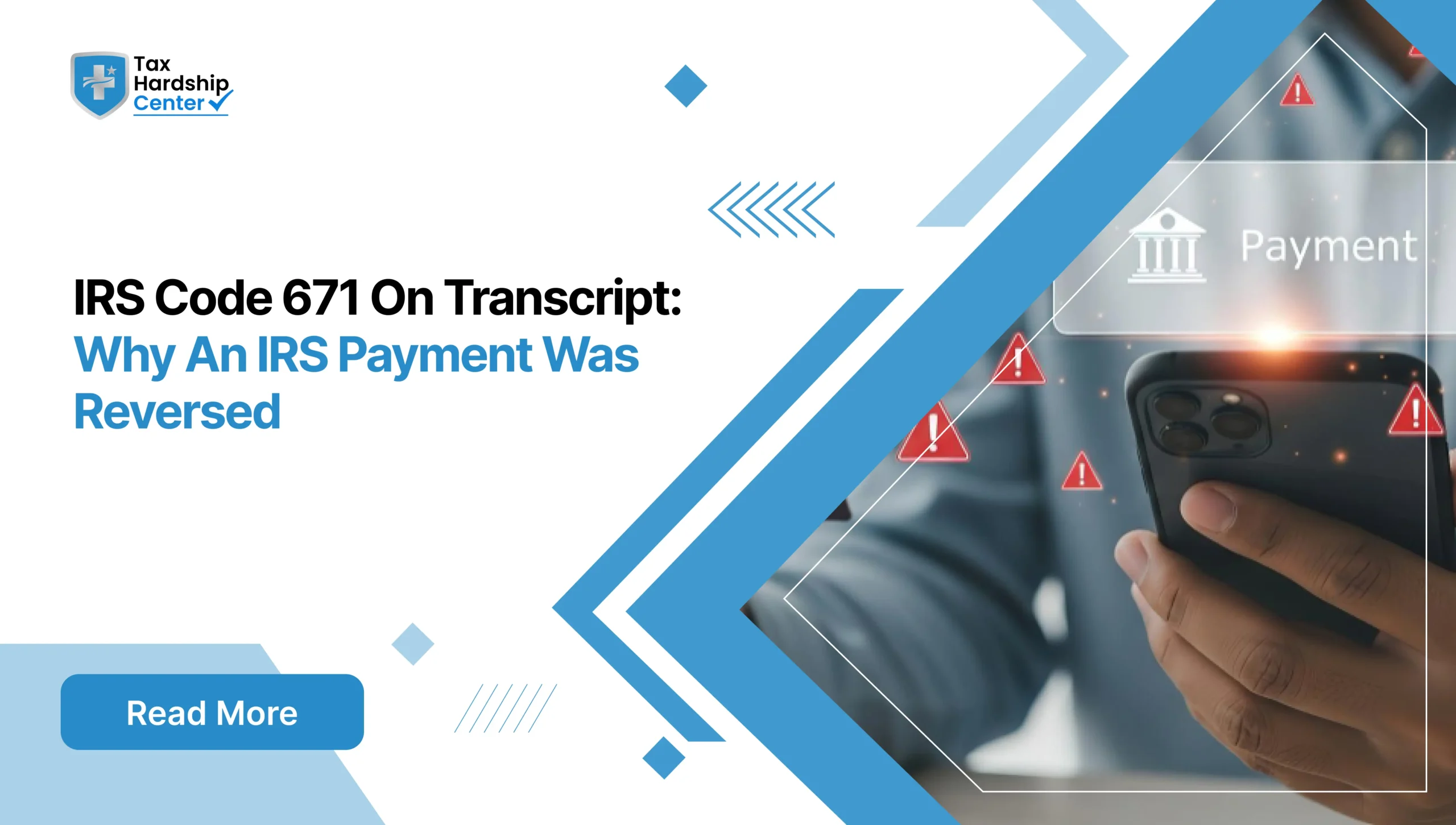

IRS code 671 on your transcript means a payment you made was reversed because it didn’t go through. The IRS calls it a dishonored payment. It usually happens when a check bounces, a bank debit fails, or the account details were wrong. The amount goes back onto your balance, and the IRS may add a dishonored payment penalty.
That’s the answer.
Now let’s talk about the moment you see it.
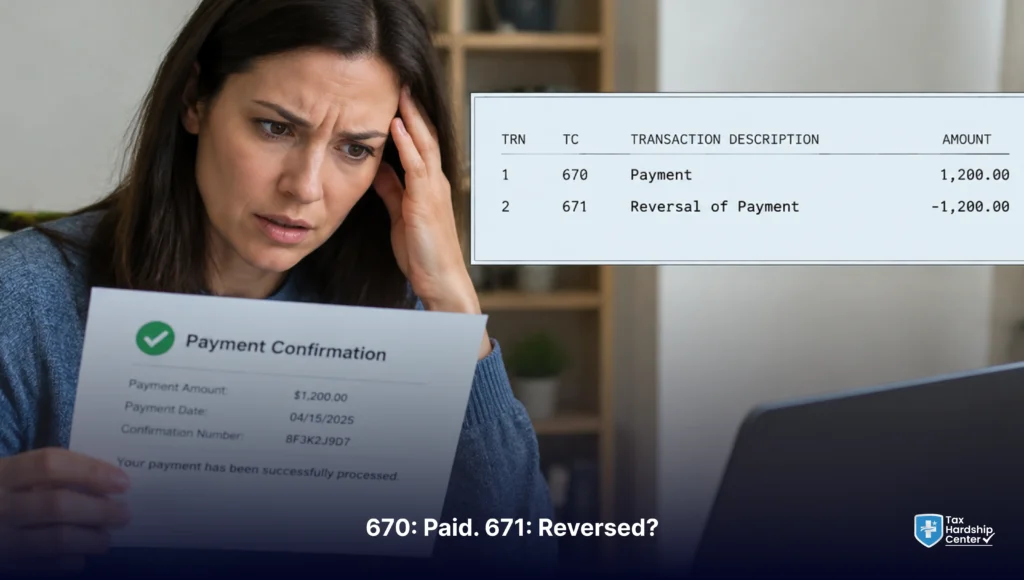
You paid the IRS. You remember doing it. Maybe you even have the confirmation email.
Then you check your transcript and see two lines:
- Payment. Good.
- Reversed.
Your stomach drops. Did you pay or not?
Here’s exactly what happened, and what to do now.
TL;DR
- IRS code 671 means a payment you made was reversed as dishonored, so the IRS never actually received the money.
- It almost always follows a code 670, which is the original payment posting.
- Common causes are insufficient funds, wrong bank details, a blocked debit, or a stopped check.
- The IRS can add a dishonored payment penalty, usually 2% of the payment, or $25 for smaller payments.
- People searching “IRS code 671 679” are often mixing up two unrelated codes. Code 679 reverses a rare bond credit, not a regular payment.
What Does IRS Code 671 Mean on Your Transcript?
Every IRS transcript line uses a transaction code. Payments made after your return was filed post as code 670. That’s the credit.
Code 671 is the opposite. It’s a debit that cancels the 670 credit.
In IRS shorthand, code 671 is listed as a “bad check payment,” but it doesn’t only mean paper checks. Any payment that comes back unpaid can trigger it, including:
→ Direct Pay transfers
→ EFTPS business payments
→ Payments by check or money order that bounce
→ Bank debits from an installment agreement
So when you see code 671, the IRS isn’t saying you didn’t try to pay. It’s saying the money never actually landed.
Your balance goes right back to where it was before the payment.
Why Would the IRS Reverse Your Payment?
This is where most people get defensive. “I paid. The IRS messed up.”
Sometimes that’s true. But usually, the reversal starts on the bank side.
Common reasons code 671 shows up:
- Insufficient funds. The account didn’t have enough money when the IRS pulled the payment.
- Wrong routing or account number. One digit off, and the payment fails.
- Your bank blocked the debit. Some accounts block ACH withdrawals from government or new payees by default.
- The account was closed. Common after switching banks during tax season.
- You placed a stop payment. Intentional or not, it reverses the payment.
- A duplicate or disputed transaction. Your bank flagged it and sent it back.
The twist most people miss? You usually won’t get a bank alert for a failed IRS debit. The first sign is often code 671 on your transcript, or a letter weeks later.
What Happens After Code 671 Posts?
Three things usually follow.
1. Your balance comes back.
Whatever you “paid” is owed again. Interest keeps running as if you never paid it.
2. You may get a dishonored payment penalty.
According to IRS Topic 206 on dishonored payments, the penalty works like this:
| Payment amount | Dishonored payment penalty |
| Less than $25 | The amount of the payment |
| $25 to $1,249.99 | $25 |
| $1,250 or more | 2% of the payment |
This penalty shows up on your transcript as code 280, usually right next to code 671.
3. The IRS sends a letter.
You’ll typically receive Letter 608C explaining that the payment was dishonored. If you’re not sure what a letter means or how to respond, our guide on what to do after receiving an IRS letter walks through it.
One important note: the IRS doesn’t resubmit failed payments for you. If you don’t pay again, the balance just sits there and grows.
IRS Code 671 679: Are These Two Codes Related?
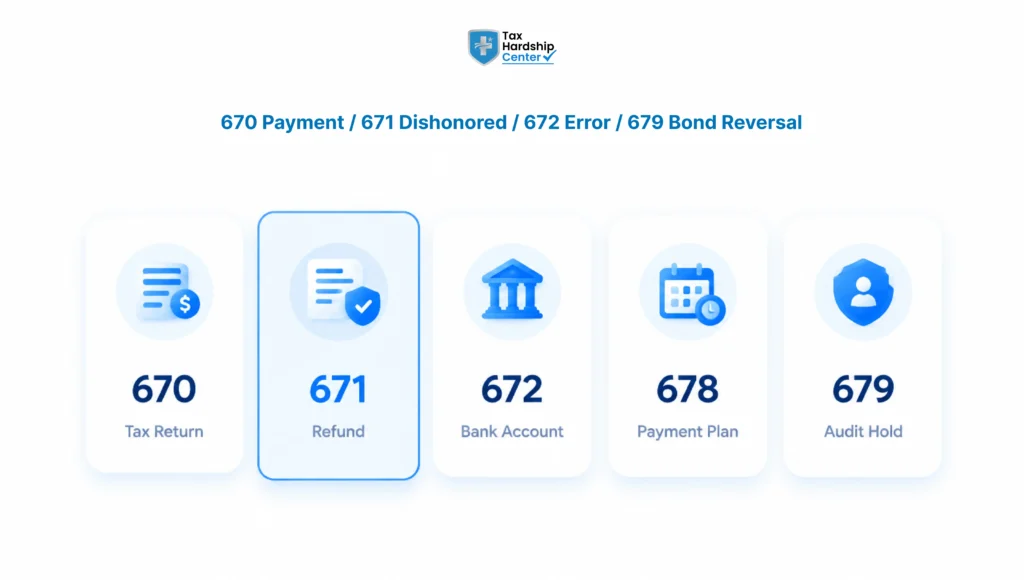
A lot of people search “IRS code 671 679” because both codes look like reversals.
Here’s the clean answer: they aren’t the same thing.
| Code | What it reverses | How common it is |
| 670 | Original subsequent payment (credit) | Very common |
| 671 | Reverses a 670 payment that was dishonored | Common |
| 672 | Reverses a 670 payment posted in error | Less common |
| 678 | Credit for Treasury bonds | Rare |
| 679 | Reverses a 678 Treasury bond credit | Rare |
So IRS code 671 679 searches usually come from someone seeing 671 on their own transcript and wondering if 679 is related. In almost every personal case, it isn’t. Code 679 reverses a bond credit, not a payment you made from your bank account.
If you actually see both on the same transcript, that’s unusual. Get the full account transcript and have a professional read it, because two different reversals in one period usually means something needs untangling.
Want help reading the rest of your transcript? Start with our guide to IRS code 150, the line that shows your return was assessed, or code 570 if your account also shows a hold.
How Does Code 671 Affect a Payment Plan?
This is where code 671 gets serious.
If you’re on an IRS installment agreement and a monthly payment bounces, the IRS will record it as a missed payment. One missed payment usually won’t end your plan immediately. But it can trigger a notice warning that your agreement may default.
Miss again, and the IRS can terminate the agreement. Once that happens, collection actions such as levies can resume.
So if code 671 shows up during a payment plan:
→ Make the missed payment as fast as possible
→ Fix the bank issue so the next debit doesn’t fail
→ Respond to any default warning before its deadline
If the real problem is that you can’t afford the monthly amount anymore, don’t let it keep bouncing. You may qualify for a lower payment or a pause under Currently Not Collectible status. Our comparison of payment plans vs. OIC vs. CNC explains which one fits which situation.
What Should You Do After a Code 671?
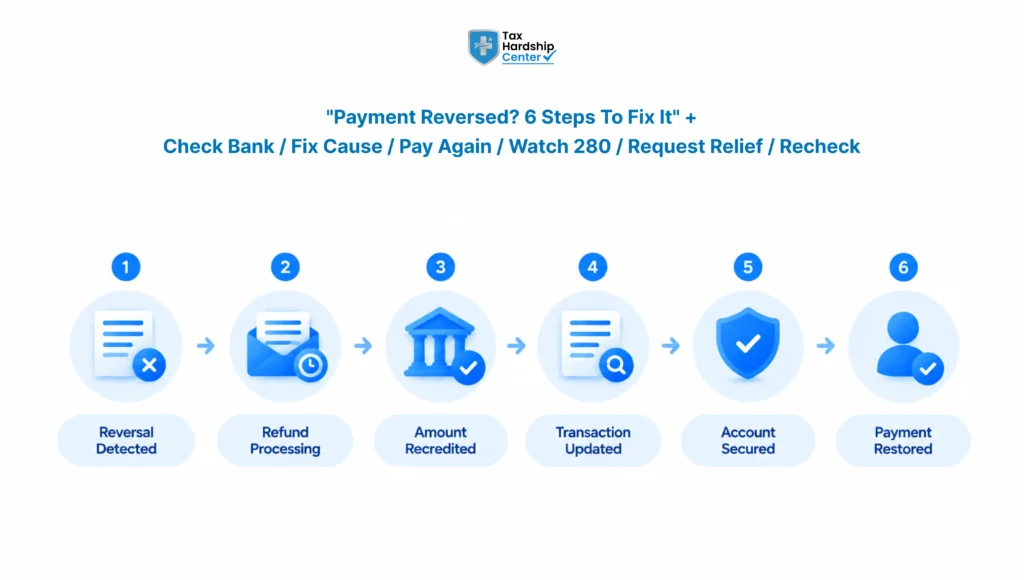
Here’s the order that works:
- Check your bank first. Confirm whether the payment was returned and why.
- Fix the cause. Update account details, add funds, or remove the debit block.
- Pay again, the right way. Use IRS Direct Pay or another official IRS payment option and save the confirmation.
- Watch for code 280. If a penalty posts, see whether you qualify for relief.
- Request penalty relief if it wasn’t your fault. The IRS can waive the dishonored payment penalty if you show it was reasonable to expect the payment to go through, such as due to a bank error. Penalty abatement covers this kind of request.
- Check your transcript again in a few weeks. The new payment should post as a fresh code 670.
You can track all of this through your IRS Online Account, which shows payments and balance changes faster than waiting for mail.
How Tax Hardship Center Helps After a Reversed IRS Payment
Most code 671 situations can be fixed on your own. But if the reversal hit during a payment plan, came with penalties you shouldn’t owe, or sits on a transcript full of codes you don’t recognize, Tax Hardship Center steps in.
We pull your full IRS transcripts, confirm exactly which payment reversed and why, and check whether penalties or a default notice followed. If your installment agreement is at risk, we contact the IRS to reinstate it or renegotiate a payment you can actually keep up with. If the reversal resulted from a bank error, we request penalty abatement, along with the documentation the IRS requires to approve it. And if you’re behind because you simply owe more than you can pay, we look at every resolution option, not just the next payment.
FAQs
What does IRS code 671 mean?
IRS code 671 means a payment you made was reversed as dishonored. The IRS didn’t receive the money, so the amount is added back to your balance.
Is code 671 the same as a bounced check?
Mostly, yes. It covers bounced checks, but also failed bank debits, wrong account details, closed accounts, and stopped payments.
Will code 671 trigger a penalty?
Usually. The dishonored payment penalty is 2% for payments of $1,250 or more, and $25 or the payment amount for smaller ones. It posts as code 280.
What is the difference in IRS code 671 679?
Code 671 reverses a dishonored payment. Code 679 reverses a credit for Treasury bonds. They’re separate codes, and most taxpayers will only ever see 671.
Can code 671 cancel my payment plan?
One reversed payment usually leads to a warning, not immediate cancellation. Repeated missed payments can default your installment agreement and restart collections.
Can I get the dishonored payment penalty removed?
Yes, sometimes. If you can show it was reasonable to expect the payment to clear, like a bank error, the IRS may remove the penalty.
Does the IRS retry a reversed payment?
No. The IRS doesn’t resubmit dishonored payments for you. You need to make a new payment yourself.
Conclusion
IRS code 671 looks scary. It isn’t a punishment. It’s a record that a payment didn’t go through.
The problem is what happens if you ignore it. The balance comes back, penalties stack up, and a payment plan can quietly start to slip.
Fix the bank issue. Pay again. Check for code 280.
And if codes 671 and 679 showed up together on your transcript, get someone to read the whole thing. That combination isn’t routine.
Key Takeaways
- Code 671 means a payment was reversed as dishonored.
- It cancels a code 670 payment that never actually reached the IRS.
- Bounced checks, failed debits, wrong bank details, and closed accounts are common causes.
- The balance comes back, and interest keeps running.
- A dishonored payment penalty may post as code 280 next to code 671.
- The penalty is 2% for payments of $1,250 or more, or $25 for most smaller payments.
- Codes 671 and 679 are unrelated: 679 reverses a rare Treasury bond credit.
- A reversed installment payment can put your agreement at risk of default.
- The IRS won’t retry the payment, so pay again and save the confirmation.
- Penalty relief is possible if the failure wasn’t your fault.
Seeing IRS code 671 and not sure where your payment went? A tax specialist can review your transcript and fix what’s left behind.
Click here to get a quote and a free transcript review
Call us at 844-427-5100 to speak to a tax specialist today.