


IRS code 960 on your transcript means someone was officially authorized to deal with the IRS for that tax year. The transcript usually labels it “Appointed representative.” It posts when the IRS records a Form 2848 (Power of Attorney) or a Form 8821 (Tax Information Authorization) in its Centralized Authorization File. It doesn’t change your balance or your refund.
That’s the short version.
Now the part that makes people nervous.
You log in to check your refund status. You scroll through the transcript codes. 150. 806. 846.
And then: 960, Appointed representative.
Wait. Appointed by who?
For most people, the answer is boring. For a few, it’s a red flag. Let’s figure out which one you are.
TL;DR
- IRS code 960 means a representative or authorized third party was added to your IRS account for that tax year.
- A code 960 appointed representative entry usually comes from a Form 2848 or Form 8821 you (or your tax pro) filed.
- Code 960 does not affect your refund, balance, or audit status on its own.
- If you didn’t authorize anyone, treat it as a possible identity theft warning and contact the IRS.
- Code 961 means the representative was removed.
What Does IRS Code 960 Mean on Your Transcript?
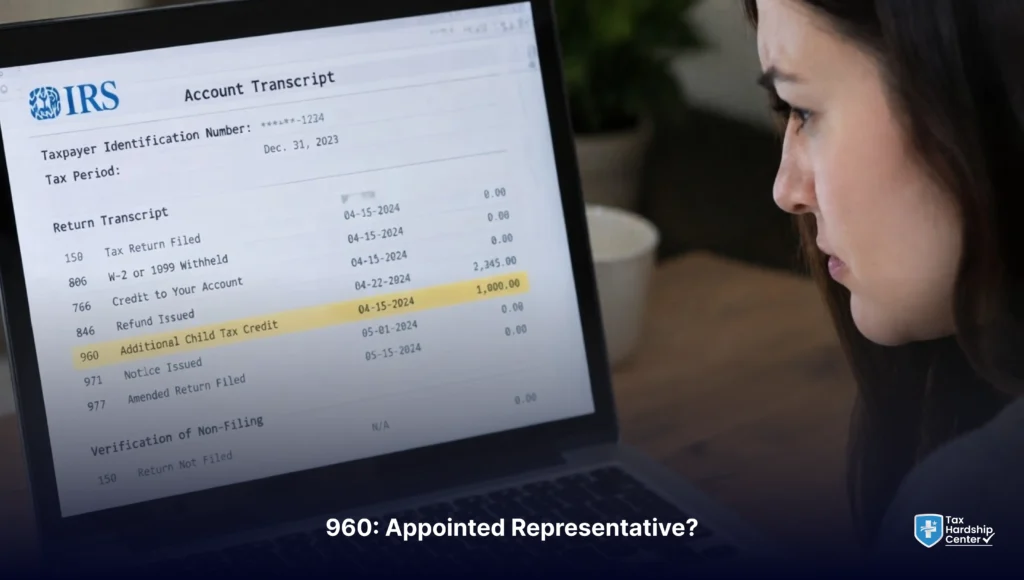
Every line on an IRS transcript has a three-digit transaction code. Each one is a record of an event on your account.
IRS code 960 indicates that a third party was authorized on your account.
Behind the scenes, the IRS keeps a database called the Centralized Authorization File (CAF). When it processes a power of attorney or tax information authorization, it adds a CAF indicator to the tax years listed on the form. That indicator shows up on your transcript as code 960.
A few things worth knowing:
→ It’s tied to specific tax years. If your form covered 2023 and 2024, you’ll see code 960 on both transcripts.
→ It’s tied to specific tax forms, like Form 1040 or Form 941.
→ It shows the date the authorization was recorded, not the date you signed it.
So code 960 isn’t the IRS doing something to you. It’s the IRS writing down that someone can now talk to it for you.
Why Is There a Code 960 Appointed Representative on My Account?
Most of the time, you already know the answer. You just forgot.
Common reasons a code 960 appointed representative shows up:
- You hired a tax professional. A CPA, enrolled agent, or attorney handling an IRS issue usually files Form 2848 first.
- Your tax preparer needed access. Some preparers file Form 8821 so they can pull your transcripts.
- You’re dealing with an audit or notice. If someone is responding to an IRS letter on your behalf, code 960 almost always follows.
- You’re working with a tax relief firm. Firms file authorizations so they can negotiate payment plans or settlements.
- Your business uses a payroll provider. Payroll companies often get authorized on business tax accounts.
Not sure whether you need a CPA, attorney, or relief firm as your representative? Our comparison of tax attorneys vs. tax relief companies vs. CPAs breaks down who does what.
Does IRS Code 960 Affect Your Refund?
No.
This is the question people ask most, and it’s the easiest one to answer. IRS code 960 is an administrative note. It doesn’t hold, delay, reduce, or release a refund.
If your refund is stuck, the reason is somewhere else on the transcript. Code 960 is just sitting next to it.
That said, code 960 can be a clue. If you see it alongside other codes, it often means your tax pro is already working on something. Which brings us to the neighbors.
What Do the Codes Around Code 960 Mean?
Transcript codes rarely appear alone. Here’s how to read code 960 in context:
| Code | What it usually means | How it relates to 960 |
| 150 | Return filed and tax assessed | Shows the return posted |
| 570 | Additional account action pending | Your rep may be handling the hold |
| 971 | Notice issued | Your rep likely received a copy |
| 960 | Appointed representative added | Someone can now act or view for you |
| 961 | Appointed representative removed | The authorization was revoked or expired |
If code 960 shows up next to a code 570 hold, your representative may already be dealing with whatever is holding your account. And if you’re still trying to make sense of the first line on the transcript, our guide to IRS code 150 is a good place to start.
You can pull your own transcripts anytime through the IRS Get Transcript tool.
What If You Never Authorized Anyone?
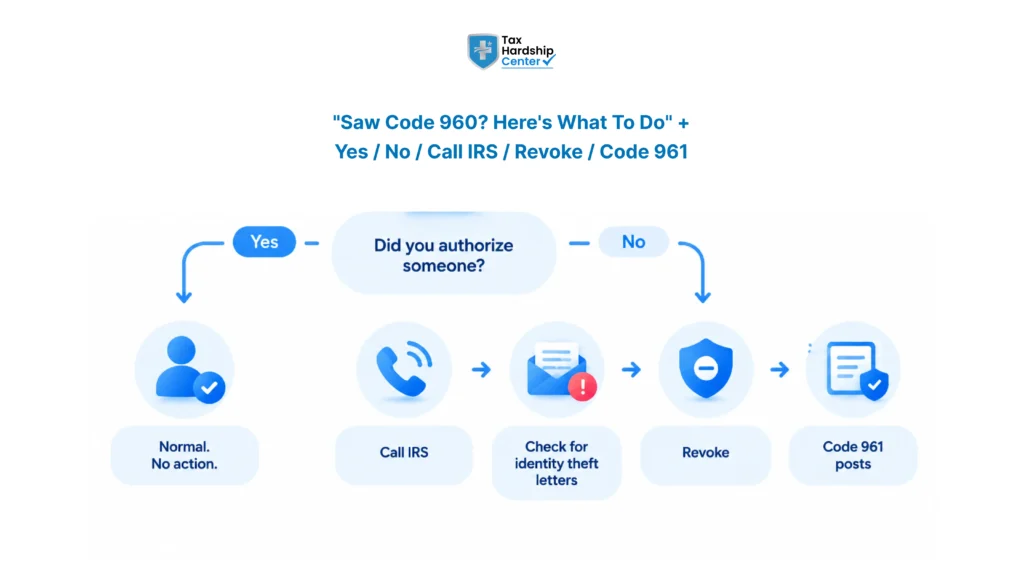
This is where IRS code 960 stops being boring.
If you see a code 960 appointed representative entry and you genuinely didn’t hire anyone, don’t ignore it. It could mean:
→ A former preparer’s authorization is still active
→ A relief company you spoke to once filed paperwork
→ Someone filed a fraudulent authorization using your information
That last one is rare, but it’s serious. An unauthorized representative can see your tax records and, with a Form 2848, potentially act on your account.
Here’s what to do:
- Call the IRS and ask who is listed on your account and which tax years are covered.
- Check for other warning signs, like identity verification letters. Our guide to IRS Letter 4883C explains one of the most common ones.
- Revoke the authorization. Send the IRS a copy of Form 2848, signed and dated, with “REVOKE” written across the top. Once processed, code 961 posts and removes the representative.
Better a 20-minute call now than a much bigger problem later.
What Can an Appointed Representative Actually Do?
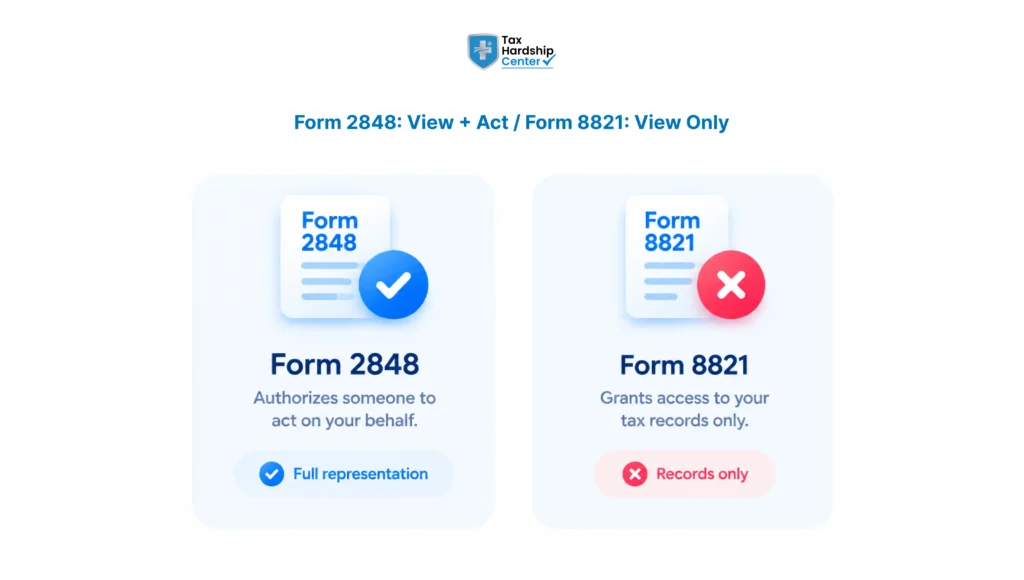
It depends on which form created the code 960 entry.
| Form 2848 (Power of Attorney) | Form 8821 (Tax Information Authorization) | |
| View your tax records | Yes | Yes |
| Receive copies of IRS notices | Yes | Yes, if selected |
| Speak to the IRS for you | Yes | No |
| Negotiate payment plans or settlements | Yes | No |
| Represent you in an audit | Yes | No |
| Who can be appointed | CPAs, enrolled agents, attorneys, and other eligible practitioners | Almost anyone you choose |
You can read the official details on IRS Form 2848.
So, a code 960-appointed representative under Form 2848 is the real deal. They can talk to the IRS, request records, and negotiate on your behalf. Under Form 8821, they can look, but they can’t act.
How Tax Hardship Center Works as Your Appointed Representative
If you’re seeing code 960 because you’re about to hire help, here’s what that help should actually do. At Tax Hardship Center, filing Form 2848 is usually step one. Once it posts, we pull your full transcripts, decode every code on them, and tell you what the IRS is actually doing on your account, not what it might be doing.
From there, the authorization lets us handle the IRS directly. That might mean responding to notices, representing you through an audit, or negotiating a resolution if you owe tax debt you can’t pay right now. You stop sitting on hold. We take the calls.
If you’re just curious about a code 960 line on your transcript, you don’t need to hire anyone. But if that line belongs to someone who isn’t actively helping you, or if you need someone dealing with the IRS for you, it’s worth a conversation.
FAQs
What does IRS code 960 mean?
IRS code 960 means an appointed representative or authorized third party was added to your IRS account for that tax year, usually through Form 2848 or Form 8821.
Does code 960 delay my refund?
No. Code 960 is an administrative entry. It doesn’t hold or change your refund. Look at other codes, like 570 or 810, to find refund delays.
What is the difference between code 960 and code 961?
Code 960 means a representative was added. Code 961 means a representative was removed, usually because the authorization was revoked or replaced.
Can a code 960 appointed representative talk to the IRS for me?
Only if they were appointed through Form 2848. A Form 8821 authorization lets them view your records, but not represent you or negotiate.
Why does code 960 show on multiple tax years?
Authorizations list specific tax years. If your representative’s form covered several years, code 960 posts on each of those transcripts.
What should I do if I didn’t authorize a representative?
Call the IRS to confirm who is listed and revoke the authorization in writing. If you suspect identity theft, report it right away.
Does code 960 mean I’m being audited?
No. Code 960 only shows a representative was added. An audit usually shows as code 420 on your transcript.
Conclusion
IRS code 960 sounds scary on a transcript. Most of the time, it isn’t.
It simply means someone is authorized to speak with the IRS or to view your records for that tax year. If you hired them, great. That’s the system working. If you didn’t, that’s your cue to call the IRS and revoke it.
Either way, now you know what that line means. And you know what to do next.
Key Takeaways
- IRS code 960 means a representative or authorized third party was added to your account.
- It posts when the IRS records a Form 2848 or Form 8821 in its CAF database.
- A code 960 entry applies to specific tax years and tax forms.
- Code 960 does not affect your refund, balance, or audit status.
- Code 961 shows the representative was removed or revoked.
- Form 2848 representatives can act for you. Form 8821 designees can only view records.
- Codes like 570 or 971 next to code 960 often mean your rep is already working on something.
- If you didn’t authorize anyone, call the IRS and revoke it right away.
- Unrecognized authorizations can be an early identity theft warning.
- A Form 2848 lets a tax professional handle the IRS so you don’t have to.
Seeing IRS code 960 and not sure what’s happening on your account? A tax specialist can read your transcript with you and explain every code.
Click here to get a quote and a free transcript review
Call us at 844-427-5100 to speak to a tax specialist today.