


When the IRS is sending notices, adding penalties, or threatening garnishments, one doubt pops up quickly:

“Do I really need an IRS lawyer, or would a tax relief company be enough?”
Both options can help. But they are not interchangeable:
- IRS lawyers/tax attorneys / IRS tax lawyers are legal professionals focused on tax law and disputes.
- Tax relief firms/tax relief companies are teams built to resolve tax debt and collection problems day in and day out.
Choosing correctly can make the difference between:
- Paying more than you need to for the wrong kind of help, or
- Getting practical, affordable representation that actually moves your IRS case forward.
This guide walks you through a straightforward, practical decision process and shows where Tax Hardship Center, a nationwide tax relief firm, fits into that decision.
Why “Who Represents You” Matters With the IRS
IRS problems are rarely static. While you’re trying to decide what to do, the IRS may:
- Add penalties and interest every month
- File or maintain a tax lien on your property
- Issue a wage garnishment or bank levy.
- Move your case to more aggressive collection units.
Having the proper IRS representation does three crucial things:
- Protects your rights and options, especially if there’s an audit, investigation, or potential legal exposure.
- Brings expertise and structure to the chaos, someone who knows what to file, who to talk to, and when.
- Opens the door to IRS relief programs, such as installment agreements, Offers in Compromise, penalty relief, or temporarily “non-collectible” status.
The right decision is not always “hire the most expensive IRS lawyer you can find.” Sometimes that is precisely what you need; often, it’s not.
What IRS Lawyers / Tax Attorneys Actually Do
IRS lawyers, tax attorneys, and IRS tax lawyers are licensed attorneys who specialize in tax law. Their work usually centers on legal disputes and defense, not day-to-day bookkeeping or routine IRS payment plans.
Core role of an IRS lawyer
According to leading tax and legal resources, you should think of a tax attorney as the professional who comes in when:
- There is a risk of criminal charges or allegations of tax fraud
- A dispute is moving toward Tax Court or other litigation.
- You’re facing a serious IRS audit or investigation with potential legal consequences.
- You need complex legal opinions on business structures, transactions, or high-dollar issues.
They are trained to:
- Interpret and apply federal and state tax laws
- Defend you in legal disputes with the IRS.
- Negotiate settlements in high-risk controversy cases.
- Protect you through the attorney-client privilege, which is critical if there’s any possibility of criminal exposure.
Strengths of IRS lawyers
Key advantages of working with an IRS tax lawyer include:
- Legal protection and strategy: they know how the IRS can build a case and how to respond.
- Court representation: only attorneys can represent you in Tax Court or federal court.
- Attorney-client privilege: Conversations with your tax attorney are generally protected, unlike conversations with most non-attorney tax professionals.
If your problem is fundamentally legal, not just financial, lawyers are the correct type of representation.
Limitations of IRS lawyers for everyday IRS debt
Most taxpayers with IRS problems are not facing criminal prosecution. They are dealing with:
- Back taxes they cannot afford to pay in full
- Liens, levies, or garnishments
- Years of unfiled returns
- Confusing notices and constant worry
In that context, relying only on a tax attorney can have drawbacks:
- Cost structure: Many IRS lawyers bill by the hour, while non-attorney resolution specialists charge higher flat fees.
- Focus: their work is oriented toward legal disputes, not always the paperwork- and follow-up-heavy process of standard IRS debt resolution.
- Operational support, routine tasks (gathering records, responding to every IRS letter, tracking deadlines) may be delegated to staff or still fall back on you.
This is where a tax relief company can be a better first step for many purely civil IRS debt problems.
What a Tax Relief Firm or Tax Relief Company Does
A tax relief firm or tax relief company is built around one mission: helping taxpayers resolve IRS and state tax debt, usually before issues become full-blown legal battles.
Core services of a tax relief company
Reputable tax relief firms typically handle:
- Back tax balances for individuals and businesses
- Unfiled returns, sometimes many years at once
- Wage garnishment relief and bank levy release
- Tax lien issues and related negotiations
- Installment agreements and partial-pay plans
- Offers in Compromise, for qualified taxpayers
- Penalty abatement requests
- Certain types of audit representation and IRS correspondence
Instead of doing “a little bit of everything,” their day-to-day work is focused on tax resolution and IRS communications.
How tax relief firms usually work
Most legitimate tax relief firms follow a structured, multi-step process:
- Initial consultation
- Review your notices and situation at a high level.
- Determine whether you’re a good candidate for professional representation.
- Investigation/discovery phase
- Pull IRS transcripts and account records.
- Confirm exactly what you owe, for which years, and to which agencies.
- Assess the urgency of liens, levies, and other collection actions.
- Resolution strategy
- Determine which relief programs fit your finances and IRS guidelines.
- Prepare and file forms, financials, and supporting documents.
- Communicate with the IRS on your behalf, responding to requests and negotiating outcomes.
Some firms, as consumer education sites point out, charge a small “research” fee for this discovery phase and then quote a second fee for full resolution.
Pros and cons of tax relief firms
Advantages:
- Specialized focus on tax relief. They handle IRS debt all day, not just during tax season.
- Integrated IRS representation. They manage calls, letters, documentation, and deadlines as a unified case.
- Clearer fee expectations. Many tax relief companies use flat or phase-based fees instead of open-ended hourly billing.
Potential downsides:
- The industry is mixed; there are strong firms and predatory operators. Red flags include guaranteeing massive reductions without reviewing your finances first or using heavy-pressure tactics.
- A tax relief firm cannot represent you in court unless a licensed attorney in the firm takes that role.
- Quality of communication and follow-through varies, so checking reviews and credentials is essential..
The takeaway: a tax relief company can be an excellent choice when your IRS problem is primarily about debt and collections, not about criminal allegations or litigation.
Tax Attorney vs Tax Relief Firm: Key Differences
Below is a practical comparison focused on IRS representation for tax debt and collection issues.
| Factor | IRS Lawyers / Tax Attorneys / IRS Tax Lawyers | Tax Relief Firms / Tax Relief Companies |
| Main role | Legal disputes, audits with legal risk, Tax Court, criminal exposure | Resolving tax debt and collections, negotiating payment and relief |
| Training & credentials | Licensed attorneys, trained in tax law and litigation | Typically staffed by Enrolled Agents, CPAs, and sometimes attorneys |
| Best suited for | Fraud allegations, criminal investigations, and complex tax controversy | Back taxes, liens, levies, garnishments, unfiled returns, and payment plans |
| Court representation | Yes, the Tax Court and other courts | Only through attorneys associated with the firm |
| Day-to-day IRS contact | Often focused on disputed matters and legal issues | Core service, calling, faxing, responding, and negotiating with the RS |
| Fee model | Frequently, hourly or high flat fees | Commonly phase-based or flat fees with defined scopes |
| Primary value | Legal protection, privilege, courtroom advocacy | Practical resolution, documentation, program selection, IRS negotiations |
Both forms of IRS representation are valuable. The question is when each is the right tool.
A Simple Decision Framework for Your IRS Situation
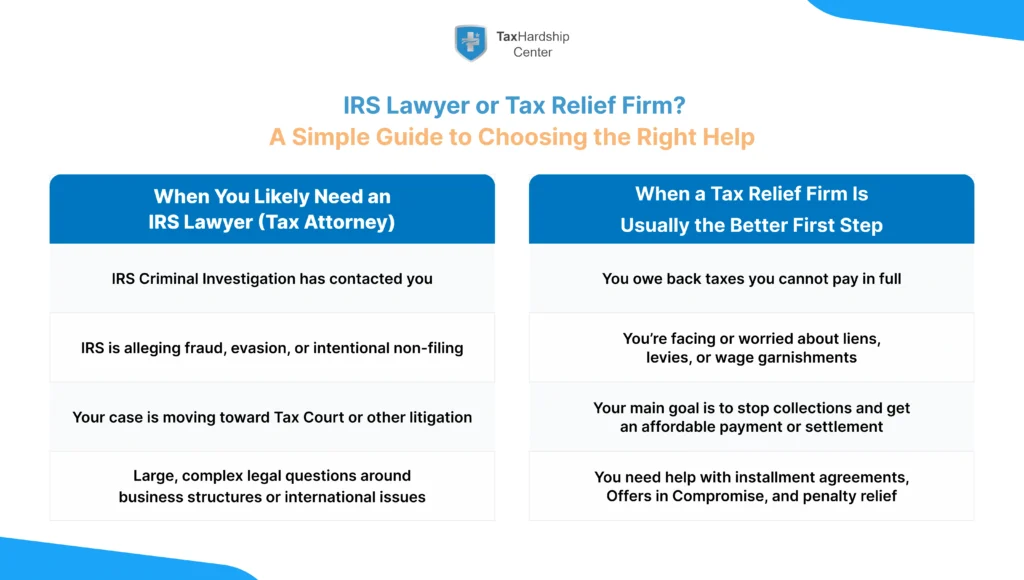
Use these questions to decide whether you likely need an IRS lawyer or a tax relief firm first.
Choose an IRS lawyer (tax attorney / IRS tax lawyer) if:
- The IRS Criminal Investigation has contacted you.
- The IRS is alleging fraud, willful evasion, or intentional non-filing.
- You’ve received a summons or know your matter is heading toward Tax Court.
- Your case involves complex legal questions (e.g., sophisticated business structures, international transactions, or substantial disputed amounts).
In these situations, legal risk is front and center. An IRS lawyer should be leading your defense.
Choose a tax relief firm if:
- You already owe the IRS or a state and cannot pay in full.
- You’re receiving collection notices, facing a lien, wage garnishment, or bank levy.
- The core question is “How do I get this under control and paid (or settled) in a way I can live with?”
- Your primary need is representation and negotiation, not courtroom advocacy.
In these situations, a tax relief company is usually the more efficient and cost-effective starting point.
What if you’re not sure?
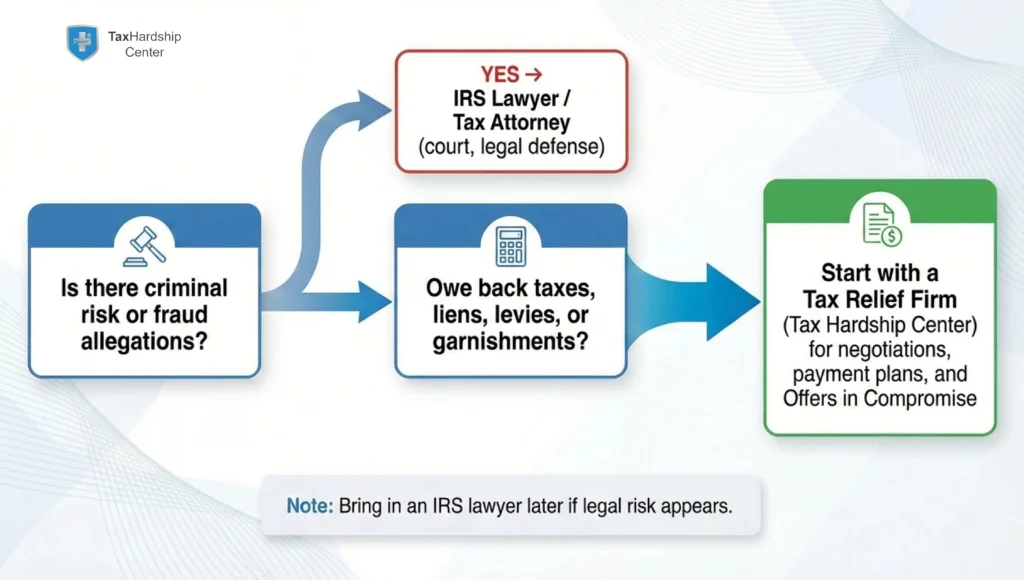
If you are uncertain whether there is a legal risk, it can still make sense to start by speaking with a tax relief firm that:
- Offers a free initial consultation, and
- It is open about when they would recommend involving an independent tax attorney.
A good firm will tell you if you’re in over their scope and need a lawyer driving the matter.
How IRS Lawyers and Tax Relief Firms Can Work Together
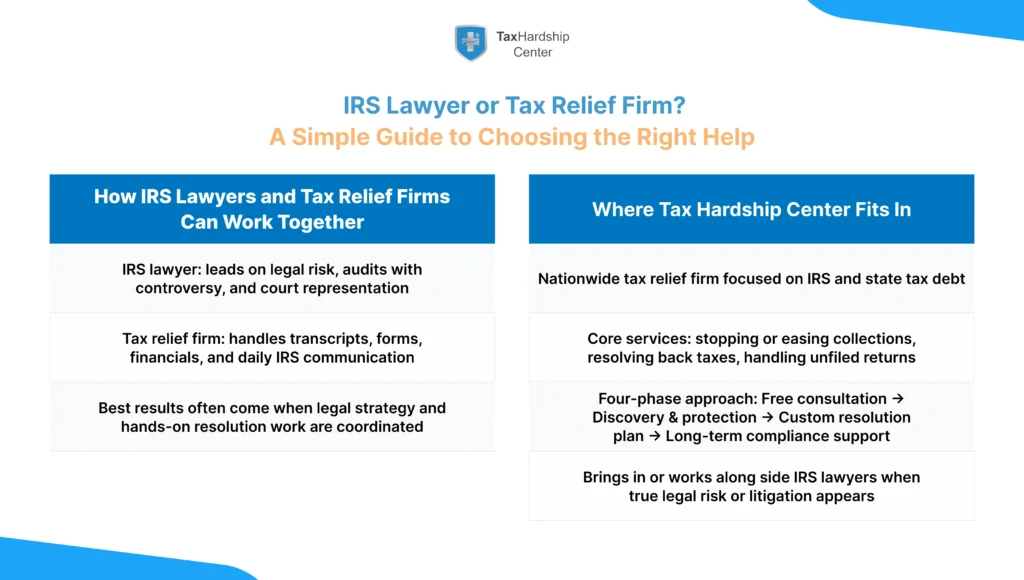
In many real-world cases, you don’t have to choose only one type of help.
- An IRS lawyer can focus on legal strategy, court issues, and protecting your rights.
- A tax relief firm can manage the heavy lifting of transcripts, financial disclosures, document gathering, and day-to-day IRS communications.
Consumer and professional sources frequently note that the best outcomes often come when legal and tax resolution expertise is coordinated rather than isolated.
This is particularly true in larger or more complex cases, where:
- A tax relief firm’s infrastructure keeps the case moving, and
- An IRS lawyer steps in for targeted legal questions or advocacy.
Why Many Taxpayers Start With a Tax Relief Firm
For most individuals and small businesses, the initial problem is not “Will I go to prison?” It is:
- “I’m overwhelmed by what I owe.”
- “The IRS is taking or about to take part of my paycheck or bank account.”
- “I don’t know which IRS forms to file, and I’m afraid of making it worse.”
In these civil IRS debt scenarios, starting with a qualified tax relief firm is often the most practical route because:
- You get immediate structure and IRS representation
The firm can step in quickly, get authorizations, pull transcripts, and begin communicating with the IRS for you. - You’re not paying legal rates for non-legal work.
Much of IRS resolution involves data gathering, forms, and negotiations that do not require courtroom advocacy. - You only bring in IRS lawyers when truly necessary.
If your matter escalates or reveals legal risk, the tax relief firm can coordinate with an attorney instead of making a tax attorney your default and most expensive option from day one.
For many taxpayers, that balance of cost, convenience, and expertise is precisely what they need.
Where the Tax Hardship Center Fits In
Tax Hardship Center (THC) is a California-based tax relief firm that provides nationwide IRS and state tax resolution services to individuals and businesses.
What Tax Hardship Center does
According to its own materials and independent reviews, Tax Hardship Center focuses on:
- IRS and state back tax debt
- Unfiled or overdue tax returns
- Wage garnishment and bank levy relief
- Assistance with tax liens
- Installment agreements and structured repayment plans
- Offers in Compromise, when financially justified
- Penalty abatement requests
- Help with many audit-related issues
- Support for small businesses and payroll tax problems
In other words, THC operates exactly where a tax relief firm adds the most value: practical, hands-on IRS representation for debt and collections.
Credentials and reputation
Publicly available information highlights several trust markers:
- Tax Hardship Center is a dedicated tax problem resolution firm licensed to represent clients nationwide.
- The company is BBB-accredited with a strong rating and years of operating history.
- Independent review sites cite high average customer ratings on platforms like Google and Trustpilot and note that THC has helped many clients stop garnishments, reduce tax bills, and avoid bank levies.
These credentials matter in a market where some tax relief providers are less transparent or not focused on long-term reputational risk.
Tax Hardship Center’s positioning vs IRS lawyers
Tax Hardship Center does not present itself as a traditional law firm; instead, it:
- Focuses on tax debt relief and IRS representation, not general legal practice.
- Uses experienced tax professionals (including Enrolled Agents) to manage cases.
- Can work alongside or coordinate with IRS lawyers when a matter requires formal legal advocacy.
For most civil IRS problems, back taxes, aggressive collections, and messy filing histories, THC is positioned as a central, practical solution provider.
What to Expect When You Call Tax Hardship Center
While each engagement is tailored, the Tax Hardship Center broadly follows a four-phase process.
1. Free, confidential consultation
You begin with a no-obligation conversation where a specialist will:
- Review the notices you’ve received
- Ask about your income, tax years, and approximate balances.
- Identify any obvious red flags that might require an IRS lawyer.
- Explain whether THC is likely to help and what that could look like
This call is about clarity, understanding whether professional IRS representation via a tax relief firm is appropriate for you.
2. Discovery and protection phase
If you choose to proceed, the Tax Hardship Center typically:
- Files authorizations so they can speak directly to the IRS on your behalf
- Pulls your IRS transcripts and account records
- Confirms exact balances, years, and statuses
- Works to stabilize the situation, which may include attempts to pause or soften specific collection actions where the IRS allows it
Many tax relief companies charge an initial fee for this research phase; third-party reviews describe THC’s discovery step as an essential part of understanding clients’ options.
3. Customized resolution plan and negotiation
With complete information in hand, THC will:
- Evaluate which relief programs you realistically qualify for
- Develop a resolution strategy such as an installment agreement, partial-pay plan, Offer in Compromise, penalty relief, or temporary hardship status.
- Prepare the necessary forms, financial disclosures, and supporting documents.
- Negotiate directly with the IRS or state agency, handling calls, letters, and follow-ups
You remain informed and involved in key decisions, but you are not expected to manage all communication with the IRS on your own.
4. Long-term stability and compliance
After the immediate crisis is resolved, the Tax Hardship Center can also:
- Assist with ongoing filings and future-year compliance
- Help you understand how to avoid falling behind again
- Provide representation if the IRS raises additional questions related to the resolved years
The aim is not just to “put out the fire,” but to help you move forward in a more stable position.
FAQs: IRS Lawyers vs Tax Relief Firms
1. How do I know if my IRS problem is serious enough for an IRS lawyer?
You likely need an IRS lawyer/tax attorney if:
You have received notice of a criminal investigation or are worried about criminal exposure.
The IRS is explicitly alleging fraud, evasion, or intentional misrepresentation.
Your case is already in Tax Court, or clearly heading there.
In those situations, you should speak with a tax attorney regardless of whether you also work with a tax relief firm.
2. If I start with a tax relief firm, can they bring in an IRS lawyer later?
Yes. In fact, many taxpayers prefer this approach:
Start with a tax relief company to organize the case, pull transcripts, and explore relief programs.
If legal controversy or litigation is likely, involve an independent IRS tax lawyer for specific legal tasks.
This way, you are only paying for attorney-level services when they are genuinely needed, while still having strong IRS representation from your tax relief firm on the administrative side.
3. Can a tax relief firm promise to settle my taxes for “pennies on the dollar”?
No legitimate firm can make that promise upfront.
Serious consumer and financial resources warn that guarantees of massive reductions before anyone reviews your finances are a major red flag.
A reputable tax relief company will:
Review your income, expenses, assets, and IRS transcripts
Explain whether you realistically qualify for an Offer in Compromise or a partial-pay agreement.
Give you a candid view of best-case, likely, and fallback outcomes.
If a salesperson is promising “pennies on the dollar” without detailed questions, consider that a warning sign.
4. Are tax relief firms regulated or accredited?
Tax relief firms themselves are not licensed as “firms” the way law firms are, but professionals within themselves, such as Enrolled Agents, CPAs, and attorneys, are individually regulated.
You can also look for:
BBB accreditation and rating
Independent reviews from trusted consumer sites
Clear disclosure of fees, scope of work, and expected timelines
Tax Hardship Center, for example, is BBB-accredited and has received positive reviews across multiple third-party platforms, helping differentiate it from less transparent operators.
5. Is Tax Hardship Center a tax law firm or a tax relief company?
Tax Hardship Center is a tax relief company, not a traditional law firm. It describes itself as a tax problem resolution firm dedicated exclusively to assisting taxpayers with tax-related issues, and it is licensed to represent clients nationwide before the IRS.
That means:
THC handles IRS representation, negotiations, and tax debt relief.
Coordinates the practical side of resolving your tax problem, and
Can refer or coordinate with IRS lawyers if your case requires full legal representation or litigation.
6. So, should I call an IRS lawyer or Tax Hardship Center first?
Ask yourself:
Am I worried about criminal charges or being sued by the IRS?
If yes, speak with an IRS tax lawyer/tax attorney immediately.
Am I overwhelmed by back taxes, liens, levies, or garnishments, and just need a realistic path out?
If yes, a tax relief firm like Tax Hardship Center is often the most practical starting point.
For most people with civil IRS debt not facing prosecution, but feeling cornered by the IRS, starting with the Tax Hardship Center gives you experienced IRS representation, a clear plan, and a path to bring in an IRS lawyer only if the facts of your case truly demand it.