

You open the mailbox. There it is. An envelope with that unmistakable government return address, the one that makes your stomach drop before you’ve even torn it open. Inside is a letter, and buried in the fine print is a form number you’ve never heard of: 433-F.
You Google it at midnight. You find twelve different explanations, half of them written like tax law textbooks. None of them tell you what you actually need to know, which is: what does the IRS want from me, and what happens if I get this wrong?
That’s what this guide is for. No jargon maze. No fear tactics. Just a straight walk through IRS Form 433-F, the Collection Information Statement, so you can hand the IRS exactly what it’s asking for and nothing it isn’t entitled to.

What IRS Form 433-F Actually Is
Strip away the legal language and Form 433-F is basically the IRS asking you one question in eight parts: what can you actually afford to pay?
Officially, it’s called the Collection Information Statement. It’s a two-page snapshot of your financial life, covering your bank accounts, your investments, your property, your debts, your income, and your monthly bills. The IRS uses it to decide what happens next in your case. Maybe that’s a payment plan. Maybe it’s Currently Not Collectible status, which pauses collection because your income doesn’t cover your basic living costs. Either way, this form is the evidence the IRS builds its decision on.
Here’s the twist most people don’t expect. Form 433-F isn’t the only version of this statement. There’s also 433-A, a longer, more detailed cousin used mostly when a revenue officer is personally assigned to your case. If you’re comparing the two, our guide to Forms 433-A and 433-B breaks down exactly which one applies to your situation. But for most wage earners and self-employed taxpayers dealing with the IRS’s Automated Collection System, 433-F is the one that lands in your inbox.
Do You Even Need to File This One?
Plot twist number two: not everyone who owes the IRS money needs to touch this form at all.
If your balance is under $50,000 and you can pay it off within the IRS’s standard timeline, you may qualify for a streamlined installment agreement online, no financial statement required. Many taxpayers resolve smaller balances this way without ever seeing a 433-F.
So when does the form actually show up?
→ You get a notice from the IRS Automated Collection System asking for financial details
→ A revenue officer requests it directly
→ You’re applying for Currently Not Collectible status because you genuinely cannot pay right now
→ You want a long-term installment agreement that doesn’t qualify for the online streamlined process
→ You’ve defaulted on a prior agreement and the IRS wants updated numbers
If any of those describe your letter, you’re not being singled out. You’re in the standard lane the IRS uses for exactly this kind of case. For a broader look at where this fits among your options, our comparison of installment agreements, Offers in Compromise, and CNC status is worth a read before you fill out a single box.
Why the IRS Sent You This Form in the First Place
Think about it from the IRS’s side for a second. They don’t know if you’re someone who can pay $2,000 a month or someone who can barely cover groceries. Form 433-F is how they find out, in your own words, with your own numbers.
That’s actually good news, even though it doesn’t feel like it right now. This form is your chance to show the real picture. If your expenses genuinely eat up your income, this is where that gets documented. If you’re eligible for a payment plan that actually fits your life instead of one that sets you up to fail, this is the form that gets you there.
The catch is that the IRS is precise about what counts as a “necessary” expense, and that’s where a lot of taxpayers stumble. More on that in a minute.
Get Your Paperwork Together Before You Start
Here’s the mistake almost everyone makes: opening the form cold and trying to remember numbers from memory. Don’t. Half an hour of prep saves you three restarts later.
Before you sit down with the form, pull together:
→ Recent pay stubs or proof of self-employment income
→ Bank statements for every account, checking, savings, and anything like PayPal or Venmo
→ Statements for retirement accounts, investments, and any cryptocurrency holdings
→ Vehicle titles and loan balances
→ Mortgage or lease statements
→ A running list of monthly bills: utilities, insurance, childcare, medical costs
→ Your most recent tax return
Once that’s in front of you, the form stops feeling like a mystery and starts feeling like data entry.
Section by Section: What the IRS Is Really Asking
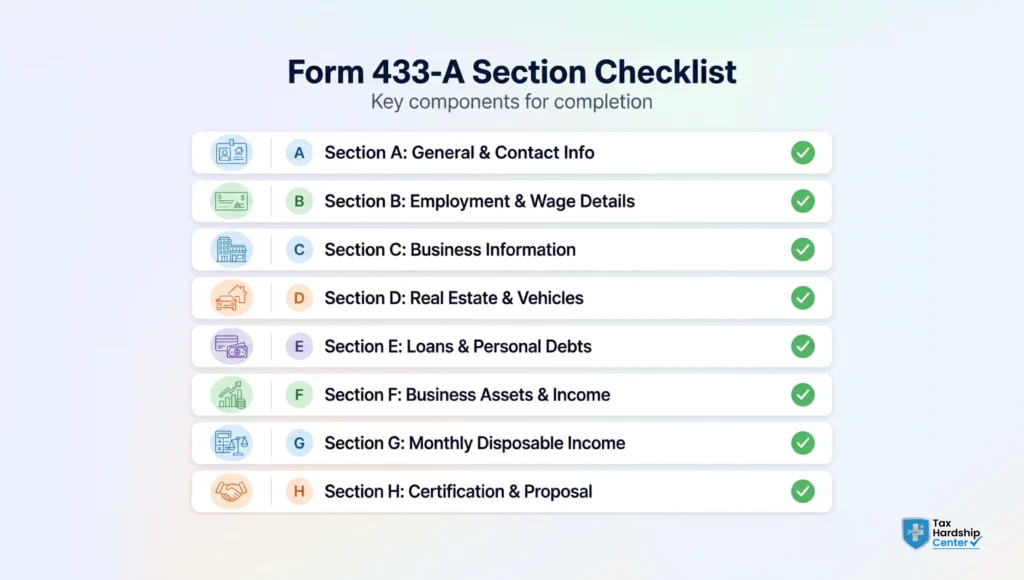
The form runs A through H. Here’s the plain-English version of each.
Section A: Accounts and Investments Every bank account, even the one with $12 in it. Every CD, IRA, 401(k), stock, and mutual fund. And yes, if you own cryptocurrency, the IRS added a dedicated line for it. Leaving it off isn’t a shortcut, it’s a red flag.
Section B: Real Estate Your home, any vacation property, land you own. The IRS wants current market value and what you still owe, because that gap is equity, and equity matters to how they view your ability to pay.
Section C: Personal Property Vehicles, boats, anything with real resale value.
Section D: Credit Cards and Lines of Credit Balances, limits, minimum payments. This tells the IRS what other obligations are already competing for your income.
Section E: Business Information If you’re self-employed, this is where accounts receivable and business income get documented separately from personal finances.
Section F: Employment Information Employer name, pay frequency, gross and net pay. If you attach a recent pay stub, you can often skip re-typing this section.
Section G: Non-Wage Household Income Self-employment income, rental income, alimony, unemployment, anything that isn’t a paycheck.
Section H: Monthly Living Expenses This is the section that decides the most, and it deserves its own spotlight. Keep scrolling.
The Number That Decides Everything: Disposable Income
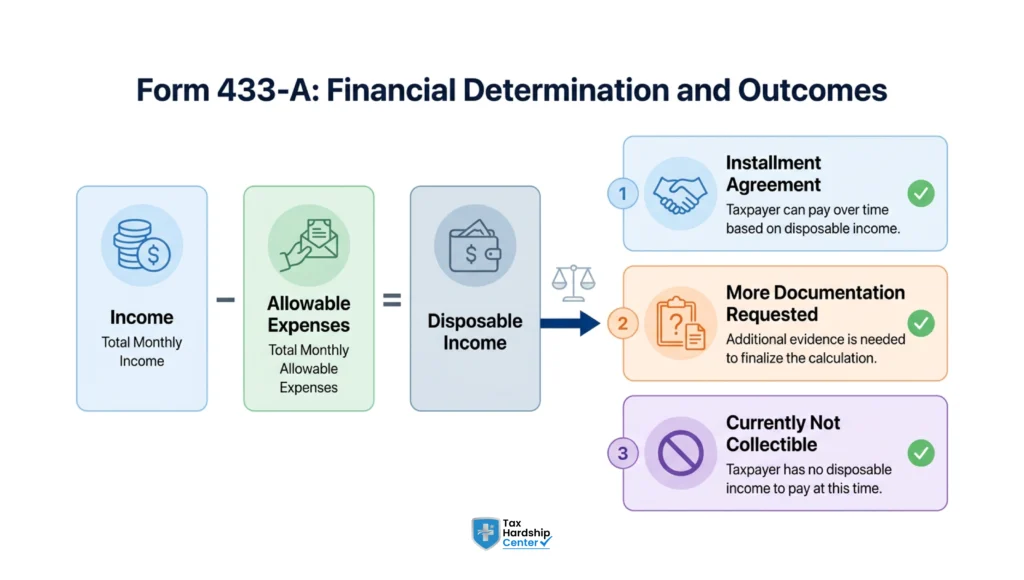
Here’s the part nobody tells you plainly enough, so let’s say it directly: everything on this form exists to produce one number. Your income, minus your allowable expenses, equals your disposable income. That single figure is what the IRS uses to decide your payment amount, or whether you owe nothing at all right now.
And here’s the twist that catches people off guard. You don’t get to claim whatever you actually spend. The IRS measures your expenses against its own Collection Financial Standards, national and local benchmarks for food, housing, transportation, and healthcare based on where you live and your household size. Spend more than the standard allows in a category, and the IRS generally won’t count the extra, unless you can document why it’s necessary.
This is the moment where a $400-a-month grocery habit doesn’t matter if the standard for your household is $839. The IRS isn’t asking what you spend. It’s asking what it considers reasonable. That gap is exactly why so many taxpayers end up with a payment plan that feels tighter than their actual budget, and it’s exactly why understanding this section before you file matters so much. If you’re weighing whether Currently Not Collectible status or an installment plan fits your numbers better, our Fresh Start eligibility checklist walks through the thresholds.
Mistakes That Turn a Simple Form Into a Bigger Problem
Small errors on this form don’t just slow things down. They can trigger a request for more documentation, a rejected payment plan, or worse, a harder look from the IRS.
Leaving boxes blank instead of writing “N/A.” An empty box looks like an omission. A written “N/A” looks like an honest answer. The IRS treats these very differently.
Forgetting an account because the balance is low. Every account matters, even the ones that feel too small to count.
Guessing at expense numbers instead of pulling real statements. Estimates that don’t match your bank records later can undo the trust you just built.
Claiming expenses above the standard without any backup. If you’re over the limit in a category, bring the receipts, the lease, the medical bills, whatever proves it’s necessary.
Not knowing what to do with the crypto question. This line trips up more people than you’d think. Reporting it accurately, wallet, exchange, current value, is not optional.
One overlooked line, and a plan that could’ve taken three weeks stretches into three months. That’s the real cost of rushing this form.
What Happens After You Hit Submit
You sign under penalty of perjury, mail it (or hand it to your revenue officer), and then you wait. But here’s what’s actually happening on the other side.
The IRS reviews your numbers against its standards and calculates your disposable income. From there, one of a few things happens: they approve an installment agreement based on what you can pay, they place your account in Currently Not Collectible status if your expenses outweigh your income, or they come back asking for more documentation if something doesn’t add up.
If you’re also requesting a formal installment agreement, this form usually travels alongside Form 9465, the actual payment plan request. Submitting them together, with consistent numbers across both, is one of the simplest ways to avoid a delay.
Why Taxpayers Bring In Help for Form 433-F
Tax Hardship Center exists for exactly this moment, the one where a two-page government form is quietly deciding how much of your paycheck belongs to the IRS every month. This isn’t a form you want to guess your way through, and it isn’t one you should have to face with a blank template and a search engine tab open at 11pm.
Our team prepares Form 433-F the way it’s meant to be prepared: with every account, asset, and expense mapped against the IRS’s actual Collection Financial Standards before it ever reaches a caseworker’s desk. That means knowing which expenses can be documented above the standard, how to present self-employment income so it doesn’t inflate your apparent ability to pay, and how to package the form alongside Form 9465 or a Currently Not Collectible request so your case moves in the direction you actually need. If you’re unsure which resolution path fits your numbers, our back tax relief options guide is a good place to see the full menu before you commit to one.
What clients consistently tell us is this: the number on the page rarely tells the full story, and that’s exactly where the difference gets made. A disposable income calculation that’s off by even $150 a month can be the gap between an installment agreement you can actually sustain and one that quietly sets you up to default six months from now. Getting it right the first time isn’t a luxury. It’s what keeps your case out of that spiral entirely.
FAQs
Who actually has to file IRS Form 433-F?
Wage earners and self-employed individuals who owe back taxes and either received a request from the IRS Automated Collection System or want to apply for Currently Not Collectible status or a long-term installment agreement.
What’s the difference between Form 433-F and Form 433-A?
Form 433-F is the shorter, two-page version used for most standard collection cases. Form 433-A is longer and more detailed, typically required when a revenue officer is personally assigned to your file.
Do I need to file Form 433-F if I owe less than $50,000?
Often not. Many taxpayers under that threshold qualify for a streamlined installment agreement through the IRS’s online system without submitting a financial statement.
What happens if I leave a section blank?
The IRS may treat it as an incomplete or inaccurate filing. Write “N/A” for anything that doesn’t apply instead of leaving it empty.
Do I have to report cryptocurrency on Form 433-F?
Yes. The form has a specific section for digital assets, including wallet details, exchange information, and current dollar value.
Can my expenses be higher than the IRS standard amounts?
Sometimes, but only with documentation proving the expense is necessary. Without that backup, the IRS generally caps your allowable amount at its published standard.
What happens after I submit the form?
The IRS calculates your disposable income and either approves a payment plan, places your account in Currently Not Collectible status, or requests additional documentation.
Should I fill this out myself or get help?
You can file it yourself, but because the disposable income calculation directly determines your monthly payment, many taxpayers choose to have a tax professional review the numbers before submission.
Get a free case review to make sure your Form 433-F reflects what you can actually afford, not just what the IRS assumes.
Conclusion
Form 433-F feels intimidating because it asks for everything. Every account, every bill, every dollar. But once you understand that it’s really building toward one number, your disposable income, the whole form gets a lot less mysterious. Gather your documents, answer honestly, measure your expenses against the standards the IRS actually uses, and you’ll walk into this with a plan instead of a guess.
Key Takeaways
- Form 433-F is the IRS Collection Information Statement, used to determine your ability to pay back taxes
- Not everyone needs to file it. Smaller balances often qualify for a streamlined online payment plan instead
- The form has eight sections, A through H, covering accounts, property, debts, income, and expenses
- Every bank account must be listed, even ones with a near-zero balance
- Cryptocurrency has its own dedicated reporting line and cannot be skipped
- Your expenses are measured against IRS Collection Financial Standards, not just what you actually spend
- Income minus allowable expenses equals disposable income, the number that decides your payment plan
- Leaving a box blank is treated differently than writing “N/A,” so never leave sections empty
- Form 433-F is often submitted alongside Form 9465 when requesting a formal installment agreement
- Getting the disposable income calculation wrong can derail a payment plan before it even starts