
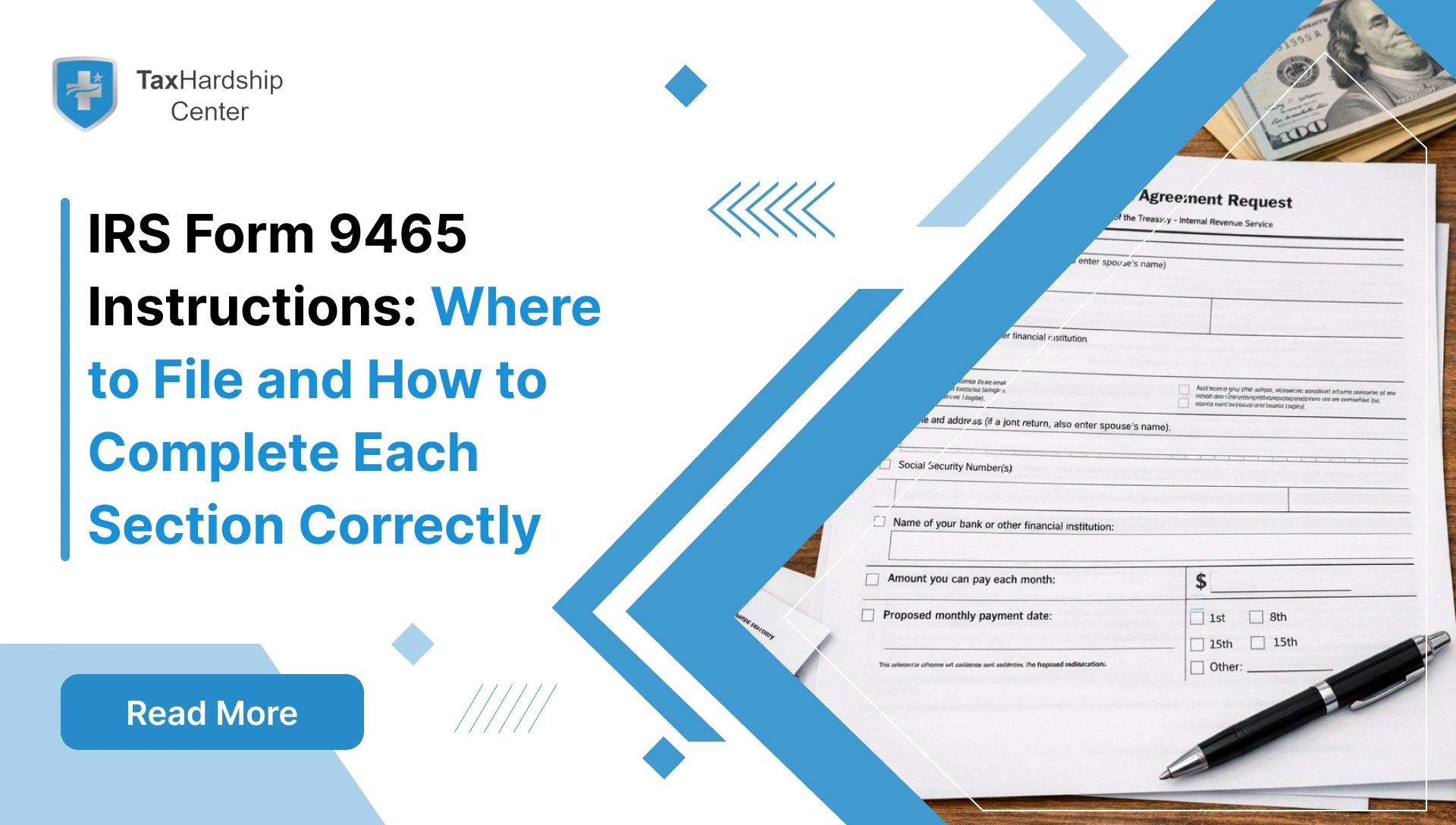

Finding IRS tax forms 9465 usually means one thing:
You can’t pay your tax bill in full and need to set up a payment plan with the IRS.
IRS Form 9465, Installment Agreement Request, is the main IRS payment plan form used when you want to:
- Request an IRS installment agreement (monthly payments), and
- Can’t or don’t want to use the IRS’s Online Payment Agreement tool.
Used correctly, Form 9465 helps you move from panic to a structured tax payment plan. Used carelessly, it can:
- Lock you into a monthly payment you can’t afford
- Delay approval because of errors or missing information
This guide breaks down Form 9465 instructions, explains where to mail Form 9465, shows how to file Form 9465 online (when you don’t need the paper form), and shows where Tax Hardship Center can step in and handle the heavy lifting for you.
What IRS Form 9465 Is (and When to Use It)
IRS Form 9465, Installment Agreement Request, is the official form you use to ask the IRS for a monthly payment plan if you can’t pay the amount you owe in full.
In practical terms, you use Form 9465 when:
- You’ve filed a return and can’t pay the full balance
- You’ve received an IRS bill or notice showing tax due.
- You want to set up a long-term IRS installment agreement (more than 180 days) rather than a short-term arrangement.
Once approved, your IRS tax payment plan helps you:
- Pay in monthly installments
- Reduce the risk of new levies or garnishments (as long as you stay compliant)
- Put your back taxes on a predictable schedule.
When You Probably Should Not Use Form 9465
The IRS notes explicitly situations where you shouldn’t use Form 9465:
You usually do not need Form 9465 if:
- You can pay in full within 180 days
- You can use a short-term payment plan instead (often set up online or by phone).
- Short-term plans have no setup fee, though penalties and interest still apply.
- You qualify to apply online
- If you owe $50,000 or less (combined tax, penalties, interest) and have filed all returns, you usually qualify to use the Online Payment Agreement (OPA) instead of Form 9465.
- You’re an in-business employer behind on payroll taxes
- For active businesses with employment tax debt, the IRS directs you to call the number on your notice rather than file Form 9465, as special rules apply.
In short, Form 9465 is the paper route when online options don’t fit or when you’re filing a return and want to request a plan at the same time.
IRS Form 9465 Instructions: Section-by-Section Walkthrough
Below is a plain-English overview of how to complete each part of IRS tax form 9465, based on the latest IRS form and instructions.
This is a guide, not individualized advice. If you have a larger balance or complex situation, it’s wise to let a professional review your numbers before you send anything to the IRS.
1. Basic taxpayer information
You’ll start by entering:
- Your full name (and spouse’s name if filing jointly)
- Your Social Security Number
- Your mailing address and phone number
Make sure this matches what’s on your most recent tax return or IRS notice. Mismatched details can slow down processing.
2. The amount you owe and the payment you can send now
You’ll be asked to show:
- The total amount you owe (from your return or IRS bill)
- Any amount you are paying with the form right now
The IRS encourages paying something upfront if you cannot reduce the principal and ongoing interest/penalties.
3. Your proposed monthly payment and due date
This is the heart of your IRS tax payment plan proposal:
- Monthly payment amount, what you think you can consistently afford
- Preferred payment date , for example, the 10th, 20th, or 28th of each month
Two important cautions:
- Don’t overpromise. If you pick a payment that’s too high, you risk defaulting later.
- Don’t underthink it. On larger balances, proposing an unrealistically low amount can trigger extra scrutiny or a request for full financial disclosure (Form 433-F).
This is one of the main areas where the Tax Hardship Center can help you match your budget with IRS expectations, so you’re not guessing.
4. Choose how you’ll make each payment
Form 9465 lets you choose your payment method:
- Direct debit from your bank (preferred by IRS, often lower setup fee, and less risk of missed payments)
- Payroll deduction (if your employer agrees and you attach Form 2159)
- Other methods (mailed checks, EFTPS, etc.) usually have higher setup fees and more room for error
Direct debit is the smartest option if your cash flow is stable.
5. Bank and employer details (if applicable)
Depending on your choices, the form may ask for:
- Bank name and address (for direct debit)
- Employer name and address (for payroll deduction)
This information allows the IRS to set up automatic payments if you’ve chosen that route.
6. Information about shared or complex tax situations
If any of the following apply, you may need to provide extra details:
- Joint returns, both spouses share responsibility for the balance
- Previously defaulted payment plans
- Multiple years or types of tax involved
The IRS may also ask for additional forms (such as Form 433-F) for higher balances, especially those above $50,000.
7. Sign and date
Finally:
- Sign and date the form
- Have your spouse sign if it’s a joint liability.
Unsigned or incomplete forms can be treated as invalid, delaying your IRS installment agreement request.
Where to File: Mailing Addresses and Filing Methods
A surprising number of Form 9465 requests are delayed simply because they’re sent to the wrong address.
The IRS gives clear guidance on where to mail Form 9465:
1. If you’re filing Form 9465 with your tax return
- Paper return:
Attach Form 9465 to the front of your Form 1040 (or other individual return) and mail everything to the standard filing address for your state and form type.
The IRS’s “Where to File Your Taxes for Form 9465” page confirms that if you attach it to your return, you send both to the usual tax-return address.
2. If you’re filing Form 9465 by itself
If you’re not attaching it to a tax return (for example, you’re responding to a bill or filing after the fact):
- Use the address listed on your IRS notice,
or - Look up the correct address for your state and situation in the IRS’s “Where to File Your Taxes for Form 9465” tables.
The address can change based on:
- The state where you live
- Whether you’re filing a Form 1040 with Schedule C/E/F
- Whether you’re filing as an individual or a business
Because these addresses change periodically, it’s safer to rely on the current IRS webpage or your specific notice rather than an outdated printed list.
3. Special rules for businesses with employment tax debt
If you’re an in-business employer with payroll/employment tax debt, the IRS generally does not want you to mail Form 9465. Instead, the instructions say to call the number on your notice or contact the IRS Business and Specialty Tax line to request the appropriate type of payment plan.
How to File Form 9465 Online (or Skip It Entirely)
Many taxpayers never touch the paper form because they can set up a plan online instead.
1. Using the IRS Online Payment Agreement tool
The Online Payment Agreement (OPA) application lets qualifying taxpayers:
- Apply for a short-term payment plan (≤180 days) if they owe less than $100,000
- Apply for a long-term IRS installment agreement if they owe $50,000 or less and have filed all returns.
- Receive immediate confirmation of approval or next steps.
You access it via the IRS site
If you qualify, the IRS actually encourages you to use this route because it is faster, more secure, and comes with lower setup fees than mail or phone in many cases.
2. E-filing Form 9465 with your return
If you’re e-filing your tax return through software, you can often e-file Form 9465 as part of the duplicate submission, as long as:
- Your balance is within the eligible limits
- The software supports installment agreement requests.
Tax preparation platforms (like TaxAct, Drake, etc.) confirm that Form 9465 can be filed electronically with the current-year return, with the same effect as mailing a paper form.
3. When you still need the paper IRS payment plan form
You may still need or prefer to mail Form 9465 if:
- You owe more than the online thresholds
- Your situation is complex (multiple years, prior defaults, etc.)
- You need to attach additional forms, such as Form 433-F for financial disclosure.
In these cases, a structured approach with professional help significantly reduces risk.
Common Mistakes to Avoid With IRS Payment Plan Forms
Even simple errors can cause headaches. Some of the most common issues professionals see include:
1. Picking a payment you can’t sustain
People often choose a monthly payment that sounds good, not one that reflects their actual budget. When life happens, they miss payments, the plan defaults, and the IRS can restart enforcement.
2. Using Form 9465 online would be easier and cheaper
If you qualify for the Online Payment Agreement, use the paper form:
- Takes longer
- May come with a higher setup fee
- Means waiting for a mailed response instead of getting a quick decision
3. Mailing to the wrong address
Sending Form 9465 to the wrong service center or ignoring the specific address on your notice can delay processing. Always:
- Use the address on your latest IRS notice, or
- Use the IRS’s current Where to File for Form 9465 page.
4. Ignoring other IRS payment options
A standard IRS tax payment plan is not always the best choice. Depending on your situation, you may be better served by:
- Short-term payment arrangements
- A partial pay installment agreement
- Penalty abatement
- An Offer in Compromise or Currently Not Collectible status if you can’t realistically pay in full
This is why many people use Form 9465 only after speaking with a tax relief professional.
How Tax Hardship Center Can Help With Form 9465 and Beyond
Tax Hardship Center is a nationwide tax problem resolution firm that focuses on IRS and state tax debt, not routine tax prep.
According to its own site and independent reviews, Tax Hardship Center:
- Helps taxpayers who owe at least $7,500 in back taxes
- Specializes in IRS payment plans / installment agreements, Offers in Compromise, penalty relief, and hardship-based resolutions
- Is licensed to represent clients nationwide, acting as your IRS Power of Attorney
- Has an IRS Enrolled Agent, led a team (plus CPAs and tax attorneys) dedicated to tax resolution.
- Offers a free, no-obligation consultation and a structured “investigation and protection” process
What this means for Form 9465 and your IRS payment plan
Instead of just filling out a form, the Tax Hardship Center can:
- Pull your IRS transcripts
- Verify exactly what you owe, for which years.
- Spot any unfiled returns or missing pieces before you request a plan.
- Run the numbers on your IRS payment options
- Compare a standard IRS tax payment plan to alternative payment plans (OIC, partial pay, CNC, etc.).
- Determine whether you should file Form 9465, use the online tool, or pursue another strategy entirely.
- Design a realistic monthly payment
- Balance IRS expectations with your actual budget
- Help reduce the chance of default and future enforcement.
- Prepare and submit the paperwork
- Complete Form 9465, any necessary Form 433-F, and supporting documents
- Request streamlined or partial-pay installment agreements when you qualify.
- Communicate directly with the IRS so you’re not stuck on the phone or decoding letters.
- Support long-term compliance
- Help you stay current on future returns and payments
- Adjust your strategy if your income or circumstances change
FAQs: Form 9465 Instructions, Online Filing, and Mailing Addresses
1. What is IRS Form 9465 used for?
IRS Form 9465, Installment Agreement Request, is used to request a monthly tax payment plan when you can’t pay the full balance due on your return or IRS notice.
2. Can I file Form 9465 online?
You typically don’t file the paper form online, but you can often skip Form 9465 entirely by using the Online Payment Agreement tool if:
You owe $50,000 or less in combined tax, penalties, and interest, and
You’ve filed all required returns.
Many tax software platforms also allow you to e-file a Form 9465 equivalent with your e-filed return.
3. Where do I mail Form 9465?
It depends:
If you attach Form 9465 to your tax return, mail it to the standard filing address for that return.
If you file Form 9465 by itself, mail it to the address on your IRS bill or notice, or use the IRS’s “Where to File Your Taxes for Form 9465” page to find the correct address for your state and situation.
4. Does filing Form 9465 guarantee the IRS will approve my payment plan?
No. Filing IRS tax form 9465 is a request, not a guarantee. The IRS will review:
The amount you owe
Your filing and payment history
Your proposed monthly payment and, for larger balances, your financial information
They may approve, adjust, or deny your request.
5. How long does it take for the IRS to respond to a Form 9465 request?
If you apply online, you usually get an answer immediately or very quickly.
If you mail Form 9465, it can take several weeks or more, depending on IRS workload.
You’ll receive a written notice confirming approval, modification, or denial.
6. Do I need Form 433-F as well as Form 9465?
You may need Form 433-F (Collection Information Statement) in addition to Form 9465 if:
You owe more than $50,000, or
You’re requesting a payment that seems low relative to your income and assets
In those cases, the IRS often requires more detail before agreeing to a tax payment plan.
7. When should I get professional help instead of doing it myself?
You should strongly consider working with a firm like Tax Hardship Center if:
You owe $7,500 or more in back taxes
You’re confused by multiple IRS notices and letters
You’re not sure whether a standard IRS payment plan is your best option
You’ve had a previous plan default or been threatened with liens, levies, or garnishments
They can handle Form 9465, evaluate all of your IRS payment options, and speak to the IRS on your behalf so you’re not navigating high-stakes decisions alone.
If you’re staring at a balance you can’t pay and a stack of IRS notices, Form 9465 is one important tool, but not the whole strategy. Before you lock yourself into a payment you might regret, it’s worth letting Tax Hardship Center review your numbers, explain your choices, and build an IRS tax payment plan that actually works in the real world.