

An IRS payment plan over $50,000 usually works differently from a smaller plan. The IRS often asks for IRS financial disclosure, may review a tax lien, and sets your payment around your real ability to pay. Handle those three things well, and an installment agreement 50k balance can still land on terms you can live with.
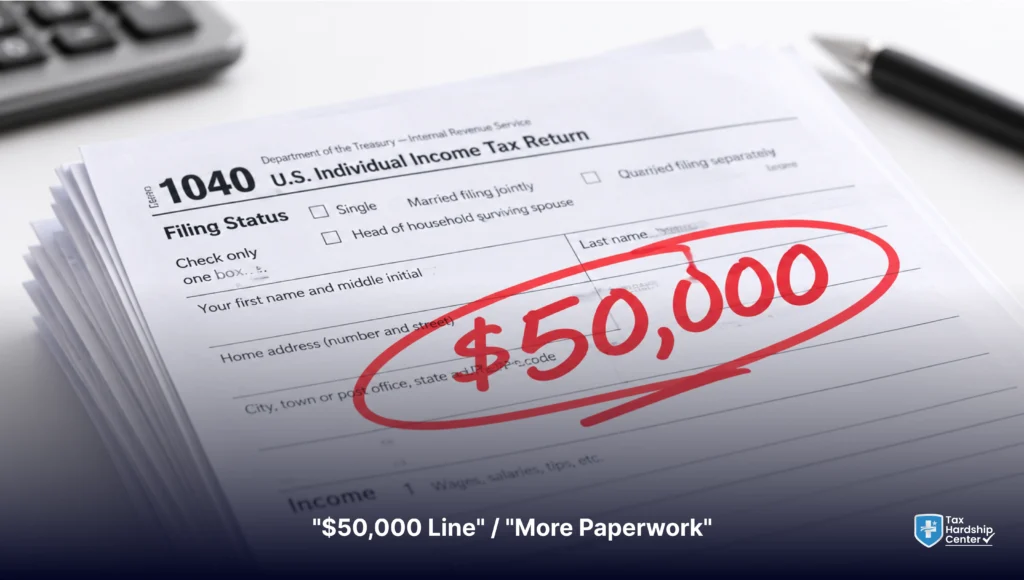
Here is the plot twist. Crossing the $50,000 line does not make you a bad case. It just makes you a paperwork case.
This guide covers what changes, what the IRS wants to see, and when to bring in a pro.
What Changes With an IRS Payment Plan Over $50,000?
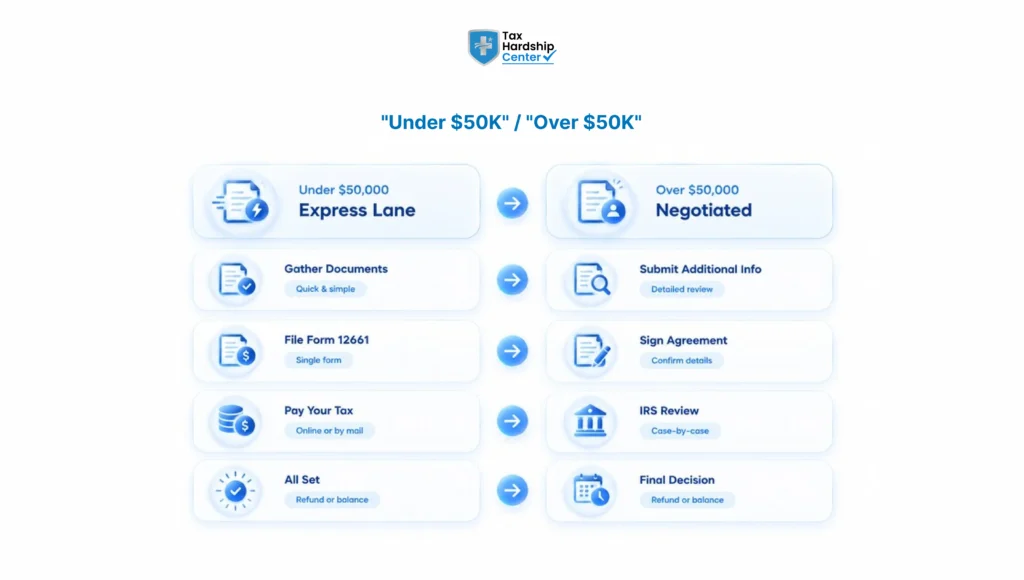
Small balances get the express lane. Many individuals under $50,000 can set up a streamlined plan online or with Form 9465 with little back and forth.
An IRS payment plan over $50,000 is more of a conversation. Here is how the two compare:
| Factor | Under $50,000 | Over $50,000 |
| Typical route | Online agreement or Form 9465 | Negotiated agreement, often by phone or mail |
| Financial statement | Usually not required | Often required |
| Lien review | Lower risk | IRS may run a lien determination |
| Payment amount | You choose one that pays in time | Based on income, expenses, and assets |
Rules vary by exact balance and case status, so treat this as a map, not a promise. Your IRS debt over $50,000 payment plan may follow a slightly different path than your neighbor’s.
Do You Have to Share IRS Financial Disclosure?
Often, yes. IRS financial disclosure means a Collection Information Statement, usually Form 433-F for wage earners or the longer 433-A for complex cases. Our guide to Forms 433-A and 433-B shows how they differ.
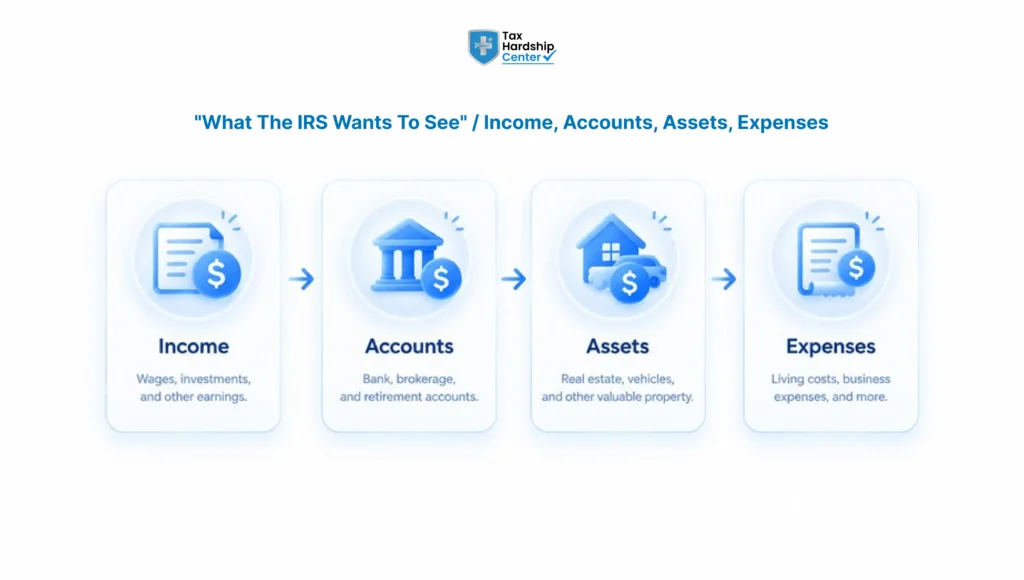
Think of it as a budget confession. The IRS wants to see:
- Income from every source
- Bank accounts and savings
- Home equity, vehicles, and other assets
- Monthly living expenses and debts
Then the IRS compares your expenses to its allowable standards. What is left over becomes your proposed payment. Honestly, this is where most big-balance requests stall, because one missing statement can reset the clock.
If your IRS payment plan over $50,000 looks unaffordable on paper, ask about a partial payment plan too, as IRS Topic 202 describes.
Will the IRS File a Lien on a Bigger Balance?
It can. An IRS payment plan over $50,000 makes the IRS more likely to review a Notice of Federal Tax Lien, and some agreements, especially without automatic payments, raise that risk.
Direct debit or payroll deduction often helps your case. Setting one up shows the IRS you are serious about paying, which can matter for an installment agreement 50k situation. Learn how liens end in our guide on how long an IRS lien lasts.
Want to stay ahead of it? File every required return and stay current on this year’s taxes. The IRS rarely negotiates with someone who is still behind.
How Long Does an IRS Debt Over $50,000 Payment Plan Last?
Not forever. An IRS payment plan over $50,000 generally needs to fit inside the Collection Statute Expiration Date, the window the IRS has to collect. That clock varies by case, so confirm yours on your account transcript.
Here is what that means in practice:
- Full-pay plan. Your payment clears the whole balance before the deadline.
- Partial payment plan. If your budget cannot clear it, the IRS may accept a smaller payment after reviewing your finances.
- Other relief. For some, an Offer in Compromise or Currently Not Collectible status fits better. See our breakdown of IRS payment plan vs OIC vs CNC.
Not everyone qualifies for the gentler options. The IRS looks at assets as well as income. A big balance plus real savings often means a full-pay plan, not a discount.
Which Mistakes Sink Larger Payment Plan Requests?
- Rounding your numbers. Estimates on the financial statement invite follow-up questions and delays.
- Forgetting assets. Omissions can damage trust and approval.
- Lowballing the payment. An offer the IRS rejects wastes weeks while interest runs.
- Ignoring notices. Silence can push your case toward enforcement.
- Skipping help. A rushed request on an IRS payment plan over $50,000 is hard to unwind.
How Tax Hardship Center Handles an IRS Payment Plan Over $50,000
When you owe more than $50,000, the details decide the outcome, and Tax Hardship Center works those details daily on every installment agreement 50k case. We pull your transcripts, confirm the balance and collection deadline, and prepare IRS financial disclosure that matches your real budget, so the IRS sees an accurate picture the first time.
Whatever shape your IRS debt over $50,000 payment plan takes, we pursue the right path: a negotiated IRS installment agreement, an Offer in Compromise review when full payment is unrealistic, or broader IRS tax relief services if a revenue officer or levy notice is involved. Curious about fees? Our tax relief service costs page lays out how pricing works.
Picture a self-employed contractor with a six-figure balance and a pile of unsorted receipts. We organize the records, build the financial statement, and handle the IRS conversations while he keeps working. We never promise outcomes, because the IRS decides, but we tell you what is realistic before you pay anything.
Conclusion
A big balance is not a dead end. Prepare your financial statement, protect against a lien, and pick the right plan for your numbers. An IRS payment plan over $50,000 rewards the taxpayers who show up organized.
P.S. How many years of statements are sitting in your junk drawer right now?
FAQs
Can I get an IRS payment plan over $50,000?
Yes. The IRS can approve larger balances, but it often asks for financial information and may review a lien first.
Do I need a financial statement for a $50,000 balance?
Often, yes. Expect to complete Form 433-F or 433-A with income, expenses, and assets, unless the IRS says otherwise for your case.
Is an installment agreement 50k balance harder to get approved?
It takes more preparation, not more luck. Accurate numbers, filed returns, and a realistic payment make approval far smoother.
Can I lower my IRS debt over $50,000 payment plan amount?
Possibly. If your budget supports a lower amount, the IRS may consider a longer plan or a partial payment option.
Will the IRS levy my wages during an IRS payment plan over $50,000?
Staying current on an approved agreement generally limits levies. Missing payments or filings can put that protection at risk.
When should I hire a tax professional?
Consider it if your case involves a revenue officer, business income, many unfiled years, or complicated assets. Ask for clear fees first.
Key Takeaways
- An IRS payment plan over $50,000 usually requires more paperwork than a smaller streamlined plan.
- IRS financial disclosure often means Form 433-F or 433-A with income, expenses, and assets.
- Your IRS debt over $50,000 payment plan should rest on accurate numbers, not fast ones.
- Direct debit or payroll deduction can help reduce lien risk on an installment agreement 50k balance.
- An IRS payment plan over $50,000 generally must fit within the IRS collection deadline.
- A partial payment plan may exist when full payment is unrealistic.
- Not everyone qualifies for relief, because the IRS reviews assets along with income.
- File all required returns and stay current before requesting any agreement.
- Missed payments or notices can push your case toward enforcement.
- An experienced pro can organize the paperwork and handle the IRS conversation.
Ready to tackle your balance? Click here to get a free quote.