
If you’re considering a loan to pay irs debt, here’s the direct answer before you apply for anything: it can work, but it’s rarely the cheapest or safest option once you compare it against what the IRS itself offers. A personal loan to pay IRS balances comes with its own interest rate, credit check, and fixed repayment schedule, and in many cases an IRS payment plan ends up costing less and carries fewer risks. Before you borrow, it’s worth understanding exactly how the two compare.
Loan to Pay IRS: Why People Consider It in the First Place
The instinct to take a loan to pay irs debt usually comes from wanting to make the problem disappear immediately. A personal loan pays the IRS in full, closes the notices, and stops the anxiety of watching the balance grow with penalties and interest. That instinct is understandable, but it skips over an important comparison most people never actually run.
The IRS itself offers structured payment options that are often cheaper than a loan for tax debt from a bank or online lender. Before applying for a loan to pay irs balances, it’s worth understanding what the IRS’s own installment agreement actually costs versus what a lender will charge you.
How a Personal Loan to Pay IRS Debt Actually Works
A personal loan to pay IRS debt functions like any other unsecured personal loan. You apply, the lender checks your credit and income, and if approved, you receive a lump sum that you then send to the IRS to pay your balance in full. From there, you repay the lender on a fixed schedule, typically over two to seven years, at whatever interest rate your credit qualifies you for.
The appeal is speed. Once the loan funds, your IRS balance is resolved and collection activity stops immediately. But the tradeoff is that you’ve now converted a tax debt into a personal loan to pay IRS obligation with a private lender, and that debt doesn’t have the same flexibility, protections, or resolution options that IRS debt does if your financial situation changes.
IRS Payment Plan vs Loan for Tax Debt: The Real Cost Comparison
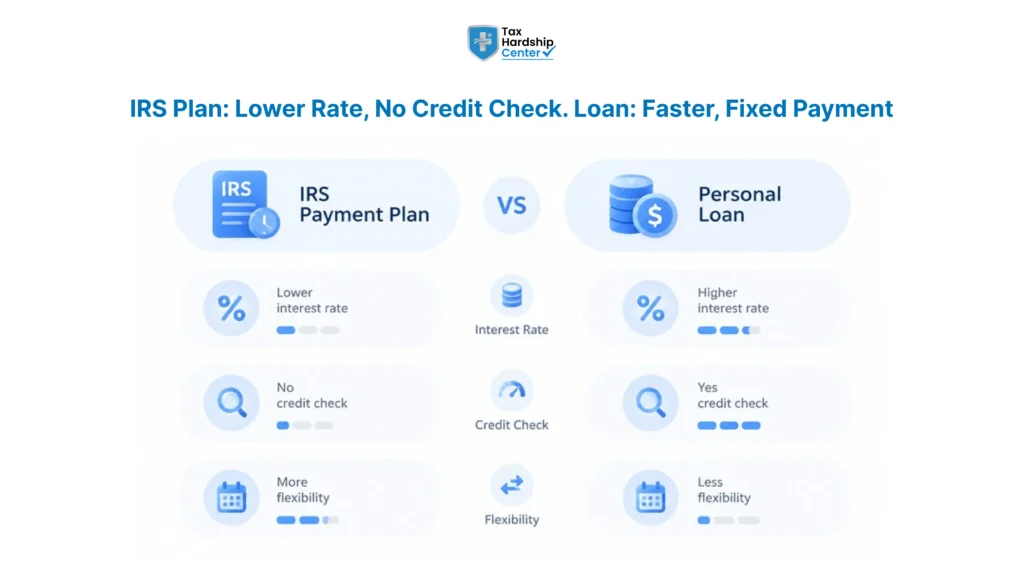
This is where the decision usually gets made, once people actually look at the numbers side by side.
IRS payment plan:
- Interest rate is based on the federal short-term rate plus 3%, currently landing in the high single digits for most balances
- No credit check required to apply for a standard installment agreement
- Can be adjusted or paused if your financial situation changes significantly
- Setup fees are minimal, especially with direct debit enrollment
Loan for tax debt from a personal lender:
- Interest rates commonly range from 8% to 25%+ depending on credit score
- Requires a credit check, which can affect approval and terms
- Fixed monthly payment with limited flexibility if your income changes
- No built-in hardship provisions if you can’t pay later
For most people with average to below-average credit, a loan for tax debt ends up costing significantly more in interest than simply setting up an IRS payment plan directly with the agency. The exception is for people with excellent credit who can secure a lower rate than the IRS’s own installment rate, which does happen, but it’s less common than most people assume going in.
When a Loan to Pay IRS Debt Actually Makes Sense
There are specific situations where a loan to pay irs debt is genuinely the better choice, and it’s worth being honest about when that applies:
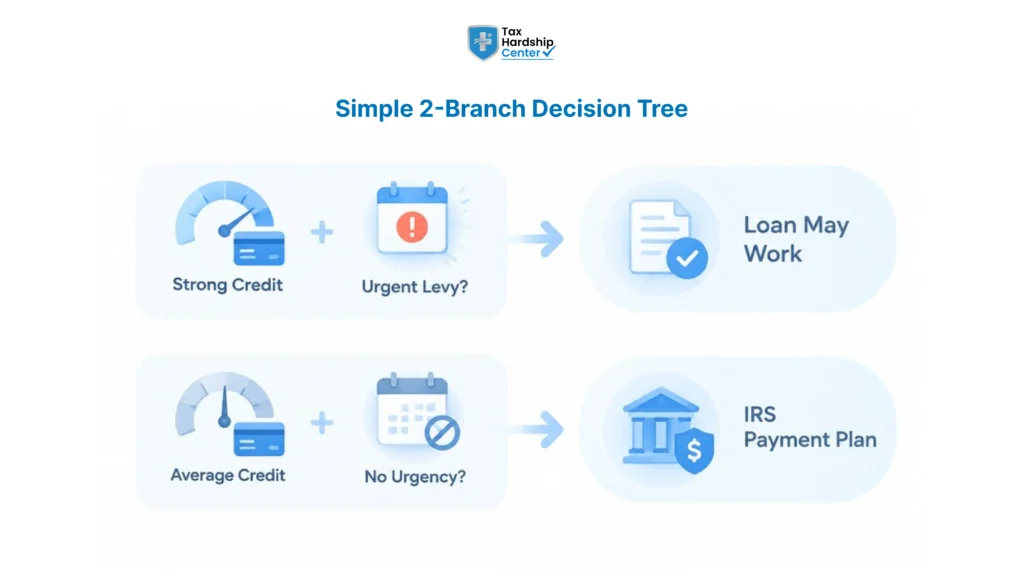
- You have excellent credit and can secure a rate lower than the IRS installment rate, making the loan cheaper over the life of the repayment
- You’re facing an active levy or lien and need the balance resolved immediately to protect an asset, like a home sale or business transaction
- The balance is small enough that a short-term personal loan closes it out faster than a multi-year IRS payment plan would
- You have a 0% introductory offer on a card or loan product that genuinely beats any interest accruing with the IRS
If none of these describe your situation, a personal loan to pay IRS debt is usually solving the emotional urgency of the problem rather than the actual financial one.
When an IRS Payment Plan Is the Smarter Move
For most taxpayers, an IRS payment plan for tax debt is the more practical and often the cheaper route, especially if your credit isn’t strong enough to secure a favorable loan rate. The IRS doesn’t run a credit check for standard installment agreements, which means approval isn’t a barrier the way it can be with a private lender.
An IRS payment plan also comes with built-in flexibility that a loan for tax debt doesn’t. If your income drops or your situation changes, you can request a modification or move to Currently Not Collectible status. A personal lender isn’t going to offer that same accommodation if you fall behind on a fixed loan payment. Our comparison of installment agreements versus other resolution options breaks down which structure fits which financial situation.
What Most People Don’t Consider Before Taking a Loan for Tax Debt
Before committing to a loan to pay irs balances, there are a few things worth weighing that don’t show up in a simple interest rate comparison:
- A personal loan doesn’t pause if you lose your job or income drops. IRS payment plans have more built-in accommodation for hardship.
- Loan approval isn’t guaranteed, and a denial after you’ve already started the process can leave you in a worse position with the IRS.
- A loan for tax debt shows up on your credit report as a new obligation, while an IRS installment agreement generally does not affect your credit score directly.
- If your balance qualifies for an Offer in Compromise, taking a loan to pay it in full means paying the entire amount rather than potentially settling for less.
That last point is especially important. Before taking a loan to pay irs debt, it’s worth checking whether you’d actually qualify to settle the balance for less through an Offer in Compromise, since borrowing to pay the full amount eliminates that possibility entirely.
How Tax Hardship Center Helps You Decide the Right Path
When a client comes to us asking whether they should take a personal loan to pay IRS debt, we start by pulling their actual IRS transcript and financial picture to see what options genuinely apply, rather than assuming a loan is the only fast solution. In many cases, setting up a properly structured IRS payment plan resolves the urgency just as fast as a loan, without the added interest cost or credit exposure.
For clients whose balance might qualify for reduced settlement, we evaluate Offer in Compromise eligibility before recommending any path that involves paying the full balance, whether through a loan or otherwise. If there’s active enforcement risk, like a pending levy or lien, we also help determine whether that timeline genuinely requires immediate full payment or whether a Collection Due Process hearing can pause things while a more cost-effective resolution is put in place.
Frequently Asked Questions
Is a loan to pay IRS debt ever a bad idea?
It can be, especially if your credit isn’t strong enough to secure a rate lower than the IRS’s own installment rate, or if your balance might qualify for a reduced settlement instead.
Does a personal loan to pay IRS debt affect my credit score?
Yes, since it’s a new loan obligation reported to credit bureaus. An IRS installment agreement generally does not affect your credit score directly.
Is an IRS payment plan cheaper than a loan for tax debt?
Often yes, since the IRS’s own interest rate is based on the federal short-term rate plus 3%, which is typically lower than most personal loan rates.
Can I still qualify for an Offer in Compromise if I take a loan to pay IRS debt?
No. If you pay the full balance through a loan, you’re paying the entire amount owed, which removes the option to settle for less through an Offer in Compromise.
What credit score do I need for a loan to pay IRS debt?
It varies by lender, but the best rates typically require good to excellent credit. Lower credit scores usually mean higher interest rates that can exceed IRS installment costs.
Does the IRS require a credit check for a payment plan?
No. Standard IRS installment agreements do not require a credit check, which makes them accessible even if your credit wouldn’t qualify for a favorable personal loan.
Conclusion
Deciding whether to take a loan to pay irs debt comes down to running the actual numbers rather than reacting to the urgency of an unpaid balance. In most cases, an IRS payment plan costs less, requires no credit check, and offers more flexibility if your financial situation changes. A personal loan to pay IRS debt makes sense in specific situations, particularly for those with strong credit or urgent enforcement risk, but it shouldn’t be the default choice without comparing it against what the IRS already offers directly.
Key Takeaways
- A loan to pay irs debt isn’t automatically cheaper than working directly with the IRS.
- IRS payment plans use the federal short-term rate plus 3%, often lower than personal loan rates.
- A personal loan to pay IRS debt requires a credit check, while IRS installment agreements do not.
- Loan for tax debt options offer less flexibility if your income or situation changes later.
- Paying your full balance through a loan eliminates eligibility for an Offer in Compromise.
- Excellent credit is the main scenario where a loan to pay irs debt beats an IRS payment plan.
- IRS payment plans generally don’t affect your credit score, unlike a new personal loan.
- Active levy or lien risk is one legitimate reason to consider fast, full payment through a loan.
- Comparing both options before borrowing prevents overpaying in interest unnecessarily.
- A transcript review is the fastest way to know which resolution path actually fits your case.
Not sure if a loan to pay the IRS is your best option? Get a free case review from Tax Hardship Center and compare it against your actual IRS payment plan options.