


When the IRS is sending letters, filing liens, or garnishing your paycheck, the pressure is real.
The question most people ask next is just as stressful:
“Do I need a tax attorney, a CPA, or a tax relief company to fix this?”
Each option can help with tax issues, but they play very different roles:
- A tax attorney (or tax lawyer / IRS lawyer) is a legal professional.
- A CPA focuses on accounting, financial records, and tax returns.
- A tax relief company or tax relief firm is built around resolving tax debt and negotiating with the IRS.
Understanding the differences is the first step. Choosing the right fit for your situation is what can save you time, money, and a lot of stress.
Below is a detailed comparison and a clear explanation of where the Tax Hardship Center fits into that picture.
Why Your Choice of IRS Help Matters
IRS problems do not stay still. While you try to figure out what to do, the IRS can:
- Add penalties and interest every month
- File a Notice of Federal Tax Lien against your property.
- Issue a wage garnishment to your employer.
- Place a levy on your bank accounts or specific assets.
The right kind of help can:
- Stop or reduce aggressive collection actions
- Open doors to IRS relief programs you may not know exist.
- Structure a solution you can actually afford and maintain
The wrong fit can leave you:
- Paying premium rates for services you don’t actually need
- Handling IRS calls and paperwork on your own
- Missing opportunities for penalty abatement, installment agreements, or an Offer in Compromise
This is why simply “hiring someone who does taxes” is not enough. You need the right professional for the specific stage and severity of your IRS issue.
What a Tax Attorney (Tax Lawyer / IRS Lawyer) Actually Does
A tax attorney is a licensed lawyer who focuses on tax law. You’ll often see them referred to as:
- Tax attorney
- Tax lawyer
- IRS lawyer
These terms are often used interchangeably.
Core role of a tax attorney
Tax attorneys are legal experts who step in when:
- There is a risk of criminal charges or allegations of fraud
- A case is moving toward Tax Court or federal court.
- The IRS is questioning issues with serious legal consequences.
- You need formal legal opinions or complex tax structuring.
They are trained to:
- Interpret and apply federal and state tax laws
- Defend you in legal disputes with the IRS.
- Protect you with the attorney-client privilege, so what you share is confidential in the context of legal advice.
Strengths of a tax attorney
A tax attorney or IRS lawyer is powerful when:
- You receive communication from IRS Criminal Investigation
- The IRS is alleging intentional misrepresentation, fraud, or evasion.
- Your case involves substantial amounts and complex legal questions.
- You need someone who can appear in Tax Court on your behalf.
In those situations, a tax attorney is often essential; they are not optional.
Limitations of a tax attorney for everyday IRS debt
For many taxpayers, the issue is not criminal exposure; it is overdue tax debt and aggressive collections. In those cases, hiring a tax attorney as your primary solution can sometimes mean:
- Higher costs than other options, especially if billing is hourly
- Less operational support with things like document collection, financial disclosures, and routine calls
- No ongoing bookkeeping or tax return preparation unless the attorney also runs an accounting function
Tax attorneys are extremely valuable when the problem is fundamentally legal. When the problem is primarily administrative and financial, back taxes, collections, and negotiating a manageable resolution, other professionals or a tax relief firm may be a better first call.
What a CPA Can and Cannot Do for IRS Debt
A Certified Public Accountant (CPA) is an accounting professional licensed by a state board. CPAs are highly trained in:
- Financial statements and bookkeeping
- Tax return preparation
- Tax planning and compliance
When a CPA is the right fit
You are generally well-served by a CPA when:
- Your primary issue is unfiled or incorrect tax returns
- Your bookkeeping is incomplete and needs to be reconstructed.
- You want to make sure your filings are accurate going forward.
- You need guidance on how to reduce future tax liability legally
A CPA is often the ideal professional to:
- Prepare or amend your returns
- Organize and document your income, expenses, and deductions.
- Coordinate with other professionals (such as a tax relief company) to support your IRS case with accurate numbers.
Limitations of using only a CPA for IRS collections
When your problem has moved beyond “filing returns” into active IRS collections, relying only on a CPA can leave gaps:
- Many CPAs do not focus daily on dealing with IRS collectors and revenue officers
- Some may be less familiar with the finer details of resolution programs, such as Offers in Compromise, partial-pay installment agreements, or aggressive penalty relief strategies.
- CPAs cannot represent you in Tax Court unless they are also attorneys.
A CPA is excellent for getting the numbers right. But if you are already facing liens, levies, or garnishments, you may benefit from a team that combines accounting expertise with full-time experience negotiating with the IRS.

What a Tax Relief Company Does Differently
A tax relief company or tax relief firm is built around one mission:
Helping taxpayers resolve IRS and state tax debt problems and move out of collections.
While every firm operates a bit differently, reputable tax relief companies share some common characteristics.
Typical services offered by a tax relief firm
A solid tax relief company will typically assist with:
- Back tax debt for individuals and businesses
- Unfiled tax returns, preparing and submitting multiple years if needed
- Wage garnishment relief
- Bank levy release
- Tax lien issues and related negotiations
- Installment agreements and partial pay plans
- Offers in Compromise (OIC), when appropriate for your situation
- Penalty abatement requests
- Certain types of audit representation and IRS correspondence
In short, a tax relief firm focuses on problem-solving and tax negotiation, not just return preparation.
How tax relief companies typically work
Although details vary, most reputable tax relief companies follow a similar approach:
- Initial consultation
- Understand your situation at a high level.
- Review the notices you’ve received.
- Determine whether you are a good candidate for formal representation.
- Investigation and analysis
- Obtain your IRS transcripts and account records.
- Verify exactly how much you owe and for which years.
- Confirm the status of liens, levies, and other collection actions.
- Strategy and execution
- Evaluate which IRS or state programs you may qualify for.
- Prepare and submit necessary forms, financial statements, and supporting documents.
- Communicate directly with the IRS or state agency on your behalf.
Pros and cons of a tax relief company vs a tax attorney or CPA
Advantages of a tax relief firm:
- Specialization in tax debt relief. Their daily work is resolving back taxes, not general accounting or broad legal practice.
- Integrated approach. They combine case analysis, documentation, and IRS communication under one roof.
- Clearer pricing structure. Many tax relief companies use project-based or phase-based fees rather than open-ended hourly billing.
- Less burden on you. They handle a large portion of the paperwork, phone calls, and follow-ups so you are not navigating the IRS alone.
Potential drawbacks:
- Quality across the industry is uneven. Some firms are highly professional; others rely on aggressive sales tactics and unrealistic promises.
- A tax relief firm itself cannot appear in court on your behalf unless a licensed attorney within the firm takes that role.
- Heavy advertising by some companies can sometimes overshadow due diligence on credentials and track record.
This is why it is important to choose a reputable tax relief company with verifiable credentials, positive reviews, and transparent communication.
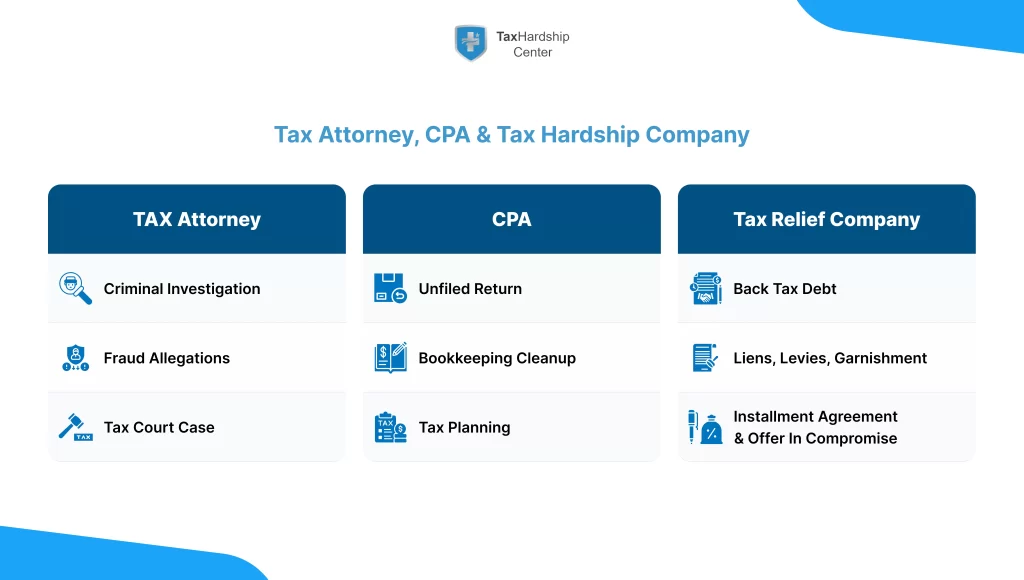
Tax Attorney vs Tax Relief Company vs CPA: Side-by-Side Comparison
To make the differences more straightforward, here is a direct comparison:
| Factor | Tax Attorney / Tax Lawyer / IRS Lawyer | CPA | Tax Relief Company / Tax Relief Firm |
| Primary focus | Tax law, disputes, litigation, legal defense | Limited, often compliance-focused | IRS and state tax debt resolution and collections management |
| Best suited for | Criminal exposure, fraud allegations, court cases | Filing/amending returns, bookkeeping, planning | Back taxes, liens, levies, garnishments, payment plans, settlement efforts |
| Court representation | Yes (Tax Court/federal court) | No | Only through attorneys employed by the firm |
| Day-to-day IRS negotiations | Yes, but usually for legal disputes | Typically, an hourly or a high flat fee | Yes, core competency |
| Tax return preparation | Rarely (unless they also run a tax prep practice) | Typically, an hourly or a high flat fee | Often coordinate or arrange; some firms provide in-house tax preparation |
| Fee structure | Accurate numbers, compliance, and planning | Per-return or hourly | Project-based or phase-based; often flat fees for specific engagement stages |
| Strengths | Legal strategy, court defense, privilege | Relief programs, case management, IRS communications, and practical resolution | Relief programs, case management, IRS communications, practical resolution |
| Typical use case | High-risk legal matters | Filing and correcting returns | Taxpayers with active or looming collections and significant back taxes |
For many everyday taxpayers dealing with civil IRS debt and collection pressure, a tax relief company is often the most balanced starting point. Tax attorneys and CPAs can still play important supporting roles, but you are not paying their top-tier rates for tasks that experienced tax relief professionals handle every day.
Who Should Handle Your IRS Debt? Practical Decision Guide
There is no one-size-fits-all answer, but this framework can help you decide.
You likely need a tax attorney if:
- The IRS Criminal Investigation has contacted you
- The IRS is alleging fraud, willful evasion, or intentional non-filing
- You have received a summons to appear in Tax Court or another court
- Your case involves highly complex legal questions, significant assets, or potential criminal exposure
In these scenarios, an experienced tax attorney or IRS lawyer should be at the center of your strategy.
You likely need a CPA if:
- Your main challenge is that your returns are incomplete, missing, or incorrect
- Your books and records need to be cleaned up or reconstructed
- You are primarily concerned with getting current and maintaining correct filings going forward
- You are not yet in heavy collections, but you want to avoid that outcome
A CPA is often most effective when the focus is on compliance and accuracy, not yet collections and negotiation.
You are often best served by a tax relief company if:
- You already owe the IRS or a state tax agency and cannot pay in full
- You are receiving collection notices or dealing with liens, levies, or garnishments.
- You want someone to speak to the IRS on your behalf, manage deadlines, and guide your options.
- You want to explore solutions such as installment agreements, Offers in Compromise, penalty relief, or hardship-based resolutions.
In these situations, a tax relief firm can coordinate the moving parts and only bring in a tax attorney or CPA when needed , rather than making them your default, high-cost starting point.
Where the Tax Hardship Center Fits In
Tax Hardship Center is a nationwide tax relief company dedicated to helping individuals and businesses resolve IRS and state tax debt. The firm is not a general-purpose accounting office or a traditional law practice; its focus is tax problem resolution.
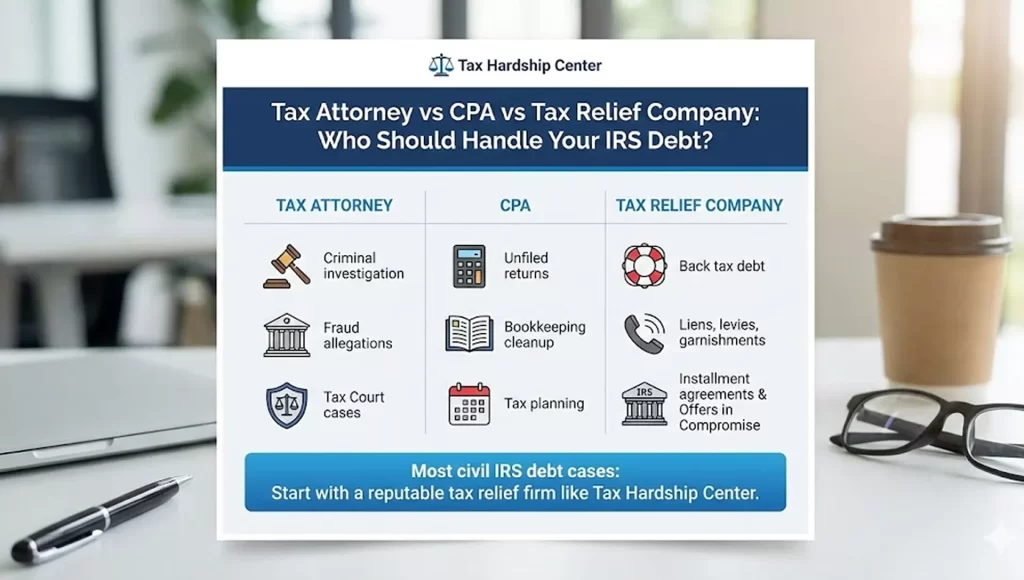
Focused on tax relief, not just tax preparation
Tax Hardship Center concentrates on:
- IRS and state back tax debt
- Unfiled or overdue returns
- Wage garnishments and bank levies
- Tax liens
- Installment agreements and partial pay plans
- Offers in Compromise, where appropriate
- Requests for penalty abatement
- Many types of audit defense and IRS correspondence
- Business and payroll tax issues
In other words, the Tax Hardship Center operates in the space where a tax relief company can often be more practical than working exclusively with a tax attorney or CPA.
Professional credentials and experience
Tax Hardship Center has:
- Been assisting taxpayers for over a decade
- Leadership that includes an IRS Enrolled Agent, a federally authorized tax practitioner recognized by the IRS
- A footprint serving clients across the United States
This combination of experience and focus enables the firm to design strategies grounded in both tax law and IRS practice, while remaining accessible to everyday taxpayers.
How Tax Hardship Center compares to a tax attorney or CPA
- Compared to a tax attorney, THC is generally more focused on the administrative resolution of tax debt (negotiating with the IRS, organizing documents, pursuing relief programs) rather than court-based litigation. In cases where legal risks arise, THC can coordinate with or refer you to a tax attorney.
- Compared to a CPA, THC focuses less on routine accounting and more on debt relief, collections, and negotiations. When your returns need to be prepared or corrected, THC can work alongside tax preparers and accountants to support your overall strategy.
In short, Tax Hardship Center sits in the middle: not replacing tax attorneys or CPAs, but often serving as the central coordinator and negotiator for taxpayers overwhelmed by IRS debt.
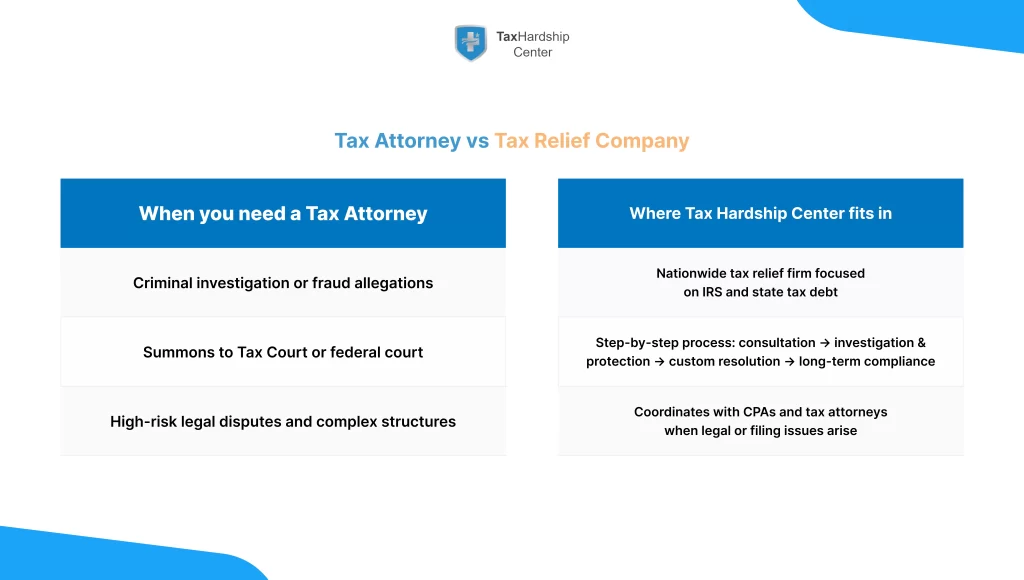
How the Tax Hardship Center Process Works
Although each case is unique, Tax Hardship Center generally follows a clear, step-by-step process to bring structure and relief to a stressful situation.
Step 1: Free, confidential consultation
The process begins with a no-cost, confidential conversation. During this call, a specialist will:
- Review your current situation and IRS or state notices
- Ask about your tax years, balances, income, and basic financial picture
- Explain whether Tax Hardship Center’s services are a realistic fit
- Outline the likely steps if you choose to move forward
There is no obligation at this stage. It is designed to give you clarity, not pressure.
Step 2: Investigation and immediate protection
If you decide to engage the firm, the first formal phase typically involves:
- Authorizing representation, so THC can speak to the IRS or state on your behalf
- Pulling account transcripts and records to confirm exactly what is owed
- Reviewing the status of liens, levies, and garnishments
- Taking steps, where possible, to halt or soften active collection actions
This phase turns a confusing situation into a clear, documented starting point, and often reduces the immediate pressure from the IRS.
Step 3: Custom tax relief strategy and negotiation
Once the facts are clear, Tax Hardship Center will:
- Evaluate which relief programs fit your financial situation and IRS guidelines
- Prepare a tailored resolution plan, which might include one or more of:
- Standard or partial-pay installment agreement
- Offer in Compromise proposal
- Penalty abatement requests
- A temporary, currently not collectible status if you qualify
- Assemble the required documentation and financial statements
- Negotiate directly with the IRS or state on your behalf, managing calls, responses, and follow-up requests
You are kept informed of progress and decisions, but you are not expected to manage the technical back-and-forth with the IRS on your own.
Step 4: Long-term compliance and support
Resolving the immediate crisis is only part of the process. Tax Hardship Center can also help you:
- File current and future returns on time
- Address any remaining items the IRS raises
- Understand how to avoid falling behind again
The goal is to move you from constant worry about the IRS to a stable, compliant position.
FAQs: Tax Attorney vs CPA vs Tax Relief Firm
1. Is it better to hire a tax attorney or a tax relief company for IRS debt?
It depends on the nature of your problem:
If there is a genuine risk of criminal charges, fraud allegations, or litigation, a tax attorney should be involved quickly.
If your challenge is primarily back taxes, collections, and the need for an affordable resolution, a reputable tax relief company is often a more efficient first step.
For most civil IRS debt cases, where the issue is how to resolve and pay, not whether you will face prosecution, a tax relief firm like Tax Hardship Center is usually better positioned to handle negotiations, paperwork, and day-to-day contact with the IRS.
2. Do I still need a CPA or tax attorney if I work with a tax relief firm?
In some cases, yes, but not always.
A tax relief firm often coordinates the overall strategy and communication. Depending on your situation, they may recommend:
Involving a CPA if your returns are missing, incorrect, or your books need repair
Involving a tax attorney if legal exposure or litigation is a concern
The advantage of starting with a tax relief firm is that you can bring in these professionals only when their specific expertise is necessary, rather than paying top rates for every step.
3. Can a tax relief firm really reduce the total amount I owe?
A tax relief company cannot guarantee a reduction. However, it can help you pursue programs that may reduce or restructure your balance, including:
Offers in Compromise, where eligible taxpayers settle for less than the full amount
Penalty abatement, which can significantly lower the total balance when penalties are large
Partial-pay installment agreements, under which you may pay less than the original amount before the collection statute expires
Whether your final balance is reduced depends on your financial situation and IRS rules. A trustworthy firm will first review your eligibility and set realistic expectations.
4. When is a tax lawyer necessary?
You should strongly consider hiring a tax attorney/tax lawyer / IRS lawyer if:
You receive notice that you are under criminal investigation
The IRS alleges fraud or intentional misconduct
Your case is headed toward Tax Court or another legal forum
You have complex legal questions about business structures, international matters, or large transactions
In these situations, legal representation is critical. A tax relief company can still support you with documentation and strategy, but only an attorney can take the lead on legal defense.
5. How do costs compare: tax attorney vs CPA vs tax relief company?
While pricing varies widely, the general pattern looks like this:
Tax attorneys often bill at the highest hourly rates, especially for litigation or complex disputes.
CPAs typically charge per tax return or hourly for accounting and advisory work.
Tax relief companies, including Tax Hardship Center, commonly use a phase-based or flat-fee model, with an investigation phase followed by a resolution phase.
One advantage of working with a tax relief firm is cost predictability: you will typically know upfront what a specific engagement will cost, rather than facing an open-ended hourly bill.
6. Is Tax Hardship Center a legitimate tax relief firm?
Publicly available information and independent reviews indicate that Tax Hardship Center is a legitimate, established tax relief company with:
A decade-plus track record of helping taxpayers with IRS and state tax debt
Leadership that includes an IRS Enrolled Agent
Service to clients across multiple states nationwide
As with any professional engagement, it is wise to:
Ask questions about the proposed strategy and fees
Read your engagement letter carefully
Make sure you’re comfortable with the plan before signing.
A Practical Way Forward
If you’re comparing tax attorneys, CPAs, and tax relief companies, start by asking:
Is my issue primarily legal, primarily about accurate filings, or primarily about collections and debt resolution?
For many individuals and small businesses burdened by IRS debt, liens, levies, or garnishments, a focused tax relief firm like Tax Hardship Center is often the most practical first step. From there, you can bring in a tax attorney or CPA when they add clear, specific value, not as an expensive default.
If you’re ready to explore your options, consider scheduling a confidential consultation with Tax Hardship Center and find out what relief might be available in your situation.
