
Haven’t filed taxes in 5 years? You’re not alone, and it’s not too late to start fixing the situation. You can still file past-due returns, claim refunds that are still within the legal deadline, and explore payment or tax relief options if you owe.
The longer you wait, however, the more complicated the situation can become. Penalties and interest may continue to grow, refunds can expire, and the IRS may move from notices to collection actions.
The good news is that you can start taking control by identifying which years are missing, gathering your records, filing accurate returns, and addressing any outstanding balance with the right IRS payment or relief option.
Why You Should File Your Past-Due Returns Now
The first step is simple: file the returns you owe, even if you cannot pay the full balance immediately.
The IRS specifically advises taxpayers to file past-due returns regardless of whether they can pay the full amount. Filing can help limit additional penalties, protect eligible refunds, and prevent the IRS from relying on a substitute return that may leave out deductions and credits.
Stop penalties and interest from growing
The failure-to-file penalty is generally 5% of unpaid tax for each month or partial month the return is late, up to 25%. A separate failure-to-pay penalty can also apply, while interest continues to accrue.
Filing your missing returns does not erase an existing balance, but it gives you a clearer picture of what you actually owe and allows you to start addressing the debt.
Protect refunds that may still be available
Not every late filer owes money. You may be entitled to a refund because of withholding, estimated payments, or tax credits.
Generally, the IRS says a refund claim must be made within the later of three years from the date the return was filed or two years from the date the tax was paid, subject to exceptions.
That means some older years may already be outside the refund window. If you have multiple unfiled years, determine which years may still contain refundable amounts before you decide how to tackle the stack.
Replace an IRS substitute return
If you don’t file, the IRS may prepare a Substitute for Return (SFR) using information it receives from employers, financial institutions, and other sources.
An SFR may not include deductions, credits, or other information you could have claimed on your actual return. The IRS says filing your own accurate return can allow your account to be adjusted to reflect the correct figures.
Reduce the risk of collection action
Unfiled returns can eventually become part of a larger collection problem. Depending on the circumstances, the IRS can pursue liens, levies, and other collection actions.
Getting your returns filed is an important first step before determining whether you need an installment agreement, hardship status, Offer in Compromise, or another resolution option.
What Happens If You Don’t File Taxes for Five Years?
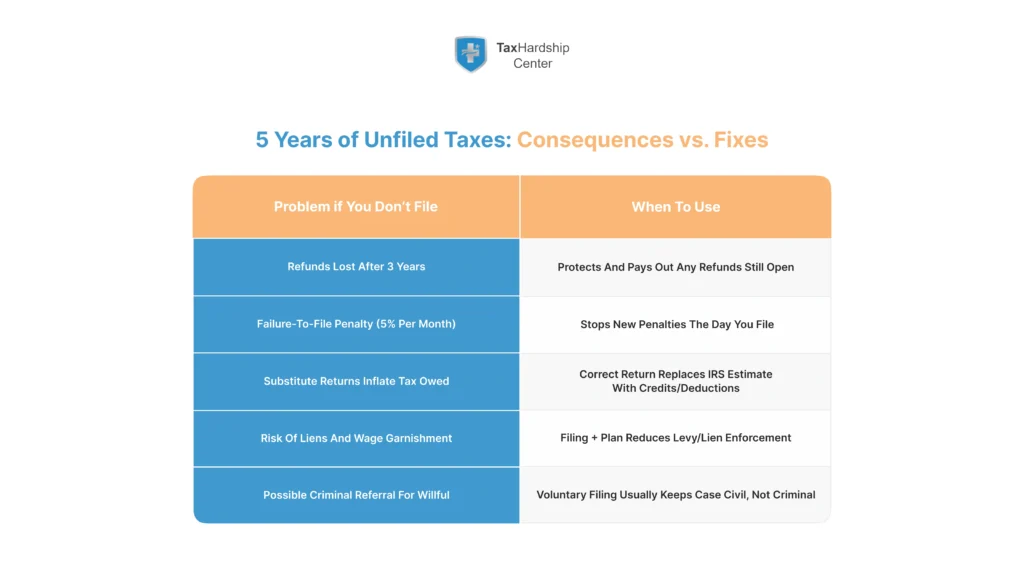
Five years of unfiled returns can create several problems at once.
The IRS may have information about your income even though you haven’t filed. It can use that information to prepare a substitute return, assess tax, send notices, and eventually pursue collection if the balance remains unresolved.
The IRS may prepare a substitute return
If the IRS has enough information to determine that you should have filed, it may prepare a substitute return on your behalf.
The resulting assessment may not reflect the deductions or credits you would have claimed on your own return. If you receive a notice proposing an assessment, pay close attention to the response deadline.
For example, a CP3219N Notice of Deficiency gives you 90 days to file a petition with Tax Court or take other appropriate action.
Collection actions can follow
Once a tax assessment has been made and remains unpaid, the IRS can pursue collection.
Depending on your situation, this can include:
- Federal tax liens
- Bank levies
- Wage levies
- Other enforced collection actions
If you are already receiving collection notices, don’t wait until the final stage to respond. Filing the missing returns and exploring available collection alternatives can give you more options.
Jail is not the typical outcome
Simply having unfiled returns does not automatically mean you are going to jail.
Most delinquent taxpayers deal with civil penalties, interest, notices, and collection procedures. Criminal exposure is a different issue and generally involves factors such as willful failure to file or fraudulent conduct.
If your situation involves intentionally hidden income, false documents, or other potentially fraudulent conduct, speak with a qualified tax attorney before taking action.
Five years is more serious than one missed return
One missed return can often be corrected relatively easily. Five years can mean multiple sets of records, different tax rules for different years, expired refund opportunities, accumulated penalties, and potentially IRS collection activity.
That doesn’t mean you should give up.
It means you need a structured plan instead of trying to file everything blindly at once.
How to Find Out Which Tax Years You Missed
Before preparing five years of returns, confirm exactly what is missing.
Your IRS records can help you determine:
- Which returns were filed
- Which years show a balance
- Whether the IRS filed a substitute return
- What income the IRS has on record
- What payments and penalties have been posted
- Which notices have been issued
Your IRS Online Account and tax transcripts are useful starting points.
Pull your IRS transcripts
Request account transcripts and wage and income transcripts for each potentially unfiled year.
These records can help you identify W-2s, 1099s, reported payments, assessments, and other information you need when rebuilding your returns.
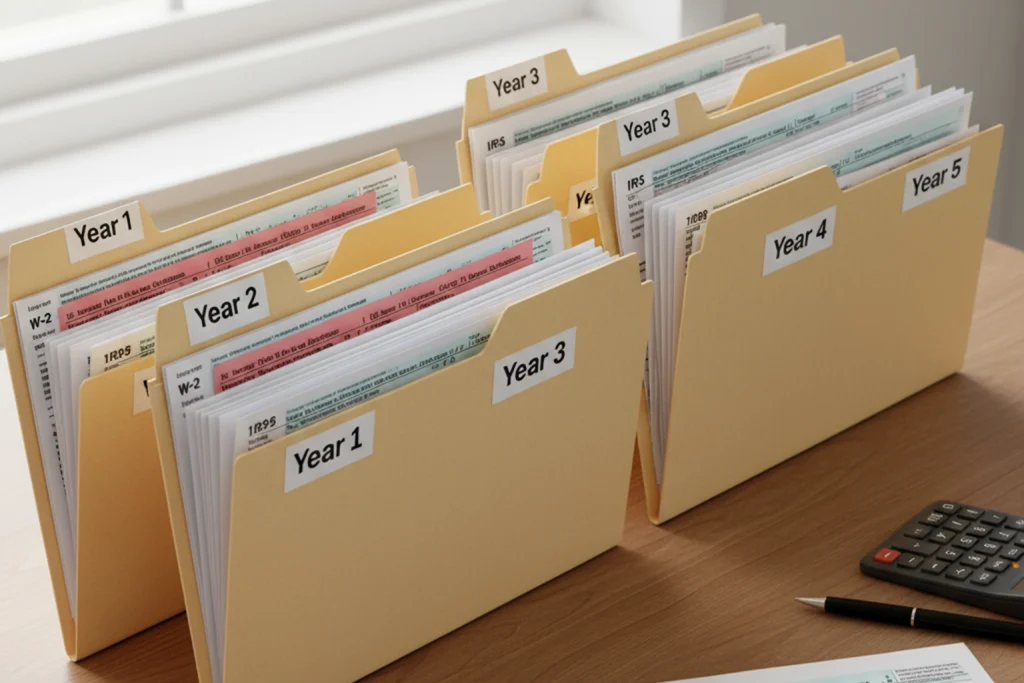
Gather documents for every year
Create a separate folder for each missing tax year.
Look for:
- W-2s
- 1099s
- 1098s
- K-1s
- Bank statements
- Investment statements
- Business records
- Receipts
- Mileage records
- Previous tax returns
If you no longer have a document, contact the employer, bank, brokerage, client, or other institution that originally issued it.
Don’t guess at missing numbers
Five years of returns can contain a lot of moving pieces. Guessing at income, deductions, cost basis, or credits can create another problem after you’ve finally caught up.
Use your transcripts and supporting records to reconstruct each year as accurately as possible.
First Steps When You Haven’t Filed Taxes in Years
Once you know which returns are missing, work through them systematically.
1. List every missing year
Create a simple checklist showing each year, whether a return was filed, whether the IRS has assessed tax, and whether you may be owed a refund.
2. Identify potential refund years
If an older return could generate a refund, check the applicable refund deadline before putting it at the bottom of the pile.
3. File the oldest balance-due years strategically
Returns showing tax owed may continue to generate penalties and interest. Your filing strategy should take into account the size of each balance and your overall IRS account.
4. Prepare accurate returns for each year
Use the forms and instructions applicable to that specific tax year.
Don’t simply use the current year’s rules for an older return. Tax forms, credits, deductions, and eligibility requirements can change from year to year.
5. Keep proof that you filed
If you have to mail a return, use a trackable method and keep copies of everything you send.
Your records should include:
- Signed returns
- Supporting documents
- IRS transcripts
- Payment confirmations
- Certified mail receipts
- IRS notices
- Correspondence
A clean paper trail can make future IRS communication much easier.
How Many Years Back Can You File Taxes?
There is not a simple rule saying you can only file a certain number of years of missing returns.
You may still file older returns, but the right to receive a refund is subject to separate time limits.
The IRS also has different statutory periods for assessing and collecting tax.
Refund deadlines are different from filing deadlines
You can generally file a late return even when a refund is no longer available.
That’s why it’s important to distinguish between:
“Can I still file this return?”
and
“Can I still receive a refund from this return?”
Those are not always the same question.
The IRS generally has a 10-year collection period
For an assessed tax liability, the IRS generally has 10 years from the assessment date to collect the tax, although the collection period can be suspended or extended in certain circumstances.
Don’t treat the 10-year period as a reason to wait. The relevant date can vary by liability, and waiting can lead to additional penalties and collection problems.
What If You Can’t Pay the Taxes You Owe?
This is one of the biggest concerns for people who haven’t filed in years.
You don’t have to wait until you can pay the entire balance before filing your returns.
The IRS offers several payment and collection options for taxpayers who cannot pay in full immediately.
Set up an installment agreement
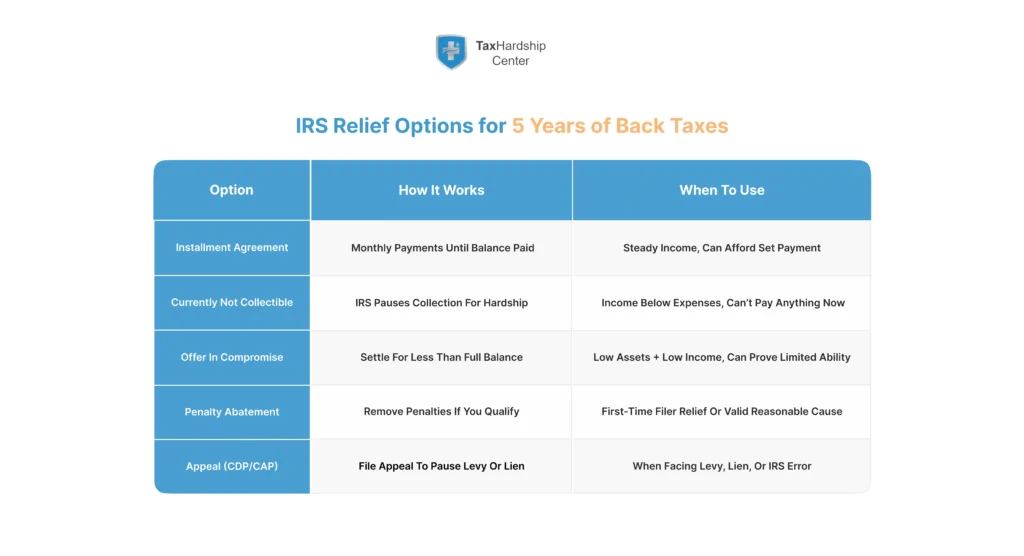
An installment agreement allows eligible taxpayers to pay their tax debt over time rather than all at once.
Your proposed monthly payment should be realistic. A payment that looks good on paper but causes you to miss future payments can worsen the situation.
Ask about Currently Not Collectible status
If you genuinely cannot pay your tax debt without being unable to meet basic living expenses, you may qualify for Currently Not Collectible (CNC) status.
CNC status does not erase the debt. It temporarily delays collection when the IRS determines that you cannot afford to pay. Penalties and interest generally continue to accrue.
Consider an Offer in Compromise
An Offer in Compromise (OIC) allows eligible taxpayers to settle certain tax liabilities for less than the full amount owed.
The IRS considers factors such as income, expenses, assets, and ability to pay. In most cases, taxpayers must also be compliant with their filing requirements before an OIC can be considered.
An OIC is not automatically the best option simply because you owe a large amount. Eligibility depends on your specific financial situation.
Respond to collection notices
If you are already facing a levy or another collection action, don’t ignore the notice.
Certain appeals and collection alternatives may be available depending on the type of notice and your circumstances. For example, a Collection Due Process hearing can be requested using Form 12153 in qualifying situations.
Can You Get IRS Penalties Removed?
Sometimes.
Penalty relief depends on your circumstances, the type of penalty, and your compliance history.
First-time and automatic penalty relief
The IRS is transitioning from its traditional First-Time Abate program to a new Automatic Exemption from Penalty (AEP) for eligible returns, beginning with certain 2025 and later tax periods.
Eligible taxpayers with a required history of timely filing and payment may automatically receive qualifying penalty relief. Not every return or taxpayer qualifies.
For older or otherwise ineligible periods, other penalty relief may still be available.
Reasonable cause relief
You may also qualify for penalty relief if you can demonstrate reasonable cause.
Depending on the circumstances, this can involve situations such as:
- Serious illness
- Natural disasters
- Theft
- Other events outside your control
- Certain problems involving professional advice
The important part is documentation. Explain what happened, when it happened, how it affected your ability to comply, and what you did to correct the problem.
The IRS may reduce or waive certain penalties when the reasonable cause requirements are met.
Form 843 and other penalty-relief requests
Depending on the penalty and situation, relief may be requested by phone, in writing, or using Form 843.
Don’t assume that every penalty can be removed. Review the specific penalty and the applicable relief rules before submitting a request.
Six Tips for Filing Five Years of Back Taxes
1. Start with IRS transcripts
Don’t begin by guessing your income. Find out what the IRS already has.
2. Use the correct forms for every year
A 2021 return should use the applicable 2021 forms and rules, not today’s versions.
3. Report all income
Check your W-2s, 1099s, investment records, business income, and other sources against your transcripts.
4. Check credits and deductions carefully
You may be entitled to deductions or credits that the IRS did not include in a substitute return. Verify eligibility under the rules for the specific tax year.
5. File completely
Missing schedules, signatures, or supporting information can create additional delays.
6. Keep a record of everything
Save copies of every return, payment, notice, transcript, and piece of correspondence.
What If You Receive an IRS Audit Letter After Years of Unfiled Returns?
Catching up on your returns does not guarantee that the IRS will never contact you again.
If you receive an audit letter, read it carefully and identify:
- The tax year involved
- What the IRS is questioning
- The documents requested
- The response deadline
Gather records that support the numbers on your return and respond by the deadline.
Don’t send random documents and hope they explain the situation. Organize your response around the specific issues identified in the notice.
Should You File Quietly or Consider Voluntary Disclosure?
Not every person with unfiled returns needs a voluntary disclosure process.
Someone who simply fell behind because of financial problems, personal circumstances, or disorganization may have a very different situation from someone who intentionally concealed income or used false documents.
If your case involves potential fraud, hidden income, offshore assets, or intentionally false information, get professional legal advice before deciding how to proceed.
For straightforward, non-willful nonfiling, the focus is generally on getting accurate returns filed and addressing any resulting balance.
Which IRS Forms Might You Need?
The exact forms depend on your situation and the tax years involved.
Common forms and records can include:
- Prior-year Form 1040 packages
- Applicable schedules
- Form 9465 for an installment agreement
- Form 433-A or related financial forms for certain collection matters
- Form 843 for certain penalty-abatement requests
- Form 12153 for qualifying Collection Due Process requests
Always use the version and instructions applicable to your specific situation.
Should You Use Tax Software or Hire a Tax Professional?

If your missing returns are simple W-2 returns, tax software may be enough in some cases.
Five years of returns become more complicated when you have:
- Self-employment income
- Multiple businesses
- Investment sales
- K-1s
- Missing records
- IRS substitute returns
- Large balances
- Tax liens or levies
- Penalty disputes
- Collection notices
A tax professional can help determine the correct filing order, reconstruct missing information, identify potential relief options, and communicate with the IRS.
The more complicated the situation, the more valuable professional review can become.
Tax Hardship Center Can Help You Get Caught Up
Five years of unfiled returns can feel overwhelming, especially when you don’t know where to begin.
Tax Hardship Center can help you review your IRS records, organize missing returns, prepare the required filings, and explore available tax resolution options based on your circumstances.
Our services include Offer in Compromise, Bank Levy help, and Penalty Abatement.
You can also learn more about the IRS Repayment Program or schedule a free consultation.
In Summary
If you haven’t filed taxes in five years, don’t make another year six.
Start by finding out which returns are missing and what the IRS already has on record.
Then:
Get current
- Pull your IRS transcripts.
- Gather documents for every missing year.
- Prepare accurate prior-year returns.
- File refund-sensitive years promptly.
Deal with the balance
- Determine what you actually owe.
- Consider an installment agreement if you can make monthly payments.
- Explore Currently Not Collectible status if you cannot afford to pay.
- Consider an Offer in Compromise if you meet the requirements.
Reduce the damage
- Review penalties for possible relief.
- Respond to IRS notices on time.
- Keep records of everything you submit.
- Get professional help when the situation involves complex tax issues.
Five years of missing returns is a serious problem, but it is still a problem you can start solving.
The first step is finding out exactly where you stand.
FAQs
How many years can you go without filing taxes?
There is no simple cutoff that prevents you from filing an older return. However, refund claims have time limits, and the IRS has separate rules governing assessment and collection.
Can you go to jail for not filing taxes?
Most cases involving unfiled returns are handled through civil penalties, interest, and collection procedures. Criminal consequences are generally associated with more serious conduct such as willful failure to file or fraud.
Can I file my taxes if I can’t pay what I owe?
Yes. The IRS advises taxpayers to file past-due returns even when they cannot pay the full balance. You may then be able to explore a payment plan or another collection alternative.
Can the IRS file my taxes for me?
The IRS may prepare a Substitute for Return using information available to it if you fail to file. That return may not include deductions or credits you could claim. Filing your own accurate return can allow the IRS to adjust the account.
Can IRS penalties be removed?
Sometimes. Depending on the penalty and circumstances, relief may be available through automatic penalty relief, First Time Abate during the transition period, reasonable cause, or another applicable procedure.
What happens if I don’t pay my taxes after filing?
Penalties and interest may continue to accrue. Depending on your circumstances, you may be able to establish a payment plan, request temporary collection relief, pursue an Offer in Compromise, or use another available resolution option.