
Pay IRS back taxes the smart way. You can check your balance online, file the missing return, and set a payment plan in the same sitting. Short-term plans run up to 180 days and cost nothing to set up. Long-term installment agreements can stretch to 72 months or more based on your balance, with lower fees if you use direct debit. Cards work in a pinch but add convenience fees that stack up. If you truly cannot pay, the IRS can pause collections or consider a settlement, but you must stay current going forward.
Start here: find what you owe and your payment window
Get clarity before you move money. You confirm your exact tax balance, filing status, and key deadlines so you do not miss a simple step that later costs more. You start by pulling your account transcript, then you file any late return to lock in the right balance and remove guesswork. You make at least a small payment now to slow interest and penalties. You then choose a plan that fits your cash flow, not a guess. You keep notes on dates, amounts, and confirmation numbers.
Check your IRS online account for your balance
Your IRS Online Account shows your current balance by tax year, recent payments, and any active payment agreement. You see assessed tax, penalties, and interest in one place. You also download your tax records, which helps if you need to show income or withholding for a late return. You confirm if the IRS filed a substitute for return, which can inflate what you owe. You watch for collection status or any lien notice so you act before enforcement ramps up.
File your tax return first, then set a payment plan
You file the original or amended return before you request a plan because the plan must match the final assessed amount. You include all income, credits, and deductions so you do not overpay. You avoid estimates that later break your agreement. You e-file when possible for faster posting, or you mail with tracking if e-file is not available. You keep a copy of the return, proof of filing, and any acceptance notice. For a step-by-step refresher, use our quick guide to file back taxes online.
Pay at least something now to cut interest and penalties
You lower the total cost by paying what you can today. You reduce the failure to pay penalty because it accrues on the remaining balance. You shrink interest because it compounds daily on what you still owe. You also show good faith, which helps if you ask for a plan, a pause, or a penalty break later. You do not drain rent or payroll money, but you move any excess cash toward the tax bill first.
How Tax Hardship Center helps you choose the cheapest way to pay
Our services at Tax Hardship Center focus on cutting your total cost and keeping you compliant. We compare a long-term installment agreement with an Offer in Compromise and check for penalty abatement where facts support it. If payroll tax debt sits on the books, we map options with our payroll tax relief team so your business stays open. We set the draft date that fits your pay cycle and set up EFTPS or Direct Pay for you. We start with a quick transcript review and a budget that works in real life.
IRS tax payment options at a glance
You can move money to the IRS in several safe ways. You pick based on speed, fees, and your control over timing. Bank transfers cost the least and post quickly. Cards add a convenience fee but may offer short-term flexibility. EFTPS suits recurring payments and businesses with payroll or deposits. Check, money order, wire, and retail cash locations cover edge cases when online options do not fit. You match the method to your deadline and your budget.
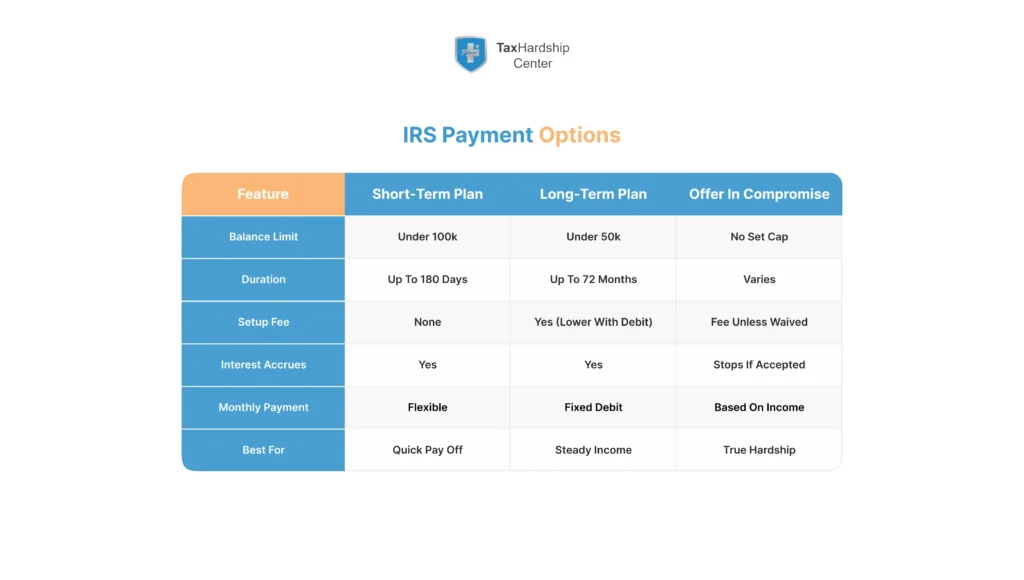
Direct Pay from your bank account
Direct Pay pulls funds from your checking or savings and posts to the exact tax form and year you choose. This self-service payment route uses an automatic bank debit and gives you a receipt within seconds. The website shows availability windows for maintenance, so plan ahead. You can store a banking account safely for repeat use, but you review consent preferences first. Direct Pay supports refund method adjustments when you overpay on an amended return that flips your balance to a credit. You get a confirmation number and email receipt. You can schedule a payment for a future date that aligns with your pay cycle. You can change or cancel a scheduled payment up to two business days before the date. You keep the receipt in your records to prove compliance.
Electronic Federal Tax Payment System for federal tax payments
EFTPS lets you schedule same-day or future-dated payments for income tax, payroll tax, and estimated tax. You can send funds by ACH Debit or ACH Credit through your bank, which helps larger businesses align with treasury controls. The EFTPS payment website logs every transaction with timestamps and confirmation numbers you can export for audits. You can set consent preferences for email reminders and browser notifications so you never miss a draft date. EFTPS also supports state e-file links and resources for non-IRS obligations that flow through federal systems. You enroll once and use it year-round. You set recurring payments for installment agreements or quarterly estimates. You get a detailed history that helps with audits and lender requests. You assign multiple users if you run a business and want roles and approvals.
Debit card, credit card, or digital wallet
Approved payment processors accept major cards and digital wallets. These are non-IRS processors that charge a convenience fee disclosed on the payment website before you enter card details. You verify the website URL to avoid lookalike scams and you never pay through random ads or comments. You compare card fees to postage costs, wire fees, or ACH options before you choose. You save the processor receipt alongside your IRS confirmation. You see the convenience fee up front, which varies by processor and payment size. You get an instant confirmation, and the payment posts to your tax year and form. You can split a large payment across multiple cards if limits apply. You never use a cash advance, which costs more than a purchase transaction.
Check or money order by mail
You can mail a check or money order with your payment voucher. You write your Social Security number, tax year, and form on the memo line. You send it with enough time for delivery and posting. You use certified mail with tracking and keep the receipt. You avoid stapling the check to the voucher to prevent processing delays.
Same-day wire from your bank
A bank wire reaches the IRS on the same day if you meet the bank cutoff time. You use the IRS wire instructions and include your tax form and year in the reference. You confirm the bank wire fee and compare it with other options. You keep the wire confirmation for your records. You use this route for last-minute deadlines or when other systems are down.
Cash payments at participating retailers
You can pay with cash at participating retail partners after you set up a payment code. You bring a government ID and the barcode the system generates. You keep the paper receipt and wait for the payment to post, which can take a day or two. You use this option if you do not have a bank account or card. You never hand cash to anyone who promises faster posting outside the approved process.
Short-term IRS payment plan
Short-term plans fit taxpayers who can clear the balance within months. You avoid setup fees, and interest and penalties still apply until you finish paying. You pick the payoff amount and date that works with your cash flow. You switch to a long-term plan if your situation changes. You aim to pay extra when you can to cut interest faster.
Who qualifies and balance limits for short-term relief
Individuals generally qualify if the balance, including penalties and interest, is under the current IRS threshold for short-term agreements at the time you apply. You can include multiple years in one plan. You cannot be in bankruptcy or have an open Offer in Compromise at the same time. You must have filed all required returns. You confirm no active default on a past agreement.
180-day payoff with no setup fee
The IRS gives you up to 180 days to pay in full under a short-term plan. You choose weekly, biweekly, or monthly payments. You can make extra payments at any time without penalty. You still accrue interest and the failure to pay penalty until the balance reaches zero. You use this plan when a bonus, tax refund offset, or expected cash inflow can clear the debt soon.
How to apply online in minutes
You apply through your IRS Online Account or the dedicated payment plan application. You verify your identity, select short-term, and enter the balance and proposed end date. You confirm your contact info and agree to the terms. You receive instant approval in most cases when your balance falls within the limits. You print or save the agreement letter for your files. For a plain-English explainer, read our overview on IRS payment plans.
Pros, cons, and when to switch to a long-term plan
Short-term plans save the setup fee and finish faster, which lowers total interest. They demand discipline and a stable cash path. If your math shows you cannot pay within 180 days, you switch to a long-term plan before you miss a payment. You avoid stacking card fees on top of IRS interest without a clear payoff plan. You check for low-income fee reductions if you move to a long-term agreement.
Long-term IRS payment plan
Long-term installment agreements spread payments over years. You choose a monthly amount that fits your budget after basics like housing, food, and transportation. You reduce risk by using direct debit and by making estimated payments for the current year. You keep the plan current to avoid default, tax liens, or levies. You review your budget every quarter and adjust if your income changes.
Installment agreement terms and maximum months
Most long-term plans run up to 72 months, though the IRS may allow different terms based on balance and compliance history. You can request a shorter term if you want to cut interest. You can pay off early without a prepayment penalty. You can include multiple tax years and penalties in one agreement. You note that interest and penalties continue until full payment. If you qualify, a streamlined installment agreement speeds approval and reduces paperwork.
Direct debit from your bank account
Direct debit pulls your monthly amount from your checking account automatically. You avoid missed payments due to busy weeks or travel. You get a consistent schedule that matches your pay dates. You reduce the risk of default and extra fees. You keep enough funds in the account two days before the draft date.
Why autopay reduces default risk and fees
Autopay improves on-time performance because it removes manual steps. You avoid card expiration issues and mail delays. You cut the chance of a returned payment and the added reinstatement fee. You protect your credit because an avoided default lowers the chance of a filed tax lien. You build a clean track record that helps if you ask for penalty relief.
Direct Pay, EFTPS, check, money order, or card
You may choose to pay each month with Direct Pay, EFTPS, check, money order, or a card. You weigh fees and timing. You keep proof of each payment in a simple folder or cloud drive. You do not switch methods frequently without a reason because that invites errors. You update your address or bank info as soon as it changes.
Setup fees, low-income waivers, and ongoing costs
The IRS charges a setup fee for most long-term plans. You pay less if you set up direct debit. Low-income taxpayers may qualify for reduced or waived fees. You still pay interest and penalties on the unpaid balance, which makes a faster payoff cheaper. You compare the all-in monthly cost with other financing options before you decide.
Keep your plan in good standing
You file all new returns on time and pay this year’s taxes when due. You avoid new balances that could default the plan. You respond to IRS letters within the deadlines. You track payment confirmations and review your account every month. You call the IRS or adjust online if you need a lower amount due to a documented hardship.
Pay by credit card or debit card
Cards can bridge a short-term gap, but you calculate the fee and interest before you swipe. You use an approved processor so the payment posts fast and correctly. You avoid cash advances and promotional traps. You treat the card as a convenience, not a habit. You track the true cost so you do not pay more than necessary.
Understand convenience fees and payment limits
Card processors charge a percentage fee or a flat fee per payment. Limits may apply to payment size or number of transactions per period. You can split a large tax payment across multiple cards if needed, but each piece adds a fee. You compare that total with a bank debit that costs nothing. You check your card’s purchase APR and payoff plan before you proceed.
When a card makes financial sense
A card can make sense when you have a 0 percent promotional APR window and a solid payoff schedule. A rewards card can help if the fee is smaller than the value of the rewards and you pay in full in the next cycle. A card can also buy time before your direct-debit plan starts. You avoid using a card for a long-term tax debt because compounding interest outweighs the perks. You never pay the IRS with a card if it pushes you over your utilization comfort zone.
Avoid cash advances and high interest
Cash advances trigger immediate interest and extra fees. You treat tax payments as purchases through approved processors to avoid the cash advance category. You never pull cash from an ATM to pay taxes. You decline convenience checks that count as advances. You keep your credit healthy by paying the card bill on time and in full when possible.
Pay from your bank account
Paying from your bank saves fees and posts cleanly to your account. You can use one-time Direct Pay, recurring EFTPS, or an urgent wire. You pick the method that matches your timeline and your records process. You keep a simple spreadsheet with dates, amounts, and confirmation numbers.
Use IRS Direct Pay for one-time payments
Direct Pay covers one-off payments like a balance due, an estimated tax, or a catch-up on your plan. You choose the tax form, year, and reason, then confirm bank routing and account numbers. You receive a confirmation code and email that you save with your tax file. You can cancel or change a scheduled Direct Pay up to two business days before it hits. You use Direct Pay when you want the lowest cost and fast posting. For official details and help topics, see the IRS Direct Pay page.
Use EFTPS to schedule recurring tax payments
EFTPS shines when you need recurring payments for an installment agreement or quarterly estimates. You log in, choose the tax type and year, and schedule payments that match your cash flow. You can set reminders and maintain a full history. You can give an accountant or bookkeeper delegated access without sharing your primary credentials. You rely on EFTPS for business and payroll deposits as well.
Consider same-day wire for urgent deadlines
If a deadline hits today, a same-day wire can save penalties. You call your bank early to confirm cutoff times. You bring the IRS wire details and include your Social Security number, tax form, and year in the reference. You compare the wire fee with a card fee to pick the cheaper route. You keep the bank receipt and confirm posting in your IRS account the next day.
Other ways to pay federal tax
Not every situation fits online or card payments. You still have safe backup options. You can mail a check or money order. You can pay cash at approved retail spots. You can even route payments straight from your paycheck if that keeps you on track. You choose the method that you can sustain.
Mail a check or money order with your voucher
You print the payment voucher for your tax form and year. You write your Social Security number, day phone, and the tax year on the check. You account for postage costs and delivery time, which can run several days. You mail to the correct IRS address for your state and form. You use certified mail with return receipt so you have proof of delivery. You write your Social Security number, day phone, and the tax year on the check. You mail to the correct IRS address for your state and form. You use certified mail with return receipt so you have proof of delivery. You avoid sending cash through the mail.
Use cash payment locations safely
Cash payment partners require a barcode and a small fee. You bring ID and keep the printed receipt. You expect a short delay for posting. You do not share the barcode with anyone else. You store that receipt with your tax file as permanent proof.
Set up a payroll deduction installment agreement
Payroll deduction sends a set amount from each paycheck to the IRS. You and your employer sign the form and agree on the schedule. You gain automation and fewer chances to miss a payment. You update the amount if your plan changes. You keep an eye on net pay so you still cover essentials.
Choose the right IRS payment option

You pick the option that costs the least over time and fits your cash routine. You factor in website return filing, state e-file needs, and whether a non-IRS processor makes sense for your matter. You weigh postage costs for checks against zero-fee ACH debit. You avoid browser pop-ups that pitch miracle fixes and stick with the IRS website or trusted providers. You keep a single source of truth for confirmations and letters. You compare interest, fees, and the friction of managing payments. You look at your payoff horizon and your backup plan. You pick a draft date that matches your pay schedule. You keep a single source of truth for confirmations and letters.
Compare monthly cost and total interest
You run the numbers on each route. You calculate the monthly payment, the setup fee if any, expected interest, and any card fees. You model an extra principal payment every quarter to see how much interest you save. You stack those totals against a personal loan or a zero-interest card. You choose the path that gets you out of debt fastest for the least money.
Payment plan vs personal loan vs 0 percent card
A direct-debit installment plan offers low administrative cost and strong compliance. A personal loan can beat card fees if the rate is lower than the effective tax interest plus penalties. A zero percent card works only if you qualify and can pay it off within the promo period. You map the payment discipline you can sustain. You avoid mix-and-match confusion that causes missed payments.
Decide between short-term and long-term plans
Short-term suits balances you can clear in months. Long-term suits larger balances that need breathing room. You do not force a short-term plan if it risks a miss. You shift to long-term before default if your cash changes. You aim for the lowest payment you know you will make every month, then pay extra when possible.
Pick the payment date that matches your pay period
You match your draft date to your paycheck to prevent overdrafts. You choose a date two or three days after payday to allow for pending items. You avoid end-of-month bottlenecks. You change the date if your employer changes pay cycles. You keep a small cushion in the account.
If you can’t pay on time
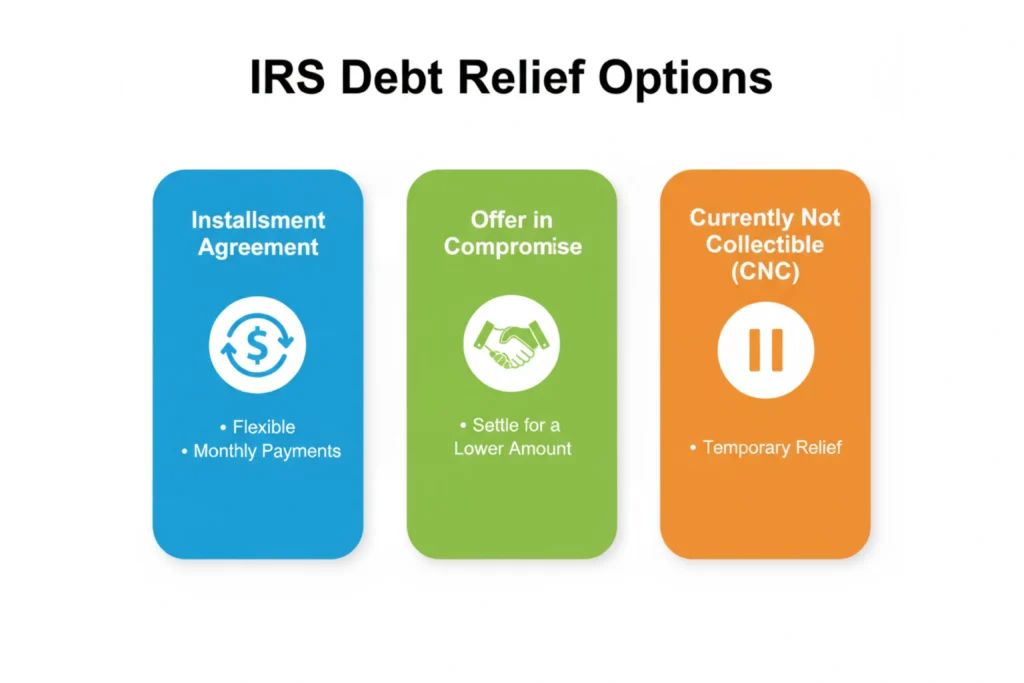
You act early if the numbers do not work this month. You request more time to pay, ask for a pause, or explore a settlement. You still file the return on time to cut penalties. You document your income and expenses to show hardship if needed. You track your Collection Statute clock to understand leverage points. You request more time to pay, ask for a pause, or explore a settlement. You still file the return on time to cut penalties. You document your income and expenses to show hardship if needed. You stay in touch with the IRS to keep options open.
Request an extension to file and pay what you can
An extension to file gives you more time for paperwork, not more time to pay. You still pay as much as you can by the April deadline. You cut the failure to pay penalty by shrinking the balance. You avoid stacking penalties by filing the return even if you owe. You use Direct Pay or EFTPS to send the money with your extension.
Ask for a temporary collection pause due to hardship
If you cannot pay anything after basic living costs, you can request Currently Not Collectible status. You provide financial details to the IRS. You may see a pause on levies while interest still accrues. You keep filing on time during the pause. You revisit the status when your income changes.
Consider an Offer in Compromise to settle for less
An Offer in Compromise can settle your tax debt for less than the full amount if you truly cannot pay in full. You use the pre-qualifier tool and review the income and asset rules. You pick a lump-sum or periodic payment option. You understand that most offers require strict compliance for five years after acceptance. You seek help if your case has liens, business taxes, or equity questions. To see how the paperwork works, review our guide to Form 656.
When an OIC beats an installment agreement
An offer can beat a plan when your reasonable collection potential falls below the balance. You may qualify if your income is modest, your assets have little net equity, and your expenses meet the national and local standards. You show that full payment would create hardship. You accept the strict compliance terms after acceptance. You weigh the time and documentation against the savings.
Stay compliant after you set a plan
A plan only works when you stay current. You make this year’s estimated payments. You file new returns on time. You adjust withholding if you work on a W-2. You track quarterly due dates on your calendar. You review your plan every quarter to see if you can pay extra.
Make estimated tax payments for this year
If you are self-employed or have side income, you send quarterly estimates. You base them on last year’s tax or on your current-year projection. You use EFTPS or Direct Pay and label the payments correctly. You avoid a new balance at filing time. You keep a simple ledger so you claim the estimates on your return.
File all future individual income tax returns on time
On-time filing keeps your agreement healthy. You e-file when possible for speed and accuracy. You confirm that you included all forms and schedules. You keep PDFs of the return, W-2s, 1099s, and confirmations. You fix any notice quickly to avoid default.
Adjust withholding or quarterly estimated tax
You submit a new Form W-4 to tune your withholding if your refund swings wildly. You adjust quarterly estimates if income rises or falls. You run a midyear checkup in June and a third-quarter check in September. You aim to break even or get a small refund. You avoid underpayment penalties and new balances.
Know the penalties, interest, and tax liens
Knowing the price of delay helps you choose faster action. You distinguish penalties for filing late and paying late. You understand how daily interest piles on. You learn when the IRS files a Notice of Federal Tax Lien. You know how a levy or garnishment interacts with payment plans. You use this knowledge to act before problems grow.
Failure-to-file vs failure-to-pay penalties
The failure to file penalty costs more than the failure to pay. You always file on time even if you cannot pay the full amount. You request penalty relief if you qualify for first-time abatement or reasonable cause. You document any disaster relief or serious illness that affected you. You track penalty accruals in your account history.
How interest accrues on unpaid individual income tax
Interest compounds daily on the unpaid balance, including penalties. The rate changes quarterly based on federal short-term rates plus a margin. You reduce interest by paying sooner and paying more than the minimum. You confirm interest amounts in your IRS account. You compare interest savings between different payoff speeds.
When the IRS files a Notice of Federal Tax Lien
A lien notice can appear when your balance crosses certain thresholds or when the IRS believes collection risk is rising. You can still avoid a lien by entering a qualifying direct debit agreement at lower balances. You can request a withdrawal after certain conditions, such as full payment or certain direct debit plans. You keep your address updated so you receive notices on time. You respond quickly to any intent-to-file letter.
How a levy or garnishment stops once a plan starts
An approved plan can stop new levies and wage garnishments in many cases. You must make the first payment and keep the plan current. You contact the assigned officer if a levy continues after approval. You keep proof of your agreement handy for your employer or bank. You escalate through the Taxpayer Advocate Service if needed.
Eligibility rules and limits for IRS plans
The IRS uses balance thresholds, filing status, and compliance history to decide what you can do online. Individuals and businesses face different rules. You must be current on all required returns. You cannot be in an open bankruptcy for standard agreements. You can still seek a specialized plan through contact with the IRS if you fall outside online limits. If you worry about the clock, see how long the IRS can collect in our explainer on collection time limits.
Balance thresholds for online approvals
Online approvals use set balance caps for short-term and long-term plans. You see different limits for individuals and for business in-business trust fund taxes. You get streamlined processing if you fall under the caps. You verify that your transcripts show all returns filed. You call in or send documents if your balance exceeds the online limits.
Business tax vs individual income tax options
Businesses can use EFTPS for payroll deposits and for payment plans on income or employment taxes. In-business trust fund cases often require direct contact and stricter terms. Sole proprietors handle Schedule C income on the individual account, which simplifies plan setup. Corporations and partnerships follow separate rules. You keep your business filings current to expand your options.
What the IRS views as “current” on tax payments
Current means your filings and this year’s payments are up to date. You made your estimates or you have correct withholding. You filed any missing returns before asking for a plan. You fixed prior defaults. You keep this status to avoid enforcement while you pay down the past due balance.
Apply for an IRS payment agreement online
Online setup takes less time than a phone call. The payment website posts planned downtime windows and availability notes, which you check before you begin. You gather your bank details, employer info, refund method preferences, and monthly income and expense numbers. You log in, choose your plan type, and pick a draft date. You store the confirmation and set a reminder two days before the draft date. You use self-service flows end to end so your records match what the IRS systems show. You can also apply directly through the IRS Online Payment Agreement application if you meet the balance limits.
Create or sign in to your IRS account
You verify your identity with a recognized method, then enter your password. You check that your browser notifications and consent preferences allow security alerts and payment reminders. You confirm your address, phone, and email. You review your balances by year. You check messages and any pending notices. You confirm your address, phone, and email. You review your balances by year. You check messages and any pending notices. You confirm no identity hold or fraud alert blocks your account.
Choose your plan, payment date, and bank account
You select short-term or long-term based on the math you did earlier. You choose a date that follows your paycheck. You enter your routing and account numbers or pick a card if you accept the fee. You confirm the website availability window posted on the application so you do not start during maintenance. You read the terms about filing and new balances, then save the draft schedule. You choose a date that follows your paycheck. You enter your routing and account numbers or pick a card if you accept the fee. You read the terms about filing and new balances. You agree and save the draft schedule.
Receive instant approval or next steps
Most online requests get instant decisions. If the system needs more review, you receive instructions and a contact path. You respond quickly to any request for documents. You do not miss the first payment date while you wait for a letter. You verify posting in your account after the first draft.
Fix common payment plan mistakes
You can avoid the slips that cause default and extra cost. You keep payments realistic. You stay current on this year’s taxes. You read and respond to letters. You check that your consent preferences allow IRS emails about changes and that your browser notifications are on for account alerts. You ask for changes early if income drops. You keep payments realistic. You stay current on this year’s taxes. You read and respond to letters. You ask for changes early if income drops. You do not ignore math that shows a different option costs less.
Setting a payment you cannot afford long term
A high monthly amount looks brave and then fails in month four. You base the payment on a 12-month budget, not a best month. You leave room for car repairs and medical costs. You start lower and pay extra when possible. You adjust the plan if your income falls for more than one month.
Missing estimated tax for self-employed income
Self-employed taxpayers often focus on the back balance and forget new estimates. You mark all four quarterly due dates in your calendar. You set a small weekly transfer to a tax savings account. You use EFTPS to automate the quarterly amounts. You avoid a new April surprise that resets the whole cycle.
Ignoring IRS letters and default notices
Letters carry real dates and consequences. You open every envelope and read the notice code. You respond by the deadline or ask for more time. You call if a bank change will bounce a draft. You keep copies of every letter and your responses. You escalate early if you cannot resolve a mismatch.
When to bring in Tax Hardship Center
Sometimes a guide saves you time and money. At Tax Hardship Center, our IRS settlement services pair installment agreements, Offer in Compromise, and penalty abatement to fit your facts. We also handle payroll tax relief when a business balance threatens cash flow. We line up drafts with your payday and keep your plan current. You get straight advice on cost and compliance.
You face a tax lien, levy, or wage garnishment
A filed lien can affect credit and business contracts. A levy can drain cash you need for rent or payroll. Wage garnishment cuts take-home pay until the issue is fixed. Tax Hardship Center helps you seek lien withdrawal or subordination when possible and works to stop levies fast. You get a plan to stabilize cash and protect essentials.
You owe multiple years of federal tax or penalties
Multiple years mean overlapping penalties, interest, and notices. Our team builds a single timeline, files missing returns, and maps the cheapest path to compliance. You see the tradeoffs between short-term, long-term, and settlement routes. You get help documenting reasonable cause for penalty relief. You avoid errors that cause costly resets.
You need help choosing between plans and settlement
Not every case fits a cookie-cutter plan. We review your income, assets, and expenses against IRS standards. We model installment options, OIC scenarios, and partial pay plans. We align the draft date with your pay cycle and set up EFTPS or direct debit. You get a realistic number you can live with.
In summary…
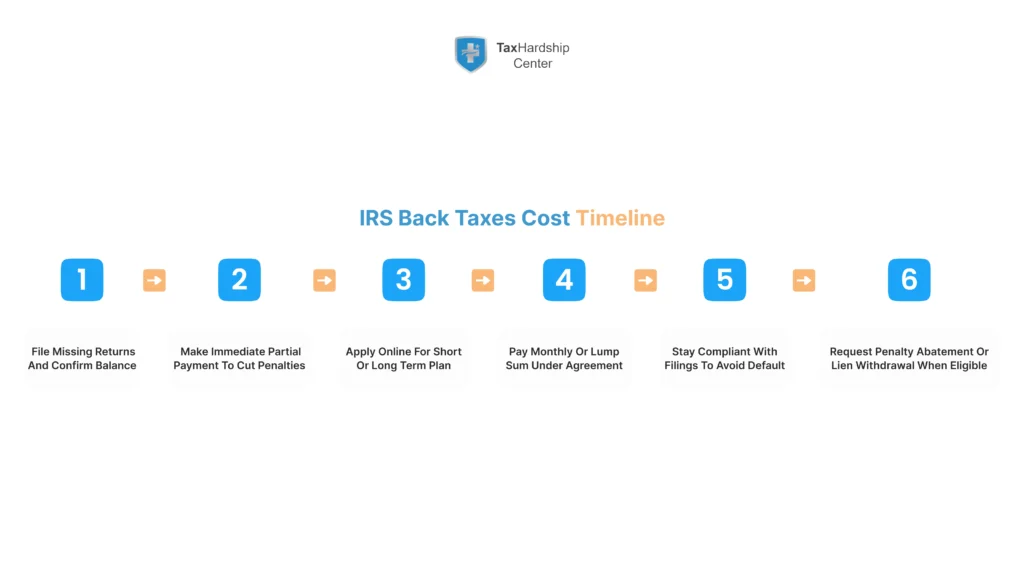
A clear plan keeps taxes from snowballing. You confirm what you owe, file the return, and pick the lowest-cost payment route you can sustain. You stay current on this year’s taxes so you never default. You ask for help if liens, levies, or multi-year issues appear. If you use non-IRS software like TurboTax or TaxSlayer for tax return filing, you still make payments on the IRS website or through EFTPS to keep records clean.
You confirm what you owe, file the return, and pick the lowest-cost payment route you can sustain. You stay current on this year’s taxes so you never default. You ask for help if liens, levies, or multi-year issues appear.
- Key steps:
- Check your IRS Online Account for exact balances and deadlines.
- File missing returns before you request any plan.
- Make a good-faith payment now to reduce interest and penalties.
- Choose bank-based payments to avoid extra card fees.
- Use direct debit for long-term plans to lower setup fees and reduce default risk.
- Check your IRS Online Account for exact balances and deadlines.
- Option comparisons:
- Short-term plans cost less to start but must finish in 180 days.
- Long-term plans spread costs over up to 72 months with ongoing interest.
- Cards add convenience fees and interest unless a true 0 percent window exists.
- EFTPS suits recurring payments and strong records.
- Short-term plans cost less to start but must finish in 180 days.
- If cash is tight:
- File on time and pay what you can.
- Ask for a temporary collection pause if you meet hardship rules.
- Explore an Offer in Compromise if full payment is not realistic.
- File on time and pay what you can.
Close the loop by setting calendar reminders, reviewing your account each month, and adjusting withholding or estimates. A steady plan beats quick fixes every time.
Pro tips for websites, e-file, and records
You gain speed and accuracy when you use the right online tools and keep tight records. The IRS website, EFTPS, and Direct Pay each log a confirmation trail that lenders and auditors accept. You keep an eye on availability notices and maintenance windows before big deadlines. You decide on refund method, record consent preferences, and set browser notifications for security. You stick with self-service options that the IRS supports and avoid random non-IRS solutions. You also keep a parallel log that ties each website return filing acknowledgment to the corresponding payment website receipt so every tax matter reconciles at year-end.
Use the IRS payment website like a pro
You bookmark the official website and verify the lock icon before entering data. You use self-service payment flows and save every confirmation as a PDF. You prefer ACH debit for zero fees and consider ACH credit only if your bank treasury needs it. You never click links in social comments that promise faster posting and say things like, “Thank you for watching. Please subscribe and stay tuned.” You update contact info after any move or name change.
Tune your tax return filing process
You e-file when possible through trusted software. If you use TaxSlayer or another vendor, you still pay through Direct Pay or EFTPS so you keep a single ledger. You check state e-file acknowledgments and match them to your federal file date. You watch postage costs if you must mail because large packets cost more and arrive slower. You store PDFs of the accepted returns and all receipts in one folder.
Track liability, CSED, and payment history
You track your liability by year and watch the Collection Statute Expiration Date in your transcripts. You tag each payment with the form and year so the ledger stays clean. You reconcile refunds that offset to back taxes and update your refund method if needed. You set a quarterly calendar review to make sure the plan stays on track.
FAQs
Can I pay IRS back taxes with a credit card or debit card?
Yes, the IRS accepts cards through approved processors that charge a convenience fee. A card can help for short-term timing if you can pay the card bill quickly. You compare the fee and your card APR with the cost of a bank transfer, which usually costs nothing. You avoid cash advances and convenience checks. You use an approved processor so the payment posts to the right year and form.
How long does a long-term installment agreement last?
Most agreements last up to 72 months, though the term can vary based on your balance and compliance history. You can request a shorter term to cut interest. You can pay off early with no prepayment penalty. You keep filing on time and paying this year’s taxes to protect the agreement. You review the plan if your income changes.
What is the minimum monthly payment on an IRS plan?
The IRS does not publish a single minimum that fits all cases. Your payment must clear the balance within the agreed term and fit within your documented budget. Direct debit often allows a lower setup fee and smoother approval. You run your numbers so the payment survives average months and lean months. You pay extra when cash allows.
Will the IRS remove penalties if I set up a payment plan?
A plan by itself does not erase penalties. You can request first-time abatement if you have a clean filing and payment history. You can ask for reasonable cause relief if events outside your control caused the issue. You reduce the failure to pay penalty by paying faster. You keep records to support any request.
How do I apply online for an IRS installment agreement?
You create or sign in to your IRS Online Account and select the payment plan application. You choose short-term or long-term, pick a draft date, and enter your bank details. You review and accept the terms. You receive an instant approval in many cases or next steps if more review is needed. You save the confirmation and track the first payment.