


Getting an IRS tax audit letter in the mail is one of those moments that makes your stomach drop.
The envelope is thin. The language is formal. The deadline is firm.
But here’s the part most people don’t realize:
An IRS audit is a process with clear steps, rules, and timelines, not a random power move where you have no control.
In this guide, we’ll walk through:
- What that IRS audit letter actually means
- A realistic IRS audit timeline from the first notice to final resolution
- How a CP2000 notice compares to a “real” audit (CP2000 vs audit)
- Key deadlines you cannot miss.
- Where professional help from Tax Hardship Center fits in, and when you should seriously consider it
What Is an IRS Tax Audit, Really?
An IRS tax audit is simply the IRS reviewing your tax return to verify that the income, deductions, and credits you reported are correct. It’s an “examination,” not automatically an accusation of wrongdoing.
Types of IRS audits
The IRS uses several different audit formats:
- Correspondence audit (by mail)
- Handled entirely through letters and documents.
- Usually focuses on a few specific issues (like a credit or deduction).
- This is the most common type of audit.
- Office audit
- You meet with an IRS examiner at a local IRS office.
- They review specific items on your return and supporting documents.
- Field audit
- The most in-depth. An IRS revenue agent visits your home, business, or accountant’s office.
- Common for complex business returns or higher-dollar issues.
IRS Publication 556 explains the general rules and procedures for these examinations and your appeal rights if you disagree with the results.
That First IRS Audit Letter: What It’s Telling You

Every IRS audit letter has three critical pieces of information:
- What year(s) is the IRS examining
- What issue(s) they’re questioning
- What deadline do you have to respond
Your initial audit notice might say the IRS wants to examine:
- Schedule C business expenses
- Rental property income
- Charitable contributions
- Credits like the Earned Income Credit or Child Tax Credit
For most correspondence audits, the letter will:
- List the documents they want (receipts, bank statements, mileage logs, etc.)
- Tell you how to respond (mail, fax, online upload in some cases)
- Give you a response deadline, often 30 days from the date of the letter.
Ignoring that first letter is the fastest way to turn a manageable audit into a serious problem.
IRS Audit Timeline: From First Notice to Final Decision
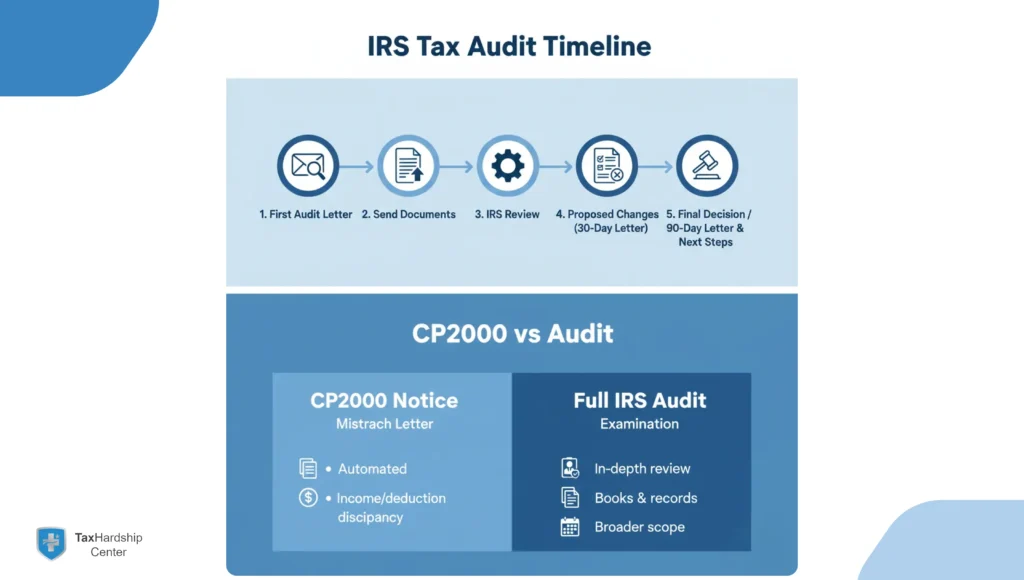
No two audits are identical, but there is a typical IRS audit timeline. How long it takes depends on:
- The type of audit (mail, office, field)
- How quickly you respond with complete information
- Whether you agree or disagree with the IRS findings
Big-picture timing: how long can the IRS audit you?
- In most cases, the IRS has three years from the date you file your return to start and complete an audit.
- That window can extend to six years if you significantly understate your income, and there is no limit if the IRS can prove fraud.
Now, let’s look at the lifecycle after that first IRS audit letter arrives.
Phase 1: Selection & First IRS Audit Letter
- Your return is flagged by an IRS system (scoring, mismatches, random selection, or related to another case).
- The IRS sends an initial audit notice explaining what they want to examine and how to respond.
Your job:
Read the letter carefully, note the deadline, decide if you’ll handle it alone or with a representative, and start gathering documents.
Phase 2: Response & Document Gathering (30+ days)
Typical time window: 30 days (sometimes more, sometimes less, depending on the notice)
You’ll usually be asked to:
- Provide specific records (receipts, statements, logs, legal documents, etc.)
- Fill out and return any questionnaires or forms included.
- Organize your documents in a clear, logical order.
For correspondence audits, you mail or fax your package. For office and field audits, you bring it to the appointment.
This is where having IRS audit representation can significantly improve the quality and completeness of what’s sent.
Phase 3: IRS Review & Follow-up Questions (weeks to months)
Once the IRS gets your response, they’ll:
- Review your documents
- Match them against your return.
- Decide whether they need more information.
For correspondence audits, the IRS may send a follow-up letter asking for:
- Additional documentation, or
- Clarification of something unclear in your records
Realistic timeframes:
- Mail audits often wrap up in 3 to 6 months, depending on response times and complexity.
- Office/field audits can take 4, 12 months or more, especially for business returns.
Phase 4: Proposed Changes (the “Exam Report” & 30-Day Letter)
When the IRS examiner has finished reviewing your case, they’ll issue a proposed examination report:
- It lists the adjustments they want to make (increases or decreases to income, deductions, credits).
- It shows the additional tax, penalties, and interest (if any) they believe you owe.
You then have a choice:
- Agree
- Sign the agreement form and return it.
- The IRS will send a bill; you can pay in full, look at payment plans, or consider tax relief options.
- Disagree (all or some)
- Explain your position to the examiner and provide any missing documentation.
- If you still disagree, the IRS will typically issue a “30-day letter” giving you 30 days to request an appeal within the IRS.
Phase 5: Appeals or 90-Day Letter
If no agreement is reached and you don’t request an appeal within the 30-day window, the IRS may issue a Notice of Deficiency (“90-day letter”):
- You have 90 days (150 days if you’re outside the U.S.) to file a petition with the U.S. Tax Court.
- If you don’t file, the IRS will assess the tax and move the case into collection.
If you do request an appeal, your case moves to the IRS Office of Appeals, where a separate group reviews the examiner’s findings.
Phase 6: Final Assessment & Collection
Once everything is finalized through agreement, appeal, or the IRS will:
- Assess the final tax, penalties, and interest
- Start or continue collection efforts if you don’t pay in full, which may include:
- Payment plans
- Liens
- Garnishments
- Levies
At this point, if you can’t pay in full, you’re in tax resolution territory, exactly where firms like Tax Hardship Center do most of their work.
CP2000 vs Audit: Are They the Same Thing?
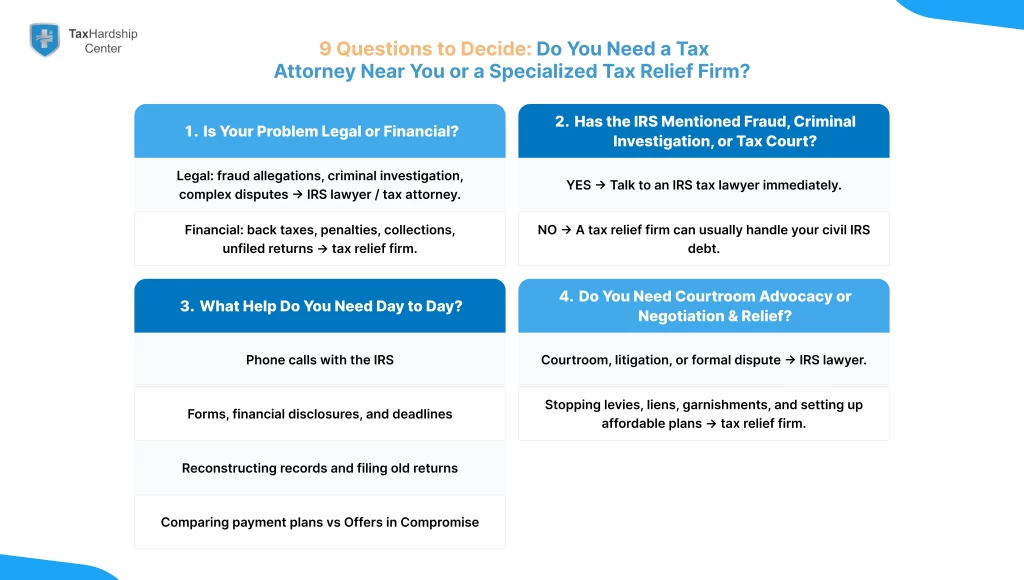
A significant point of confusion in IRS tax audit searches is the distinction between a CP2000 notice and a formal audit.
What is a CP2000 notice?
A CP2000 is a notice the IRS sends when the income or payment information reported on your return doesn’t match what third parties (like employers, banks, or brokerages) reported to the IRS.
Key points:
- It is not a formal audit.
- It’s a proposal to adjust your tax based on the mismatch.
- It explains the information the IRS used and shows the proposed additional tax, penalties, and interest.
- You must respond by the due date, either agreeing or disagreeing and providing documentation.
However, ignoring a CP2000 can absolutely lead to bigger problems, up to and including assessments, collection, and potentially a broader audit.
CP2000 vs IRS tax audit: side-by-side
| Feature | CP2000 Notice (Underreporter) | IRS Tax Audit (Examination) |
| Trigger | Income mismatch between your return and third-party reports | Can involve income, deductions, credits, business records, and multiple years |
| Format | Notice by mail only | Mail audit, office audit, or field audit |
| Scope | Usually focused on income reporting | Yes, a formal examination of your return |
| Is it an “audit”? | IRS will complete the exam without your input and assess what they think you owe | No, it’s a proposed change, not a full examination |
| Response required | Yes, agree, partially agree, or disagree with the explanation | Yes, a formal examination of your return |
| Risk if ignored | IRS will assess additional tax, penalties, and interest | IRS will complete the exam without your input and evaluate what they think you owe |
| Can it lead to an audit? | Yes, especially if ignored or if issues appear broader | Already an audit |
Because a CP2000 isn’t a full audit but can escalate, many people treat it as “audit-lite,” another situation where professional help can add real value.
Key IRS Audit Deadlines You Must Not Miss
Every audit case is unique, but several common deadlines appear repeatedly:
- Initial IRS audit letter deadline
- Often 30 days to respond with documents or contact info.
- Missing this can lead the IRS to move forward without your side of the story.
- CP2000 response date
- The CP2000 notice includes a clear “respond by” date; if you agree, you sign and return; if you disagree, you must explain why.
- 30-day letter (proposed changes)
- After an exam report, you may get a 30-day letter giving you 30 days to request an appeal.
- 90-day Notice of Deficiency
- Once a Notice of Deficiency is issued, you typically have 90 days (150 days abroad) to file a Tax Court petition. Miss this, and the IRS can assess the tax and move to collection.
- Statute of limitations (audit window)
- Generally, three years from the date you filed the return, with extensions for substantial understatements and no limit for fraud.
If you’re already close to or past one of these deadlines, you should not be handling this alone.
How an IRS Audit Can End (Three Possible Outcomes)
Every IRS tax audit ends in one of three ways:
- No change
- The IRS accepts your return as filed.
- This can happen when your documentation fully supports your positions.
- Agreed changes
- You and the IRS agree on adjustments.
- You sign the agreement, and the IRS assesses the revised tax.
- If you can’t pay in full, you may explore installment agreements, Offers in Compromise, or other relief.
- Disagreed changes
- You don’t agree with some or all of the IRS’s proposed changes.
- You can appeal within the IRS and, if necessary, petition the Tax Court.
What happens after an audit is often where the real financial impact is felt, which is why pairing audit defense with tax resolution planning is so important.
When You Should Get Professional IRS Audit Representation
Not every audit requires a tax relief firm or tax attorney; many do.
You should seriously consider professional IRS audit representation if:
- The amount at stake is significant (often $10,000+ in potential tax, penalties, interest).
- The audit involves a business, rental property, multiple years, or complex deductions.
- You’ve received multiple letters and are unsure how they fit together.
- You’re worried the audit could expand into other years or issues.
- You’re already behind on taxes and might not be able to pay the result in full.
You definitely want professional help if:
- There are questions of unreported income beyond simple mistakes.
- The IRS is hinting at fraud, evasion, or willfulness.
- You’ve already missed deadlines or had a prior audit go badly.
That’s precisely the territory where a firm like Tax Hardship Center is built to operate.
How Tax Hardship Center Helps During an IRS Tax Audit
Tax Hardship Center (THC) is a national tax resolution and audit defense firm that works with individuals and businesses facing IRS and state tax problems, including audits.
Dedicated IRS audit defense services
Tax Hardship Center’s Audit Defense offering focuses on:
- Interpreting your IRS audit letter and explaining what the IRS is really asking for
- Acting as your authorized representative so they can speak to the IRS for you
- Preparing and organizing the documentation that the IRS wants to see
- Attending or handling office and field audit appointments on your behalf, where permitted
- Pushing back on unreasonable adjustments and helping you assert your rights
Their audit defense guide and service pages emphasize representation in all three common audit types: correspondence, office, and field.
Beyond the audit: tax relief when you can’t pay
Because Tax Hardship Center is a full tax resolution firm, they don’t stop at “helping you survive the audit.” They also help if the audit ends with a new balance you can’t pay, including:
- IRS installment agreements/payment plans
- Offer in Compromise (settling for less than you owe when you qualify)
- Penalty abatement requests
- Currently Not Collectible status for severe hardship
- Relief for liens, levies, and wage garnishments if the audit feeds into collections
In other words, they combine audit defense with post-audit tax relief, which is what many taxpayers ultimately need.
How their process typically works
While each case is different, the Tax Hardship Center commonly follows a structured process:
- Free consultation
- Review your IRS audit letter or CP2000 notice.
- Discuss what’s at stake and how much time you have.
- Outline whether they can realistically improve your position.
- Investigation and protection phase
- Obtain your IRS transcripts and, where relevant, your internal account notes.
- Map out the complete IRS audit timeline in your case.
- Begin communication with the IRS so you’re not doing it alone.
- Audit defense & documentation phase
- Help you reconstruct records, where possible.
- Organize and present documents in a format that makes sense to an examiner.
- Represent you in correspondence, office, or field interactions.
- Resolution & tax relief planning
- If the audit results in additional tax, it will help you evaluate:
- Payment plans
- Offers in Compromise
- Hardship options
- Support you in staying compliant going forward, so you avoid future audits and collections.
- If the audit results in additional tax, it will help you evaluate:
FAQs: IRS Tax Audit Letters, Timelines & CP2000 Notices
1. Does getting an IRS tax audit letter mean I did something wrong?
Not necessarily. The IRS selects returns for audit for several reasons, including random selection, computer scoring, or issues that statistically warrant a closer look. Many audited taxpayers did nothing wrong intentionally, and some audits end with no change or even a refund.
2. How long does an IRS audit usually take?
It depends on the type of audit and complexity:
Mail (correspondence) audits often take about 3 to 6 months.
Office and field audits may last 4, 12 months, or more, especially for businesses.
Delays are common when taxpayers respond late, submit incomplete records, or when issues are complex.
3. Is a CP2000 notice the same as an IRS audit?
No. A CP2000 is a notice of proposed changes when your return doesn’t match the income information the IRS received from third parties. It is not a full audit, but ignoring it can lead to assessments, penalties, and possibly a broader examination.
4. What happens if I ignore an IRS audit letter?
Ignoring an IRS audit letter is one of the worst things you can do. If you don’t respond:
The IRS may disallow deductions and credits you could have substantiated.
They can issue a Notice of Deficiency, assess the tax, and move into collection.
If you’ve already missed a deadline, talk to a professional immediately to see what can still be salvaged.
5. How far back can the IRS go with a tax audit?
In most cases, the IRS can audit returns filed within the last three years. That window can extend to six years for substantial understatements of income and is unlimited if the IRS can prove fraud.
6. Can an IRS audit lead to criminal charges?
Most audits are civil, not criminal. However, if the IRS discovers evidence of willful tax evasion or fraud, it can refer the case to IRS Criminal Investigation. That’s rare compared to the total number of audits, but if there’s any risk of criminal exposure, you should speak with a qualified tax attorney immediately.
7. How can Tax Hardship Center help if I’ve already received an IRS audit letter?
Tax Hardship Center can:
Review your IRS audit letter or CP2000
Explain your IRS audit timeline and immediate priorities
Represent you with the IRS so you’re not dealing with them alone
Help organize and present documentation to support your return
If the audit results in a balance due, design and negotiate IRS tax relief options (payment plans, Offers in Compromise, hardship status, and more)
If you’ve just opened an IRS audit letter or CP2000 notice, you don’t have to navigate the process alone or guess at the rules and deadlines. A short conversation with Tax Hardship Center can turn a frightening envelope into a clear, step-by-