
If you’re behind on taxes, it’s never just about a number on paper. It’s the IRS notices you’re afraid to open, penalties and interest that never seem to stop, and the constant worry about liens, levies, or wage garnishments. It’s why so many people start Googling things like “help with back taxes,” “help with IRS back taxes,” “back tax relief,” or “IRS back taxes help” the moment the pressure becomes too much.
The good news is that the IRS does have official, structured relief programs. The bad news is that they’re complex, overlapping, and easy to misuse if you’re trying to figure it all out on your own.
In this guide, we’ll break down the seven primary IRS relief options for back taxes, explain who each one is best suited for, walk through the trade-offs and pitfalls to avoid, and show how a specialized tax relief firm like Tax Hardship Center can review your entire situation and build a clear, step-by-step plan to move you out of crisis and back into control.
Step One: Get a Clear Picture of Your IRS Back Taxes
Before you decide which back tax relief path to pursue, you need exact facts. Guessing from old letters is how people end up on the wrong plan.
What “getting clear” actually means
- Identify all tax years involved
- Which years did you not file?
- Which years did you file but couldn’t pay?
- Pull your IRS account transcripts
- These show:
- Tax assessed
- Penalties and interest
- Payments or credits applied
- Current collection status (e.g., notice phase, levy warning, etc.)
- You can view much of this via your IRS Online Account, or request transcripts by mail or phone.
- These show:
- Check for current-year compliance
The IRS is far more willing to work with you on past debt if you’re:- Filing current returns on time
- Withholding enough or making estimated tax payments going forward
Most professional help with IRS back taxes starts with this “x-ray” of your IRS record. Tax Hardship Center typically pulls transcripts at the start of a case, so you’re working from a complete, accurate picture, not just the last envelope that showed up.
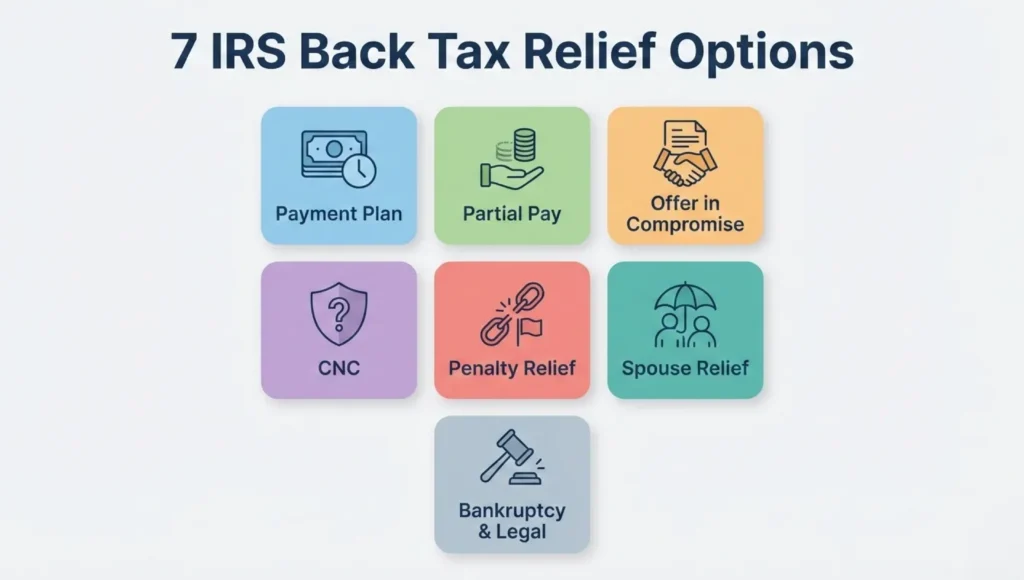
The 7 Main IRS Back Tax Relief Options
These are the seven main tools the IRS uses to resolve back taxes. The right choice depends on your balance, income, assets, and hardship level.
1. Standard IRS Payment Plan (Installment Agreement)
This is the workhorse solution when you can’t pay in full now but can over time.
An IRS payment plan (also called an installment agreement) is a formal agreement with the IRS that lets you pay your tax balance in monthly installments instead of all at once.
How it works
The IRS offers:
- Short-term payment plans
- Up to 180 days to pay in full
- Generally, for balances under $100,000 (tax + penalties + interest)
- No setup fee, but penalties and interest still accrue
- Long-term payment plans (installment agreements)
- Typically up to 72 months for individuals with balances under $50,000 who have filed all returns
- Setup fees vary depending on whether you apply online and whether you use direct debit.
You can request a plan:
- Online via the IRS Online Payment Agreement tool
- By filing Form 9465, Installment Agreement Request (paper or e-file with your return)
Who it’s best for
- You can afford a reasonable monthly payment without skipping essentials
- Your back taxes are significant but manageable over several years.
- Your income and assets are too high to qualify for deeper reductions like an OIC.
Pros
- Predictable monthly payment
- Generally stops new levies and garnishments once approved and kept current.
- Often easy to set up online if you’re under the thresholds
Cons
- Penalties and interest continue until the debt is paid in full.
- If you overpromise and can’t maintain the payment, the agreement can default.
- It does not reduce the principal, only spreads it out over time.
Example
You owe $22,000 in back taxes across two years. You’re employed, with a stable income, but no savings to pay in full. A 72-month installment agreement at an affordable monthly amount (plus potential penalty abatement) may resolve your back taxes without upending your budget.
2. Partial Pay Installment Agreement
A Partial Pay Installment Agreement (PPIA) is like a standard payment plan, but your monthly payments will not fully pay the debt before the IRS’s collection clock runs out. Some balance remains unpaid when the 10-year collection statute expires.
How it works
- The IRS reviews a detailed financial statement (Form 433 series) to determine:
- Reasonable basic living expenses
- Income, assets, and equity
- You’re approved for a monthly amount you can afford, even if it won’t fully pay the debt before the statute expiration.
- The IRS periodically re-evaluates your finances (typically every two years) and can increase, decrease, or terminate the agreement.
When the collection statute expires, the IRS generally cannot legally collect any remaining balance.
Who it’s best for
- You can’t qualify for an Offer in Compromise, but
- You also can’t realistically pay your back taxes before the 10-year collection statute runs out
- You have limited equity in assets and a tight but somewhat stable income
Pros
- Often leads to paying less than the full amount over time
- Provides structured compliance and collection protection similar to other installment agreements
- Helpful for taxpayers who are too “strong” for OIC, but not strong enough to full-pay
Cons
- Significant documentation burden and ongoing reviews
- IRS may push for higher payments if your income improves
- Not easy to secure without careful negotiation
Example
You owe $120,000 in back taxes. The IRS has eight years left to collect. Your budget supports $350/month, which won’t cover the full balance. A properly negotiated PPIA could keep you compliant, prevent aggressive collection, and let the remaining balance expire at the end of the statute.
3. Offer in Compromise (Settle for Less Than You Owe)
An Offer in Compromise (OIC) is the flagship back tax relief program that can settle your IRS back taxes for less than the full amount when paying in full would create significant financial hardship or the IRS doesn’t reasonably expect to collect the full balance.
How it works
You submit:
- Form 656, Offer in Compromise
- A detailed financial statement (Form 433-A (OIC) for individuals, 433-B (OIC) for businesses) with supporting documentation
- A non-refundable application fee and initial payment
The IRS evaluates your reasonable collection potential (RCP) based on:
- Net realizable equity in assets (home, car, savings, investments)
- Future disposable income over a set number of months
- Age, health, and other exceptional circumstances
If your RCP is less than your total liability, and you meet other criteria, the IRS may accept your offer and forgive the rest once you pay the agreed amount and stay compliant.
There is also an official OIC Pre-Qualifier tool you can use as a preliminary check.
Who it’s best for
- Your back taxes are significant compared to your income and assets
- You cannot realistically full-pay, even over many years
- You are willing to fully disclose your finances and stay compliant for years after acceptance.
Pros
- Often provides the most significant reduction in overall IRS back taxes
- Gives a clean break if you keep up with filing and payment obligations afterward
- Can resolve multiple years of debt in a single agreement
Cons
- Not everyone qualifies; the IRS is careful about approvals.
- The process is document-heavy, slow, and can take many months
- If you default on the terms or fail to stay compliant, the IRS can reopen the full debt
Example
You owe $86,000 in back taxes. You rent, have an older car, no significant savings, and modest self-employment income. After analyzing your financials, your reasonable collection potential is about $12,000. A carefully prepared OIC might propose $10, 12k to settle the entire balance, if you meet all eligibility criteria and maintain future compliance.
4. Currently Not Collectible (CNC) Hardship Status
Currently Not Collectible (CNC) status is used when the IRS determines you cannot pay anything toward your tax debt without failing to meet basic living expenses.
How it works
- You (or your representative) contact the IRS and provide a financial statement (Form 433-A/F/B) showing:
- Income
- Necessary living expenses
- Basic asset information
- If the IRS agrees you can’t pay without economic hardship, it flags your account as Currently Not Collectible.
What CNC does:
- Stops most active collection (new levies and garnishments) while you’re in status
- Allows the 10-year collection clock to continue running
- Leaves your debt on the books, with penalties and interest accruing
The IRS may periodically review your situation and restart collection if your financial picture improves.
Who it’s best for
- You are on a fixed or very low income (e.g., disability, Social Security only)
- Your expenses barely cover basic needs
- You have little to no equity in assets
- Any payment, even $25/month, would cause genuine hardship
Pros
- Immediate breathing room with no required monthly payment
- Can prevent or stop levies and garnishments while in CNC
- If hardship continues long enough, the debt may expire with the statute of limitations
Cons
- Debt is not forgiven; it grows with penalties and interest
- IRS can resume collection if your finances improve
- Not a permanent solution for someone whose income may bounce back soon
Example
You’re 68, living on Social Security with modest rent and medical costs. You owe $17,000 in old back taxes. After reviewing your budget, the IRS agrees that any payment would cause hardship and places your account in CNC. Collections stop, though interest continues, and your case is periodically reviewed.
5. Penalty Abatement (Including First-Time Penalty Relief)
For many people, a considerable portion of their IRS back taxes is actually penalties, not just the original tax. The IRS does offer penalty relief in certain situations.
Types of penalty relief
The primary forms of penalty abatement are:
- First-Time Abatement (FTA)
- For taxpayers with a clean 3-year compliance history who receive a failure-to-file, failure-to-pay, or failure-to-deposit penalty for the first time.
- Reasonable Cause Relief
- For taxpayers who tried to comply with the law but couldn’t due to circumstances beyond their control, such as serious illness, natural disasters, death in the family, etc.
- Statutory/Administrative Relief
- Special programs, disaster relief, or IRS errors that qualify under specific rules.
How it works
You or your representative:
- Request penalty relief by phone, letter, or via Form 843, depending on the situation
- Explain the facts and circumstances that prevented timely filing or payment
- Cite relevant IRS guidelines for First-Time Abate or reasonable cause
If granted, the IRS removes some or all penalties; interest on penalties may also be reduced accordingly.
Who it’s best for
- Your back taxes include significant penalties
- You otherwise qualify for an installment agreement, OIC, or CNC
- You have a good history or a legitimate hardship story backed by documentation.
Pros
- Can dramatically reduce your total back-tax bill
- Often pairs well with other relief (payment plan, OIC, etc.)
- First-time abatement can be relatively straightforward if you qualify
Cons
- Does not remove interest on the underlying tax
- Not guaranteed; IRS reviews each case
- Often requires clear documentation and well-crafted explanations
Example
You owe $12,000 in tax and $4,500 in penalties. You missed filing and paying because of a serious accident and hospitalization. A reasonable cause penalty abatement request, adequately documented, could reduce most penalties, and then you resolve the remaining tax with a standard installment agreement.
6. Innocent Spouse & Related Spouse Relief
If your IRS back taxes stem from a joint return, but the problem came from your spouse or ex-spouse, you may qualify for spouse-based relief, including Innocent Spouse Relief.
Main categories
The IRS offers three closely related protections:
- Innocent Spouse Relief
- You filed a joint return with an understatement of tax due to your spouse’s erroneous items (unreported income, bogus deductions).
- You didn’t know and had no reason to know about the problem.
- Separation of Liability Relief
- You’re divorced, legally separated, or living apart, and want to divide the liability between you and your former spouse.
- Equitable Relief
- When you don’t technically qualify for the first two, but holding you fully liable would be unfair, given all facts and circumstances.
Requests are typically made via Form 8857, Request for Innocent Spouse Relief.
Who it’s best for
- Your back taxes are tied to your spouse’s actions (hidden income, fraudulent deductions, etc.)
- You genuinely did not know and couldn’t reasonably have known.
- You’ve separated, divorced, or there are other fairness concerns.
Pros
- Can partially or completely shift liability away from you
- Essential for taxpayers trapped in unfair joint tax situations
Cons
- The IRS may contact your spouse or ex as part of the investigation.
- The process can be emotionally complex and take time
- You may still be liable for other years or non-spousal issues.
Example
Your ex-spouse ran a cash-heavy side business and underreported income on your joint return. Years later, the IRS audits and assesses $40,000 in back taxes and penalties. You had no access to the business accounts and reasonably believed the return was accurate. An Innocent Spouse Relief request may be your best path to back tax relief for that year.
7. Bankruptcy & Other Legal Options
In limited circumstances, bankruptcy can discharge some back income tax debts, but it’s a specialized tool with strict rules and serious long-term consequences.
Very high-level overview
- Some older income tax debts can be discharged in Chapter 7 or Chapter 13 if they meet specific timing and filing conditions (e.g., taxes assessed more than a certain number of years ago, returns filed timely or long enough ago, no fraud).
- Trust fund taxes (such as payroll withholdings), many penalties, and other obligations are typically not dischargeable.
Because this overlaps with bankruptcy law, you should only consider it:
- After speaking with a qualified bankruptcy attorney, and
- In coordination with a tax professional or firm like Tax Hardship Center, who can analyze the tax side and suggest alternatives.
Who it’s best for
- You have large, older income tax debts and major other debts (credit cards, medical, etc.)
- You’ve explored traditional IRS relief and still don’t have a viable path
- You’re willing to accept the credit and legal consequences of bankruptcy.
How to Choose the Right Relief Option
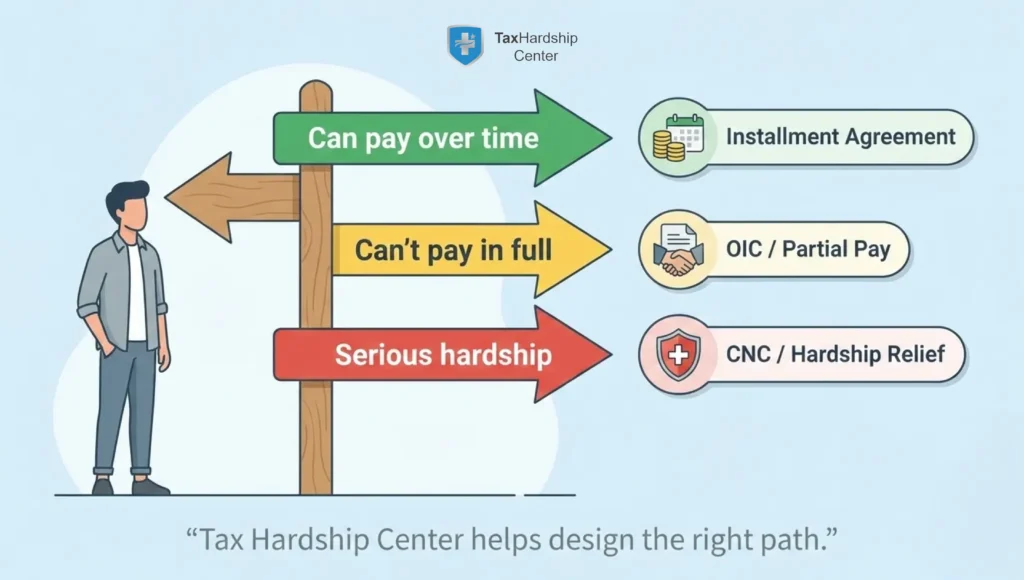
There’s no one “best” solution for back taxes for everyone. But a structured way to think about it looks like this:
1. Can you realistically full-pay over time?
- Yes, without significant hardship
- Focus on:
- Standard installment agreement (maybe streamlined)
- Penalty abatement to reduce the total cost
- Focus on:
- No, even over the years
- Explore:
- Offer in Compromise
- Partial Pay Installment Agreement
- Currently Not Collectible
- Explore:
2. How severe is your current hardship?
- Severe hardship (basic living expenses > income, no meaningful assets)
- CNC status and/or a low-amount OIC might be appropriate
- Moderate hardship (you can pay something, but not enough to fully pay)
- Consider PPIA, OIC, or a carefully structured payment plan plus penalty relief.
3. What’s actually in your balance?
- Mostly penalties → penalty abatement should be part of the plan.
- Joint return spouse issues → review Innocent Spouse and related relief.
4. What’s your risk tolerance and timeframe?
- Want the most aggressive reduction and can wait for a complex process? → OIC or PPIA.
- Want stability and predictability quickly? → Standard installment agreement plus penalty review.
A professional’s job is to run these scenarios using their actual numbers and the IRS transcripts’ rules of thumb.
How Tax Hardship Center Helps With IRS Back Taxes

If you’re searching “help with back taxes” or “help with IRS back taxes,” you probably don’t want to become an expert in IRS procedures, but wish to have someone to take control of the process.
Tax Hardship Center (THC) is a national tax resolution firm focused specifically on helping individuals and small businesses resolve:
- IRS back taxes and state tax debt
- Tax liens, levies, and wage garnishments
- Complicated cases with multiple years, audits, and notices
Public information and reviews indicate that Tax Hardship Center works mainly with taxpayers who owe at least several thousand dollars and need more than a simple phone call to the IRS.
Their typical process for back tax relief
- Confidential consultation
- Review your situation, notices, and approximate balances.
- Determine if you’re a good fit for professional back tax relief
- Investigation & protection phase
- Pull IRS transcripts and account records
- Confirm all years, balances, and current collection status
- Take steps, where possible, to stabilize enforcement (respond to notices, address levy threats, etc.)
- Strategy design: choosing among the seven options
- Model your situation against:
- Standard/streamlined installment agreements
- Partial Pay Installment Agreement potential
- Offer in Compromise eligibility
- Currently Not Collectible hardship
- Penalty abatement possibilities
- Any spouse-based or legal options
- Recommend a primary strategy plus backup paths if the IRS doesn’t grant the first choice.
- Model your situation against:
- Implementation and negotiation
- Prepare all required forms (e.g., 9465, 433-A/F, 656, 8857) and documentation.
- Communicate directly with the IRS as your authorized representative.
- Negotiate payment terms, settlement figures, or hardship status.
- Respond to IRS questions and keep your case moving.
- Long-term compliance support
- Help you get all returns filed.
- Adjust withholdings or estimates so new debt doesn’t pile up.
- Guide if the IRS resurfaces about resolved years.
Instead of you trying to guess which relief program fits, the Tax Hardship Center builds a custom map of the options and handles day-to-day interactions with the IRS.
FAQs: Help With Back Taxes & IRS Back Tax Relief
1. What’s the first thing I should do if I need help with back taxes?
Gather your IRS notices
Pull or have a professional pull your IRS transcripts
Make sure you’re current on this year’s filings and withholdings
Then speak with a tax professional or relief firm about which of the seven relief options fit your situation best.
2. Can I really settle back taxes for “pennies on the dollar”?
Sometimes, only through a properly supported Offer in Compromise, and only if your reasonable collection potential is far below what you owe.
Any company that promises a settlement without reviewing your finances is not being honest. A reputable firm will gather your income, expense, and asset information before telling you whether an OIC is realistic.
3. Will ignoring my back taxes make the IRS go away?
No. Ignoring back taxes almost always makes things worse:
Penalties and interest keep growing
The IRS can file tax liens, levy bank accounts, and garnish wages
You reduce your options because you miss important deadlines
If you can’t pay, you generally need to engage with the IRS, not disappear; disappear, disappear, disappear, disappear; that’s what back tax relief programs are designed for.
4. How long does the IRS have to collect my back taxes?
In most cases, the IRS has 10 years from the date of assessment to collect a tax debt (the collection statute expiration date), with some exceptions (specific appeals, bankruptcy, and other events can extend it).
This 10-year clock is central to strategies like Partial Pay Installment Agreements, Currently Not Collectible, and some OIC decisions.
5. Will I go to jail for owing back taxes?
The overwhelming majority of back tax cases are civil, not criminal. The IRS focuses on getting taxpayers back into compliance and collecting what it can. Criminal prosecution is generally reserved for deliberate tax evasion or fraud, not people honestly seeking help with IRS back taxes.
That said, never lie to the IRS or destroy records. If there’s any concern about fraud, speak with a tax attorney.
6. Can Tax Hardship Center help if I already set up a payment plan?
Yes. Many clients come to the Tax Hardship Center with an existing payment plan that:
It is too expensive to maintain
Didn’t factor in penalty abatement or other relief
Was set up without exploring whether they might qualify for OIC, PPIA, or CNC
THC can review your plan, your finances, and your IRS transcripts to see whether a different strategy could reduce your overall burden or monthly payment.
7. When is it time to stop DIY and get professional help?
It’s usually time to bring in a professional if:
You owe more than a few thousand dollars across multiple years
You’ve received lien, levy, or garnishment notices.
You’re overwhelmed by IRS terminology and deadlines.
You’ve tried calling the IRS and are getting nowhere.
At that point, a focused firm like Tax Hardship Center can turn scattered notices and anxiety into a clear, structured plan using one or more of the 7 IRS back tax relief options that match your real-world budget and circumstances.