


Innocent Spouse vs Injured Spouse is one of the most confusing IRS topics for taxpayers. The two forms sound almost identical, but they solve completely different tax problems. Understanding the difference before you file can save you months of delays and help you choose the relief you’re actually eligible for.
You file a joint tax return like you have every year of your marriage. Nothing unusual. You expect a refund, maybe enough to cover a car repair or a few bills that have been piling up.
Then the letter comes.
Your refund is gone. Or worse, the IRS says you owe money for a return you signed years ago, based on income you never even knew existed. Somewhere in that joint “we,” something went wrong, and now the IRS is looking at you like you’re just as responsible as the person who actually caused the problem.
Here’s the twist nobody tells you about until it’s happening to them. When it comes to Innocent Spouse vs Injured Spouse, there are two completely different IRS relief options for situations like these, and choosing the wrong one can cost you months of waiting for nothing. One is called innocent spouse relief. The other is injured spouse relief. They sound almost identical. They are not.
Let’s untangle Innocent Spouse vs Injured Spouse before it untangles you.
What Innocent Spouse Relief Actually Covers
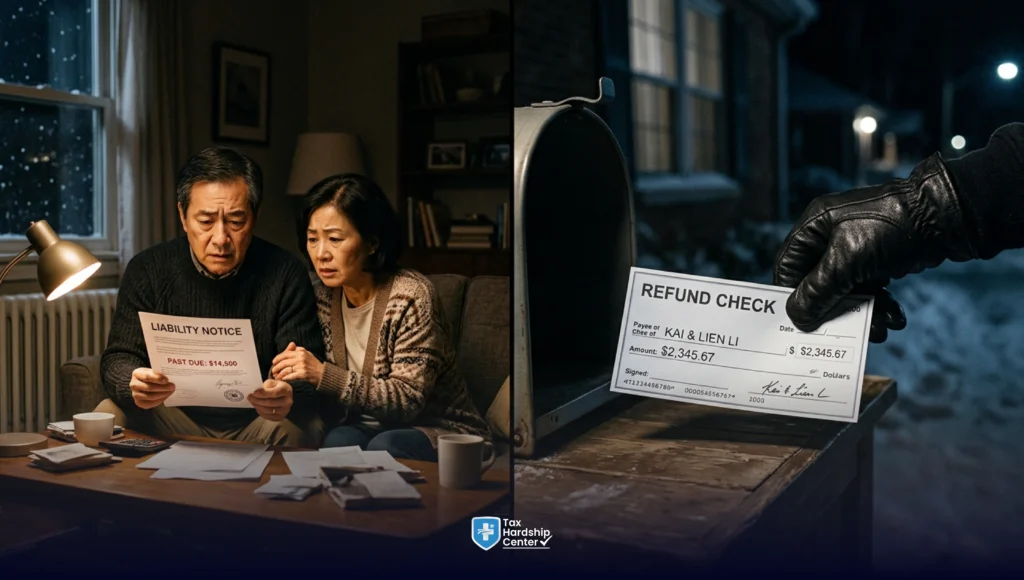
Innocent spouse relief is for the person who got blindsided by their own tax return.
Maybe your spouse or ex-spouse ran a side business and didn’t report the cash income. Maybe they claimed deductions that never existed. Maybe they flat out lied on a joint return you trusted them to handle honestly. You signed it because that’s what married couples do. You trust the person sitting across the kitchen table from you.
Years later, the IRS shows up with a bill for taxes, penalties, and interest tied to a mistake or a lie you had no part in. That is the exact situation innocent spouse relief was built for. It can release you from liability for tax, interest, and penalties that resulted from your spouse’s errors on a joint return, as long as you can show you didn’t know, and had no reason to know, about the problem when you signed it.
This is not a small ask. The IRS wants proof. Financial records, your role in the household finances, whether you benefited from the unreported income, all of it gets examined. It’s a fairness argument, and fairness has to be documented, not just felt.
What Injured Spouse Relief Actually Covers
Injured spouse relief is a completely different animal, and honestly, the name confuses more people than it helps.
Here’s the scene. You filed jointly. You did everything right. But your refund got seized anyway, not because of anything wrong with your return, but because your spouse owes something from before you were even part of the picture. Old back taxes. Defaulted student loans. Unpaid child support. The IRS runs your joint refund through the Treasury Offset Program, and the whole thing disappears into your spouse’s debt.
You didn’t do anything wrong. You just happened to be married to someone with a paper trail. Injured spouse relief exists to pull your portion of that refund back out and put it in your hands, where it belonged the whole time.
The One-Sentence Test That Separates Them
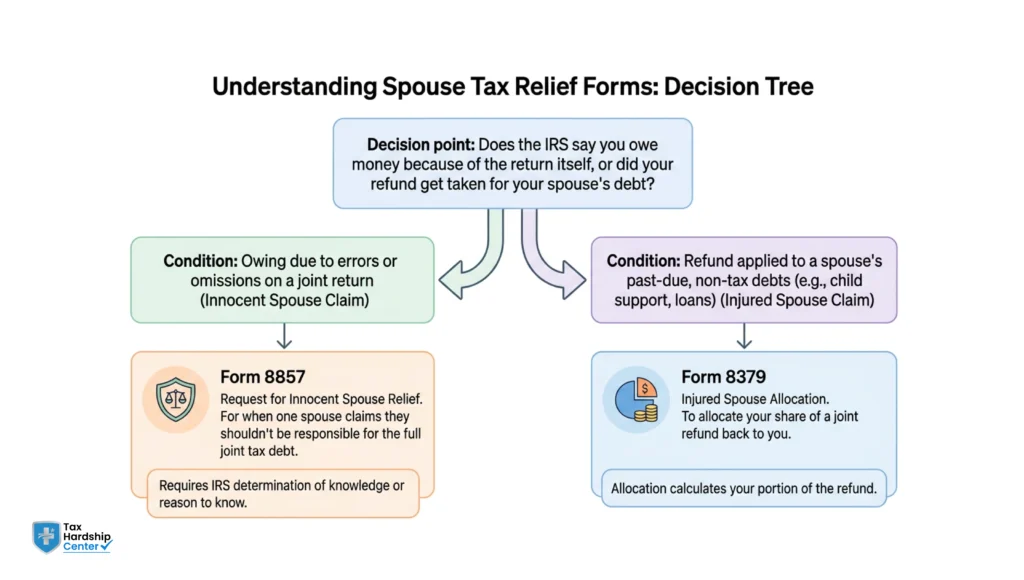
If you’re still not sure which one applies to you, here’s the fastest gut check available: innocent spouse relief is about liability, injured spouse relief is about a refund that already got taken.
Ask yourself this. Does the IRS say you owe money because of something wrong on the return itself? That’s innocent spouse territory. Did you file correctly, expect a refund, and then watch it vanish to cover someone else’s old debt? That’s injured spouse territory.
One is about being blamed for something you didn’t do. The other is about losing money you were owed because of a debt that isn’t yours. Different problem, different form, different fix.
Form 8857 vs Form 8379: What Each One Asks For
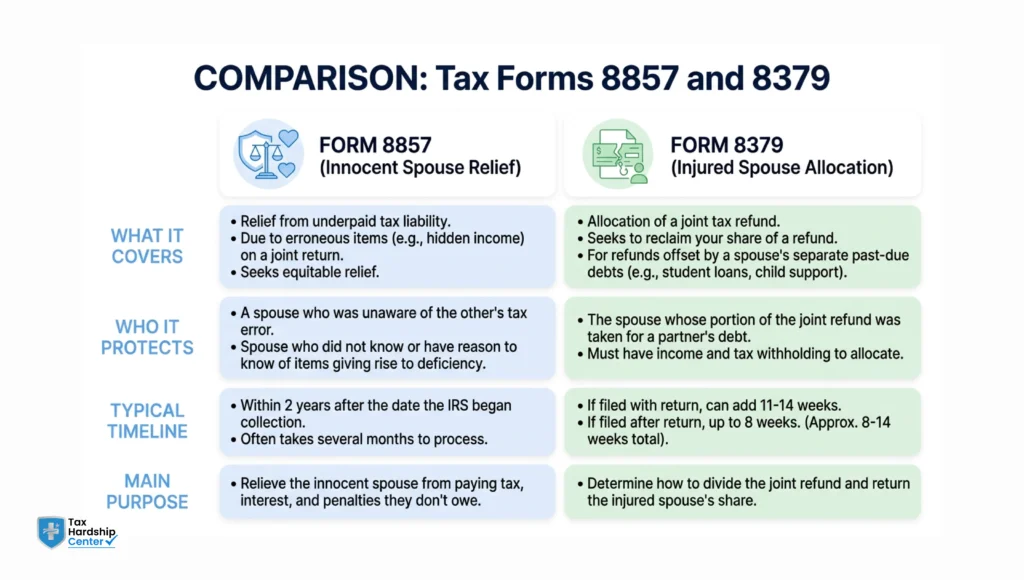
Form 8857, Request for Innocent Spouse Relief, is the paperwork trail for the liability side of this. It asks the IRS to look at your marriage, your financial situation, and your knowledge of the errors on the return, and then decide whether it’s fair to hold you responsible. There’s no strict deadline tied to the tax year itself in most cases, but waiting rarely helps your case, since records get harder to produce and memories get fuzzier.
Form 8379, Injured Spouse Allocation, is the refund-recovery form. It walks the IRS through how much of the joint refund actually belongs to you based on your individual income, withholding, and credits, so they can release your share instead of applying the whole thing to your spouse’s debt. This one has real timing pressure. You can file it with your original return, or afterward if the offset already happened, but the sooner you file, the sooner your money comes back.
Two forms. Two very different conversations with the IRS. Filing the wrong one is like showing up to small claims court with a divorce petition. Technically you’re in a courtroom, but not the right one.
Can You File Both at the Same Time?
Sometimes, yes, and this is where things get genuinely messy. It’s entirely possible to be both blindsided by a spouse’s tax mistake and have a refund seized for an unrelated debt in the same marriage. If both situations apply to you, both forms can be filed. They just address separate problems, and each one needs its own documentation and its own case built around it.
This is usually the point where people stop trying to figure it out alone, and that’s a reasonable place to land. Two overlapping IRS processes with two different sets of requirements is not a weekend project.
The Mistake That Delays Almost Every Case
The single most common error is filing the wrong form and waiting weeks, sometimes months, for a response that never comes because the IRS is processing an application that doesn’t match the actual problem.
Close behind it is under-documenting. Innocent spouse cases live and die on proof: bank statements, evidence of separate finances, timelines showing when you actually learned about the issue. The IRS lays out exactly what counts as sufficient evidence in Publication 971, Innocent Spouse Relief, and it’s worth a skim before you start writing your narrative, not after. Injured spouse cases live and die on accurate income and withholding allocation between spouses. Guessing at these numbers, or leaving gaps, is how a legitimate claim gets stuck in review purgatory.
What Happens After You File
Once either form is submitted, the IRS reviews it, and reviews take time. Innocent spouse determinations can take several months, sometimes longer if your case involves an audit or your spouse disputes the claim, and if the IRS denies the request, both spouses have the right to see the determination letter and file an appeal within 30 days. Injured spouse allocations tend to move faster, often resolved within eleven to fourteen weeks if filed with your original return.
During this window, notices may keep arriving, collection activity may or may not pause depending on your specific case, and the silence in between updates is, frankly, the hardest part. This is exactly the stretch where having someone track the case for you changes the experience from anxious guessing to actual visibility.
Why Tax Hardship Center Is the Right Partner for Innocent and Injured Spouse Relief
Tax Hardship Center works directly with taxpayers navigating both sides of this problem, whether that means building a documented innocent spouse case around Form 8857 or handling the refund allocation math behind a Form 8379 claim. The team reviews joint filing history, separates individual income and withholding where an injured spouse claim requires it, and gathers the financial evidence an innocent spouse case depends on, things like proof of separate accounts, timelines of when income discrepancies were discovered, and documentation showing no benefit was received from unreported earnings.
For taxpayers dealing with a spouse’s unfiled or inaccurate returns on top of a liability question, THC also handles the surrounding issues that often show up in the same case, from help with back taxes to sorting through IRS payment plan options if some liability remains after relief is granted. In cases where remaining liability is too large to pay off through a standard plan, it’s also worth understanding who qualifies for an Offer in Compromise as a way to settle it for less. When the bigger picture involves enforcement notices layered on top of a spousal liability dispute, the tax debt relief options page breaks down how these pieces fit together, and if it’s not yet clear whether this needs an attorney, a CPA, or a resolution firm, the tax attorney vs. tax relief company vs. CPA breakdown is a fast way to figure out who should actually handle the file. A free case review is the fastest way to find out which form actually applies to your situation before you spend weeks filing the wrong one.
FAQs
What is the difference between innocent spouse and injured spouse relief?
Innocent spouse relief removes your liability for tax errors your spouse made on a joint return. Injured spouse relief recovers your share of a joint refund that was seized for your spouse’s separate debt.
Which form do I use, 8857 or 8379?
Use Form 8857 if the IRS says you owe money because of something wrong on your joint return. Use Form 8379 if your refund was taken to cover a debt that belongs only to your spouse.
Can I file for both innocent spouse and injured spouse relief?
Yes, if both situations genuinely apply to you. Each form addresses a separate problem and requires its own supporting documentation.
How long does the IRS take to process an injured spouse claim?
Typically eleven to fourteen weeks if filed with your original return, and up to eight weeks if filed afterward on its own.
How long does an innocent spouse relief request take?
It varies widely depending on complexity, but several months is common, especially if your spouse disputes the claim or an audit is involved.
Do I need to be divorced to qualify for either form?
No. Both forms are available to married, separated, and divorced taxpayers, as long as the underlying joint return and liability or refund issue applies.
Will filing innocent spouse relief affect my current marriage or joint finances?
It can create tension if your spouse disputes the claim, since the IRS typically notifies the other spouse and may request their input during review.
Conclusion
Innocent spouse relief and injured spouse relief solve two different problems that happen to share a last name. One clears you of a liability you never should have carried. The other returns money that was always yours. Knowing which door to walk through before you file is the difference between a resolution in weeks and a resolution that never quite arrives.
Key Takeaways
- Innocent spouse relief addresses tax liability caused by your spouse’s errors on a joint return
- Injured spouse relief recovers your portion of a refund seized for your spouse’s separate debt
- Form 8857 is for liability disputes, Form 8379 is for refund allocation
- Both forms can be filed together if both situations apply to your case
- Innocent spouse claims depend heavily on documented proof of what you knew and when
- Injured spouse claims depend on accurate income and withholding allocation between spouses
- Filing the wrong form is the most common reason these cases get delayed
- Injured spouse claims generally process faster than innocent spouse determinations
- Notices and collection activity may continue while your case is under review
- Reviewing your specific situation before filing prevents months of avoidable waiting
Ready to find out which form fits your situation? Get a free case review and speak with a tax specialist today.