

You opened your IRS account transcript expecting boring numbers. Instead, one line says “Abatement of prior tax assessment” right next to 291.
Cue the 11 pm spiral.
Here is the short version. IRS code 291 means the IRS reduced or removed tax it had assessed on your account earlier. That is a tax assessment abatement, and most of the time it works in your favor. Let’s walk through what it means, what it doesn’t, and what to check next.
Quick Answer: Key Facts at a Glance
- IRS code 291 is a transaction code showing a prior tax assessment was abated, meaning reduced or cancelled.
- Code 290 vs 291 is simple: 290 adds tax to your account, 291 takes tax off.
- A tax assessment abatement lowers what you owe, but it does not automatically mean a refund or a $0 balance.
- The amount and date next to the code tell you how much changed and when.
- Always read the codes around it before you celebrate or panic.
What Does IRS Code 291 Mean on a Tax Transcript?
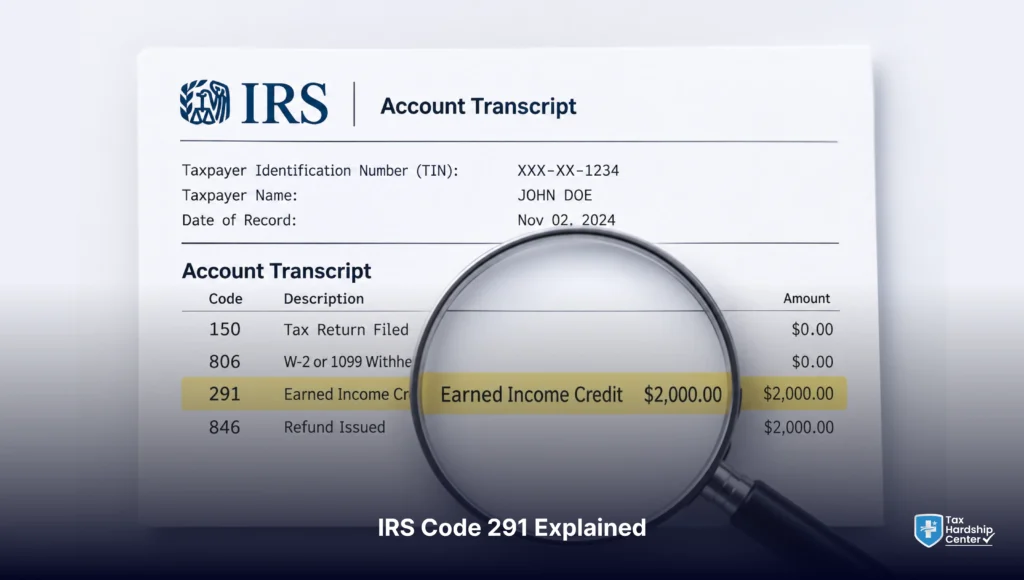
Every action on your tax account gets a three-digit transaction code. Payments, penalties, notices, adjustments. All of them.
IRS code 291 is the one that records an abatement of a prior tax assessment. “Abated” is just IRS language for reduced or cancelled. If you have already decoded code 570 on your transcript, this is the same kind of puzzle with a friendlier ending.
On your account transcript, you will usually see four things next to it:
- The code (291)
- The description (“Abatement of prior tax assessment”)
- The date the adjustment posted
- The amount removed
That amount is the star of the show. It tells you exactly how much tax came off your account.
Why Would the IRS Do a Tax Assessment Abatement?
The IRS does not hand out a tax assessment abatement for fun. Something changed, and the IRS agreed with it.
Common reasons include:
- You answered a notice and won. If you disputed a mismatch and the IRS accepted your response, the extra tax gets removed. This often follows a CP2000 notice.
- An amended return was processed. Your corrected return lowered the tax.
- An exam changed its result. New documents can shrink what the IRS first proposed. Our IRS audit timeline guide shows where that fits.
- The IRS made an error. It happens more than anyone likes to admit.
One thing to keep straight. Penalties and interest use their own transaction codes. A tax assessment abatement through code 291 deals with the tax itself.
Code 290 vs 291: What Is the Actual Difference?
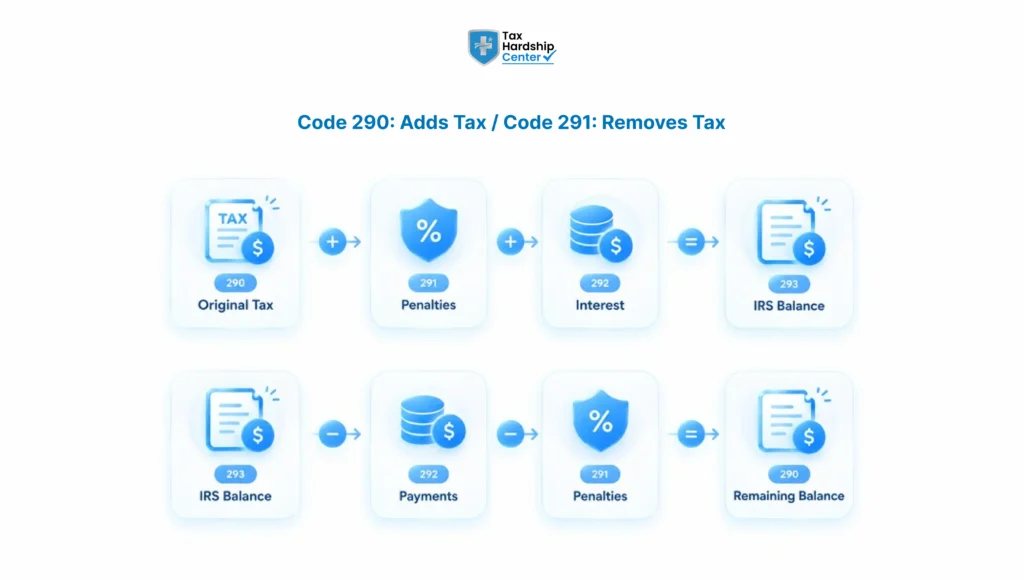
Think of code 290 vs 291 as a plus sign and a minus sign.
| Feature | Code 290 | Code 291 |
| What it means | Additional tax assessed | Prior tax assessment abated |
| Effect on balance | Usually increases it | Usually decreases it |
| Common trigger | Unreported income, exam changes | Dispute accepted, amended return, correction |
| Can show $0.00? | Yes, often as a record update | Yes, but less common |
So when you compare code 290 vs 291 on the same transcript, order matters. A 290 followed by a 291 often tells a short story. The IRS added tax, then took some or all of it back.
Seeing IRS code 291 after a 290? That is usually a plot twist in your favor.
Does IRS Code 291 Mean My Balance Is Zero?
Not automatically. Sorry. This is where people get ahead of themselves.
IRS code 291 lowers the assessed tax. Your actual balance depends on:
- What you already paid
- Penalties and interest still on the account
- Other tax years with balances
- Other codes that posted after the abatement
If the abatement is bigger than what you owed, you may end up with a credit. A credit is not the same as a refund in your bank account, because the IRS can apply it to other debts first. Flip to your balance line, not just the 291 line.
What Does a $0.00 Amount Next to IRS Code 291 Mean?
Seeing IRS code 291 with $0.00 feels weird. Like a receipt for nothing.
Usually it means the IRS posted an adjustment to your record without changing the tax amount. It can be a correction or a status update. The amount alone will not tell you why, so look at the codes nearby and any notice you received.
If you cannot connect the dots, that is a good moment to ask for a second pair of eyes. A $0.00 line is rarely dangerous, but rarely self-explanatory either.
What Should You Check After You Spot IRS Code 291?
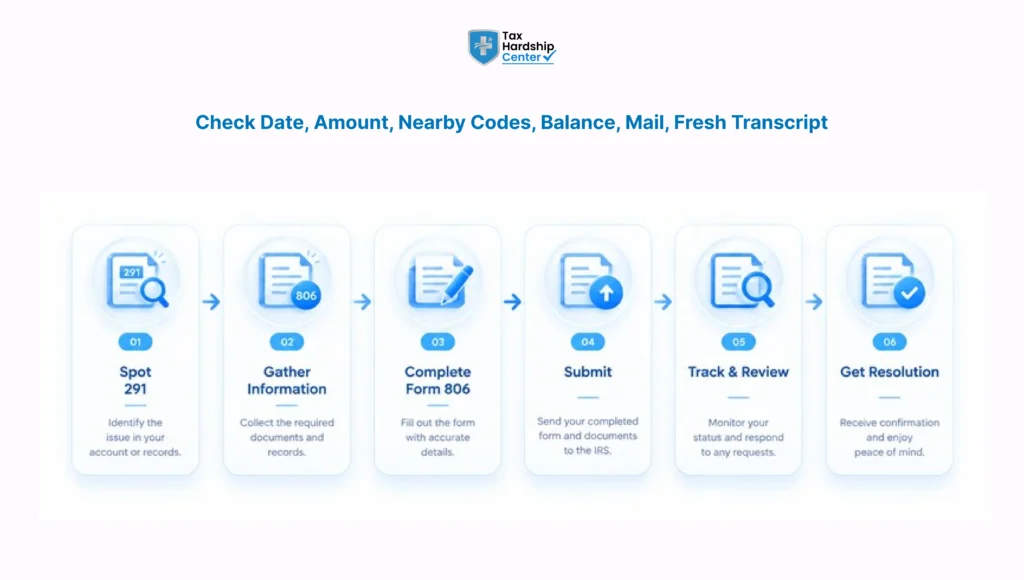
Do this in order:
- Check the date. Does it match a notice, amended return, or response you sent?
- Check the amount. Is it the figure you expected?
- Read the codes around it. Look for an earlier 290 and anything posted after.
- Check your balance. Compare it to your last notice.
- Look for mail. The IRS often sends a notice explaining adjustments. Tax Topic 653 explains IRS notices and bills.
- Pull a fresh transcript. You can get your transcript from the IRS online for free.
Do this and you will know more than most people who Google this at midnight. (No judgment. We have all been there.)
What If the Abatement Looks Wrong or the Balance Is Still High?
Sometimes the tax assessment abatement is smaller than expected. Sometimes penalties and interest are still sitting there. Sometimes a later code 290 adds tax back.
Here is what to do:
- Compare the abatement to your documents. Match it to your amended return or notice response.
- Ask about penalties separately. You may be able to request relief with Form 843.
- Do not ignore a remaining balance. Penalties and interest keep growing on unpaid tax.
- Look at your options. A payment arrangement may be the quickest way to stop the stress if you cannot pay in full.
Remember that the IRS controls the result. A lower balance is possible, but it is never guaranteed.
How Tax Hardship Center Helps When IRS Code 291 Raises More Questions
Reading a transcript is one thing. Knowing what to do with it is another. Tax Hardship Center reviews your account transcript line by line, explains what IRS code 291 did to your balance, and tells you honestly whether anything is left to fix. We cover the full range of IRS tax relief services, so you get one team instead of five phone calls.
In real life, that looks like this. Someone sees an abatement, assumes the debt is gone, and then gets a bill for penalties and interest. We trace the posted codes, compare code 290 vs 291 entries, confirm the tax assessment abatement actually landed, and map out what remains. If a balance is left, we walk through back tax relief options and compare an offer in compromise against a payment plan, so you only pursue a path you can qualify for.
Not everyone qualifies for a reduction, and we will tell you that before you pay for the wrong route.
Click here to get a quote or call us at [phone number] to talk through your transcript.
Conclusion
IRS code 291 is usually a good sign. It tells you the IRS took back some or all of a tax assessment. But it is one line in a longer story, so read the date, the amount, and the codes around it before drawing conclusions. If the numbers still look off, compare your options in our guide to payment plans vs OIC vs CNC.
P.S. What is the strangest code you have ever found on a transcript?
FAQs
What is IRS code 291?
IRS code 291 is a transaction code meaning “abatement of prior tax assessment.” It shows the IRS reduced or removed tax it assessed earlier. The amount beside it shows how much came off.
What is the difference between code 290 vs 291?
Code 290 records additional tax assessed, which usually raises your balance. Code 291 abates a prior assessment, which usually lowers it. Reading both together shows what changed and when.
Does a tax assessment abatement mean I get a refund?
Not by default. It lowers assessed tax, and a refund only happens if you end up with a credit. The IRS may apply that credit to other debts first.
Can IRS code 291 show $0.00?
Yes. A $0.00 entry usually means an adjustment posted without changing the tax amount. Check nearby codes and your notices for context.
Does IRS code 291 remove penalties and interest?
No, not directly. Penalties and interest have their own codes. Your balance may still include them after the abatement.
How long does it take for IRS code 291 to appear?
Timing varies. It posts after the IRS processes your response, amended return, or review, and the transcript date shows when it posted. Weeks to months is common.
Should I worry if I see a 290 after a 291?
Look closely, because it can mean tax was added back later. Compare dates and amounts and check for new notices.
Key Takeaways
- IRS code 291 means a prior tax assessment was abated, so it reduces tax on your account.
- A tax assessment abatement targets the tax, while penalties and interest use separate codes.
- Code 290 vs 291 works like add and subtract, and order of posting matters.
- The amount beside the code shows exactly how much tax was removed.
- A 291 does not guarantee a $0 balance or a refund.
- A $0.00 entry often signals a record adjustment, not a change in tax.
- Check the date, amount, nearby codes, and your balance after every abatement.
- Pull a fresh transcript from IRS.gov to confirm what actually posted.
- If a balance remains, compare payment plans, OIC, and penalty relief before choosing a path.
Ready to Make Sense of Your Transcript?
Get a free case review and find out exactly where you stand.