

That IRS letter can make your stomach drop. Most people are not trying to dodge taxes; they are trying to keep up with life, and the paperwork falls behind.
Here is the good news. In many cases, you can handle back taxes yourself if you stay organized and choose the right IRS option. In other cases, DIY mistakes get expensive fast, and professional IRS representation can protect your income, your bank account, and your peace of mind.
This guide breaks down exactly when “tax help for back taxes” is a do-it-yourself job and when it is time to call a professional.
Back Taxes First: Know What Problem You’re Solving
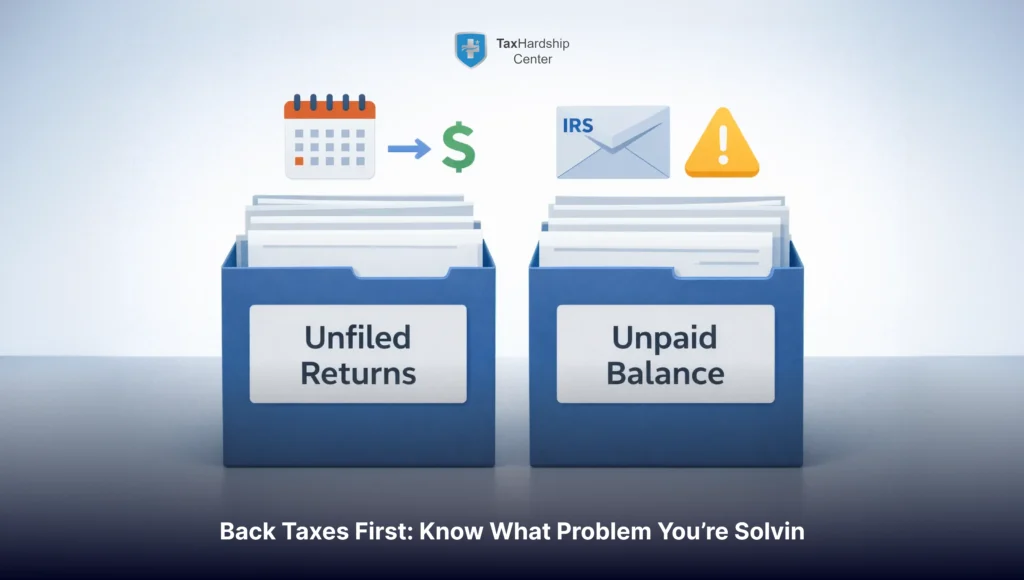
“Back taxes” usually means one (or both) of these situations:
Unfiled Returns
You did not file one or more required tax returns. Even if you cannot pay, filing is still the first step because it prevents the failure-to-file penalty from accruing and brings your account current.
An Unpaid Balance
You filed, but you owe money you cannot pay in full. The IRS has structured options for this, including payment plans and other relief paths.
Important detail many people miss: the IRS can hold refunds when returns are past due, and refunds are time-limited. If you are owed a refund, you generally must file within 3 years of the return due date to claim it.

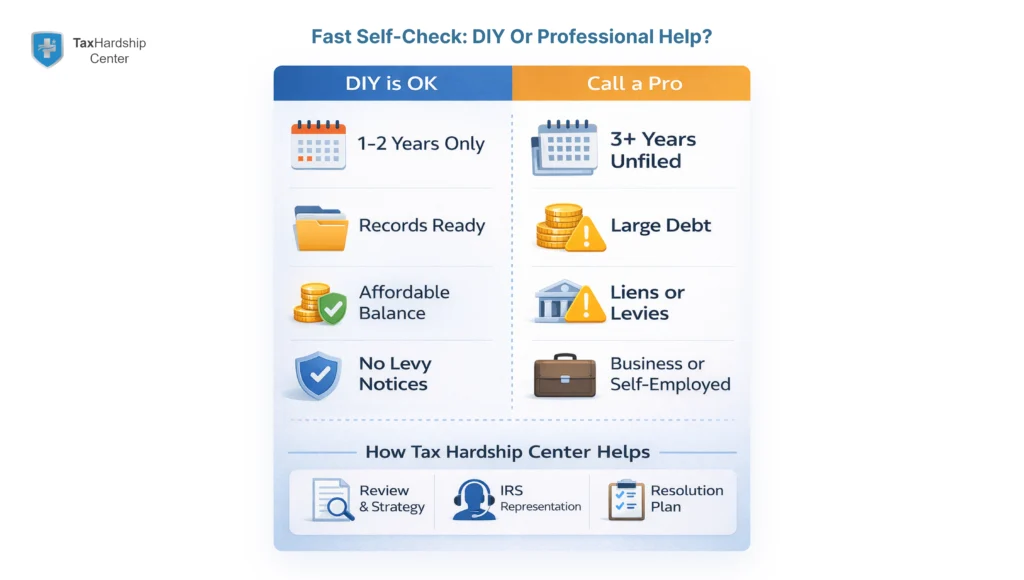
A Fast Self-Check: DIY Or Professional Help?
Use this quick screen before you choose your path.
DIY Is Often Reasonable If
- You have one tax year (or maybe two) to fix.
- You can gather your income documents and expenses without major gaps.
- You owe an amount you can realistically pay over time.
- You have not received urgent enforcement notices (levy, garnishment, or lien escalation).
- You are comfortable communicating with the IRS and following deadlines.
Call A Professional If Any Of These Are True
- You have multiple years of unfiled returns.
- You owe a large balance, especially if it is above online-plan thresholds.
- You are self-employed, own a business, or have payroll tax exposure.
- You received lien or levy notices, wage garnishment threats, or a Revenue Officer contact.
- You want to pursue an Offer in Compromise, hardship status, appeals, or penalty abatement beyond a simple request.
- You want someone to speak to the IRS for you under a Power of Attorney (POA).
When You Can DIY Tax Help For Back Taxes
If your situation is straightforward, here is a clean DIY workflow.
Step 1: Confirm What You Owe And What Years Are Missing
Start with facts, not anxiety.
- Read every IRS notice and note the tax year, form number, and deadline.
- Check your IRS account and balance details.
- If you need a payment plan, the IRS Online Payment Agreement tool is the standard self-serve route for many taxpayers.
Step 2: File Missing Returns The Right Way
If you have unfiled returns, file them before you negotiate. The IRS generally expects all required returns to be filed before approving many resolution options.
Practical tips:
- Use the correct tax forms for each year.
- Rebuild missing records carefully (income transcripts can help if documents are gone).
- File even if you cannot pay yet. Waiting usually makes the total worse.
Step 3: Choose A Payment Path That Matches Reality
If you can pay your balance in a structured way, start here.
Option A: Pay In Full (If You Can)
Paying in full avoids ongoing penalties and interest and closes the file fastest.
Option B: Short-Term Payment Plan
If you can pay within about six months, a short-term plan can buy time without a setup fee in many cases. Eligibility commonly depends on balance size.
Option C: Long-Term Payment Plan (Installment Agreement)
A long-term plan spreads payments monthly. Many individuals can apply online if they owe $50,000 or less in combined tax, penalties, and interest and have filed required returns. The IRS also lists setup fees that vary depending on how you apply and how you pay (for example, direct debit can be cheaper).
If you want a deeper walkthrough of payment plans.
Step 4: Ask For Penalty Relief If You Qualify
Penalty relief can reduce what you owe, but it depends on your history and facts.
The IRS outlines administrative penalty relief, including First Time Abate for certain penalties, when you have a good compliance history.
Best DIY move: if you qualify, request it using the instructions on your notice or by calling the number on the notice.
Step 5: If You Cannot Pay Anything Right Now
If paying would prevent you from covering basic living expenses, you may be able to ask the IRS to temporarily delay collection. Interest and penalties can continue, but it can stop active collection pressure while you stabilize.
For a deeper comparison.
Step 6: Consider An Offer In Compromise Only If It Fits
An Offer in Compromise (OIC) is a settlement option that can resolve tax debt for less than the full amount, but the IRS evaluates the ability to pay, income, expenses, and asset equity.
DIY-friendly starting point: Use the IRS Offer in Compromise Pre-Qualifier to see if it is even worth pursuing.
When To Call A Professional (And Why It Usually Pays Off)
DIY is great until the downside risk outweighs the savings.
You Should Strongly Consider Professional Help If
- You have three or more years to file, or your records are incomplete.
- You owe enough that the IRS will require a full financial disclosure.
- You are facing a lien, levy, wage garnishment, or business collections pressure.
- You are self-employed, have cash income, or have complex deductions.
- You are being audited or responding to discrepancy notices.
- You are pursuing OIC, hardship status, appeals, or major penalty relief.
CBS also notes that multiple years of unfiled returns and irregular income can make relief eligibility and paperwork much harder, which is where a qualified professional can make a real difference.
What “IRS Representation” Actually Means
When you hire a qualified professional, they can often represent you before the IRS through a Power of Attorney.
- Form 2848 authorizes an eligible individual to represent you before the IRS.
- With a POA, the representative can communicate with the IRS, receive notices if you choose, and advocate or negotiate on your behalf.
- The IRS also explains that enrolled agents, CPAs, and attorneys have unlimited representation rights for audits, collections, and appeals.
If you are getting escalating notices, representation is not just convenience; it is risk control.
Fresh Start Program Help: What It Is, What It Isn’t
A lot of people search for “fresh start program help” because ads make it sound like a special application.
In real IRS language, Fresh Start is commonly discussed as a set of debt-resolution pathways, and IRS guidance even notes that an Offer in Compromise “used to be called the Fresh Start program.”
The safest way to think about it:
- It is not a magic button.
- It is a collection of options, such as payment plans, settlement tools, and relief requests, depending on your situation.
Choosing Tax Relief Companies Safely
Not all “tax relief companies” are the same. Some are solid. Some are expensive middlemen. Some are outright harmful.
Use These Credibility Checks
- Verify credentials and qualifications. The IRS explains the types of preparers and how to choose a tax professional.
- Look for professionals who can actually represent you (EA, CPA, attorney).
- Get everything in writing: scope, timeline expectations, and fees.
Watch For These Red Flags
- Promises like “pennies on the dollar” before reviewing your finances.
- Heavy pressure to sign immediately.
- High upfront fees without a clear plan.
- OIC marketing that ignores the reality of eligibility. The IRS warns about “offer in compromise mills” that push ineligible people into expensive applications.
- The FTC warns that some tax relief companies collect large upfront fees and leave people worse off.
Three Questions To Ask Before You Hire Anyone
- What credentials do you hold, and can you provide IRS representation if needed?
- What exact resolution path are you recommending, and why does it fit my financial profile?
- What will you do in the first 14 days, specifically (filings, transcripts, negotiations, holds)?
How Tax Hardship Center Supports Back-Tax Resolution
If you want help beyond DIY, the Tax Hardship Center’s value is in doing the heavy lifting correctly and reducing risk when the IRS process gets serious.
Depending on your case, support typically includes:
- Reviewing what is missing (returns, records, notices).
- Building a strategy that matches IRS rules and your cash flow.
- Helping you pursue the right solution, like an installment agreement or an Offer in Compromise.
- Providing IRS representation when appropriate to ensure communication is handled professionally.
FAQs
Can I File Back Taxes Myself?
Yes, many taxpayers can file missing returns themselves if the situation is limited and the records are available. The IRS encourages filing delinquent returns even when you cannot pay in full.
What if I cannot Pay Back Taxes In Full Right Now?
Common starting points include a short-term plan, a long-term installment agreement, or a request for a temporary delay if you are facing true hardship.
How Do I Know If I Qualify For An Offer In Compromise?
Use the IRS Offer in Compromise Pre-Qualifier to estimate eligibility before you spend time and money on a full application.
Is The Fresh Start Program Real?
You will see the term used widely in marketing. IRS guidance ties it to tax debt help paths and notes that Offer in Compromise used to be called the Fresh Start program. The practical takeaway is that it refers to relief options, not a guaranteed approval program.
Do I Need IRS Representation, Or Can I Talk To The IRS Myself?
You can represent yourself, but you can also authorize an eligible representative using a Power of Attorney. Representation becomes especially valuable when notices escalate, financial disclosure is required, or you need negotiation and documentation done correctly.
How Do I Avoid Tax Relief Scams?
Follow IRS guidance for choosing a tax professional, watch for unrealistic promises, and be cautious with upfront fees. The IRS warns about misleading Offer in Compromise “mills,” and the FTC warns about tax relief companies that can leave people worse off.
Conclusion
Tax help for back taxes is not one-size-fits-all. If your case is simple, a clean DIY approach can work well: file what is missing, confirm totals, choose a payment plan you can actually maintain, and request penalty relief when you qualify.
If your case is complex, the smartest move is often professional support, especially when enforcement risk is rising or when you need IRS representation and negotiation.
Key Takeaways:
- File missing returns first, even if you cannot pay yet.
- Use IRS tools for payment plans, hardship delays, and OIC screening before you commit to any paid help.
- Call a professional when multiple years, high balances, business taxes, audits, liens, or levies are involved.
- If you hire help, vet credentials, and avoid “too good to be true” tax relief company promises