
You finally pulled your IRS transcript to check your refund, and instead of progress, you found code 810.
That one line usually means the IRS hit pause on the entire refund. It feels personal, but most of the time, it is the IRS running a verification or compliance step before money goes out.
This guide explains what the IRS code 810 refund freeze means, why it happens, and the most realistic next steps to get things moving again.

What Does 810 Mean on a Tax Transcript
IRS transcript code 810 is officially labeled “Refund Freeze.” The IRS reference definition is straightforward: it freezes the tax module from refunds, offsets, and credit elections.
In plain English, what does 810 mean on a tax transcript? It means the IRS has stopped your refund from going out until a review, verification, or internal issue is resolved.
One more important detail: the same IRS reference shows TC 811 as the code that reverses TC 810, allowing credit to be released if no other freezes are in effect.

IRS Code 810 Refund Freeze Vs A 570 Hold
People often confuse “freeze” and “hold,” especially when both appear in the same transcript.
Here is the simplest way to separate them.
| Code | Plain Meaning | What It Typically Stops |
| 810 | Refund Freeze | Refunds, offsets, and credit elect |
| 570 | Additional Liability Pending And Or Credit Hold | Freezes the module from refunding or offsetting credit out |
A 570 is often a processing hold while something is verified. An 810 is a stronger “do not release” type of freeze, and it usually requires a specific resolution step before the refund can move.
Common Triggers That Cause An 810 Refund Freeze
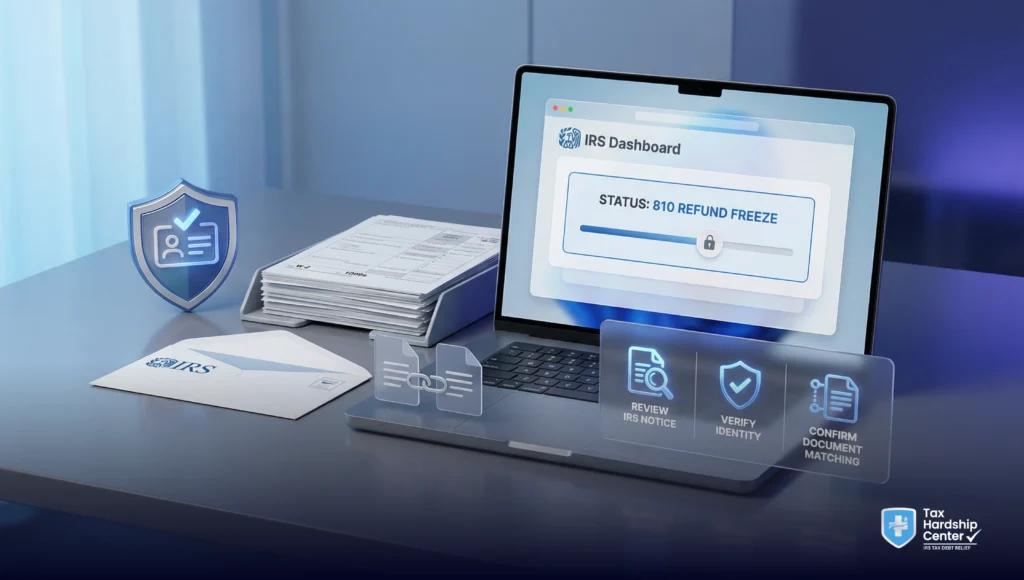
There is no single reason code 810 appears. But the common triggers usually fall into a few categories.
Identity Verification Or Fraud Filters
If the IRS needs you to verify your identity or confirm that you filed the return, your refund can freeze while that verification is in progress. The IRS identity verification guidance says it may take up to 9 weeks to process your return after you verify, and you should wait 2 to 3 weeks before checking your refund status again.
Helpful next read on the Tax Hardship Center if you received an identity verification letter:
Refund Or Credit Eligibility Review
Returns that include certain credits, unusual refund amounts, or information the IRS cannot quickly match can get pulled into review pipelines. The IRS also notes that refunds can take longer when a return requires additional review, and it specifically calls out identity theft or fraud as a reason delays happen.
Examination Related Issues
In IRS procedures, TC 810 and TC 811 can appear in exam-related situations. The IRS manual notes that a refund held by TC 810 may have a TC 811 posted to release the portion of the refund not related to an audit issue, depending on what is being reviewed.
Specific Internal Programs
The IRS transaction code reference lists internal indicators tied to TC 810, including prefiling notification, abusive tax shelter detection teams, earned income credit check freezes, and frivolous return program indicators. You do not need to decode these yourself, but it explains why the IRS treats 810 as more than a routine delay.
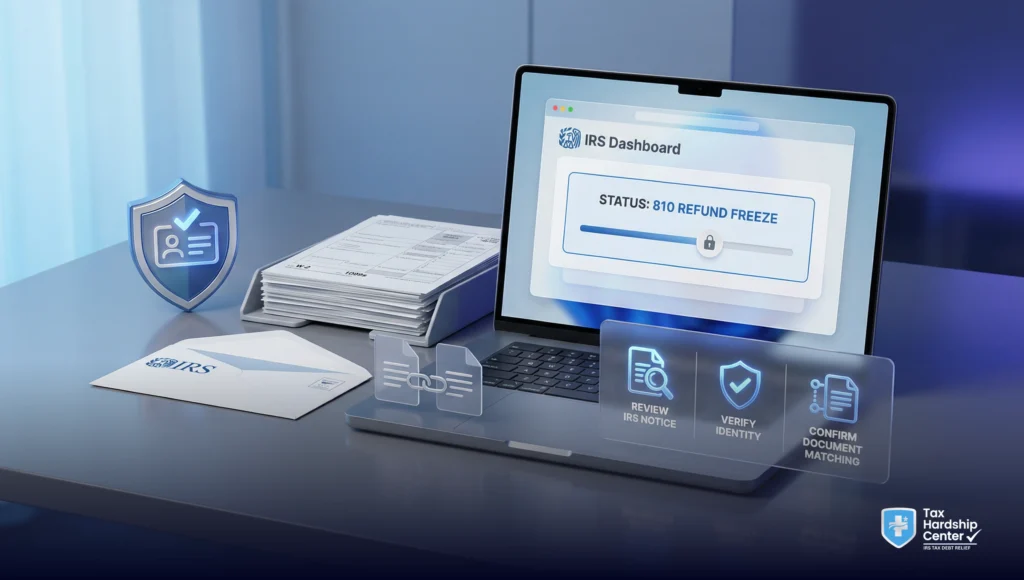
What Codes You May See With 810
Code 810 rarely tells the whole story on its own. What matters is what shows up before it and after it.
Code 811
TC 811 is the official reversal of TC 810. If you see 811, it is a sign the freeze has been lifted in whole or in part, assuming no other freezes are holding your account.
Code 971
TC 971 is a “Miscellaneous Transaction” in IRS reference materials, and in many taxpayer transcripts, it commonly lines up with a notice being issued. If you see 971 around the same time as 810, treat it as a strong signal that a letter is coming, or is already available in your online account.
Code 570
If you also have 570, it indicates an additional liability pending and/or a credit hold that freezes the module from refunding or offsetting credits. It can appear before or alongside deeper freezes depending on what the IRS is reviewing.
Code 846
846 is “Refund Issued.” If you do not have 846, your refund is not scheduled yet. If you do have 846, the IRS has authorized the refund, and your next questions become delivery timing or offsets.
How To Unfreeze Refund After Code 810
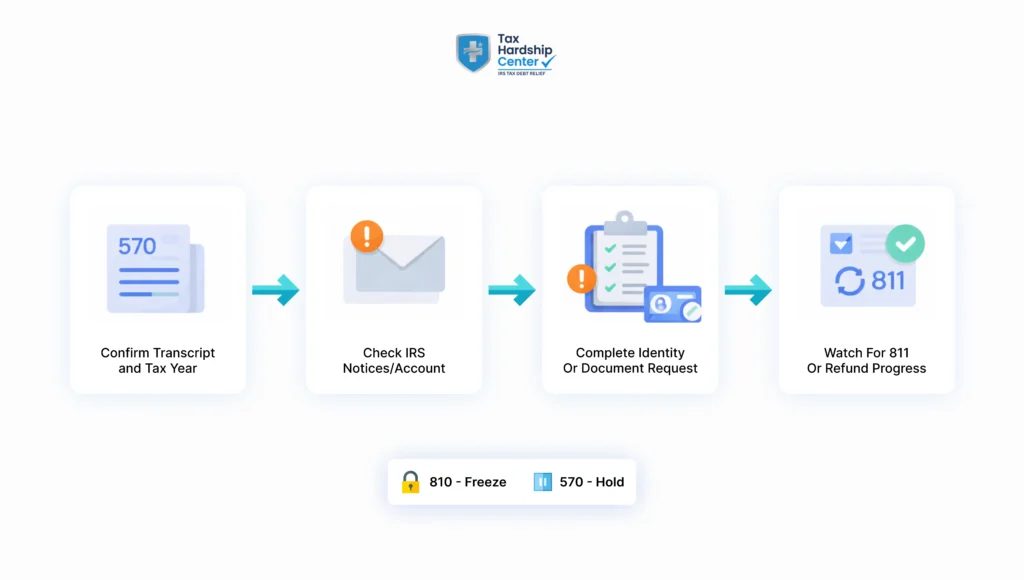
Here is the step-by-step path that covers most situations without making the problem worse.
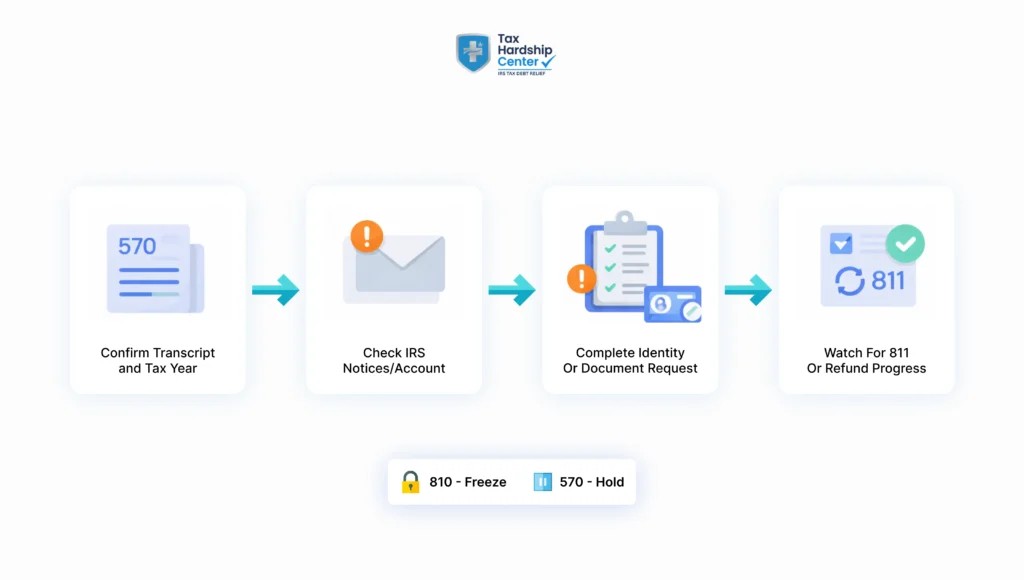
Step 1: Pull The Right Transcript And Confirm The Tax Year
Start with the IRS transcript tools to ensure you are looking at the correct year and transcript type.
If you want a Tax Hardship Center guide for requesting transcripts, this is helpful:
Step 2: Check Your IRS Online Account For Notices
Many taxpayers wait for the mail, but the IRS says you can find digital copies of most IRS notices in your online account under “Notices and Letters.”
If you find a CP or LTR notice number, use the IRS notice lookup guidance and follow the instructions exactly.
Step 3: If The IRS Is Asking You To Verify Identity, Do That First
If identity verification is required, that is often the main blocker.
Use the IRS “Verify your return” instructions, then give the IRS time to process. The IRS states it may take up to 9 weeks after verification.
Step 4: Confirm Your Address If You Moved
If the IRS mailed a notice to an old address, you can lose weeks without realizing it.
The IRS lists multiple ways to change your address, including using Form 8822.
Step 5: Prepare Your Support Documents Before The IRS Asks
Do not send documents unless the IRS requests them, but do get organized now:
- W-2s, 1099s, and any wage and income items you used
- Proof for major credits you claimed, especially if a notice asks for it
- A copy of the filed return and schedules
- Any IRS notice letters, with deadlines highlighted
Step 6: Avoid The Moves That Commonly Backfire
When someone is stressed about a frozen refund, these are the most common mistakes:
- Filing a duplicate return because you think the IRS did not receive it
- Amending too early without a clear trigger or IRS instruction
- Sending “extra” documents that the IRS did not request
If the IRS needs information, it will typically request it through a notice or letter, and the documents they request matter.
Step 7: Track Status The Right Way
Use Where’s My Refund for high-level refund progress and dates after approval. The IRS notes most refunds are issued within 21 days, but some take longer when additional review is required.
Also, do not overread the date next to a transcript entry. Transaction dates and cycle dates can differ, and the Taxpayer Advocate explains that cycle dates reflect processing timing, while transaction dates are the effective dates used for many calculations.
How Long Does An 810 Refund Freeze Last
There is no universal timeline. It depends on what triggered the freeze and whether the IRS is waiting on you.
A few timing anchors that are actually useful:
- If identity verification is required, the IRS says processing may take up to 9 weeks after you verify.
- If a notice requires documents, the clock usually starts when you respond and is determined by what the notice says. The IRS notice guidance emphasizes following the instructions and deadlines in the letter.
- If the freeze is tied to examination activity, the IRS manual shows scenarios in which 811 may release a portion of the refund that is not tied to the exam issue, which can change timing and amounts.
When To Get Help
Consider getting support if any of these are true:
- You have code 810, and no notice appears in your online account after a reasonable period.
- You received an identity verification letter and are unsure how to complete it correctly.
- Your transcript shows multiple freezes, multiple tax years, or exam indicators.
- You are facing financial hardship and cannot afford a prolonged delay.
How the Tax Hardship Center Can Help
If an 810 refund freeze is not clearing, the fastest path forward is usually clarity, not guessing.
Tax Hardship Center helps taxpayers by reviewing transcripts, notices, and the timeline of IRS actions so the response matches what the IRS is actually asking for, especially in identity verification or audit-related situations.
Frequently Asked Questions
What Does 810 Mean On Tax Transcript
It means the IRS placed a refund freeze that stops refunds, offsets, and credit elects until the freeze is released.
Does Code 810 Mean I Am Being Audited
Not always. It means your refund is frozen. Some 810 freezes are related to exam activity, while others are verification or fraud-filter related.
What Do 810 And 811 Mean Together
810 is the refund freeze. 811 reverses the refund freeze, in whole or in part, depending on the entry.
Can I Verify Identity Online To Unfreeze My Refund
If the IRS requires identity verification, follow the IRS verification instructions. The IRS states it may take up to 9 weeks to process your return after verification.
Why Do I Have 810 But No IRS Letter Yet
Check your IRS online account first. The IRS says digital copies of most notices can be found under “Notices and Letters.” If you moved, confirm your address is updated.
Should I Amend My Return To Fix An 810 Freeze
Not automatically. Amending without a clear reason can create additional delays. If the IRS needs something corrected, it typically explains it in a notice or letter and provides instructions.
Conclusion
An IRS transcript code 810 refund freeze is frustrating, but it is also a clear signal. The IRS is not releasing money yet because it needs to complete a verification step, respond to a notice, or conduct an internal review.
Key takeaways:
- Code 810 freezes the module from refunds, offsets, and credit elect, and 811 is the reversal code.
- 810 differs from a 570 hold and usually requires a more specific resolution step.
- Your best next move is to check IRS Online Account notices, then follow the exact instructions on any CP or LTR letter.
- If identity verification is required, complete it first, then allow processing time.
- If the freeze does not clear, a transcript and notice review can prevent missteps and speed up the right response.