
You need to file an old tax return. Maybe you missed 2020 and just realized it. Maybe you skipped three years, and now the IRS is sending notices. Either way, you know you need to file, but you’re not sure how filing a 2020 return in 2026 works. Do you use the current year’s forms or the old ones? Can you e-file it? Where do you mail it? If you’re owed a refund, is it too late to claim it?
Filing an old tax return is not the same as filing your current year return. The process is different. The forms are different. The deadlines matter more than you think. And if you owe money or the IRS has already filed substitute returns on your behalf, getting this right matters even more.
This guide walks through exactly how to file a past due tax return, which forms to use, where to send them, what happens if you owe money or are owed a refund, and when professional help makes the difference between fixing the problem and making it worse.
Do You Need to File an Old Tax Return?
Not everyone is required to file a tax return every year. Whether you need to file depends on your income, filing status, and age for that specific year.
If your income was above the filing threshold for that year, you must file. The filing threshold changes every year based on inflation adjustments to the standard deduction. For 2020, a single filer under 65 needed to file if their gross income was $12,400 or more. For 2023, that threshold was $13,850. If your income was below the threshold for a given year, you are not required to file for that year.
If you are owed a refund, you should file even if your income was below the threshold. The IRS will not send you a refund unless you file a return. If your employer withheld taxes from your paycheck and you did not file, that money stays with the IRS unless you claim it by filing.
If you had self-employment income of $400 or more, you must file. The self-employment filing threshold is much lower than the standard filing threshold because self-employment income triggers Social Security and Medicare tax obligations. Even if you had a loss, you still need to file if your gross self-employment receipts were $400 or more.
If the IRS has already filed a Substitute for Return (SFR) on your behalf, you need to file your own return to replace it. An SFR is the IRS’s calculation of what you owe based on income reported to them by employers and third parties. It does not include deductions, credits, or adjustments that could lower your tax liability. Filing your actual return almost always results in a lower balance than the SFR.
To check whether you need to file for a specific year, request an IRS wage and income transcript for that year. The transcript shows what income was reported to the IRS under your Social Security number. If there is reported income above the filing threshold, you need to file.
Which Tax Year Forms to Use When Filing Back Taxes
You must use the tax forms from the year you are filing. You cannot use a 2025 Form 1040 to file your 2020 taxes. Tax brackets, standard deductions, credits, and deductions change every year, and the forms reflect those changes.
Each tax year has its own version of Form 1040 and its own set of schedules. If you are filing a 2020 return in 2026, you need the 2020 Form 1040, 2020 Schedule 1, 2020 Schedule C if you had self-employment income, and any other schedules that apply to that year.
The same rule applies to state tax returns. If you are filing a prior-year California return, use the California Franchise Tax Board forms for that specific year.
Using the wrong year’s forms will cause processing delays. The IRS will either reject the return or send it back, asking you to refile with the correct forms.
Where to Get Prior Year Tax Forms
The IRS publishes prior-year forms on IRS.gov. Go to the Forms and Publications page and search for the form you need. You can filter by year. Every Form 1040 and its schedules are available going back several years.
If you need instructions for a prior-year form, they are also available on IRS.gov. The instructions explain the tax law, deduction limits, and credit rules for that specific year. Do not rely on current year instructions when preparing a back tax return. The rules change.
For state tax forms, go to your state’s Department of Revenue or tax authority website. California taxpayers can find prior year forms at FTB.ca.gov. New York taxpayers can find them at tax.ny.gov. Every state tax agency publishes prior-year forms online.
If you are working with a CPA or tax software, most professional tax software includes prior year forms. TurboTax and H&R Block sell prior-year software for a fee. TaxAct offers prior-year filing through its platform. If you are preparing the return yourself, download the PDF forms from IRS.gov, fill them out by hand or using a PDF editor, print them, and mail them.
Can You E-File an Old Tax Return?
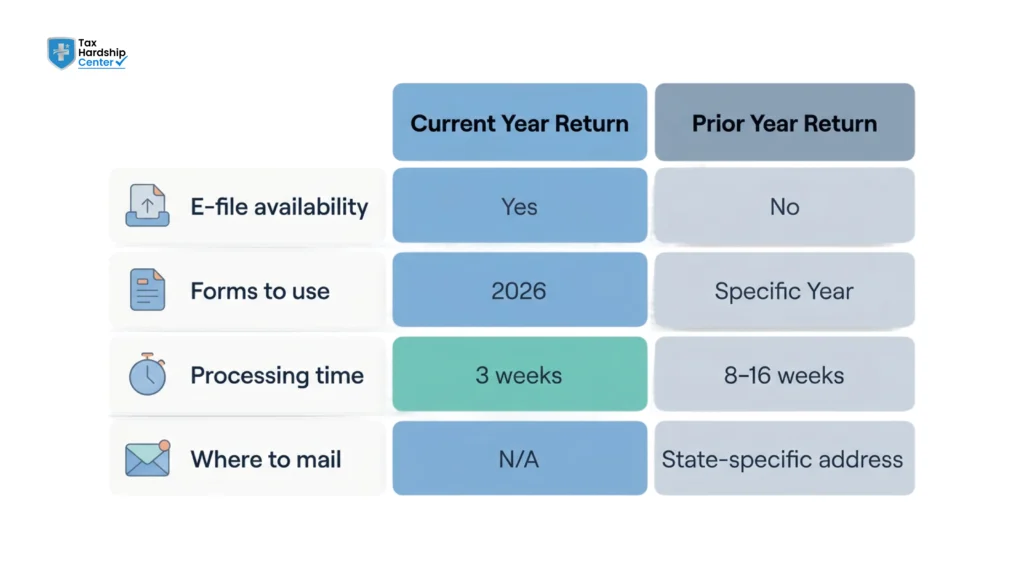
No. The IRS does not accept e-filed returns for prior tax years. If you are filing a 2020 return in 2026, you must print the return and mail it to the IRS.
This rule applies to both federal and most state returns. A few states allow prior-year e-filing under limited circumstances, but the IRS does not. Even if your tax software generates the return electronically, you still have to print it, sign it, and mail it.
Some tax preparation services claim they can e-file prior-year returns. They cannot. What they mean is that they will prepare your return electronically, then print and mail it for you. The IRS still processes it as a paper return.
Because old returns must be mailed, processing takes longer than current-year e-filed returns. Expect 8 to 16 weeks for the IRS to process a mailed prior-year return. If you are claiming a refund, allow an additional 4 to 8 weeks for the refund check to arrive.
Where to Mail Your Old Tax Return
The mailing address for your old tax return depends on which state you live in and whether you are enclosing a payment. The IRS uses different processing centers for returns with payments and those without.
If you live in California and you are not enclosing a payment, mail your return to:
Department of the Treasury
Internal Revenue Service
Fresno, CA 93888-0002
If you live in California and you are enclosing a payment, mail your return to:
Internal Revenue Service
P.O. Box 7704
San Francisco, CA 94120-7704
The addresses vary by state. The IRS publishes the full list of mailing addresses in the instructions for each year’s Form 1040. Always check the instructions for the specific year you are filing. The addresses change periodically.
Do not mail your return to a local IRS office. They will not process it. Use the address listed in the Form 1040 instructions for your state and payment status.
Send your return by certified mail with a return receipt requested. This costs a few dollars extra but gives you proof that the IRS received your return. Keep the receipt and the signed return receipt. If the IRS later claims they never received your return, you have documentation.
Mail each tax year in a separate envelope. Do not mail 2020, 2021, and 2022 returns in the same envelope. The IRS processes each year separately, and mailing them together causes delays.
Refund Deadlines: How Long You Have to Claim a Refund
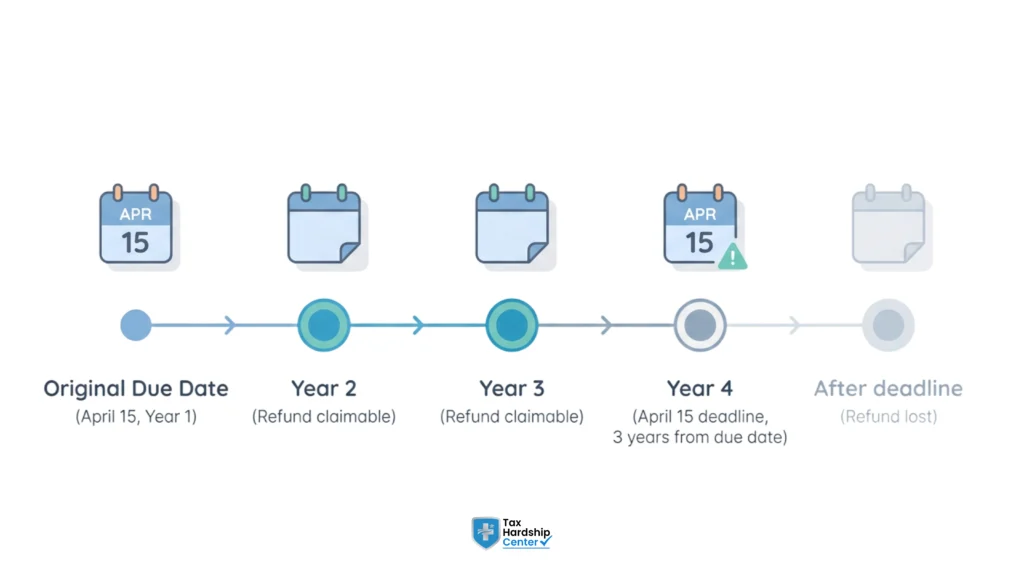
You have three years from the original due date of the return to file and claim a refund. After that, the refund is lost.
Example: Your 2020 tax return was originally due on April 15, 2021. You have until April 15, 2024, to file that return and claim the refund. If you file on April 20, 2024, the IRS will process the return but will not send the refund. The window closed.
If you filed an extension for a given year, the three-year deadline starts from the extended due date, not the original due date. If you extended your 2020 return to October 15, 2021, you have until October 15, 2024, to claim the refund.
This three-year rule only applies to refunds. If you owe money, there is no deadline to file. You still must file the return, and penalties and interest will continue to accrue until you do.
Why the IRS keeps your refund after three years: The rule exists to close out old tax years. After three years, the IRS can reallocate unclaimed refunds. If you did not file within the window, the money does not sit in an account waiting for you. It is gone.
If you are owed a refund and you are close to the three-year deadline, file immediately. Do not wait for the IRS to send you a notice. The deadline does not extend just because you did not know about it.
What Happens If You Owe Money on an Old Return
If you file an old return and owe money, the IRS will assess penalties and interest from the original due date of the return.
Failure-to-file penalty: 5% of the unpaid tax per month, up to a maximum of 25%. This penalty applies from the original due date until you file the return. Once you file, the penalty stops accruing.
Failure-to-pay penalty: 0.5% of the unpaid tax per month, up to a maximum of 25%. This penalty applies from the original due date until the balance is paid in full. It continues to accrue even after you file.
Interest: The IRS charges interest on unpaid tax and penalties from the original due date. The interest rate changes quarterly and is currently around 8% annually. Interest compounds daily.
Example: You owe $5,000 on your 2020 return, which was originally due April 15, 2021. You file the return on May 1, 2026. The failure-to-file penalty maxed out at $1,250 after five months. The failure-to-pay penalty has been accruing since April 2021 and is now around $1,250. Interest has been compounding for five years, adding roughly $2,000 to the balance. Your total balance is approximately $9,500.
Filing stops the failure-to-file penalty immediately. The failure-to-pay penalty and interest continue until the balance is paid.
If you cannot pay the balance in full, you have options. You can set up an IRS payment plan, apply for an Offer in Compromise to settle for less than you owe, request Currently Not Collectible status if you cannot afford any payment right now, or apply for penalty abatement if you have reasonable cause for filing late. All of these options require that your returns be filed and current. The IRS will not negotiate a resolution until you are compliant.
Why Professional Help Matters for Old Tax Returns with Complications

Filing one old tax return is manageable for most people. Filing multiple years with missing records, IRS substitute returns, and growing penalties is where things get complicated fast.
Substitute returns filed by the IRS usually inflate the balance because they don’t include deductions, credits, or the correct filing status. And since every tax year uses different rules and forms, even small mistakes can create bigger problems later.
Then comes the harder part: balancing. Payment plans, Offers in Compromise, and hardship status all have different requirements, and applying for the wrong option can waste months or trigger enforcement.
Tax Hardship Center helps taxpayers reconstruct missing records using IRS transcripts, replace substitute returns with accurate filings, and figure out the best resolution option based on their financial situation. That can include payment plans, settlement programs, or penalty relief when clients qualify.
If you need to file old tax returns and don’t know where to start, getting professional help early can make the process far less stressful and help reduce expensive mistakes.
FAQs
Can I still file old tax returns?
Yes. There is no deadline to file an old tax return if you owe money. If you are owed a refund, you have 3 years from the original due date to file a claim for it. After three years, you can still file the return, but you will not receive the refund.
How do I file taxes from 10 years ago?
Request an IRS wage and income transcript for that year to see what income was reported. Download the prior year tax forms for that specific year from IRS.gov. Prepare the return using the forms and tax law from that year. Print the return, sign it, and mail it to the IRS address listed in the instructions. Use certified mail to get proof of delivery.
Can I file an old income tax return?
Yes. You must use the tax forms from the year you are filing. You cannot e-file. You must print the return and mail it to the IRS. Processing takes 8 to 16 weeks. If you are claiming a refund, make sure you are within the three-year filing window.
What is the best way to file taxes from previous years?
Request IRS transcripts for the years you need to file to see what income was reported. Use those transcripts to prepare your returns. Download prior year forms from IRS.gov. Prepare each return separately using the correct year’s forms. Mail each year in a separate envelope using certified mail. If you no longer have records, the returns are complicated, or the IRS filed substitute returns on your behalf, work with a tax resolution firm to ensure the returns are prepared correctly and your balance is accurate.
How can I file taxes for previous years without W2 forms?
Request a wage and income transcript from the IRS for each year you need to file. The transcript shows income reported by employers, banks, and other third parties. Use the transcript data to prepare your return. You do not need the actual W-2 or 1099 forms if you have the transcript.
Where do I mail my old tax return?
The mailing address depends on which state you live in and whether you are enclosing a payment. Check the Form 1040 instructions for the specific year you are filing. The instructions list the correct mailing address for your state. Do not mail your return to a local IRS office.
Conclusion
Filing an old tax return is straightforward when you know the process. You use the forms from the year you are filing, not the current year. You print the return and mail it because the IRS does not accept e-filed prior-year returns. You send it to the correct address for your state and payment status. If you are owed a refund, you have three years from the original due date to claim it. After that, the refund is gone.
If you owe money, penalties and interest have been accruing since the original due date. Filing stops the failure-to-file penalty immediately, but the failure-to-pay penalty and interest continue until the balance is paid. The IRS offers payment plans, settlements, and hardship status for taxpayers who cannot pay in full, but none of those options are available until your returns are filed and current.
The challenge increases when you need to file multiple years, you no longer have your records, or the IRS has already filed substitute returns that inflated your balance. In those cases, professional help ensures the returns are prepared correctly, and the resolution strategy fits your financial situation.
Key Takeaways:
- Use the tax forms from the year you are filing, not the current year’s forms
- Prior year returns cannot be e-filed. You must print and mail them
- Check the Form 1040 instructions for the correct mailing address for your state
- Mail each tax year in a separate envelope using certified mail
- You have three years from the original due date to file and claim a refund. After that, the refund is lost
- Filing stops the failure-to-file penalty immediately, even if you cannot pay
- Request IRS wage and income transcripts if you no longer have W-2s or 1099s
- If the IRS filed substitute returns on your behalf, file your actual returns to replace them and reduce your balance
If you need to file old tax returns and you are not sure where to start or how to handle the balance once the returns are in, get a free case review at Tax Hardship Center.