
The first year you didn’t file felt manageable. Maybe you were going through something. Maybe the deadline passed, and you told yourself you’d handle it later. Then, it became another year. And another. Now you’re sitting here with five years of unfiled returns and a growing sense that the longer you wait, the worse it gets.
You are right about that last part. But here is what most people in this situation don’t know: the IRS would rather you file than not. The penalties for filing late are serious, but the penalties for never filing at all are worse. And the path back to compliance, while not simple, is a defined process with a clear sequence.
This is that sequence.
What Actually Happens When You Don’t File for 5 Years
Unfiled returns do not disappear. They accumulate consequences.
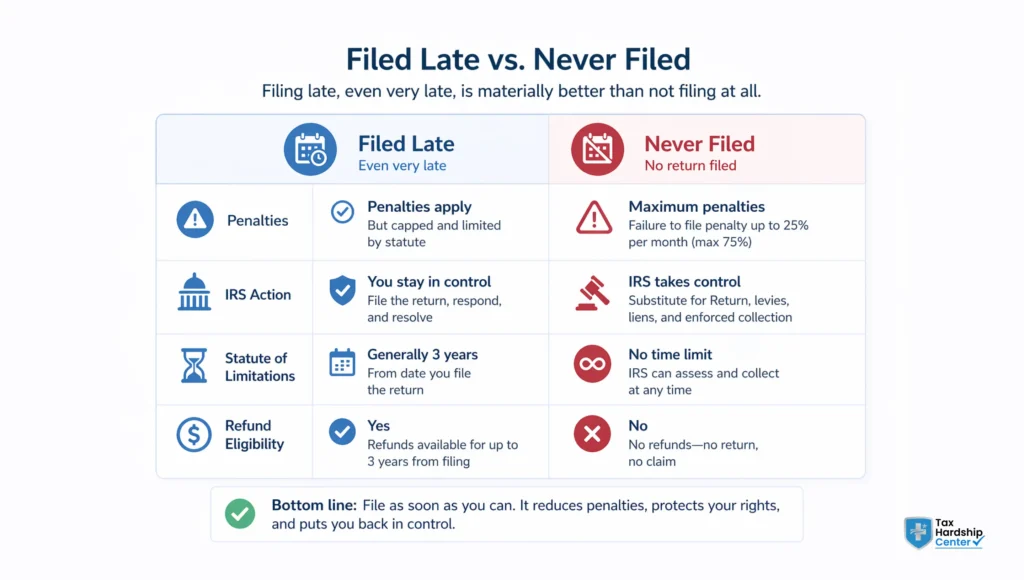
The failure-to-file penalty is 5 percent of your unpaid tax for each month your return is late, up to a maximum of 25 percent. The failure-to-pay penalty runs separately at 0.5 percent per month. Interest accrues on top of both. On a tax bill of $10,000, five years of combined penalties and interest can more than double what you originally owed.
Beyond the math, the IRS has other tools. If you do not file, the IRS can file a Substitute for Return (SFR) on your behalf using income data it already has from your employers, banks, and 1099 issuers. An SFR does not include your deductions, credits, or exemptions. It calculates the maximum amount the IRS thinks you owe and sends you a bill for that number. You then have to file your actual return to correct it, which takes up time you no longer have.
After the IRS establishes a balance through an SFR or through enforcement, collections follow: liens, levies, and wage garnishment. The IRS outlines the full enforcement sequence on its website. None of it is pleasant, and all of it is avoidable by filing.
There is also a refund window you may not be aware of. The IRS only issues refunds for returns filed within 3 years of the original due date. If you were owed a refund for 2021 and you file that return in 2026, that refund is gone. Filing late costs you money even when you are owed money.

How Many Years Do You Need to File?
The IRS generally requires six years of back returns to bring a non-filer into compliance, though the specific requirement depends on your situation and the IRS examiner handling your case. In practice, most tax resolution professionals aim for six years as the standard for full compliance.
If the IRS has already filed SFRs for certain years, those years still need your actual return to replace the substitute. Filing your own return supersedes the SFR and allows your real deductions and credits to be applied.
There is no statute of limitations on unfiled returns. The clock does not start until you file. For years, you filed, the IRS generally has 3 years to audit from the filing date and 10 years to collect. For years, you never filed, that clock never starts.
What Records You Need Before You Start
Gathering documents is where most people stall. Here is what you are looking for, by category.
Income records: W-2s from employers, 1099s from clients, banks, or brokerage accounts, K-1s from partnerships or S corporations, Social Security benefit statements, unemployment compensation records, and any other income documentation for each year.
Deduction records: Mortgage interest statements (Form 1098), charitable donation receipts, business expense records if you were self-employed, student loan interest statements, and medical expense documentation if deductions were significant.
Prior year returns: If you filed any returns in adjacent years, those help establish your filing history and confirm which years are actually open.
If you cannot locate these documents, the IRS has them. See the next section.
The Right Order to File Your Returns
File in chronological order, starting with the oldest year. Here is why that matters.
Some returns carry information forward. Net operating losses, capital loss carryovers, and certain credits from an earlier year affect the calculations in a later year. If you file 2023 before 2020, you may be computing the 2023 return incorrectly because you are missing carry-forward items from the years in between.
The sequence also matters for negotiating your overall balance. Once all returns are filed, the IRS can calculate your total liability across all years. That total is what determines which resolution options you qualify for. An installment agreement, an Offer in Compromise, or Currently Not Collectible status all require complete compliance with filing requirements before the IRS will consider them.
You cannot negotiate a resolution while years remain unfiled. That is a hard rule.
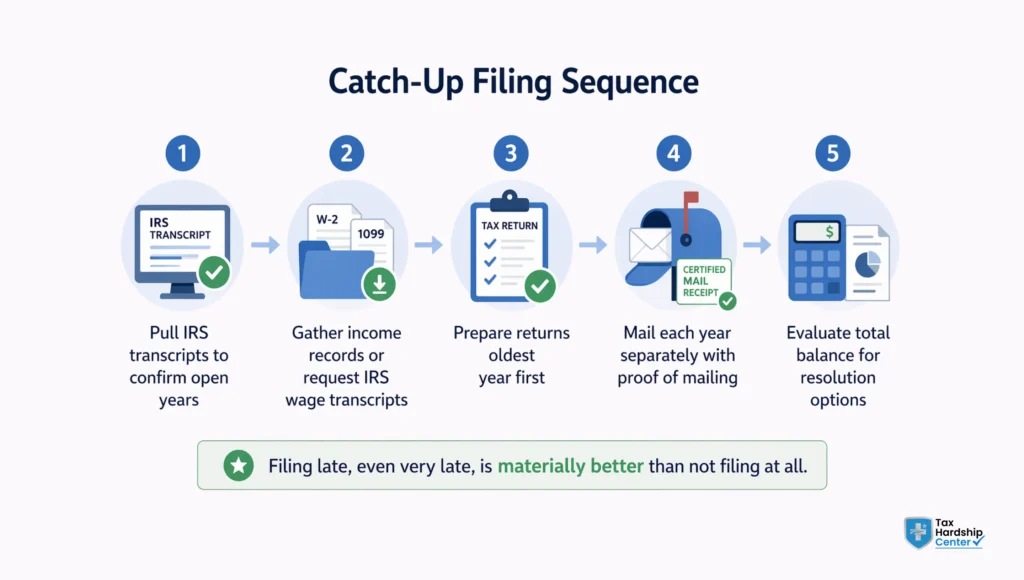
Step 1: Pull your IRS transcript to confirm which years show no return filed. You can request transcripts through the IRS online account portal or by calling 1-800-908-9946.
Step 2: Gather documents for the oldest unfiled year and prepare that return first.
Step 3: Work forward one year at a time. Do not skip years.
Step 4: Mail each return separately. Late returns cannot be e-filed using standard software for tax years more than 2 years old. They must be mailed to the IRS service center for your region, with each year in its own envelope.
Step 5: Keep copies and proof of mailing for every return you send.
What to Do When You Cannot Find Records
Missing records are not grounds for delaying filing. They are a problem to solve.
The IRS keeps wage and income transcripts for at least ten years. A Wage and Income Transcript (also called a W-2/1099 transcript) pulls all income reported to the IRS under your Social Security number for a given year. This includes W-2s, 1099s, 1098s, and most other third-party documents. You can request these through your IRS online account or by submitting Form 4506-T.
For self-employment income without 1099s, you need to reconstruct from bank records, invoices, and payment platform statements. PayPal, Venmo for Business, Stripe, and similar platforms retain transaction histories.
For deductions you cannot document, do not claim them. Filing a return with estimated deductions you cannot support creates audit exposure. A smaller refund or a larger bill based on provable numbers is better than a fabricated return.
What Happens After You File: Penalties, Interest, and Relief Options
Filing without paying does not make the problem worse. It makes it better.
The failure-to-file penalty is ten times the size of the failure-to-pay penalty. Getting your returns in stops the larger penalty from accruing further. Once your returns are filed, you know exactly what you owe. From there, several options exist.
First-time penalty abatement: If you have a clean compliance history for the three years prior to the year you are requesting abatement for, the IRS will often waive the failure-to-file and failure-to-pay penalties for that year. This is one of the most underused relief tools available and does not require hardship documentation.
Reasonable cause abatement: If a specific event, illness, or circumstance prevented you from filing, you can request penalty relief based on reasonable cause. This requires documentation and a written explanation.
Installment agreements: Once all returns are filed and your total balance is calculated, the IRS will allow you to pay over time. Streamlined installment agreements are available for balances under $50,000 and do not require detailed financial disclosure.
Offer in Compromise: If your total liability genuinely exceeds your ability to pay based on income and assets, an OIC allows you to settle for less than the full amount. Not everyone qualifies. The IRS accepts roughly 40 percent of OIC applications. A professional can evaluate whether your numbers actually support an offer before you spend time preparing one.
When DIY Stops Being the Right Call
Filing one or two late returns with straightforward W-2 income is manageable on your own using prior-year tax software.
Five years of back taxes get complicated faster than most people expect. Self-employment income, carry-forward items, missing records, IRS SFRs already filed for some years, and an existing balance that has grown with penalties and interest all add layers that increase the risk of errors. An error on a back-tax return can trigger an audit, delay resolution, or produce an incorrect liability that takes months to correct.
The line is roughly this: if your situation involves self-employment, business income, multiple income sources, SFRs already in place, or a total balance above $10,000, professional representation is the cost-effective choice. The fee for a resolution firm is almost always less than the cost of an error, a missed abatement opportunity, or a resolution option you did not know to pursue.
How the Tax Hardship Center Can Help
If you have five or more years of unfiled returns, Tax Hardship Center works through the full process with you: pulling transcripts to confirm which years are open, gathering income records through IRS requests where yours are missing, preparing and filing each return in the correct sequence, and then evaluating your total balance for every available resolution option.
That last step matters. Most people who spend months filing their own back returns arrive at a total they do not know how to negotiate. THC handles both sides: the compliance catch-up and the subsequent resolution strategy.
THC works with back tax situations across all 50 states, including self-employed filers, gig workers, and small business owners with payroll tax issues. A free case review will tell you exactly where you stand, which years are actually required, and what resolution options your numbers support.
Get a free case review at Tax Hardship Center.
FAQ
Can I file 5 years of back taxes all at once?
Yes, you can file multiple years together without any issue. Just make sure they are prepared in order and sent separately so everything calculates correctly.
Can you get in trouble for not filing taxes for 5 years?
Yes, but most cases lead to penalties and interest rather than criminal action. Filing sooner always puts you in a stronger, more manageable position.
What is the IRS’s 6-year rule for unfiled taxes?
The IRS generally expects the last six years of returns to be filed to consider you compliant. It is a practical benchmark that most professionals follow.
Will the IRS forgive unpaid taxes from past years?
Not automatically, but there are ways to reduce the burden. Options like penalty relief, payment plans, or settlements can help you move forward.
What is the 3-year rule on tax refunds?
You have three years to claim a refund from the original due date. After that, the refund is no longer available.
How does the IRS catch people who don’t file taxes?
Income is reported directly to the IRS through forms like W-2s and 1099s. If a return is missing, it gets flagged, and the IRS takes follow-up action.
What documents do I need to file 5 years of back taxes?
You will need income records like W-2s and 1099s, along with any deduction documents. If something is missing, IRS transcripts can help you fill the gaps.
Conclusion
Falling behind on taxes for several years can feel like something that keeps growing in the background, getting harder to face with time. But the reality is much simpler than it seems from a distance. It is not about solving everything at once. It is about starting, one year at a time.
The process has a rhythm. When you follow the right order and focus on what is in front of you, the situation begins to shift. What once felt uncertain becomes clearer with each return you complete. The numbers stop being assumptions and turn into something you can actually work with.
There is a quiet relief in moving forward. Not because everything is instantly fixed, but because you are no longer stuck. Each step builds momentum, and that momentum is what brings the situation back under control.
You do not need to have it all figured out today. You just need to take the first step and let the process unfold from there.
Key Takeaways
- Five years of unfiled tax returns may feel overwhelming, but it is a structured and solvable process once you begin.
- Filing is always better than avoiding it, as penalties for not filing are significantly higher than for filing late.
- The IRS generally expects the last six years of returns to bring you back into compliance.
- Always file in chronological order, starting with the oldest year, to ensure accurate calculations and carry-forwards.
- Missing records are not a dead end; IRS transcripts can help you recover most of the required income data.
- Filing stops the larger failure-to-file penalties from growing and gives you clarity on your actual liability.
- Refunds expire after three years, so filing older returns promptly can prevent you from losing money that is rightfully yours.
- Resolution options such as installment plans, penalty relief, or settlements only become available after all returns are filed.
- Complex situations involving self-employment, multiple years, or large balances are often better handled with professional help.
- The biggest mistake is waiting longer; starting the process is what makes the situation manageable.