

If your taxes are three years late, you are not the only one sitting with a pile of unopened envelopes telling yourself you’ll handle it soon. A lot of people land here, a difficult year, an income change, a situation that felt too complicated to deal with, and then another year passed on top of it.
The problem is that the IRS does not stop the clock while you wait. Penalties accumulate. Refunds expire. Enforcement options open up. And the longer the gap between where you are and where you need to be, the more complicated it gets to sort out.
This article explains exactly what happens when taxes are three years late, what you can still recover, and what the realistic steps forward look like.

What the IRS Does When You Don’t File
The IRS does not immediately send agents to your door when you miss a filing deadline. What it does instead is build a paper trail, and it does it quietly.
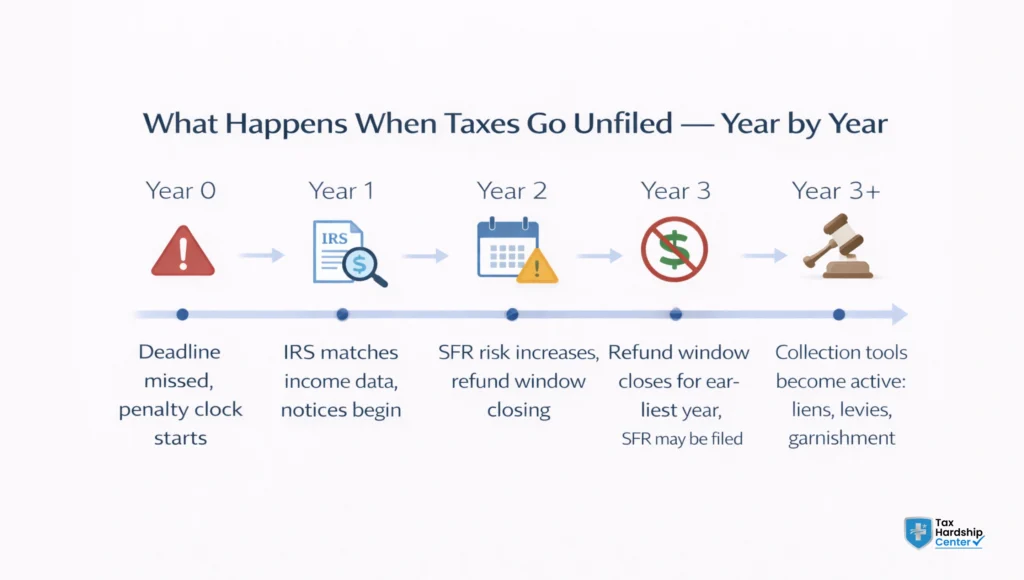
First, the IRS matches income information it already has, W-2s, 1099s, and bank interest statements, against whether a return was filed. When you go three years without filing, the IRS has typically received several years of that income data from your employers and financial institutions.
At some point, it may file what is called a Substitute for Return (SFR) on your behalf. An SFR is not filed in your favor. The IRS uses only the income information it has and applies the standard deduction, nothing more. No deductions you would have legitimately claimed, no credits, no adjustments. The resulting balance is usually higher than what you would have actually owed.
Once an SFR is filed, the IRS issues a notice, typically a CP2000 or a formal notice of deficiency, and starts the collections clock. That is when levy notices, wage garnishment exposure, and tax liens become real possibilities. If you have already received a collections notice, you can learn more about what happens next in this guide on CP504 IRS Notice: Final Warning Before Levy, Immediate Actions To Prevent Enforcement.
The point: three years of inaction is not neutral. The IRS has been moving forward without you.
The 3-Year Refund Deadline You Cannot Get Back
This is the part most people do not know about until it is too late.
If you are owed a refund for a tax year, the IRS only allows you to claim it within three years of the original filing deadline. After that window closes, the money is gone. You cannot appeal it. There is no exception for not knowing the rule.
For a 2021 tax return (original deadline April 18, 2022), the refund claim deadline is April 18, 2025. If you are reading this and that year is still unfiled, time is short.
This matters even more for people with low to moderate incomes who may qualify for the Earned Income Tax Credit (EITC). If you had qualifying children and income under the EITC thresholds in a given year, the potential refund for a single year can exceed $6,000. That money expires within the three-year window.
File the return even if you are unsure whether you will get anything back. The cost of finding out is far lower than the cost of assuming you owed and walking away from a refund. You can check whether you qualify for the EITC using the IRS EITC Assistant tool on the official IRS website.
What Penalties Actually Look Like After 3 Years
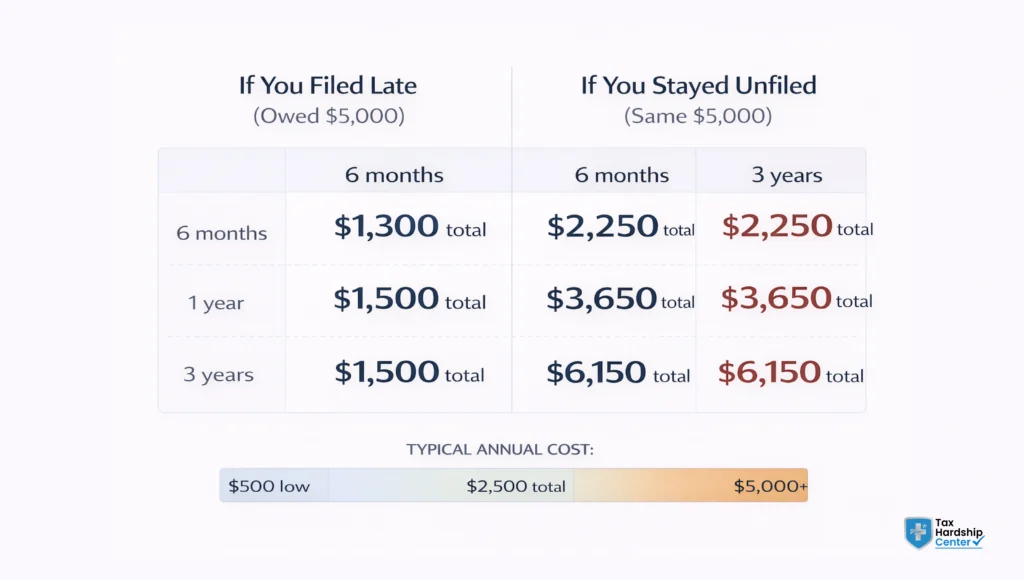
Two penalties apply when a return is late, and taxes are owed. Understanding both helps you know what you are actually facing.
Failure-to-File Penalty: This is 5% of the unpaid tax per month, capped at 25% of the total unpaid balance. If you owed $5,000 and went five months without filing, the penalty alone would reach $1,250 before interest.
Failure-to-Pay Penalty: 0.5% of the unpaid tax per month, capped at 25%. It runs separately from the filing penalty.
When both apply at the same time, the IRS caps the combined rate at 5% per month. But after the filing penalty reaches its 25% cap (at five months), the failure-to-pay penalty continues to accrue on its own.
Interest accrues on both penalties, calculated at the federal short-term rate plus 3%. As of 2026, that rate is meaningful. On a $10,000 balance carried for three years, interest alone adds several hundred to over $1,000, depending on the interest rate.
The honest picture: if you owed money and have been unfiled for three years, the balance you face today is likely meaningfully larger than the original tax owed. But the penalties are negotiable in ways the original tax is not. Penalty abatement, including first-time penalty abatement, is a real option for many people who get current and make their case properly. Learn more about how Penalty Abatement works and whether you may qualify.
What the IRS Can Do If You Stay Unfiled

Filing late, even years late, gives you options. Staying unfiled takes options away.
An unfiled return is treated differently from a filed return with a balance. The IRS can file an SFR and assess a tax, and once assessed, it has ten years to collect. That collection period includes:
- Tax liens filed against your property and credit
- Wage garnishment (the IRS can take a significant portion of each paycheck without a court order)
- Bank levies (the IRS can freeze and seize your bank account)
- Passport revocation for balances that reach the “seriously delinquent” threshold of $62,000 or more as of 2026
None of these actions is automatic or immediate. There are notice sequences and response windows before enforcement begins. But they are real, and the path to each one gets shorter the longer the situation sits.
The IRS is not in a hurry, but it is not forgetting either.
Can You Still File Taxes from 3 Years Ago?
Yes. The IRS accepts late returns going back many years. There is no filing deadline on the back end, only on the refund claim side.
What You Need to File a Prior-Year Return
- The correct tax forms for that year (prior-year forms are available at IRS.gov)
- All income documentation W-2s, 1099s, self-employment records
- Records of deductions and credits you are entitled to claim
- A mailing address, since prior-year returns cannot be e-filed through standard consumer software for years more than two years old
If you are missing income documents, the IRS has a process for requesting wage and income transcripts through Form 4506-T. These pull the records the IRS already has from your employers and financial institutions and can substitute for missing paperwork in many cases.
You cannot fix what you do not file. Filing late, even imperfectly, is almost always the right first move. If you are weighing whether to handle this yourself or bring in professional help, this breakdown on Tax Help For Back Taxes: When You Can DIY And When To Call A Professional walks through exactly that decision.
Your Real Options for Getting Current
Once you have a clearer picture of what you owe across multiple years, the resolution path depends on how much is owed and what your current income and assets look like.
Installment Agreement
If you owe $50,000 or less in combined tax, penalties, and interest, you may qualify for a streamlined installment agreement that does not require full financial disclosure. Monthly payments are set based on what you owe divided by 72 months. You can apply online through the IRS Online Payment Agreement tool.
Currently Not Collectible (CNC) Status
If your income genuinely does not cover basic living expenses, you can request that the IRS classify your account as CNC. Collections pause. The debt does not go away, but the IRS stops active enforcement while your situation is documented.
Offer in Compromise (OIC)
This is the program most people have heard advertised as “settle your taxes for less than you owe.” It is real, but qualifying is narrower than the ads suggest. The IRS accepts an OIC when the amount offered represents the most it can realistically collect from you, given your income, assets, and expenses. The IRS OIC Pre-Qualifier tool at irs.treasury.gov gives you a rough sense of whether you might qualify before you invest time in a formal application.
Penalty Abatement
First-time penalty abatement is available to taxpayers who have a clean compliance history for the three years prior to the penalty year. It applies to failure-to-file, failure-to-pay, and failure-to-deposit penalties. If your prior compliance was solid and one period went sideways, this is worth pursuing formally.
The path that fits your situation depends on the specifics of how many years are unfiled, what the income picture looks like across those years, whether an SFR has already been filed, and whether collections are active. There is no one-size answer, and anyone who gives you one without reviewing your actual situation is guessing. You can also explore whether a broader program like the Fresh Start initiative might apply to your case by reading Is The IRS Fresh Start Program Right For You? How Tax Hardship Center Evaluates Cases.
How the Tax Hardship Center Helps With Unfiled Returns
Tax Hardship Center works with individuals and small business owners who have unfiled returns, IRS balances, and active enforcement situations. The work starts with getting the complete picture: pulling transcripts, identifying what years need to be filed, understanding what the IRS already has on record, and building a compliance and resolution strategy that reflects your actual numbers.
For clients with multiple unfiled years, that means filing returns in the right sequence, managing how assessments land, and pursuing whatever resolution program the actual numbers support, whether that is an installment agreement, an OIC, CNC status, or penalty abatement. Find out more about how the Tax Hardship Center handles Unfiled Tax Returns for clients across all 50 states.
The firm does not promise specific outcomes. The IRS controls the final decision on every resolution program. What THC provides is representation, preparation, and honest qualification guidance before you pay for a path that may not fit your situation.
If you have unfiled returns and want to understand where you actually stand, a free case review is a reasonable starting point. No pressure, no promises you cannot count on.
FAQ
What happens if I file my taxes 3 years late?
If you owe taxes, penalties have likely already added up and increased your balance. If you were due a refund, you may have lost the ability to claim it, and the IRS might have already filed a higher estimated return on your behalf.
Can you file taxes 3 years late?
Yes, you can file at any time; there is no strict cutoff for submitting returns. The three-year limit only applies to claiming refunds, not to filing itself.
What is the penalty for filing taxes 3 years late?
Penalties can accrue quickly, starting at 5 percent per month for failure to file and 0.5 percent per month for failure to pay. Over time, these stack up and increase the total amount you owe.
What is the IRS 3-year rule on taxes?
It simply means you have three years from the original deadline to claim a refund. After that window closes, the refund is no longer available.
How many years can the IRS come after you for back taxes?
Once your tax is officially assessed, the IRS has up to ten years to collect it. During this time, they can use different methods to recover the amount owed.
Can the IRS put me in jail for not filing for 3 years?
In most cases, no. The IRS usually focuses on penalties and collections, and jail is only considered in rare cases involving intentional and serious misconduct.
What if I can’t afford to pay what I owe from 3 years of unfiled returns?
Start by filing your returns, even if payment is not possible right away. Once your balance is clear, you can explore options like payment plans or temporary relief based on your situation.
Is there any IRS forgiveness for back taxes from unfiled years?
There is no simple forgiveness, but there are structured options that can reduce or manage what you owe. These depend on your financial situation and whether you meet the eligibility criteria.
Conclusion
Falling behind on taxes for three years can feel heavy, but it is not the end of the road. What matters most is not how long it has been, but what you choose to do next. The situation becomes clearer the moment you take the first step and start filing.
Yes, penalties grow, and some opportunities like refunds may close, but there are still real paths forward. The IRS offers structured ways to resolve what you owe once you engage with it properly.
Progress begins with clarity. When you understand your actual numbers, the problem stops feeling overwhelming and starts becoming something you can handle step by step. Whether that means setting up a payment plan, requesting relief, or simply getting current, each action moves you closer to stability.
You do not need a perfect plan to begin. You just need to begin.
Key Takeaways
- The IRS does not pause enforcement just because you have not filed; it continues building records using your income data.
- After three years, you permanently lose the right to claim any refund from that tax year.
- IRS Substitute for Return (SFR) filings often result in higher tax bills because they exclude deductions and credits.
- Failure-to-file penalties can reach up to 25% of your unpaid taxes, with additional penalties and interest further increasing the total.
- Interest continues to accumulate on both the original tax and penalties, making the total debt significantly larger over time.
- Staying unfiled increases the risk of serious enforcement actions, such as wage garnishment, bank levies, and tax liens.
- The IRS generally has up to 10 years to collect taxes once they are officially assessed.
- Filing late is always better than not filing, as it opens up resolution options and stops further escalation.
- You can still file taxes from previous years, even beyond three years, but refunds may no longer be available.
- Options like installment agreements, Offer in Compromise, Currently Not Collectible status, and penalty abatement can help manage or reduce the burden.
- Starting the process is the most important step; clarity on your actual numbers makes the problem manageable.
Tax Hardship Center helps individuals and small businesses resolve IRS and state tax debt. For a free case review, visit taxhardshipcenter.com/contact.