
You haven’t filed taxes in three years. Maybe you moved, switched jobs, dealt with a health crisis, or just avoided it because you didn’t have the money to pay what you owed. Now you’re ready to catch up, and you’re hoping you can just file everything online like a normal tax return.
Here’s what most people don’t realize: the IRS only allows e-filing for the current and prior tax years. If you’re trying to file 2023, 2022, or earlier in 2026, e-filing through commercial tax software is closed. You’ll need to file by mail or use a workaround.
This guide explains which tax years you can still e-file in 2026, what to do when e-filing isn’t available, and the fastest way to get multiple years of back taxes filed without waiting months for the IRS to process paper returns.
Can I Still File Old Taxes Online?
Yes and no. It depends on the tax year.
The IRS allows e-filing for the current tax year and one prior year. Once a tax year is more than one year old, the IRS closes e-filing for that year. You can still file the return, but you have to mail it.
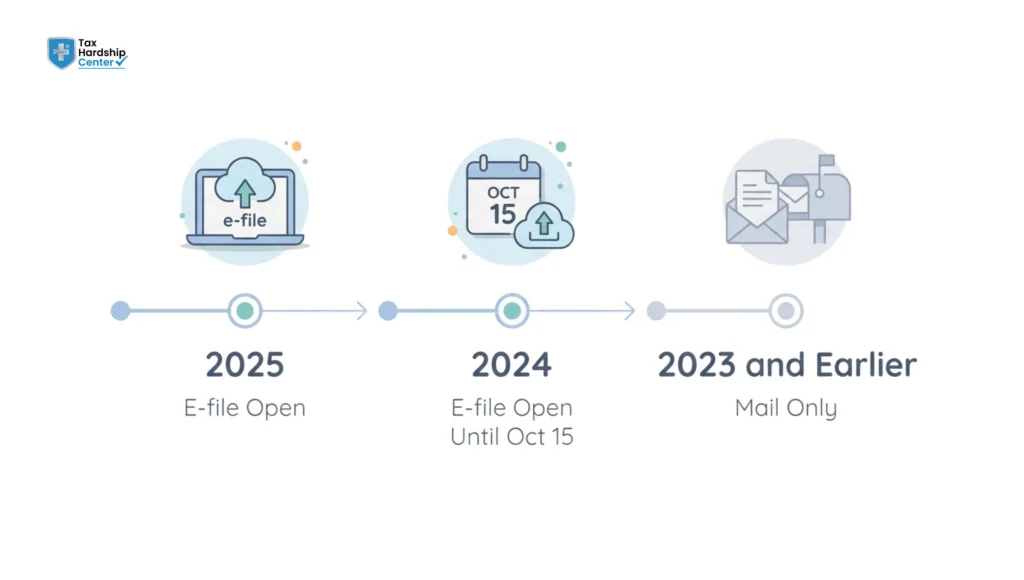
Here’s the 2026 e-filing window:
- 2025 tax year: E-filing is open. You can file online through any major tax software (TurboTax, H&R Block, FreeTaxUSA, TaxAct) or through a tax professional.
- 2024 tax year: E-filing is open until October 15, 2026 (the extended deadline). After that, you’ll need to mail the return.
- 2023 and earlier: E-filing is closed. You must print and mail your return to the IRS.
If you’re trying to file for 2023, 2022, 2021, or earlier, you’ll prepare the return using tax software or by hand, then print, sign, and mail it to the IRS address for your state. The IRS no longer accepts e-filed returns for those years.

How Many Years Back Can I File Taxes?
There’s no legal limit on how far back you can file. The IRS will accept returns from any year you didn’t file, even if it’s been 10 or 15 years.
However, there’s a practical limit for refunds. If you’re owed a refund, you have three years from the original due date to claim it. After three years, the refund is gone. You can still file the return to comply with IRS requirements, but you won’t get a refund.
Example: The deadline to file your 2021 tax return was April 15, 2022. You have until April 15, 2025, to claim your 2021 refund. If you file after April 15, 2025, the IRS will accept the return but keep the refund.
If you owe taxes, there’s no time limit. The IRS wants those returns filed regardless of how old they are. The longer you wait, the more IRS penalties and interest accumulate.
What Happens If You File Taxes Late?
If you owe taxes and you file late, the IRS charges two main penalties:
- Failure-to-file penalty: 5% of the unpaid tax for each month or part of a month the return is late, up to 25%. If your return is more than 60 days late, the minimum penalty is $485 or 100% of the tax owed, whichever is less.
- Failure-to-pay penalty: 0.5% of the unpaid tax for each month or part of a month the tax remains unpaid, up to 25%.
Interest accrues on top of the penalties. The IRS charges interest on unpaid tax from the due date until you pay in full. According to the IRS official penalty guidance, the interest rate changes quarterly and was around 8% annually as of 2026.
If you’re owed a refund and you file late, there’s no penalty. The IRS doesn’t penalize you for filing late if you owe them money. But if you wait longer than three years from the original due date, you lose the refund.
How to File Back Taxes Online When E-Filing Is Closed
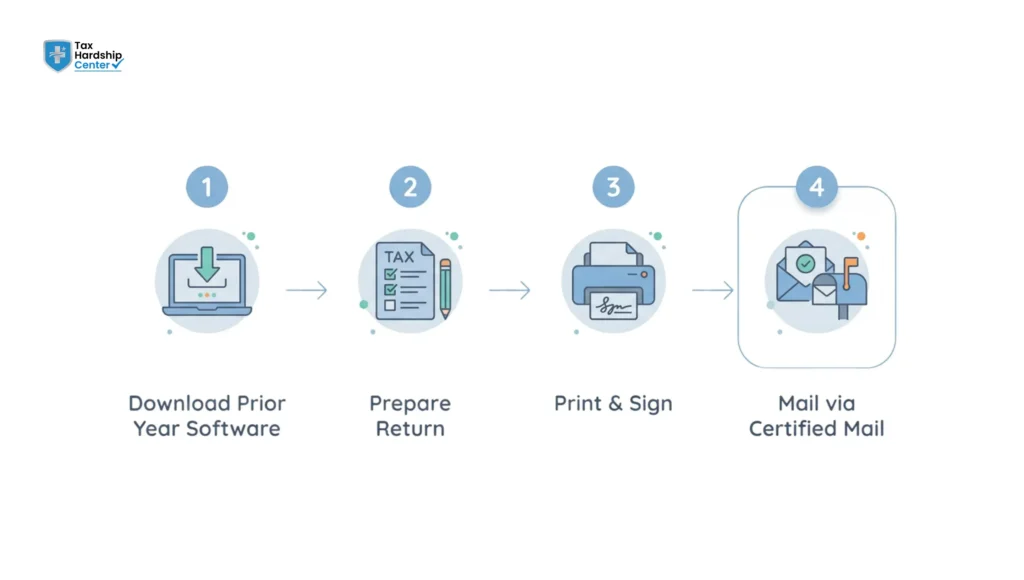
You can’t e-file tax years older than the prior year, but you can still use tax software to prepare the return. Here’s the process:
Step 1: Use Prior Year Tax Software
Most major tax software platforms offer prior-year versions of their software. You download the version for the tax year you need to file, enter your information, and the software calculates your return.
- FreeTaxUSA offers prior year filing for $17.99 per federal return. You can file back to 2016.
- TurboTax offers prior-year software for purchase. Pricing varies by version. Expect to pay $40 to $120 per year, depending on complexity.
- H&R Block offers prior-year filing online and through its desktop software.
- TaxAct offers prior year filing starting at around $25 per federal return.
The software walks you through the same questions as a current-year return, applying the tax laws, credits, and deductions in effect for that year. Once you finish, it generates a completed return.
Step 2: Print and Mail Your Return
After the software completes your return, you print, sign, and mail it to the IRS. Each tax year has a different mailing address depending on your state and whether you’re including a payment. The IRS publishes mailing addresses on IRS.gov.
Include any W-2s, 1099s, or other required forms. Attach them to the front of your return. Keep copies of everything you mail.
Step 3: Track Your Return
The IRS doesn’t provide tracking for mailed returns the same way they do for e-filed returns. Mail your return via certified mail with a return receipt. This gives you proof the IRS received it. The IRS can take 6 to 12 months to process a mailed back tax return, especially if you’re filing multiple years at once.
Can I File Multiple Years of Back Taxes at Once?
Yes. You can file multiple years at the same time. Prepare each year separately, print each return, and mail them in separate envelopes. Do not staple multiple years together or mail them in the same envelope.
Each return goes to the same IRS processing center, but they’re processed individually. Mailing them separately reduces the chance of processing errors or lost returns.
File in order: oldest to newest. If you owe taxes for 2020, 2021, and 2022, file 2020 first, then 2021, then 2022. The IRS processes returns in the order you file them, and they need information from earlier years to accurately process later ones. If you’re owed refunds, filing in order ensures you don’t miss the three-year deadline for the oldest year.
Do I Need All My Documents to File Back Taxes?
You should have your W-2s, 1099s, and any other income documents for the year you’re filing. If you don’t have them, you can request copies from the IRS.
How to Get Old Tax Documents
Wage and Income Transcript: This free IRS transcript shows income reported to the IRS by your employers and payers. It includes W-2, 1099, and 1098 information. You can request it online through your IRS online account, by phone at 800-908-9946, or by mailing Form 4506-T.
Prior Year Tax Return Transcript: If you filed a return in the past but lost your copy, you can request a tax return transcript. This shows what you filed, but it doesn’t include W-2s or 1099s.
Contact Your Employer or Payer: If you still have contact information for past employers or clients, ask them for copies of your W-2s or 1099s. Some employers keep records going back several years.
What If I Can’t Pay What I Owe?
File the return anyway. The longer you wait, the more penalties and interest you owe. Filing stops the failure-to-file penalty, which is five times higher than the failure-to-pay penalty.
Once you file, you have options:
- Installment agreement: The IRS will set up a payment plan. You pay monthly over time. If you owe less than $50,000, you can apply online through the IRS payment plan tool.
- Offer in Compromise: If you can’t afford to pay the full amount, the IRS might accept a lower settlement. You submit an offer based on your income, expenses, and assets. Explore your IRS Offer in Compromise options if your financial situation is genuinely difficult.
- Currently Not Collectible status: If your income barely covers necessary living expenses, the IRS can temporarily pause collections. You submit Form 433-F showing your income and expenses. If approved, the IRS stops enforcement until your situation improves.
Don’t let the inability to pay stop you from filing. Filing protects you from worse penalties and keeps your options open for relief.
Will the IRS Come After Me If I Haven’t Filed in Years?
Yes, eventually. The IRS doesn’t forget about unfiled returns. If you have income reported to them (W-2s, 1099s, Social Security, pensions), they know you should have filed.
The IRS can file a Substitute for Return (SFR) on your behalf. They use the income reported to them, but don’t include deductions or credits you’re entitled to; the result is usually a much higher tax bill than if you had filed yourself.
Once the IRS files an SFR, it begins collection actions, such as bank levies, wage garnishment, or liens on your property. Filing voluntarily before the IRS acts gives you control. You claim all the deductions you’re entitled to, avoid the inflated SFR tax bill, and can request penalty relief or a payment plan on your terms.
Can I Get Penalty Relief for Filing Late?
Yes, in some cases. The IRS offers penalty relief under two main programs:
First-Time Penalty Abatement (FTA): If you have a clean filing history for the past three years, the IRS will remove failure-to-file and failure-to-pay penalties for one tax year. You don’t need a reason — you just need to have filed and paid on time for the prior three years.
Reasonable Cause Relief: If you couldn’t file on time due to circumstances beyond your control, such as serious illness, death in the family, natural disaster, or missing records, the IRS may remove penalties. You submit a written statement explaining what happened with supporting documentation.
You request penalty relief after you file and receive your bill from the IRS. You can call the IRS, write a letter, or submit Form 843 (Claim for Refund and Request for Abatement).
How Tax Hardship Center Helps When Years of Unfiled Returns Are Stacking Up
When you’re behind on multiple years of unfiled returns and e-filing windows have closed, the process gets complicated fast, with missing documents, conflicting years, IRS substitute returns already filed, and penalties growing every month. That’s the exact situation the Tax Hardship Center is built to handle.
Tax Hardship Center prepares prior year returns going back 10+ years, coordinates Wage and Income Transcript requests directly with the IRS when original W-2s and 1099s are unavailable, and files returns by certified mail with tracking to confirm IRS receipt. For clients who owe after filing, the firm structures IRS installment agreements based on real monthly cash flow, not just what the IRS initially demands.
For taxpayers who genuinely can’t pay the full amount, Tax Hardship Center submits Offer in Compromise applications, requests Currently Not Collectible status when living expenses exceed income, and pursues penalty abatement for clients who missed filings due to illness, family crises, or lost records. The firm also removes IRS Substitute for Returns filed on incomplete information, handles levy threats during the filing process, and manages audit responses when late-filed returns trigger examination. If you’re ready to get compliant, contact the Tax Hardship Center to start the process.
FAQs
Can I still file old taxes online?
You can prepare old taxes using tax software, but you can’t e-file them if they’re older than the prior year. In 2026, you can e-file 2025 and 2024 returns. For 2023 and earlier, you prepare the return with software, print it, and mail it to the IRS.
How many years back can I electronically file taxes?
You can e-file for the current and prior years. For 2026, that means 2025 and 2024 returns can be e-filed until October 15, 2026. Tax years 2023 and earlier cannot be e-filed at all they must be mailed.
Can I file 4 years of back taxes?
Yes. You can file back taxes for any year you missed, no matter how old. Prepare each year separately and mail each return in its own envelope. File them in order from oldest to newest, and the IRS will process them individually.
What happens if I submit my tax return late?
If you owe taxes, the IRS charges a failure-to-file penalty (5% per month, up to 25%) and a failure-to-pay penalty (0.5% per month, up to 25%), plus interest. If you’re owed a refund, there’s no penalty for filing late but you lose the refund if you wait more than three years from the original due date.
Can I file my old taxes electronically?
Only if they’re from the current year or prior year. In 2026, you can e-file 2025 and 2024 returns. Tax years 2023 and earlier must be mailed. You can still use tax software to prepare them, but you print and mail the completed return instead of filing electronically.
Will I get into trouble for not filing 4 years of back taxes?
Not if you file voluntarily. The IRS will work with you on payment plans and penalty relief once you’re compliant. If you don’t file and the IRS files a Substitute for Return for you, you’ll face higher tax bills, aggressive enforcement, and fewer relief options.
How far back can I electronically file a tax return?
E-filing is limited to the current tax year and the prior year. Once a tax year is more than one year old, e-filing closes. You can still file by mail for any prior year, but electronic submission is no longer available through the IRS or commercial tax software.
Conclusion
You can file back taxes for any year you missed, but e-filing is only available for the current year and the prior year. In 2026, that means 2025 and 2024 returns can be e-filed. For 2023 and earlier, you prepare the return using prior year tax software and mail it to the IRS.
Filing late triggers penalties if you owe taxes, but filing voluntarily is always better than waiting for the IRS to act. Once you file, you can request penalty relief, set up a payment plan, or apply for an Offer in Compromise if you can’t afford the full amount.
If you’re missing documents, request a Wage and Income Transcript from the IRS, which shows all income reported to them for a given year. File returns in chronological order, mail each year in a separate envelope via certified mail, and keep proof of delivery. The IRS takes 6 to 12 months to process mailed returns, but filing stops the failure-to-file penalty and sets you on the path back to compliance.
Key Takeaways
- E-filing is only available for the current tax year and prior year in 2026, that’s 2025 and 2024 returns; everything older must be mailed
- You can file back taxes for any year you missed, with no cap on how far back you can go
- Refunds are only claimable for three years from the original due date; after that, the IRS keeps the money
- Use prior year tax software to prepare old returns, then print and mail via certified mail to the correct IRS address for your state
- Filing late triggers a 5% per month failure-to-file penalty if you owe always better to file than to wait for the IRS to act
- The IRS can file a Substitute for Return on your behalf, which typically results in a much higher, deduction-stripped tax bill
- If you can’t pay what you owe, file installment agreements anyway. Offer in Compromise, and Currently Not Collectible status are all available after filing
- Missing W-2s and 1099s can be replaced with a free Wage and Income Transcript requested through IRS.gov or Form 4506-T
- Mail each tax year in a separate envelope, filing oldest to newest. Never combine multiple years in one package
- Penalty abatement is available for first-time filers with a clean history or those with a documented reasonable cause for late filing