

You were expecting a refund. Then a letter arrived from the IRS saying they had made changes to your return.
Confusing? Yes. Something to panic about? Not necessarily.
A CP21B notice is actually one of the better letters the IRS sends. It means a change was made to your return, and your refund is increasing as a result. But there are still things you need to understand before you assume everything is fine and move on.
Here is the full breakdown.
Table of Contents
- What Is a CP21B Notice?
- Why Did You Get One?
- What the Notice Actually Tells You
- How Long Until You Get Your Refund?
- What to Do If You Agree With the Changes
- What to Do If You Disagree
- What If Your Refund Never Arrives?
- When a CP21B Is a Sign of a Bigger Issue
- How the Tax Hardship Center Helps When IRS Notices Get Complicated
- Conclusion
- FAQs
- Key Takeaways
What Is a CP21B Notice?

A CP21B is a notice from the IRS confirming that changes were made to your Form 1040 and that those changes resulted in an increased refund for you.
In plain terms, the IRS processed a correction to your return, and now you are owed more money back than your original return showed.
This is different from a notice that says you owe money. The CP21B is telling you the math moved in your favor. But that does not mean you just sit back and wait. There are steps to take and things to verify before the refund ever hits your account.
According to the IRS’s official CP21B notice page, the notice also includes any interest the IRS owes you on the adjusted refund amount, which you will need to report on your next tax return.
Why Did You Get One?
A CP21B is issued when a change to your return increases what you are owed. There are a few common reasons this happens.
You filed an amended return. If you submitted a Form 1040-X to correct something on a prior return and that correction resulted in a larger refund, the IRS sends a CP21B to confirm the updated amount.
The IRS corrected an error on your original return. Sometimes the IRS catches a calculation error or applies a credit differently than you did. If the correction works in your favor, you get a CP21B.
A credit was recalculated. Tax credits like the Earned Income Credit or the Child Tax Credit can be adjusted during IRS processing. If the recalculation increases your refund, this notice follows.
An offset was resolved. If a prior refund was held or offset against another debt and that situation was corrected, a CP21B may reflect the release of those funds.
Whatever the reason, the notice will tell you the tax year it applies to, the change that was made, and the new refund amount. Read all of it carefully.
What the Notice Actually Tells You
The CP21B notice includes a few key pieces of information worth paying attention to.
The updated refund amount. This is the new total the IRS says you are owed. It may be higher than your original refund, or it may represent a refund on a return where you originally owed money, and the correction eliminated that balance.
The interest amount. If the IRS owes you a delayed refund, they typically add interest to it. That interest is taxable income and needs to be reported on your return for the year you receive it.
A description of the change. The notice should explain what was adjusted. If it is unclear, the IRS number on the notice is the place to call for a specific explanation.
If you previously went through a CP2000 notice process and disputed a proposed change, a CP21B may be the final confirmation that your dispute was resolved in your favor.
How Long Until You Get Your Refund?
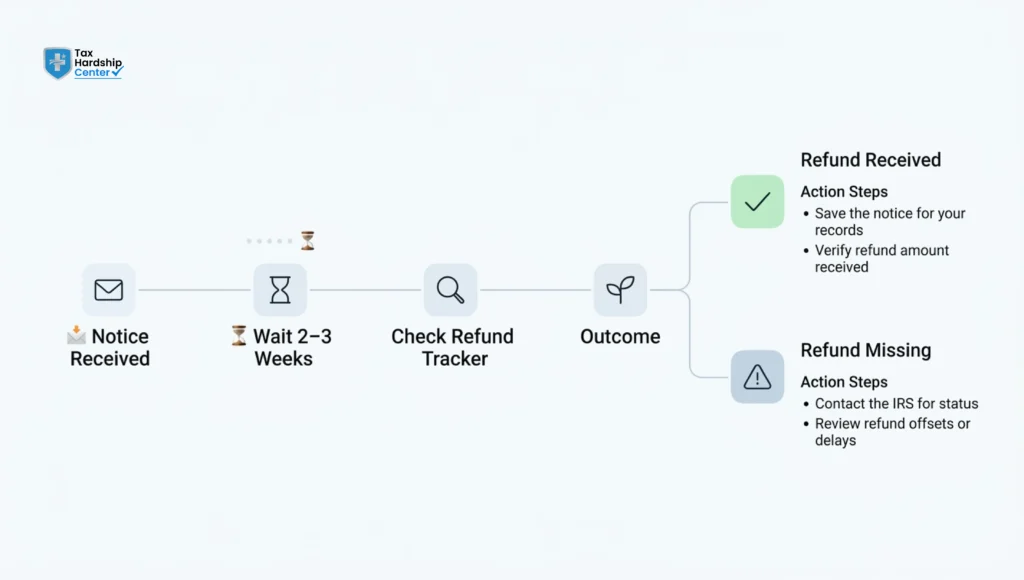
According to the IRS, most refunds after a CP21B are issued within 2 to 3 weeks of the notice date.
If you chose direct deposit on your original return, the refund typically goes to the same account. If you did not, the IRS will mail a check to the address on file.
That 2- to 3-week window is the standard. Real life sometimes runs longer. Processing volumes, verification steps, and system updates can all add time. The IRS refund tracker at IRS Where’s My Refund is the best tool to check the actual status. It updates daily and shows whether your refund has been processed and sent.
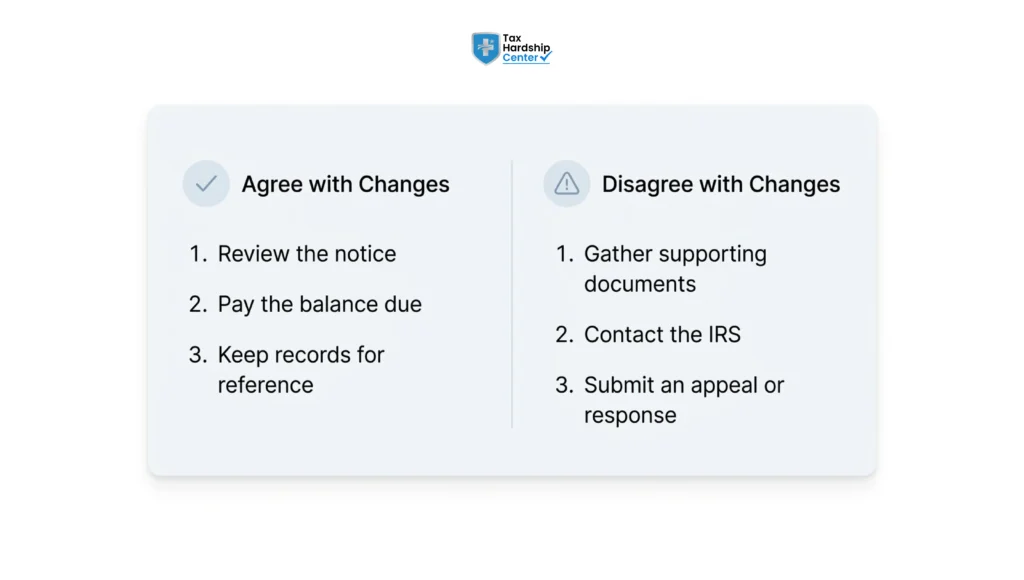
What to Do If You Agree With the Changes
If the change on your CP21B makes sense to you, whether because you filed an amended return or because the IRS correction is clearly right, you do not need to contact the IRS or send anything back.
Just wait for the refund.
A few practical things to keep in mind while you wait:
Make sure your mailing address and bank details are up to date. If you have moved since the original return was filed, the refund check could be sent to an old address. You can update your address with the IRS using Form 8822.
Note the interest amount. The CP21B will show any interest added to your refund. Write it down or save the notice. That amount gets reported as income on your next return.
Do not file another amended return based on this notice. The correction has already been made. Filing another 1040-X at this point could create confusion and delay things further.
What to Do If You Disagree
This is where people sometimes freeze up. They get a notice saying they are getting more money, and still something feels off. Maybe the amount is wrong. Maybe they do not remember requesting any change. Maybe they are worried about a scam.
All of that is worth paying attention to.
If you did not initiate any amendment and the IRS is saying a change was made, you have the right to find out exactly what happened. Call the number on the notice and ask specifically: what change was made, on what basis, and what documentation the IRS received to initiate it.
If you believe the change is incorrect or was made in error, you can dispute it. The dispute process for a CP21B involves:
Call the IRS directly with your original return and any supporting documents in hand.
Submit a written response explaining your position if the issue cannot be resolved by phone.
Requesting an account transcript to see exactly what was applied to your return and when. You can request a transcript through IRS Get Transcript.
If you think someone else filed something under your name or Social Security number, that is a potential identity theft issue and needs to be flagged to the IRS immediately using Form 14039.
What If Your Refund Never Arrives?
This is one of the most common frustrations people post about after getting a CP21B. The notice says the refund is coming. Weeks go by. Nothing.
Here is what to do:
Wait the full 2 to 3 weeks from the date of notice before taking action. The IRS is clear that this is their standard processing window, and calling before that window closes rarely speeds things up.
After 3 weeks, check the refund tracker at IRS Where’s My Refund. If the tracker shows the refund was issued, but you have not received it, a check may have been mailed to an old address, or a direct deposit may have been rejected.
If the refund was mailed and lost, you can request a payment trace by calling the IRS or submitting Form 3911.
If the refund shows as not yet processed in the tracker, the IRS may still be working on it. Give it another week before escalating.
If you are well past the window and getting nowhere through regular IRS contact, the Taxpayer Advocate Service is an independent office within the IRS that helps taxpayers facing significant delays or hardship. They can intervene on your behalf when normal channels are not moving.
When a CP21B Is a Sign of a Bigger Issue
Most of the time, a CP21B is benign. You get it, you wait for the refund, done.
But occasionally, it surfaces something worth investigating.
If the notice references an amendment you did not file, that is a red flag. Someone may have filed a fraudulent amended return using your information to redirect a refund. Respond immediately and report it as potential identity theft.
If the change is tied to an earlier IRS notice you ignored, the CP21B might be the tail end of a longer-standing issue with unresolved pieces. For example, if a CP501 or CP503 came before this and you did not respond, other balances or account adjustments may still be pending.
And if you have multiple years with unfiled returns or unresolved IRS correspondence, a single CP21B is unlikely to be the only thing the IRS has noted on your account.
How the Tax Hardship Center Helps When IRS Notices Get Complicated
A CP21B on its own is usually straightforward. But IRS notices rarely arrive in isolation, and when one notice is part of a longer pattern of IRS contact, it helps to have someone map the full picture.
Tax Hardship Center works with taxpayers who have received IRS notices and are not sure what they mean for their broader situation. Whether the CP21B is the only letter you have received or one of several piling up, the team reviews your account history, identifies what the IRS actually has on file, and advises on the right response at each step.
For situations where a CP21B is connected to an amended return, a disputed adjustment, or a missing refund that has been delayed for months, Tax Hardship Center handles the follow-up directly. That includes IRS calls, transcript requests, written responses, and payment trace submissions if a refund was issued but never received. Visit the IRS notices help page to understand how notice resolution works in practice, or get a free case review if your situation involves more than one notice or an unresolved IRS issue.
If the CP21B indicates a larger tax balance or unresolved debt, the tax relief services at Tax Hardship Center cover the full range of resolution options, from installment agreements to penalty abatement to an Offer in Compromise evaluation.
FAQs
What does CP21B mean from the IRS?
CP21B is a notice confirming that the IRS made a change to your Form 1040 that resulted in an increased refund. The change may come from an amended return you filed or a correction the IRS applied during processing.
How long after a CP21B notice will I get my refund?
The IRS typically issues the refund within 2 to 3 weeks of the notice date. You can track the status using the IRS Where’s My Refund tool at irs.gov/refunds. If it has been more than 3 weeks and the refund has not arrived, contact the IRS or request a payment trace using Form 3911.
Why did I get a CP21B notice?
Common reasons include filing an amended return that resulted in a larger refund, the IRS correcting a calculation error on your original return, or a credit being recalculated in your favor during processing.
What if I disagree with the changes on my CP21B?
Call the number on the notice and ask the IRS to explain exactly what change was made and why. If you believe it is incorrect, you can submit a written dispute with supporting documentation. Request a transcript first to see exactly what is on your account.
Do I need to report the interest on a CP21B?
Yes. Any interest the IRS adds to your refund is taxable income and needs to be reported on your return for the year you receive it. The CP21B notice will show the interest amount separately.
What if my CP21B refund never arrived?
First check the IRS refund tracker at irs.gov/refunds. If the tracker shows it was issued but you did not receive it, the check may have gone to an old address or a direct deposit may have been rejected. You can request a payment trace by calling the IRS or submitting Form 3911.
What if I never filed an amended return but got a CP21B?
If the IRS made a change you did not initiate, call the number on the notice and ask what triggered it. If you suspect someone else filed an amended return under your name, report it as potential identity theft using Form 14039 immediately.
Conclusion
A CP21B is the IRS telling you that a change was made to your return and more money is coming back to you. That is the good news version of an IRS notice.
But good news from the IRS still deserves your attention. Check that the change makes sense. Track your refund. Report the interest on your next return. And if something feels off or the refund never arrives, you have options.
Most CP21B situations resolve without any drama. The ones that do not usually involve either an unrelated dispute or a larger IRS issue that the notice surfaced. Know the difference and you will know exactly what to do.
Key Takeaways
- CP21B confirms a change was made to your Form 1040 that increased your refund
- It is not a bill and does not mean you owe anything
- Common causes include amended returns, IRS processing corrections, and credit recalculations
- The IRS typically issues the refund within 2 to 3 weeks of the notice date
- Any interest included in your refund is taxable and must be reported on your next return
- If you agree with the changes, no action is needed; just wait for the refund
- If you disagree, call the IRS immediately and request a full explanation of what changed
- If your refund does not arrive after 3 weeks, check the IRS refund tracker and consider requesting a payment trace
- A CP21B referencing an amendment you never filed is a potential identity theft flag
- If this notice is part of a longer pattern of IRS correspondence, review the full picture before assuming everything is resolved
Have an IRS notice situation that is more complicated than it looks? Get a free case review with Tax Hardship Center and find out exactly where your account stands.