

You logged into your IRS online account. Or you opened a notice. And there it was: “Your account is in jeopardy of lien or levy.”
If that phrase just stopped you cold, that reaction is completely normal. It sounds alarming. It is alarming. But what it means, and what you can actually do about it, is something most IRS notices never bother to explain clearly.
This article does exactly that.
Table of Contents
- What Does “In Jeopardy of Lien or Levy” Actually Mean?
- Lien vs. Levy: They Are Not the Same Thing
- Which IRS Notices Carry This Warning?
- What Happens If You Ignore It
- How to Respond Right Now
- How Tax Hardship Center Helps With IRS Lien and Levy Cases
- Conclusion
- FAQs
- Key Takeaways
What Does “In Jeopardy of Lien or Levy” Actually Mean?
It means the IRS has assessed a balance against your account and believes you have not taken steps to resolve it. That warning is not just noise. It is the IRS signaling that enforcement is next on its list.
At this stage, they are not saying they have already filed a lien or executed a levy. They are saying your account has reached the threshold where those actions are now on the table.
The IRS follows a process. You get balance-due notices. You get reminders. You get escalating letters. When you see the jeopardy language, you are usually well into that sequence, and the window between “warning” and “action” is getting narrow.
Lien vs. Levy: They Are Not the Same Thing
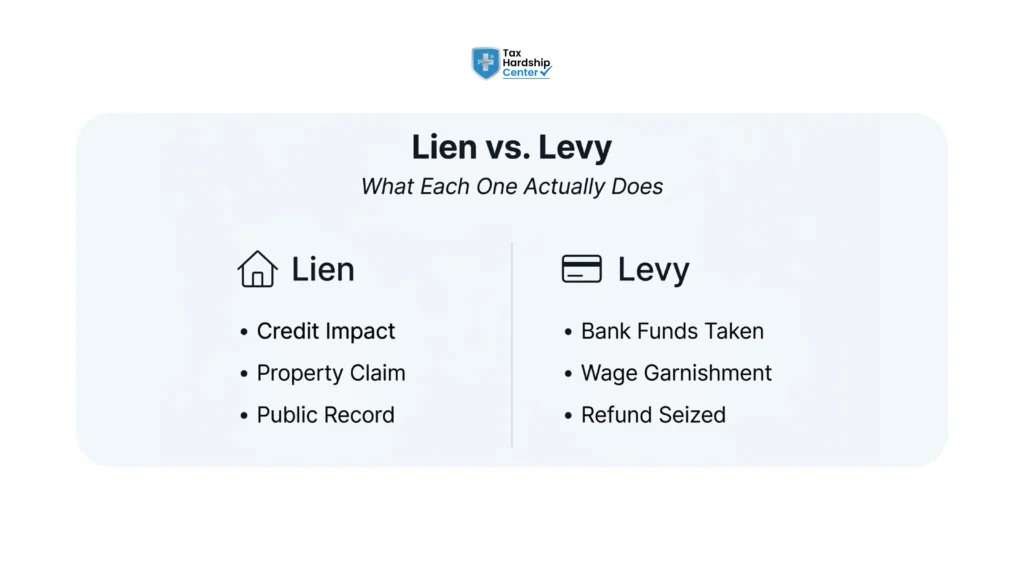
People use these words interchangeably. They should not. The difference matters a lot for what happens to you practically.
What Is a Tax Lien?
A federal tax lien is a legal claim the IRS places against your property. This includes your home, your car, your financial accounts, and any other assets you own. It does not mean the IRS has taken anything. It means they have staked a legal interest in your property.
The real-world impact is significant. A lien:
- Appears on your credit report and damages your credit score
- Attaches to property you own, making it difficult to sell or refinance
- Can affect your ability to get business financing or credit lines
- Follows you until the debt is paid or the lien is released
The IRS files a Notice of Federal Tax Lien with your county records office. Once it is there, it is public. Lenders can see it. Potential buyers of your property will see it.
What Is a Tax Levy?
A levy is different. A levy is the actual seizure of your assets. The IRS uses a levy to collect the money you owe by taking it directly.
What can the IRS levy? Practically everything:
- Your bank account (they can drain it in a single sweep)
- Your wages (a portion of every paycheck until the debt is resolved)
- Your Social Security benefits
- Your state tax refunds
- Accounts receivable if you own a business
- In serious cases, physical property including vehicles and real estate
A levy on your bank account is particularly brutal because it happens fast and without additional warning once the final notice has been issued. You log into your account, and the balance is gone or frozen. That is not a hypothetical. It happens regularly.
Which Comes First?
Typically, a lien comes before a levy. The IRS files a lien to protect its interest in your assets, then escalates to a levy to actually collect. But in jeopardy situations, where the IRS believes you are about to move assets or leave the country, they can skip the usual sequence. More on that below.
Which IRS Notices Carry This Warning?
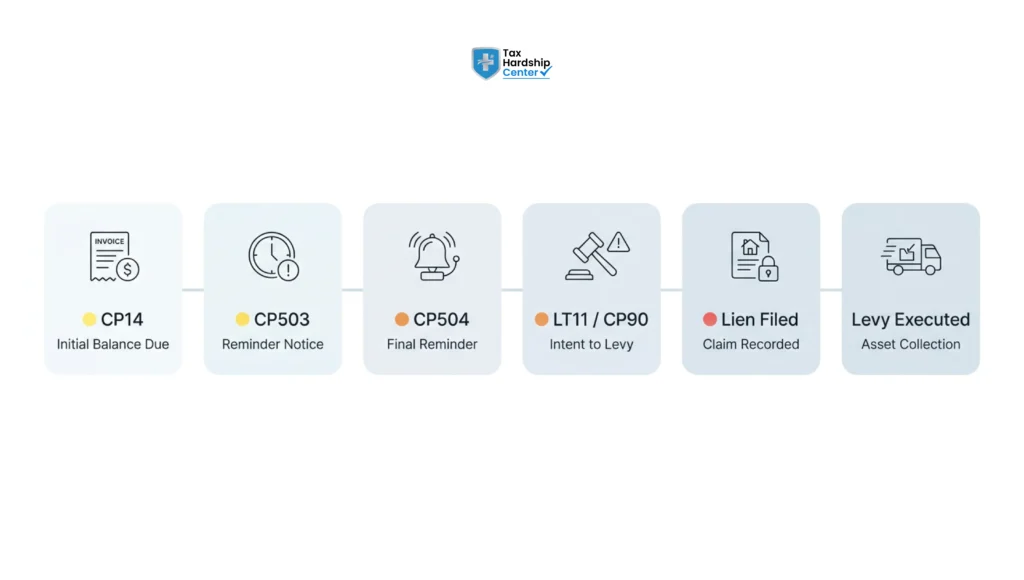
Several notices in the IRS collection sequence reference jeopardy of lien or levy. Knowing which one you are holding tells you exactly where you are in the timeline.
CP14
This is the first balance-due notice. It informs you that you owe taxes and requests payment. This is early in the sequence and, while it can reference lien or levy consequences, you still have the most options available at this stage.
CP503
A second reminder. The language gets firmer. Payment is expected. If you have received this and done nothing, the next notice will be considerably more serious.
CP504 (The One Most People Are Holding When They Search This Phrase)
The CP504 is the IRS’s notice of intent to levy your state tax refund. This is a critical notice. It is labeled a “Final Notice” for the purpose of your state refund, but it also formally warns you that lien or levy action on other assets may follow.
If you have a CP504, the IRS can already take your state tax refund without further warning. For other assets, they still need to issue a final notice and give you the right to a Collection Due Process (CDP) hearing, but that step can come quickly. You can read more about the CP504 notice and how to respond to IRS collection notices on our site.
LT11 / Letter 1058
This is the final notice of intent to levy. Once you receive this, the 30-day clock for requesting a CDP hearing via Form 12153 starts ticking. Missing that window removes one of your most powerful tools for stopping collection action.
CP90
Similar to the LT11, the CP90 is a final notice targeting specific asset types. Receipt of the CP90 triggers the same 30-day right to request a CDP hearing.
What Happens If You Ignore It
This is the part most people do not want to think about. But it is worth being direct.
If you ignore the jeopardy warning and the subsequent final notice:
The IRS will file a Notice of Federal Tax Lien. Your credit takes a hit. Refinancing your home can become complicated or even impossible. Your business credit can be affected.
Then the levy follows. Your bank account gets swept. Or your employer receives an IRS wage levy notice, which means a significant portion of every paycheck goes directly to the IRS. There is no soft landing here. The garnishment percentages the IRS uses are higher than most people expect, and they continue every pay period until the debt is resolved or a formal agreement is in place.
For self-employed individuals and business owners, the IRS can also levy accounts receivable, seize business assets, and, in serious cases, pursue personal assets for business tax debt through trust fund recovery penalties.
Waiting is not neutral. Every week of inaction narrows your options and makes resolution more expensive.
How to Respond Right Now
If your account is showing the jeopardy of lien or levy warning, here is what to prioritize immediately.
Pull your IRS transcript. Log into your IRS account at irs.gov and check your balance, the notices that have been issued, and whether a lien has already been filed. You need to know exactly where you are.
Identify which notice triggered this. The notice number matters. CP14 leaves you more room than LT11. If you have received a final notice, the 30-day window for a CDP hearing is either open or already closing.
Do not ignore the timeline. If a final notice has been issued, requesting a CDP hearing through Form 12153 temporarily stops IRS collection activity while your case is reviewed. That is a concrete, real protection. But it requires you to act within 30 days of the notice date.
Look at your resolution options. Depending on your financial situation, you may qualify for an IRS installment agreement, an Offer in Compromise, or Currently Not Collectible status, which pauses collection while you are in genuine financial hardship. Each path has different eligibility requirements, and the right one depends on your income, assets, and the total balance owed.
Get representation before the final notice window closes. Once the IRS executes a levy, stopping it requires releasing the levy, which is harder and slower than preventing it. The time to move is before the seizure, not after.
How Tax Hardship Center Helps With IRS Lien and Levy Cases
When your account is flagged for the risk of a lien or levy, speed and precision matter. The Tax Hardship Center works with individuals and small businesses who are facing active IRS collection action, not just general tax debt.
That means pulling your transcripts, identifying exactly which notices are in play, and building a response strategy before the IRS takes the next step. The firm handles CDP hearing requests, installment agreement negotiations, levy releases, and Offer in Compromise submissions for eligible clients. For cases where a levy has already hit a bank account or a wage garnishment is active, levy release and garnishment relief are handled as urgent matters rather than standard queue items.
The Tax Hardship Center is straightforward about one thing: not every case qualifies for a settlement or significant debt reduction. But every case with active collection risk can be stabilized with the right approach. If you are at the jeopardy stage, the consultation is the first step to understanding which path fits your situation before any money changes hands.
Get a free case review at Tax Hardship Center.
FAQs
What does it mean when it says your account is in jeopardy of lien or levy?
It means the IRS has an unpaid balance on your account and is warning you that it may file a legal claim against your property (lien) or seize your assets directly (levy) if the balance remains unresolved. This language typically appears on escalating collection notices like the CP504, LT11, or CP90.
Is a lien or levy worse?
A levy is worse in immediate terms because it means the IRS is actively taking your money or property. A lien is a legal claim that damages your credit and complicates property transactions, but it does not involve direct seizure. Typically, a lien comes before a levy in the IRS collection sequence.
How serious is an IRS levy?
Very serious. A bank account levy can drain your account in a single sweep. A wage levy takes a portion of every paycheck until the debt is resolved. The IRS does not need to go to court to execute a levy once a final notice has been issued and the 30-day response window has passed.
How much notice does the IRS give before a lien or levy?
The IRS is required to send multiple notices before levying most assets. For a standard levy, a final notice (LT11 or CP90) must be issued at least 30 days before enforcement. However, in jeopardy situations where the IRS believes assets are at risk of being moved, they can act more quickly.
Can you stop a levy after it starts?
Yes, but it is harder than preventing it. The IRS can release a levy if you enter into a payment agreement, prove financial hardship, or resolve the underlying balance. If the levy is on a bank account, you may be able to recover funds if you act quickly and demonstrate the levy caused immediate hardship.
How do you request a Collection Due Process hearing?
You file Form 12153, Request for a Collection Due Process or Equivalent Hearing, within 30 days of the date on your final notice (LT11 or CP90). This temporarily stops IRS collection activity while your case is reviewed. Missing this window means you lose the right to a CDP hearing, though an equivalent hearing may still be available.
What is a jeopardy levy and how is it different?
A jeopardy levy is an expedited enforcement action the IRS can take when it believes the collection of a tax is in jeopardy, typically because they think you are about to move assets or leave the country. Unlike a standard levy, it does not require the usual 30-day notice period. These situations require immediate professional intervention.
Conclusion
“Your account is in jeopardy of lien or levy” is not a scare tactic. It is a formal notification that enforcement tools are next. A lien damages your credit and attaches to your assets. A levy takes them. Both are avoidable with the right response at the right time. The window is open right now. The question is what you do with it.
Key Takeaways
- “Your account is in jeopardy of lien or levy” is a formal IRS warning that enforcement action is imminent, not a general reminder
- A lien is a legal claim against your property; a levy is the actual seizure of your assets
- A bank account levy can happen in a single transaction; a wage levy continues every pay period until it is resolved
- The CP504 is a critical notice that already authorizes the IRS to seize your state tax refund without further warning
- The LT11 and CP90 are final notices that trigger a 30-day window to request a Collection Due Process hearing
- Missing the CDP hearing deadline removes one of your strongest tools for stopping collection action
- Installment agreements, Offers in Compromise, and Currently Not Collectible status are all potential resolution paths, depending on your specific situation
- Jeopardy levies can happen without the standard 30-day notice, making a fast professional response essential
- Acting before the levy is always faster, cheaper, and less stressful than trying to reverse one after it hits
- A free case review gives you a clear picture of where you stand and what options are actually available to you