
You got a letter. The return address says IRS ACS Support. Maybe it came from Philadelphia or a similar IRS processing center. Maybe you searched the address and ended up more confused than when you started.
Here is what you need to know.
Table of Contents
- What Is IRS ACS Support?
- How Does Your Account End Up With ACS?
- What ACS Can Actually Do To You
- ACS vs. a Revenue Officer: Why the Difference Matters
- The Notice Sequence You Need to Understand
- What Is ACS Support Stop 5050?
- How to Respond When ACS Contacts You
- Why do taxpayers facing ACS choose the Tax Hardship Center
- Conclusion
- FAQs
- Key Takeaways
What Is IRS ACS Support?
ACS stands for Automated Collection System. It is the IRS’s centralized, largely automated unit that handles collection on unpaid tax balances.
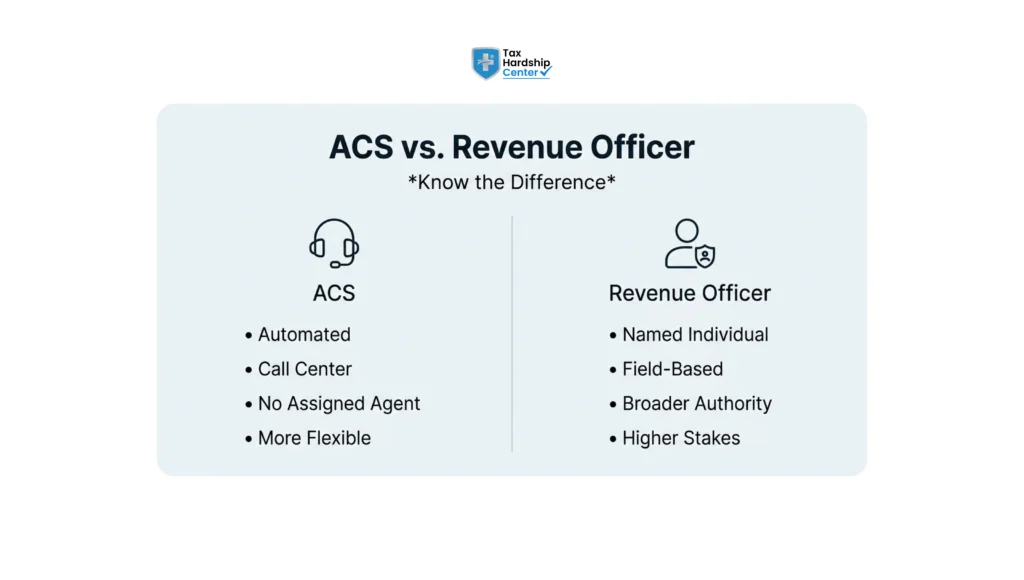
When most people imagine the IRS coming after them, they picture a specific agent knocking on their door or calling their office. That is not how ACS works. ACS is a call center and letter-processing system. There is no single assigned agent. Your case is managed through automated queues, and when you call, you may speak to a different representative every time.
The “Support” in ACS Support refers to the back-end processing function: the unit that handles the physical and clerical side of IRS collection activity, including mailing notices, processing levy requests, filing tax liens through the Automated Lien System (ALS), and routing correspondence.
When a letter from IRS ACS Support lands in your mailbox, your account is in the IRS’s active collection pipeline.
How Does Your Account End Up With ACS?

The IRS does not move accounts to ACS immediately after a missed payment. The process follows a sequence.
You file a return with a balance due and do not pay. Or the IRS assesses a balance after an audit or correction. Initial balance-due notices go out. If those notices go unaddressed, the account moves into IRS collections.
From there, it typically lands with ACS first. ACS handles the high volume, the accounts that have not yet escalated to a point requiring a dedicated revenue officer. Think of it as the first real stage of enforcement before a human field agent gets involved.
Cases stay with ACS for varying amounts of time. If you call, respond to notices, and work toward a resolution, the case may stay in ACS throughout. If you ignore everything, the case can escalate. More on that below.
What ACS Can Actually Do To You
This is the part that matters most. ACS is not just sending reminder letters. ACS has real enforcement authority.
File a Federal Tax Lien
ACS processes Notice of Federal Tax Lien (NFTL) filings through the Automated Lien System. Once a lien is filed, it becomes a public record attached to your property, damages your credit, and complicates any attempt to sell or refinance real estate. You can read more about how long an IRS lien lasts and how to remove it on our site.
Execute a Wage Levy
ACS can issue a wage levy to your employer. This means a portion of your paycheck is taken every pay period and sent directly to the IRS. The IRS’s levy exemption tables determine how much you keep. For most people, the amount garnished is higher than expected and continues until the debt is resolved or a formal agreement stops it. If you are already in this situation, wage garnishment relief is worth understanding before your next payday.
Levy Your Bank Account
ACS can also levy bank accounts. Unlike a wage levy, a bank levy is a one-time sweep. The bank freezes the funds in your account up to the amount owed and sends them to the IRS 21 days later. If you have multiple accounts, all of them are at risk.
Certify Your Passport as Seriously Delinquent
If your balance crosses the threshold for seriously delinquent tax debt (over $62,000 as of 2024, adjusted annually), ACS can certify your account to the State Department, which can revoke or refuse to renew your passport.
Refer Your Case to a Revenue Officer
If your case does not resolve through the automated system, ACS can escalate it to a field revenue officer. That is a named, in-person IRS agent assigned specifically to your case. At that point, the dynamic changes entirely.
ACS vs. a Revenue Officer: Why the Difference Matters
Most people dealing with ACS do not fully appreciate this distinction, and it costs them.
ACS is a system. It sends letters. When you call, you are talking to a representative who is reading your account on a screen and has no long-term familiarity with your case. That can actually work in your favor. ACS cases have more flexibility in some ways because there is no individual agent with a specific opinion about your account.
A revenue officer is different. They are assigned to your case, they investigate assets and income directly, and they have broader enforcement authority. They can show up at your home or business. Cases that escalate from ACS to a revenue officer are generally more serious and require a more structured response.
If your case is still with ACS, keeping it there, while resolving the underlying issue, is usually a better outcome than letting it escalate.
The Notice Sequence You Need to Understand
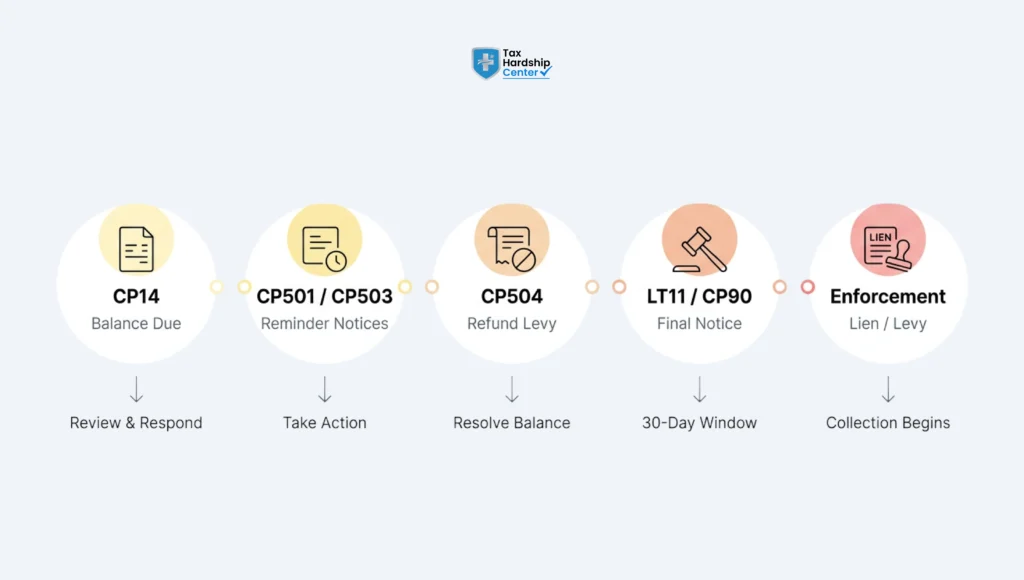
ACS does not spring enforcement on you without warning. The notice sequence is the map.
CP14 is where most cases start. It is the first formal notice that a balance is due. Calm in tone. But ignoring it starts the clock.
CP501 and CP503 are follow-up reminders. The language firms up. The consequences become more specific.
CP504 is the notice of intent to levy your state tax refund. This is a meaningful escalation. ACS can already take your state refund without further warning. It also signals that other levy actions are being prepared.
LT11 / Letter 1058 is the final notice of intent to levy. This is the trigger for your 30-day window to request a Collection Due Process hearing. That hearing request temporarily stops ACS from executing most collection actions while your case is reviewed. Missing this 30-day window is one of the most consequential mistakes people make when dealing with ACS.
CP90 is similar to the LT11 and carries the same CDP rights. It targets specific asset types, including Social Security benefits.
CP523 means your existing installment agreement has defaulted. ACS will resume collection activity unless the agreement is reinstated or a new arrangement is made.
What Is ACS Support Stop 5050?
Some people searching for ACS Support end up finding references to “Stop 5050.” This is an internal IRS routing code, not a notice type. It refers to the specific ACS Support location code used on IRS correspondence and for routing mail to the ACS unit in certain IRS campuses.
If your notice has “Stop 5050” in the address, it indicates where to send your response or payment and does not convey any specific information about your account status. What matters is the notice type itself, not the stop code in the address block.
How to Respond When ACS Contacts You
Getting a letter from ACS Support does not mean it is too late. It means the timeline is real, and action is required.
Read the notice carefully. The notice number tells you exactly where you are in the sequence. A CP14 gives you more room than a CP504. An LT11 means you are at the final notice stage, and the 30-day window is live.
Do not ignore it, hoping it resolves itself. It will not. Unaddressed ACS cases escalate to levies, liens, and eventually revenue officers. The cost of inaction is consistently higher than the cost of responding.
Check your IRS account transcript. Log in at IRS.gov to confirm the balance, the notice history, and whether any enforcement actions have already been initiated.
Understand your resolution options. Depending on your income, assets, and total balance, you may qualify for an IRS installment agreement, an Offer in Compromise, Currently Not Collectible status, or penalty abatement. Each path has specific eligibility requirements. The right one depends on your actual financial situation, not a general impression of what sounds best.
If a final notice has been issued, act on the CDP right immediately. Filing Form 12153 within 30 days of the LT11 or CP90 date puts a hold on collection. That protection disappears if you wait.
Why do taxpayers facing ACS choose the Tax Hardship Center
When ACS is involved, the margin for error shrinks quickly. Tax Hardship Center works with taxpayers at every stage of the ACS collection process, from the first CP14 through active levy situations.
The firm pulls IRS transcripts, identifies exactly where a case stands in the ACS sequence, and builds a response before enforcement proceeds. For clients at the final notice stage, CDP hearing requests are filed immediately. For clients who have already received a wage or bank levy, levy release and garnishment relief are handled as urgent matters, with same-week action where warranted.
Tax Hardship Center handles installment agreement negotiations directly with ACS, offers in Compromise submissions for qualifying cases, and penalty abatement requests where the client’s history supports it. The firm is direct about what each path requires and what it does not guarantee, because a clear picture of your options is worth more than a confident-sounding promise.
Get a free case review to find out where your ACS case stands.
FAQs
What is ACS support at the IRS?
ACS Support is the back-end processing unit of the IRS’s Automated Collection System. It handles the clerical and administrative side of collection activity, including mailing notices, processing levy requests, and filing federal tax liens. When you receive mail from IRS ACS Support, your account is in active collection status.
What does ACS stand for at the IRS?
ACS stands for Automated Collection System. It is the IRS’s centralized, largely automated unit that manages unpaid tax balances before cases escalate to individual revenue officers.
Is ACS worse than a revenue officer?
Not necessarily worse, but different. ACS is a system with no assigned agent. A revenue officer is a designated individual assigned to your case who has broader investigative and enforcement authority. Cases with revenue officers are generally more serious. Keeping your case at the ACS stage while resolving it is typically preferable to escalation.
What is ACS support stop 5050?
Stop 5050 is an internal IRS routing code that appears in the address block on certain ACS correspondence. It identifies the specific IRS campus and unit handling your mail. It does not indicate anything about your account status. Focus on the notice number, not the stop code.
Can ACS levy my wages or bank account without more notice?
ACS cannot levy wages or most assets without first issuing a final notice and giving you 30 days to request a Collection Due Process hearing. The exception is your state tax refund, which can be levied after a CP504 without further warning. Once the final notice period passes without a response, enforcement can begin.
What happens if I just ignore ACS letters?
The case escalates. ACS will file a lien, issue a levy to your bank or employer, and, in some cases, certify your tax debt to the State Department, which affects passport eligibility. Eventually, the case may be transferred to a revenue officer. The options available to you narrow with each unanswered notice.
Can a tax professional stop ACS collection activity?
Yes, in most cases. A CDP hearing request stops most collection actions while the case is under review. Entering into an installment agreement or other formal resolution also suspends enforcement. A qualified tax resolution firm can handle these steps and communicate directly with ACS on your behalf.
Conclusion
IRS ACS Support is not junk mail, and it is not a scare tactic. It is the IRS’s active collection system working on your account through a documented enforcement sequence. The earlier you respond, the more options you have. The later you wait, the fewer you keep.
Key Takeaways
- ACS stands for Automated Collection System, the IRS’s centralized collection unit for unpaid tax balances
- Mail from IRS ACS Support means your account is in active collection status, not a general reminder
- ACS can file federal tax liens, levy wages, sweep bank accounts, and certify serious delinquency to the State Department
- The notice sequence runs from CP14 through CP504 to LT11 or CP90, each stage narrowing your options
- The LT11 and CP90 are final notices that trigger a 30-day window to request a Collection Due Process hearing
- Missing the CDP hearing deadline removes one of the most effective tools for stopping collection activity
- Stop 5050 in a mailing address is a routing code, not a status indicator about your specific account
- ACS cases can escalate to a revenue officer if ignored, which creates a significantly more difficult situation
- Installment agreements, Offers in Compromise, and Currently Not Collectible status are all paths available through ACS
- Acting while the case is still with ACS gives you more leverage than waiting for escalation