


IRS lien subordination could be the difference between a refinance that closes and one that falls apart. Your loan officer says the words nobody wants to hear mid-refinance. “There’s a lien on file.”
You freeze. You thought this was almost done. Rates are good, the paperwork is nearly signed, and now this one line item on a title search is threatening to blow up the whole deal.
Here’s what most homeowners don’t know in that moment. You do not need to pay off the entire tax debt to move forward. There’s a tool built exactly for this situation, and it doesn’t erase the lien; it just steps it out of the way long enough for your loan to close. It’s called a certificate of subordination, and it might be the only thing standing between you and a refinance that actually happens.
Why a Federal Tax Lien Blocks Your Refinance in the First Place
Once the IRS files a Notice of Federal Tax Lien, it puts the government’s claim to your property on public record, and that claim usually sits ahead of any new loan in line for repayment. A lender isn’t going to hand over refinance money if the IRS has first dibs on your house the moment things go sideways.
This is the piece that catches people off guard. You can be perfectly current on your mortgage, have decent equity, and still get stopped cold at closing because of a lien tied to a completely separate tax year. The lien doesn’t care that your refinance has nothing to do with the debt. It just sits there, first in line, until something changes its position.
What Subordination Actually Does (And What It Doesn’t)
Subordination does not remove the lien. Let’s be clear about that up front, because it’s the single biggest misconception around this word. What it does is move the IRS’s claim behind another creditor’s claim, specifically for that one transaction. Your new lender effectively jumps the line, ahead of the IRS, so the loan can close.
The debt is still yours. The lien is still filed. What changes is priority, not existence. Think of it less like erasing a debt and more like letting someone cut in front of you in line while you’re still standing there, waiting your turn behind them.
How to Qualify for a Certificate of Subordination
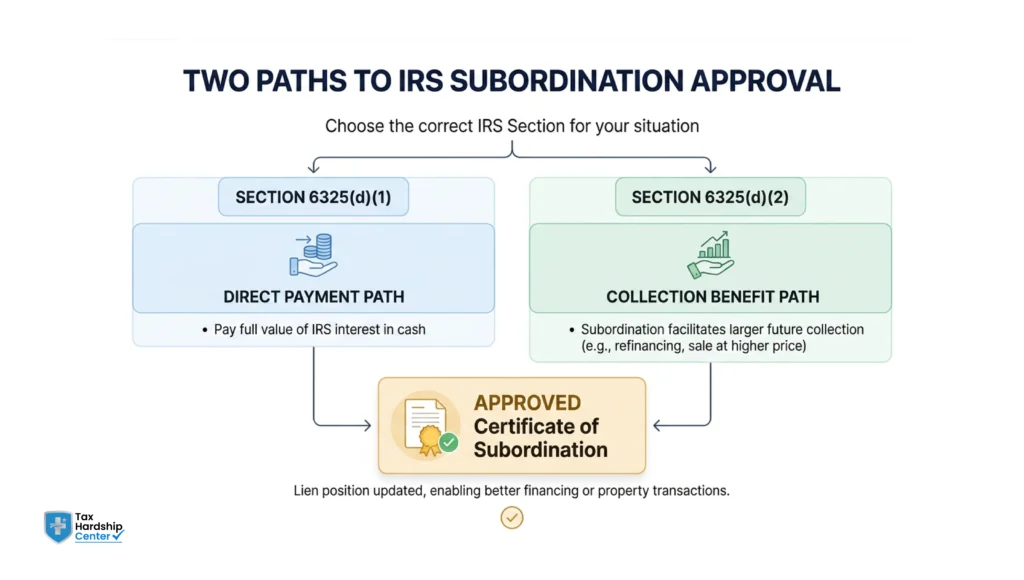
The IRS grants subordination under two main paths, both of which are filed using Form 14134, Application for Certificate of Subordination of Federal Tax Lien.
The first path, under Internal Revenue Code Section 6325(d)(1), works when the IRS receives a payment equal to the amount of the lien or interest being subordinated. In plain terms, if refinancing generates enough cash to hand the IRS its share up front, they’ll often step aside for the new loan.
The second path, under Section 6325(d)(2), doesn’t require an immediate payout. Instead, you have to show that subordinating the lien will ultimately help the IRS collect more, or collect faster, than if they refused. A refinance that lowers your monthly payment and frees up cash flow to keep paying down the tax debt is a common example that fits this path. If you’re already working through tax debt relief options or an active installment agreement, this is often the stronger argument, since it shows the IRS a realistic path to getting paid rather than a one-time payoff.
Subordination vs Discharge: Picking the Right Tool
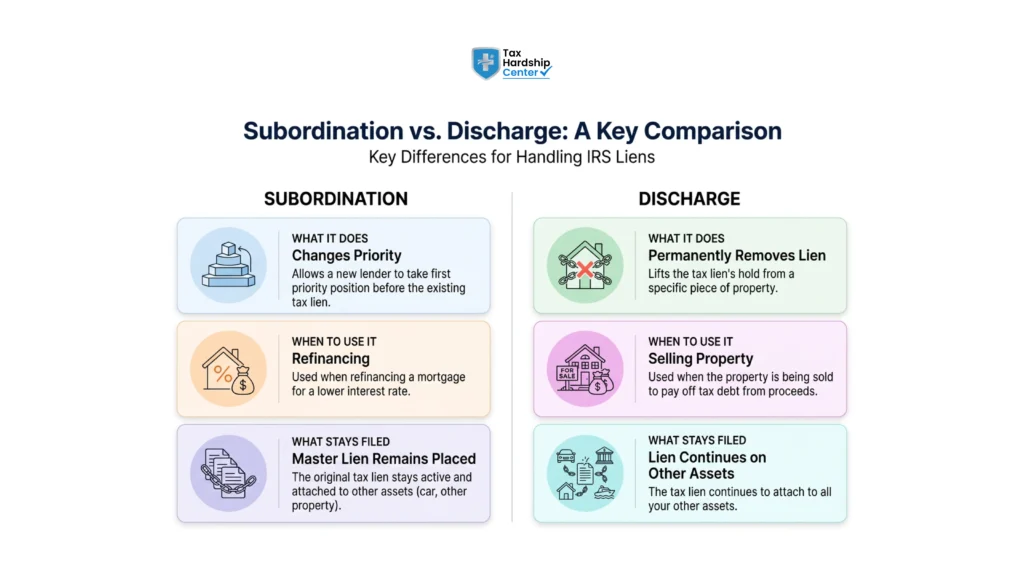
People constantly confuse subordination with discharge, and picking the wrong one wastes weeks. A discharge removes the lien entirely from a specific piece of property, typically used when you’re selling that property outright and need it to close lien-free. Subordination doesn’t remove anything; it just reorders who gets paid first, which is exactly what a refinance needs since you’re not selling; you’re borrowing against equity you still hold.
If you’re selling a home and walking away from it, discharge is usually the right conversation. If you’re refinancing and keeping the property, subordination is the tool built for that. Confusing the two at the application stage is one of the most common reasons these requests get delayed.
The Application Nobody Files Correctly the First Time
Form 14134 asks for specifics most taxpayers don’t have sitting in a drawer. A copy of the recorded Notice of Federal Tax Lien. A property description matching the title or deed exactly. Documentation of the new loan terms. And under the 6325(d)(2) path, a signed, dated statement explaining exactly how subordination increases what the IRS ultimately collects or speeds up collection. That last part is not optional paperwork; it’s the actual argument the IRS is evaluating.
Miss a document, mismatch a property description, or submit a vague explanation of collection benefit, and the request stalls or gets denied, usually right when your closing date is bearing down on you. If you’re not sure how a lien on your file interacts with a balance you’re still resolving, our guide on how long a federal tax lien lasts is a useful starting point before you file anything.
What Happens if the IRS Denies Your Request
A denial isn’t the end of the road. You can request a conference with the IRS Independent Office of Appeals using Form 9423. But appeals take time, and time is exactly what most refinance and sale timelines don’t have. This is where a lot of deals fall apart, not because subordination was impossible, but because the first application wasn’t strong enough and there wasn’t enough runway left to fix it.
Why Tax Hardship Center Is the Right Call for Lien Subordination

If a federal tax lien is holding up your refinance or complicating a sale, Tax Hardship Center handles exactly this kind of time-sensitive lien work. This isn’t a generic settlement conversation; it’s a document-heavy application with a real deadline attached to it, and getting it right the first time is what keeps your closing date intact.
THC prepares Form 14134 with the property documentation, lien details, and collection-benefit statement the IRS actually needs to approve a 6325(d)(2) request, and coordinates the payment structure when a 6325(d)(1) payoff path makes more sense for your numbers. For taxpayers who are also resolving the underlying balance, THC can build the subordination request alongside a broader resolution strategy, whether that’s an Offer in Compromise or a properly structured payment plan, so the lien work and the debt work move in the same direction instead of against each other.
Timing is everything with subordination requests tied to a closing date, and THC treats these cases with the urgency they require rather than processing them as routine paperwork. If a lien is standing between you and a refinance or sale right now, a free case review is the fastest way to see what your options look like before your closing window closes.
FAQs
Can I refinance my home if I have a federal tax lien?
Often yes, through a certificate of subordination, which moves the IRS’s claim behind your new lender’s claim without removing the lien or requiring full payment first.
What is the difference between lien subordination and lien discharge?
Subordination reorders priority so another creditor gets paid first, used mainly for refinancing. Discharge removes the lien entirely from a specific property, used mainly when selling.
How do I apply for a certificate of subordination?
You file Form 14134, Application for Certificate of Subordination of Federal Tax Lien, along with documentation of the property, the lien, and how the transaction benefits the IRS’s ability to collect.
Does subordination remove the tax lien?
No. The lien stays filed and the debt remains yours. Subordination only changes who gets paid first in that specific transaction.
What if the IRS denies my subordination request?
You can appeal using Form 9423 through the IRS Independent Office of Appeals, though this adds time, which can be difficult if you’re working against a closing deadline.
How long does it take the IRS to process a subordination request?
Processing times vary by case complexity and documentation completeness, so submitting a full, accurate application from the start matters more than almost anything else in the timeline.
Conclusion
A federal tax lien doesn’t have to freeze your refinance or sale in place. Subordination won’t make the debt disappear, but it can move the IRS out of the way long enough for the transaction you actually need to go through. The application has real requirements and real timing pressure, so the sooner you understand which path fits your situation, the better your odds of closing on schedule.
Key Takeaways
- A federal tax lien can block a refinance because the IRS claim usually sits ahead of a new loan
- Subordination does not remove the lien, it only reorders payment priority for one transaction
- Form 14134 is filed under either Section 6325(d)(1), a direct payoff, or 6325(d)(2), a collection benefit argument
- Subordination fits refinancing scenarios, discharge fits property sales, the two are not interchangeable
- The 6325(d)(2) path requires a signed statement proving how the IRS ultimately collects more or faster
- Incomplete documentation or a vague collection benefit statement is the top reason these requests stall
- A denied request can be appealed through Form 9423, but appeals take additional time
- Subordination timelines are closely tied to closing deadlines, so early filing matters
- Pairing subordination with an active resolution strategy strengthens the collection benefit argument
- Reviewing your lien and balance details early gives you more room to fix application gaps before closing
Have a federal tax lien standing between you and a refinance or sale? Get a free case review and find out your options today.