


Tax lien withdrawal isn’t the same thing as paying off your IRS debt, and that’s the mistake many taxpayers don’t realize until it’s too late.
You paid off the debt. You did the hard part. You expected the IRS problem to be over.
Then you go to refinance the house, or a lender pulls your file, and there it is. A federal tax lien, sitting on public record, staring back at you like it never got the memo that you already paid.
Here’s the part almost nobody explains clearly enough. Paying your tax debt in full does not automatically erase that public notice. It gets marked “released,” which sounds like closure, but a released lien can still show up in property records and county filings for years. There is a second, far less understood tool that actually removes the notice as if it was never filed in the first place, and it’s called a tax lien withdrawal.
Release and withdrawal are two different outcomes, filed under two different rules, with two very different effects on your financial life. Confusing them is how people end up thinking their lien problem is solved when the public record says otherwise.
What a Federal Tax Lien Notice Actually Does
When the IRS assesses a tax debt and you don’t pay it, a lien attaches to everything you own automatically. But it’s the Notice of Federal Tax Lien, the NFTL, that does the real damage. That’s the public filing that alerts lenders, county recorders, and anyone doing a title search that the government has a legal claim on your property.
Once that notice is filed, it can limit your ability to sell, refinance, or borrow against real estate, and it can attach to business assets and accounts receivable too. Credit bureaus stopped pulling liens onto standard credit reports back in 2018, but that does not mean the lien is invisible. Lenders, title companies, and background check services still find it through public county and state records, which is exactly the gap that trips people up.
Lien Release: What It Clears and What It Leaves Behind
A release happens automatically once your tax debt is paid in full, or once it’s satisfied through an accepted resolution like an Offer in Compromise. The IRS is required to release the lien within thirty days of full payment.
Here’s the catch. A release confirms the debt is gone. It does not remove the notice from where it was recorded. The filing stays on record marked as “released,” which is better than “open,” but it’s still a historical entry that a lender, landlord, or business partner can find if they go looking. If you’re catching up on old balances through an installment agreement or working through tax debt relief options right now, it’s worth knowing that a release is often the finish line for the debt itself, but not necessarily for the paper trail.
Lien Withdrawal: The Only Option That Erases the Public Record
A withdrawal does something a release never does. It removes the public notice entirely, as if it had never been filed at all. Once the IRS approves a withdrawal, they issue a follow-up document, Form 10916(c), that goes back to the same county recorder or state filing office and pulls the notice from the record. Credit reporting agencies and other creditors get notified too.
This is the version people actually want when they say “I need this lien off my record.” A withdrawal doesn’t just confirm you’re square with the IRS, it acts like the government never told the world you owed them in the first place.
Do You Actually Qualify for a Withdrawal?
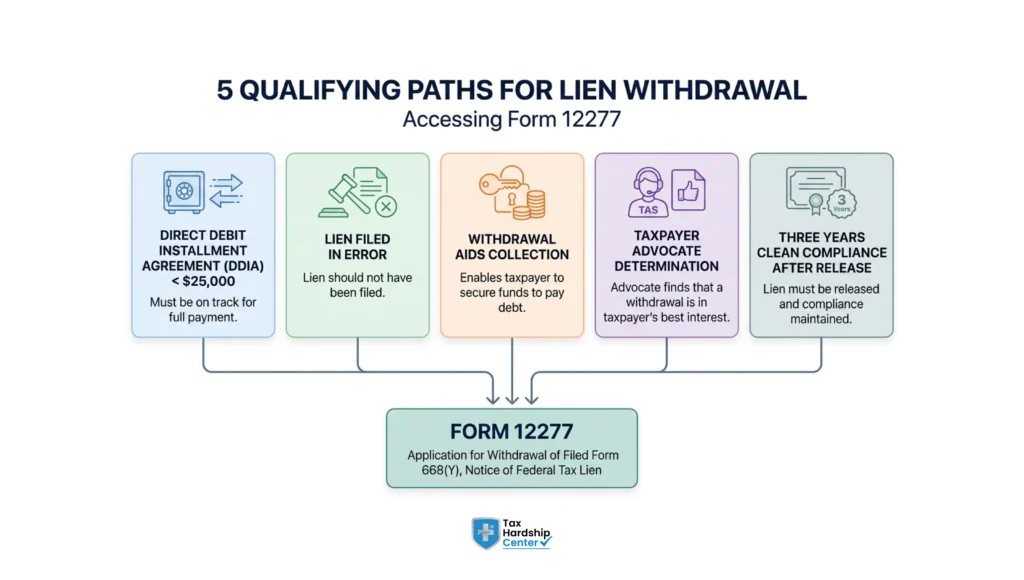
Not everyone does, and this is where a lot of taxpayers get their hopes up without checking the fine print first.
You can request a withdrawal under IRC Section 6323(j) using Form 12277 in a few specific situations. The notice was filed prematurely or outside proper IRS procedure. You entered a Direct Debit Installment Agreement and owe $25,000 or less, with the plan set to pay off the balance within 60 months or before the collection statute expires, whichever comes first, and you’ve already made three consecutive on-time direct debit payments. Withdrawal will help the IRS actually collect what’s owed, for example by letting you refinance to pay the balance faster. Or a Taxpayer Advocate determines that withdrawal serves both your interest and the government’s.
There’s also a path to request withdrawal after the lien has already been released, if you’ve stayed compliant on filing and payments for the past three years. If you’re not sure how long a lien has been sitting on your record or whether it’s already past the release stage, our breakdown of how long a federal tax lien lasts walks through the timeline in more detail.
Release vs Withdrawal: The Difference That Actually Matters
Think of it this way. A release is the IRS saying “this debt is paid.” A withdrawal is the IRS saying “we’re taking back what we told the public about you.”
If your only goal is to confirm the debt is gone, a release does that. If your goal is refinancing a home, securing a business loan, bidding on a contract that requires a clean lien search, or repairing how your financial history looks to anyone pulling public records, a release alone usually won’t get you there. Withdrawal is the tool built for exactly that gap.
Discharge and Subordination Are Not the Same Thing
Two other lien terms get thrown around interchangeably with withdrawal, and they shouldn’t be. A discharge removes the lien from one specific piece of property, useful when you’re selling a single asset and need it lien-free for that transaction, but the lien can still apply elsewhere. Subordination doesn’t remove the lien at all, it just lets another creditor, like a mortgage lender, move ahead of the IRS in priority so you can close a refinance. Neither one clears the public notice the way a withdrawal does.
The Mistake That Keeps a Cleared Debt on Public Record for Years
Most taxpayers assume that once the balance hits zero, the lien problem disappears with it. It doesn’t, not automatically, and not without you taking the extra step. The IRS will not proactively suggest a withdrawal on your behalf in most cases. You have to know it exists, confirm you meet one of the qualifying reasons, and file Form 12277 yourself, or have someone file it correctly for you.
The most common reason a withdrawal request gets delayed or denied is incomplete documentation, missing lien filing details, an outdated address, or a compliance history that has a gap somewhere in the last three years. Getting this right the first time matters, because a rejected application means starting the review clock over.
Why Tax Hardship Center Is the Right Call for Lien Withdrawal
If a federal tax lien is sitting on your record and you’re trying to figure out whether you qualify for a withdrawal, a release cleanup, or something else entirely, Tax Hardship Center is built for exactly this kind of case. This isn’t a generic settlement pitch, it’s a specific, document-heavy process, and it’s the kind of work that goes sideways fast when it’s handled without someone who’s filed it correctly before.
THC pulls your lien filing history, confirms your current status with the IRS, and determines which qualifying reason under Section 6323(j) actually applies to your situation before anything gets submitted. For taxpayers still working through the underlying balance, THC coordinates lien resolution alongside broader tax debt relief options, an Offer in Compromise if you qualify for one, or a properly structured Direct Debit Installment Agreement that meets the Fresh Start thresholds for withdrawal eligibility down the line.
For taxpayers who’ve already paid off the debt and are now stuck with a released-but-still-public lien hurting a refinance or a business deal, THC handles the withdrawal application directly, gathers the compliance documentation the IRS requires, and tracks the case through to the Form 10916(c) confirmation. A free case review is the fastest way to find out whether you already qualify.
FAQs
What is the difference between a tax lien release and a tax lien withdrawal?
A release confirms the tax debt is paid or satisfied but leaves the filing on public record as “released.” A withdrawal removes the public notice completely, as if it was never filed.
How do I apply for a federal tax lien withdrawal?
You file Form 12277, Application for Withdrawal of Filed Notice of Federal Tax Lien, and select the qualifying reason that applies to your situation, such as a Direct Debit Installment Agreement or a lien filed in error.
Can I get a lien withdrawn if I still owe money?
Yes, if you’re on a qualifying Direct Debit Installment Agreement for $25,000 or less and have made three consecutive on-time payments, among other conditions.
Does a lien withdrawal happen automatically after I pay off my tax debt?
No. A release happens automatically within 30 days of full payment. A withdrawal must be requested separately using Form 12277, even after the debt is paid.
How long does the IRS take to process a lien withdrawal request?
Most Form 12277 applications are processed within 30 to 45 days, though complex cases can take longer.
Will a tax lien withdrawal improve my credit score?
Since 2018, tax liens generally don’t appear on standard credit reports, but a withdrawal can still help with lenders, title companies, and background checks that pull public county and state records directly.
What is the difference between a lien withdrawal and a lien discharge?
A discharge removes the lien from one specific piece of property for a transaction like a sale. A withdrawal removes the entire public notice across all your property.
Conclusion
A release confirms your tax debt is paid. A withdrawal makes the public record forget the lien ever happened. If you’re trying to refinance, borrow, or simply stop explaining an old tax problem to every lender who runs a title search, withdrawal is the step that actually gets you there, and it’s a step you have to request, not one that happens on its own.
Key Takeaways
- A federal tax lien release confirms the debt is paid but leaves the filing on public record
- A tax lien withdrawal removes the public notice entirely, as if it was never filed
- Withdrawal requires filing Form 12277 under IRC Section 6323(j), it does not happen automatically
- Direct Debit Installment Agreements under $25,000 can qualify for withdrawal after three on-time payments
- Withdrawal after full payment and release is also possible with three years of clean compliance
- Discharge removes a lien from one asset, subordination reprioritizes creditors, neither erases the public notice
- Tax liens generally don’t appear on standard credit reports since 2018, but still show up in public records
- Incomplete documentation is the most common reason a withdrawal request gets delayed or denied
- Approved withdrawals are confirmed through IRS Form 10916(c), sent to recorders and creditors
- Knowing your qualifying reason before filing prevents a rejected application and a restarted review clock
Have a federal tax lien on your record and not sure if you qualify for withdrawal? Get a free case review and find out today.


