

You set up a payment plan with the IRS, breathed easier, and a few months later the balance looks bigger than when you started, even though you’ve paid every month. That’s not a mistake. It’s the IRS payment plan interest rate doing exactly what it’s built to do, and almost nobody explains this before you sign.
What Is the IRS Payment Plan Interest Rate Right Now?
The IRS payment plan interest rate for individual taxpayers is 7% for the third quarter of 2026, up from 6% the quarter before. This is the rate charged on unpaid tax interest whether you’re on a formal plan or simply carrying a balance you haven’t addressed.
It comes from a set formula: the federal short-term rate, currently 4%, plus 3 percentage points. Large corporate underpayments carry a steeper 9%, but for most people, 7% is the number on the account right now.
Here’s the part that trips people up. IRS payment plan interest rates apply from your original due date, not the day your payment plan application was approved. If your 2023 return was due in April 2024 and the balance is still open, interest has been running since that date.
How the IRS Interest Rate Gets Set Every Quarter
The IRS interest rate doesn’t stay fixed for the life of your agreement. It’s reviewed four times a year, tied to movement in the federal short-term rate, and when that number rises, so does what you owe. Nobody sends a letter walking you through the math. Your statement just shows a new figure, and your balance grows a little faster or slower depending on which way the quarter moved.
There’s another detail worth knowing: the IRS payment plan interest rate compounds daily, not monthly or annually. Interest is calculated on your original tax debt plus whatever interest has already piled on, so a $10,000 balance doesn’t grow by one flat number each year. It grows a little every single day, and each day’s charge becomes part of what tomorrow’s interest is calculated against.
Does a Payment Plan Stop Unpaid Tax Interest From Growing?
No, and this is the biggest misunderstanding taxpayers have. Setting up an installment agreement doesn’t pause the IRS payment plan interest rate. It keeps running on whatever balance remains until that balance hits zero.
What a plan actually changes is your failure to pay penalty, not the interest itself. Once approved, that penalty typically drops from 0.5% a month to 0.25%, but the IRS interest rate you were quoted keeps ticking regardless of whether you’re current on payments.
This is why two people who owe the same amount can pay very different totals. Someone who pays extra toward principal sees daily compounding work in their favor sooner. Someone paying only the minimum watches unpaid tax interest eat into a bigger share of every payment for months, sometimes years.
What a $10,000 Balance Actually Costs in Interest
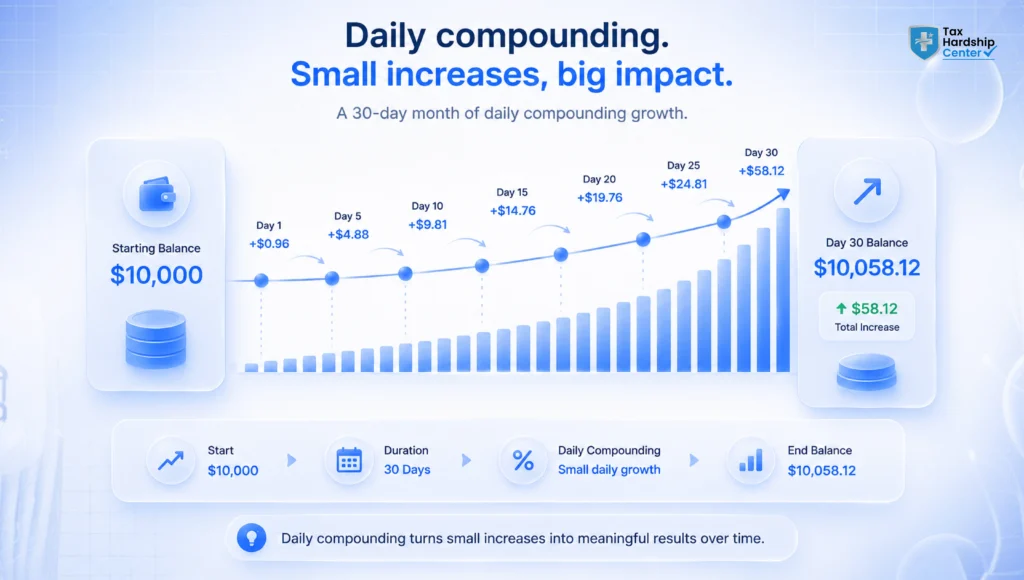
Let’s make this concrete. At the current 7% IRS payment plan interest rate, a fresh $10,000 balance accrues roughly $1.92 a day. Over a 30-day month, that’s close to $58 in interest before a dollar of the actual debt is touched.
That daily figure shrinks as principal drops, since it applies to whatever remains, not the original amount. On a long-term plan where you’re only making the minimum, a real chunk of every payment goes toward interest rather than the debt itself.
Multiply this across a $25,000 or $50,000 balance, and IRS payment plan interest rates stop being a footnote. They become the difference between a three-year payoff and a five-year one, which is exactly the kind of gap covered in our guide to tax debt relief options.
Payment Plan Interest vs the Failure to Pay Penalty
People use “interest” and “penalty” interchangeably, but they’re separate charges stacked on top of each other. The IRS interest rate compensates the government for money it didn’t receive on time. The failure to pay penalty is a separate charge for not paying at all, capped at 25% of the unpaid tax, and both apply at the same time in most cases.
Getting on a plan cuts the penalty rate in half, which helps, but it does nothing to the IRS payment plan interest rate itself. Reducing how long your balance sits unpaid, so there are fewer days for interest to compound, moves the needle further than penalty relief alone. This is often the first thing worth reviewing in any back tax help conversation.
Can You Lower Your IRS Payment Plan Interest Rate?
You can’t negotiate the rate itself. It’s set by statute and applies the same way regardless of your situation. What you can influence is how much total unpaid tax interest you end up paying, and that comes down to strategy, not negotiation.
Paying more than the minimum whenever you’re able shrinks the balance the IRS payment plan interest rate compounds on. A few taxpayers with a matching underpayment and overpayment in the same period may qualify for a net interest rate of zero using Form 843, though this fits a narrow set of cases.
For real financial hardship, options like Currently Not Collectible status or an Offer in Compromise can resolve a case faster than a slow installment agreement, limiting how long the rate has time to work against you. Not everyone qualifies, and that’s worth checking against the Fresh Start eligibility criteria before assuming a standard plan is your only option.
What Happens If You Ignore the Balance?
Ignoring it doesn’t freeze it. The IRS payment plan interest rate keeps compounding daily whether you’re managing the case or avoiding the mail, and a debt that felt manageable at $8,000 two years ago can look very different once daily compounding and a few rate increases have had time to work.
The IRS also has enforcement tools, including a tax lien and eventually a levy, that activate the longer a balance sits. None of that lowers the underlying rate. It just adds pressure on top of a number that was already climbing.
Why Tax Hardship Center Is the Right Call on Interest-Heavy Cases
Tax Hardship Center works directly with taxpayers whose balances are growing because the IRS payment plan interest rate is quietly compounding in the background. That starts with reviewing your notices and transcript to confirm exactly how much is tax, penalty, and interest, then building a plan that limits how many more days interest gets to compound.
For taxpayers who qualify, this can mean a small business IRS payment plan structured with higher early payments to cut principal faster, instead of the IRS minimum. For others, it means evaluating whether combining an installment agreement, Offer in Compromise, or penalty relief resolves the case faster, with direct IRS communication handled on your behalf throughout.
FAQs
Does the IRS charge interest while I’m on a payment plan?
Yes. The IRS payment plan interest rate keeps accruing daily on your balance for the life of the agreement. A plan only reduces your failure to pay penalty, not the interest itself.
What is the current IRS payment plan interest rate?
The rate is 7% annually for individuals in the third quarter of 2026, compounded daily. It was 6% the quarter before and can move again next quarter.
How often does the IRS interest rate change?
It’s reviewed and reset four times a year based on the federal short-term rate at the time. Each new rate applies to the following calendar quarter.
Is unpaid tax interest the same as a penalty?
No. Interest compensates the IRS for late payment. The failure to pay penalty is a separate charge for missing the deadline entirely, and both can apply at once.
Can the IRS waive interest on my balance?
Rarely, and usually only when the delay was caused by IRS error. The IRS payment plan interest rate itself isn’t waived just because paying it is difficult, though a net interest rate of zero is possible in narrow cases involving matching underpayments and overpayments.
Will paying extra each month lower my total interest?
Yes. Extra payments shrink your principal faster, which reduces the base that interest compounds on going forward.
What if I can’t afford my current payment plan?
You may qualify for Currently Not Collectible status or a renegotiated agreement based on updated finances. Interest continues either way until the case resolves.
Conclusion
IRS payment plan interest rates aren’t something a payment plan makes disappear. It’s a fixed, quarterly rate that compounds daily until your balance hits zero, whether or not you’re current on payments. Knowing how it stacks against the failure to pay penalty is the difference between a payoff strategy that saves money and one that quietly costs more every quarter.
Key Takeaways
- The IRS payment plan interest rate is 7% for individuals in Q3 2026, up from 6% the prior quarter.
- The rate resets every quarter based on the federal short-term rate plus 3 points.
- Interest compounds daily, not annually or monthly.
- A payment plan lowers your failure to pay penalty but not the interest itself.
- A $10,000 balance accrues roughly $58 in interest during its first month.
- The rate itself can’t be negotiated since it’s set by statute.
- Paying more than the minimum shrinks the balance interest compounds on.
- Some taxpayers may qualify for a net interest rate of zero using Form 843.
- Ignoring a balance doesn’t pause the interest rate or enforcement risk.
- Faster resolution paths can limit how long IRS payment plan interest rates work against you.
Ready to find out exactly what your balance is really costing you? Get a free case review from Tax Hardship Center today.