
Low Income Taxpayer Clinics offer free or low cost legal services when you face IRS audits, appeals, collections, or Tax Court. Most clinics serve people at or below 250 percent of the federal poverty level and can assist if you speak English as a second language. Clinics operate independently from the Internal Revenue Service so they can advocate only for you and your rights. You usually do not pay for help, and any small fee depends on your income and the case. You can find a nearby clinic in minutes using IRS Publication 4134, then contact the clinic to confirm eligibility and next steps.
Understanding low income tax clinics and who qualifies
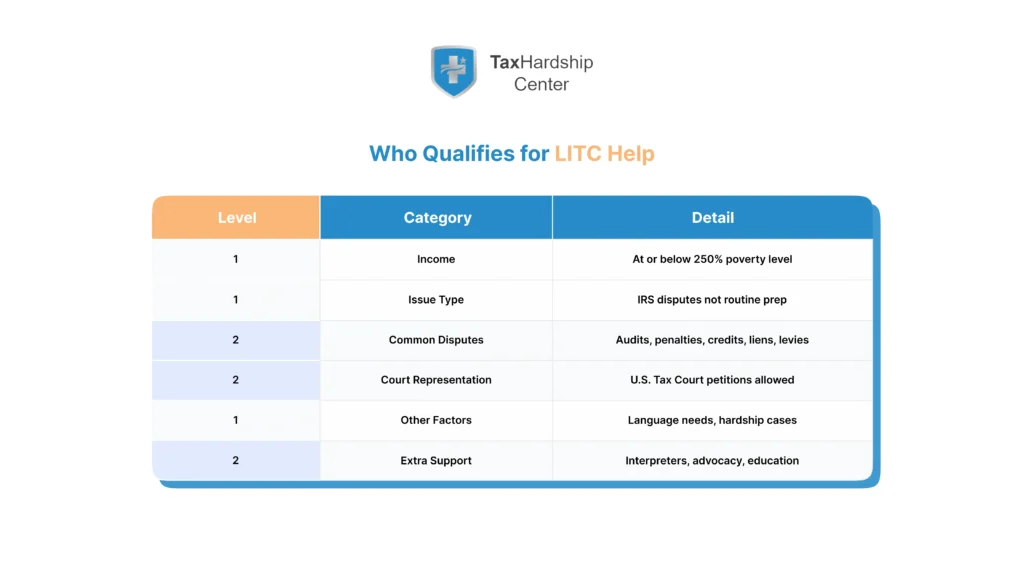
Low Income Taxpayer Clinics exist to help low income taxpayers handle IRS disputes and protect taxpayer rights. Congress funds the program through grants, and independent nonprofits, universities, and legal services groups run the clinics. This structure keeps the clinic on your side and separate from the Internal Revenue Service while the clinic applies IRS rules to your case. The clinic focuses on controversies like audits, penalties, liens, levies, and Tax Court petitions, not routine tax preparation unless it directly solves a dispute. If you qualify based on income and issue type, a clinic attorney or enrolled agent can represent you before the IRS or in U.S. Tax Court.
What is a low income taxpayer clinic and how does it work
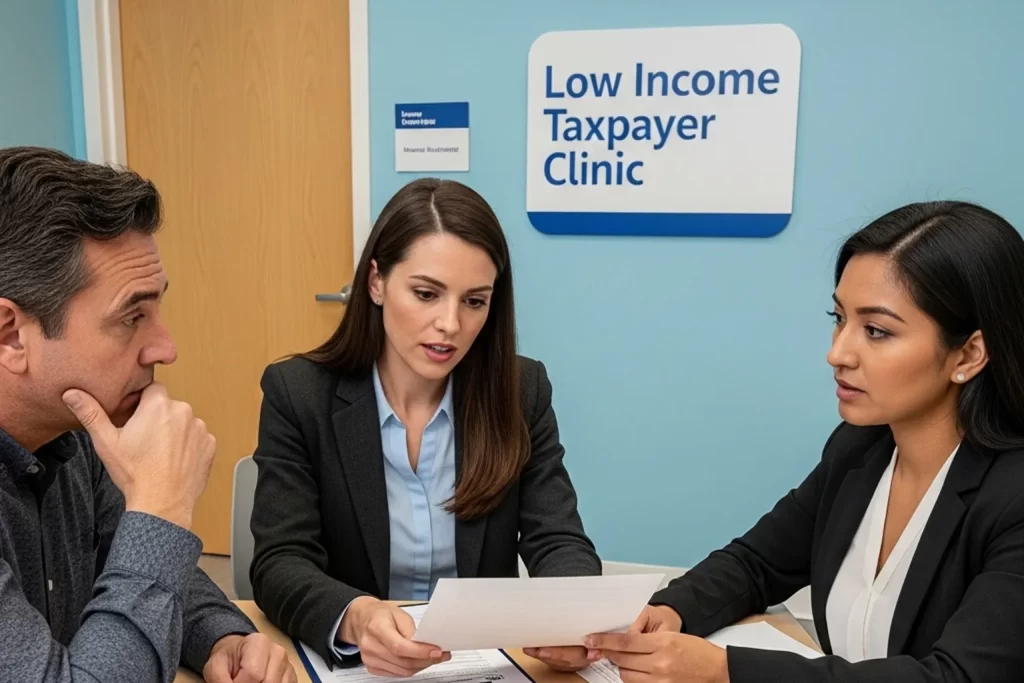
An income taxpayer clinic is a legal services program that represents eligible taxpayers in disputes with the IRS. A clinic reviews your notice, requests your IRS account records, and builds a facts and law strategy for the tax issue. The team may include attorneys, enrolled agents, and interpreters who prepare written responses, negotiate with revenue officers, and file Tax Court petitions when needed. Clinics also teach taxpayers about rights under the Taxpayer Bill of Rights and how to respond to future notices. You stay the client of record, and the clinic files a power of attorney so the IRS communicates with the clinic directly.
Who qualifies, income thresholds and dispute limits
Most clinics use an income ceiling near 250 percent of the federal poverty level, adjusted for household size and location. Many clinics also set case selection rules to focus on disputes that fit their training and capacity. You improve your odds when your issue involves audits, penalties, refundable credits, or collection actions rather than business planning or general tax advice. Clinics may cap the dollar amount in dispute so they can serve more taxpayers across the community. Always ask the clinic about current criteria, wait times, and documentation you need for intake.
How clinics address tax issues, disputes and taxpayer rights
Clinics start with a clear theory of the case and match facts to the Internal Revenue Code, regulations, and IRS procedures. They gather records, sworn statements, and third party proof to meet substantiation rules for credits and deductions. They protect your taxpayer rights by monitoring deadlines, demanding proper notice, and seeking manager review when procedures break. They escalate to Appeals or Tax Court if the facts and law support a better result than the initial IRS position. They also coach you on future filing practices so the same tax issue does not return.
How low income taxpayer clinics provide free IRS tax help for low income individuals
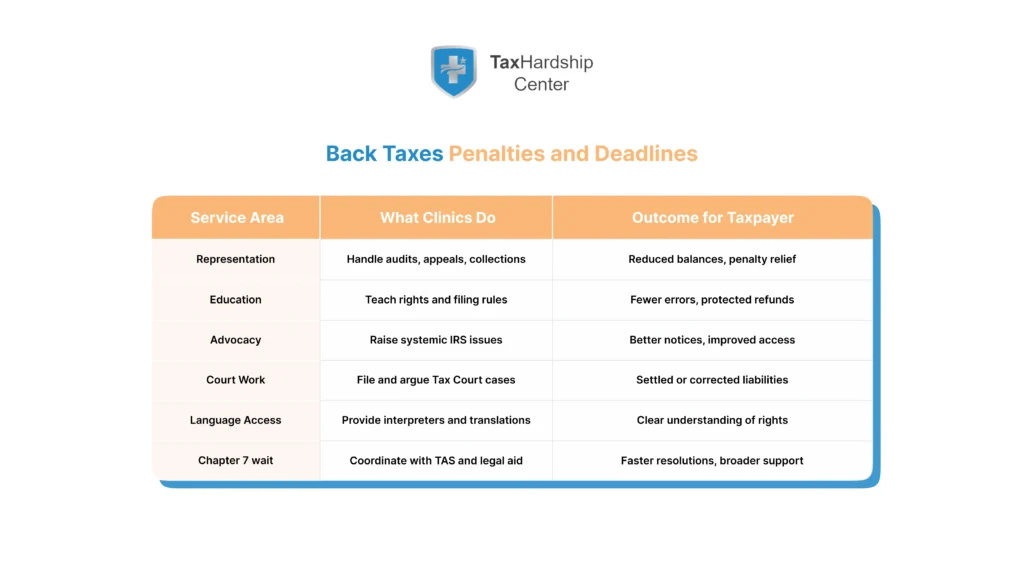
Clinics deliver free or low cost legal representation and taxpayer education so low income households can manage IRS pressure. The clinic model blends case work with outreach, which reduces both tax debt and repeat errors in returns. You get a single point of contact who understands your income, language needs, and family credits. The clinic explains every step and sets expectations about likely timelines and outcomes. This combination of representation, education, and advocacy gives you a fair chance to resolve a federal tax problem.
Pro bono legal services for audits, appeals and collections
Clinics prepare audit responses, manage document requests, and push for audit reconsideration when evidence emerges later. They present your case to the Independent Office of Appeals and argue for penalty relief, credit allowance, or a better adjustment. On the collections side, clinics request holds, verify account accuracy, and propose installment agreements or Currently Not Collectible status. When a levy or lien threatens wages or property, clinics ask for release or subordination based on hardship. If the IRS rejects a fair solution, clinics reopen talks, add new evidence, or prepare a court petition. If settlement is on the table, learn how Offer in Compromise payments work and when a streamlined installment agreement fits better.
Educating taxpayers on internal revenue service rules and responsibilities
Clinics run workshops and one on one sessions that explain filing duties, estimated tax, and refundable credits such as the Earned Income Tax Credit. They show how to read IRS notices, set up online accounts, and keep receipts that satisfy substantiation rules. Education reduces repeat disputes and protects refunds that support rent, food, and child care. Clinics also teach rights under IRS procedures, including appeal rights and the right to pay no more than the correct amount of tax. You leave with checklists and timelines that make future tax returns simpler and more accurate. Start with our plain English guide to handling an IRS tax notice and review payment plan choices so you know what to expect if a balance remains.
Advocacy in tax court and resolution of tax disputes
When a Notice of Deficiency or a Notice of Determination arrives, clinics prepare and file your Tax Court petition on time. They manage discovery, stipulate facts, and negotiate with IRS Counsel to settle when the law favors compromise. If the case goes to trial, a clinic attorney presents documents and witness testimony to support your position. Clinics also use small Tax Court sessions to secure quick resolutions for pro se taxpayers who ask for help on site. Many disputes end with a stipulated decision that reduces liabilities or restores credits with legal certainty.
Our services at Tax Hardship Center: practical help for IRS disputes
Our services at Tax Hardship Center focus on fast, clear relief when the IRS turns up the heat. We start with a straightforward consultation and roadmap, then match you to the right path: full service IRS Tax Relief representation, a qualifying Offer in Compromise to settle for less, an affordable Installment Agreement to pay over time, or Currently Not Collectible status when hardship rules apply. We handle calls and letters on your behalf, set firm deadlines, and keep you updated by phone and email so nothing slips. You get transparent pricing, weekly status updates, and documents explained in plain English. If we cannot improve your position, we tell you early so you avoid wasted time and money.
Why free IRS representation matters to income taxpayers
Representation changes outcomes because tax law rests on evidence, deadlines, and procedure. Low income taxpayers often face barriers such as limited records, limited English, and little time off work to respond. Clinics bridge those gaps with interpreters, document templates, and direct access to IRS staff. The clinic also reduces the stress of calls and letters because the IRS must contact the representative. This structure protects your rights and supports a result that reflects the real facts of your income and expenses.
Leveling the playing field with taxpayer advocate support
Clinics coordinate with the Taxpayer Advocate Service when systemic issues delay refunds or block account fixes. Advocate caseworkers help move stalled matters, while the clinic handles the legal arguments and documentation. Together they push for relief when IRS systems cause harm that you cannot fix alone. This team approach speeds account corrections, lifts identity holds, and restores credits for eligible families. You get both advocacy inside the IRS and legal representation outside it.
Ensuring taxpayer rights during tax return disputes
Clinics enforce the right to be informed by translating notices, summarizing issues, and setting reply plans before each deadline. They enforce the right to quality service by escalating when an examiner ignores evidence or misapplies a rule. They enforce the right to appeal by creating a complete case file for Appeals review with clear citations. They enforce the right to a fair and just tax system by documenting hardship and seeking penalty abatement where reasonable cause exists. Every step centers on your rights and the correct amount of federal tax.
Protecting ESL and vulnerable communities from unfair collection
Clinics screen for victims of domestic abuse, identity theft, and wage theft, then tailor strategies that keep clients safe. They request holds on levy actions, propose affordable payment plans, and file hardship claims with proof. Interpreters help clients who speak English as a second language understand options and sign forms with confidence. Clinics track compliance so the IRS keeps agreements in place and avoids default. These safeguards protect income taxpayers who live close to the margin from losing wages or essential property.
What to expect when working with an income taxpayer clinic
You start with an intake call or online form, then meet with a representative who confirms your identity and reviews notices. The clinic explains eligibility, signs a representation agreement if accepted, and files Form 2848 or 8821 to access your IRS records. You receive a plan that lists action items, target dates, and the legal theory for your case. The clinic communicates by phone, email, or text in your preferred language and tracks every contact with the IRS. You stay informed until the IRS closes the case and the clinic confirms the outcome.
Using email to track notices, deadlines, and documents
Clinics use email to confirm meeting times, send checklists, and log every deadline so nothing gets missed. You create a folder for IRS notices and clinic messages and keep subject lines short and clear for quick searches. You avoid sending full Social Security numbers or bank details by unsecured email and use secure portals when offered. You reply to each message with the requested documents and ask for confirmation that the clinic received them. This simple discipline keeps your file organized and speeds responses to the Internal Revenue Service.
The intake process and how to speak English or other languages
Intake gathers documents such as notices, tax returns, pay stubs, and benefit letters so the clinic can validate facts. Staff ask about language needs and connect interpreters or bilingual advocates as needed. You pick your preferred communication channel, and the clinic sets clear response times so updates arrive on schedule. If you speak English, Spanish, or another language, the clinic adapts forms and meetings to fit. Intake ends with a checklist that shows what you must provide and the next IRS deadline.
Intake checklist highlights
- Government ID and Social Security or ITIN proof
- IRS notices, letters, and transcripts
- Last filed tax returns and wage or benefit records
- Proof for credits and deductions in dispute
- Authorization forms for representation
Typical services from legal representation to tax return corrections
Clinics write letters that answer IRS exams, request penalty relief, and outline legal support with citations. They prepare amended returns when a correction will resolve the controversy or protect a credit. They build installment agreement proposals with financials that meet IRS standards and avoid default. They ask for Currently Not Collectible status when income falls below allowable expenses and payment would cause hardship. They keep case notes so you can track what the IRS received and what remains outstanding. When financials are required, use our checklist for IRS Form 433-F so your numbers match IRS standards from day one.
Outreach, education and legal services beyond direct dispute support
Clinics host education events at libraries, schools, and community centers that explain rights and responsibilities. They publish tip sheets on refund timing, W-2 and 1099 reporting, and credit eligibility so fewer returns trigger audits. They partner with social service agencies to reach people who do not file because of fear or confusion. They collect data on common tax issues and share trends with policymakers through the taxpayer advocate community. This outreach expands access to accurate information and reduces future disputes.
When bankruptcy, liens and tax liability collide
Clinics help you sort out how bankruptcy, tax liens, levies, and tax liability interact so you keep income and assets safe. The team explains which IRS debts may qualify for discharge and which debts survive. They also check whether a tax lien limits your options even if a court discharges some income tax. You leave with a plan that sequences filings, pauses collection where allowed, and protects your rights at each step. Clear coordination prevents avoidable mistakes and speeds a workable resolution.
Bankruptcy and tax liability: what clinics review before you file
Clinics assess whether your income tax meets common discharge tests such as the three year, two year, and 240 day rules. They flag debts that rarely discharge, including trust fund recovery penalties and taxes tied to fraud or willful evasion. They confirm that all required returns are filed, because missing returns can block relief and raise tax liability. They check assessment dates, tolling events, and prior offers so timing supports the strongest result. They explain how a discharge affects remaining balances and what you still must pay after bankruptcy.
Tax liens and levies during or after bankruptcy
A bankruptcy filing usually triggers an automatic stay that stops most levies while the case proceeds. Existing IRS tax liens may still attach to your property, so clinics map what the lien actually covers. After the case, a clinic may ask for lien withdrawal, release, or subordination if the facts support it. The team verifies that post bankruptcy collection follows the law and correct account balances. If problems persist, the clinic reopens talks with Collections or Appeals on your behalf. For practical steps, see our explainer on addressing an IRS tax lien.
Coordinating with legal aid and tax litigation counsel
Clinics often partner with consumer bankruptcy attorneys and legal services offices to align strategy. When an adversary proceeding or Tax Court issue overlaps, the clinic coordinates pleadings and evidence with tax litigation counsel. The team weighs options such as installment agreements or Currently Not Collectible status after discharge. They also revisit penalty abatement and credit adjustments that reduce the final tax liability. This coordination delivers one plan across courts and agencies so you can move forward.
How to find and access low income taxpayer clinics in America
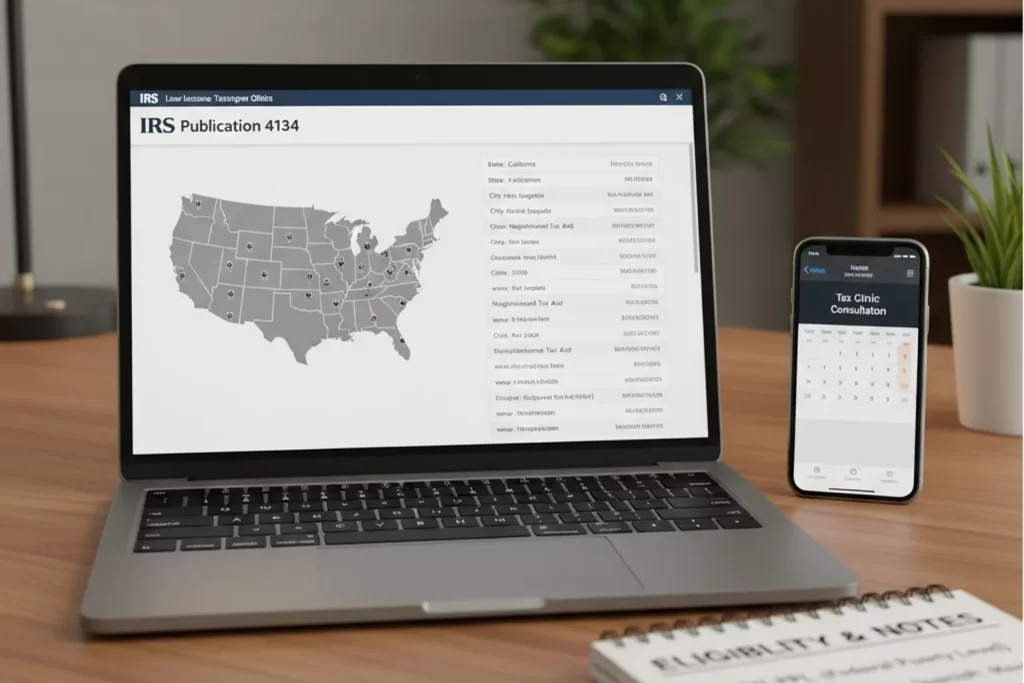
You can locate clinics by using IRS Publication 4134 and the IRS online lookup tool. The directory lists clinic names, counties served, languages offered, and contact details. You select a few clinics near you, call to confirm eligibility, and ask about current wait times. If a clinic cannot take your case, ask for referrals to nearby clinics, legal aid, or law school programs. Keep notes on each call and follow up within two business days if you do not hear back.
Using IRS tools and Publication 4134 for locating clinics
Publication 4134 provides a current list of clinics with addresses, phone numbers, and languages. You can also use the IRS LITC webpage to search by state and county. Write down three options, gather your documents, and call during intake hours to reach staff quickly. Ask about income thresholds, case types accepted, and whether the clinic offers Tax Court representation. Confirm what to bring to the first meeting so you avoid delays. Use the official IRS Publication 4134 list and the IRS LITC page to verify clinic details and languages offered.
State level clinics and legal services that handle federal tax issues
Many states fund legal services programs that include federal tax disputes within their mission. These groups coordinate with LITCs to refer overflow cases and share training resources. You may find help through statewide legal aid hotlines that screen for income and urgency. Some states also run specialized units for veterans, survivors of domestic abuse, or workers facing wage garnishments. Always ask about language access and interpreter availability when you set an appointment.
University and nonprofit based taxpayer clinic options
Law schools often host clinics where supervised students handle real IRS controversies under faculty guidance. Nonprofit organizations also run clinics with staff attorneys and enrolled agents who focus only on tax. Both settings follow strict ethics rules and confidentiality standards that protect your information. University clinics may focus on cases tied to education credits and low wage workers near campus. Nonprofit clinics often cover a wider region and maintain year round intake.
What the IRS and clinics have achieved for low income taxpayers
Clinics expand access to justice by delivering representation where the market would not. They reduce incorrect assessments through better documentation and legal arguments. They secure penalty abatements, release levies, and restore refundable credits to eligible families. They help taxpayers set sustainable payment plans or obtain Currently Not Collectible status when income falls short. They also improve IRS procedures through feedback that drives clearer notices and better frontline training.
Impact through representation, education and advocacy successes
Clinic cases often end with corrected returns, reduced balances, or restored Earned Income Tax Credit amounts. Education efforts help first time filers claim credits and avoid errors that trigger audits. Advocates highlight systemic issues like identity theft holds or backlog delays so the IRS can fix them. Combined, these efforts protect low income households from long term financial harm. Communities benefit because more refunds reach rent, food, and child care.
Key outcomes including refunds secured, liabilities reduced and rights protected
Clinics measure success by dollars returned to clients, dollars saved through abatements, and the number of disputes resolved. They track the share of cases where the IRS accepts a payment plan that fits the budget. They count levies released and liens withdrawn after the clinic proves hardship or error. They report training hours delivered and languages served so outreach keeps pace with need. Most importantly, they document rights vindicated through Appeals and Tax Court decisions.
Alternatives and complementary free tax help programs
Several free programs complement the work of taxpayer clinics and help you file accurate tax returns. VITA sites prepare current year returns for eligible taxpayers so fewer accounts enter dispute. The Tax Counseling for the Elderly program focuses on seniors and retirement topics. IRS Free File offers no cost online tax software for eligible filers who prefer to file themselves. These tools reduce future issues while clinics handle legal disputes with the IRS.
Volunteer Income Tax Assistance (VITA) vs taxpayer clinics
VITA helps prepare current year tax returns and checks credits such as the Earned Income Tax Credit and Child Tax Credit. VITA does not represent clients in audits, appeals, or collections, so it differs from a clinic. Clinics step in when the IRS questions a return, assesses penalties, or starts collection action. Many communities host both services and share referrals to get people the right help. Use VITA for filing and a clinic for disputes.
Tax Counseling for the Elderly, IRS Free File and other tools
The Tax Counseling for the Elderly program provides free preparation and counseling for people age 60 and older. It focuses on retirement income, Social Security benefits, and credits that apply to seniors. IRS Free File supplies brand name software for eligible taxpayers who want to file on their own. The IRS website also offers publications, videos, and account tools that answer common questions. These resources keep your returns accurate and reduce the need for a clinic later.
At Tax Hardship Center, we help you choose the right path
At Tax Hardship Center, we help you compare relief options so you pay the correct tax and nothing more. Our team reviews transcripts, income, and expenses, then recommends a strategy from our Services catalog. Many clients resolve a balance with an Offer in Compromise or secure breathing room through Currently Not Collectible. Others choose an affordable Installment Agreement while we pursue penalty relief. We manage the paperwork and calls and confirm results before we close the file.
In summary…
The clinic network delivers free or low cost legal services that protect rights and resolve IRS disputes for low income taxpayers. Use the IRS directory to find a clinic, confirm eligibility, and start intake before deadlines.
- Who qualifies and what clinics do
- Most serve households at or below 250 percent of the poverty level
- Clinics handle audits, penalties, credits, liens, levies, and Tax Court
- Clinics operate independently from the Internal Revenue Service
- Most serve households at or below 250 percent of the poverty level
- How clinics help
- Representation covers audits, appeals, and collections
- Education reduces repeat errors and protects refunds
- Advocacy fixes systemic issues through the taxpayer advocate community
- Representation covers audits, appeals, and collections
- Where to find help
- Use Publication 4134 and the IRS LITC webpage
- Ask legal aid and university clinics for referrals
- Check language access and wait times before you apply
- Use Publication 4134 and the IRS LITC webpage
You control the timeline when you act early, gather documents, and partner with a clinic that fits your case.
FAQs
What does a Low Income Taxpayer Clinic do?
A clinic represents eligible taxpayers in disputes with the IRS, including audits, appeals, collections, and Tax Court. It also teaches rights and responsibilities and helps correct returns when that resolves a dispute.
How do I know if I qualify for a clinic?
Most clinics use an income limit near 250 percent of the federal poverty level and accept cases that involve IRS controversies. Call to confirm income rules, case types, and documents needed for intake.
Do clinics prepare tax returns?
Clinics do not run general tax preparation, but they prepare amended returns or filings that directly resolve an IRS dispute. For current year filing, use VITA or IRS Free File.
Can a clinic help if I do not speak English well?
Yes. Clinics offer interpreters and multilingual staff so you can understand your rights and options and sign forms with confidence.
How do I find a clinic near me?
Use IRS Publication 4134 or the IRS LITC search tool to locate clinics by state and county. Call the listed numbers and ask about eligibility, wait times, and the best way to submit documents.