

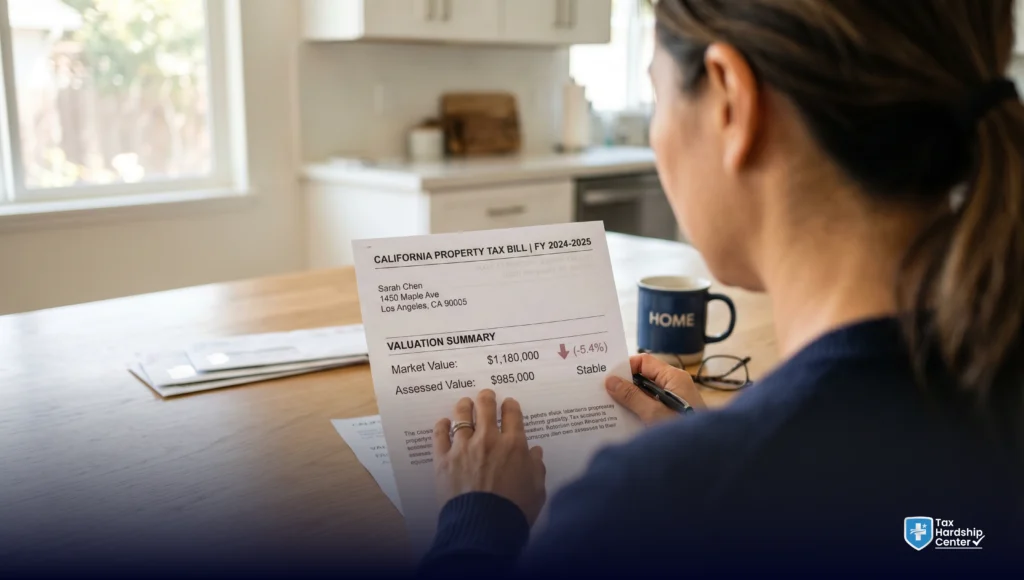
You bought your home at a certain value. The market shifted. Your home is worth less now than it was when you bought it, or less than what the county assessor says it is. But your property tax bill? Still reflecting that old, higher number.
That is not how it is supposed to work.
California has a law specifically for this. It is called Proposition 8, and it allows your county assessor to temporarily reduce your assessed value to match what your home is actually worth in the current market. If the value drops, so should your taxes.
Here is what you need to know about how it works, who qualifies, and what to do if the assessor gets it wrong.
What Is Proposition 8 in California?
Proposition 8 was passed by California voters in November 1978. It amended Proposition 13 to require that property assessments reflect the lower of either the property’s original purchase price (adjusted for inflation) or its current fair market value.
In plain English: if your home’s market value drops below what you originally paid for it, or below your current assessed value, you can request that the county assessor temporarily lower your assessment. That means a lower tax bill.
This is not a loophole or a workaround. It is built into California law under Revenue and Taxation Code Section 51(a)(2). You have a right to request this review.
How is Proposition 8 Different from Proposition 13?
This trips up a lot of people.
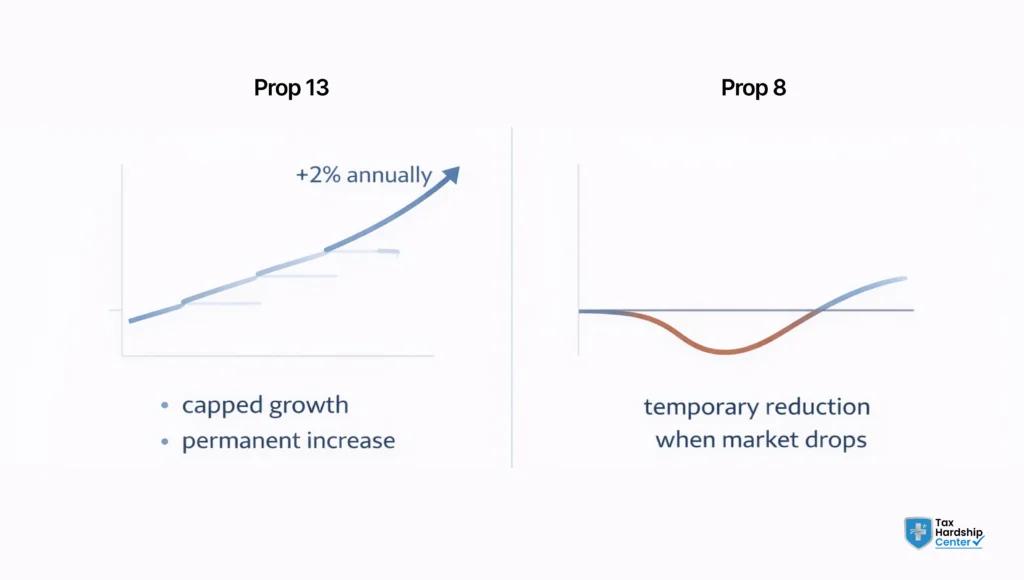
Proposition 13, passed in 1978, caps how fast your assessed value can increase each year at 2% or less. That is the long-term protection most California homeowners know about.
Proposition 8 is the other side of that coin. It kicks in when your property’s current market value falls below the county’s assessed value. In that case, the assessor is required by law to use the lower number.
Once market values recover and your home is worth more than its base-year value again, the assessor can restore the assessed value. It goes back up, potentially to the Prop 13 base, and then the 2% annual cap resumes. The Prop 8 reduction is temporary. Prop 13 protection is permanent.
Who Qualifies for a Prop 8 Reduction?
You may qualify if your property’s current fair market value is lower than its current assessed value as of January 1 of the tax year. This applies to:
Residential homeowners whose neighborhood values have declined due to market shifts, economic downturns, or localized factors like nearby foreclosures or environmental issues.
Owners of property damaged by disaster, fire, or casualty, where the physical condition of the property has reduced its value.
Commercial property owners where comparable sales or income data support a lower current value.
There is no application fee. You do not need to hire anyone to request this review. You contact your county assessor’s office and request a Decline in Value review.
The key date is January 1. That is the assessment date the county uses each year. If your property’s value was below the assessed value on January 1 of the current tax year, you have a valid basis for a request.
Most counties set a November 30 deadline to file for that tax year. Miss that deadline, and you wait until the next cycle.
How the Decline-in-Value Review Process Works
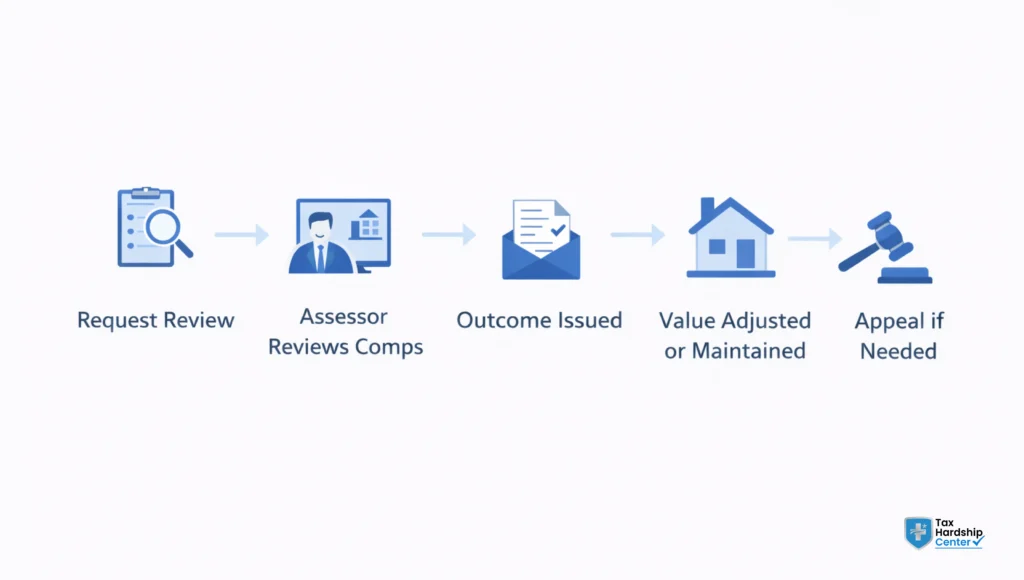
The process is more straightforward than most people expect. Here is the typical sequence:
Step 1: Contact your county assessor’s office.
Every California county has its own assessor. You can search “[your county] assessor decline in value review” to find the right form or portal. Some counties, including Los Angeles County, have an online status check system.
Step 2: Submit your request.
You will fill out a form requesting the review and provide your parcel number. Some counties ask for initial documentation at this stage. Others review first and ask for evidence later.
Step 3: The assessor reviews comparable sales.
The assessor’s office will look at sales of comparable properties in your area around the January 1 assessment date. They are trying to determine what your property would have sold for on that date.
Step 4: You receive a notice of the outcome.
The assessor will either agree to reduce your assessed value or maintain the current assessment. If they agree, you will see the change reflected in your next annual tax bill.
Step 5: If you disagree, you can appeal.
More on that below.
The review can take a few months. The assessor is handling many of these requests, particularly after market downturns.
What Evidence Does the Assessor Use?
The assessor looks at comparable sales, called “comps,” of similar properties in your neighborhood that sold close to the January 1 assessment date. Similar means comparable in size, condition, age, and location.
If you want to support your case, you can gather this evidence yourself before the assessor completes the review:
Recent sales of similar homes in your area from late the prior year through early the current year. Online tools like Zillow, Redfin, or your county recorder’s office are useful for this.
A recent appraisal of your property, if you have one. This carries significant weight with the assessor.
Documentation of any damage, deferred maintenance, or other conditions that reduce your property’s value relative to nearby homes.
The assessor is not required to accept your evidence, but submitting a clear, factual case makes it harder to dismiss.
What Happens If the Market Recovers?
This is the part that surprises people.
A Prop 8 reduction is not permanent. It is reviewed every year. If the market recovers and comparable sales show your property is worth more than the current reduced assessment, the assessor can increase your assessed value again.
There is a limit to how quickly it can recover, but it can exceed the 2% annual cap on Prop 13 base values. It can increase until it reaches your original Prop 13 base year value, at which point the normal 2% annual cap applies again.
This is not a trick. It is how the law works. You benefit when values drop. The county recovers when values rise. The ceiling is always your Prop 13 base, not some new, higher number.
What to Do If You Disagree with the Assessor’s Decision
If the assessor reviews your property and maintains the higher assessed value, or gives you a lower reduction than you believe is warranted, you can file a formal assessment appeal.
The appeal goes to the Assessment Appeals Board (AAB) or Hearing Officer in your county. Most counties require you to file this appeal within 60 days of receiving the assessor’s notification, though deadlines vary by county, so confirm yours before acting.
At the hearing, you present your evidence. The assessor presents their analysis. The board makes a determination.
This is where having a professional in your corner helps. Assessment appeals are not complicated legal proceedings, but persuasively presenting comparable sales data, responding to the assessor’s methodology, and meeting procedural deadlines requires preparation. If the tax difference is significant, it is worth getting help.
How the Tax Hardship Center Can Help
Property tax issues are different from IRS debt, but the stress is the same. You are looking at a bill that feels wrong, you are not sure what to do about it, and you do not want to make a mistake that costs you more time or money.
At Tax Hardship Center, we help individuals and business owners navigate California tax situations. While our primary focus is on IRS and state income tax resolution, we understand the full picture of what our clients are dealing with. If you are managing both IRS tax debt and a property tax dispute, or if you have questions about how California FTB issues intersect with your overall financial situation, we can walk you through your options.
We do not promise dramatic outcomes. We tell you what is realistic based on your specific situation. That is the whole model.
If you have questions about where your California tax situation stands, contact us for a free case review.
Frequently Asked Questions
Is Proposition 8 still in effect in California?
Yes. Proposition 8 has been part of California law since 1978 and remains active. Your county assessor is required to apply the lower of your Prop 13 base year value or current market value when determining your annual assessment.
How do I know if my property qualifies for a Prop 8 reduction?
Compare your current assessed value (on your tax bill) to what similar homes in your area actually sold for around January 1 of the current tax year. If the sales data suggests your home is worth less than its assessed value, you have grounds for a decline-in-value review.
Does my county automatically apply a Prop 8 reduction?
No. You have to request a decline-in-value review. The assessor does not proactively search for properties that may be over-assessed. You initiate the process.
How long does a Prop 8 reduction last?
It is reviewed annually. As long as your property’s market value remains below your Prop 13 base year value, the reduction can continue. Once market values recover, the assessor may restore or increase your assessed value, up to but not exceeding your original base year value.
What is the deadline to file for a Prop 8 review?
Most California counties set a November 30 deadline for the current tax year’s assessment. Contact your county assessor to confirm the specific deadline in your jurisdiction.
Can I do this on my own, or do I need a professional?
For a basic decline-in-value review, most homeowners can handle this themselves. For a formal appeal to the Assessment Appeals Board, having support with comparable sales analysis and presentation helps, especially if the tax difference is substantial.
Does Prop 8 apply to commercial property?
Yes. Commercial, industrial, and residential properties are all eligible for decline-in-value reviews under Proposition 8.
Conclusion
California Proposition 8 is a real, accessible protection for property owners whose home values have dropped below their current assessed value. The process starts with a simple request to your county assessor. In most counties, you have until November 30 to file for the current tax year. The reduction is temporary and reviewed annually. If the assessor disagrees with your position, you can appeal to the Assessment Appeals Board. The cost to request a review is zero. The potential benefit is real.
If you are managing California property tax questions alongside IRS or state income tax issues, the Tax Hardship Center is here to help you understand the full picture. Get a free case review today.
Key Takeaways
- Proposition 8 allows a temporary property tax reduction when the market value drops
- Assessment is based on the lower of purchase value or current market value
- You must request a decline-in-value review; it is not automatic
- January 1 is the key valuation date each year
- Most counties have a November 30 deadline to apply
- No application fee is required
- Reduction is temporary and reviewed annually
- Assessed value can increase again when the market recovers
- You can appeal if you disagree with the assessor’s decision
- Comparable sales data is the most important supporting evidence
- Applies to residential, commercial, and industrial properties
- Potential savings can be significant over time.